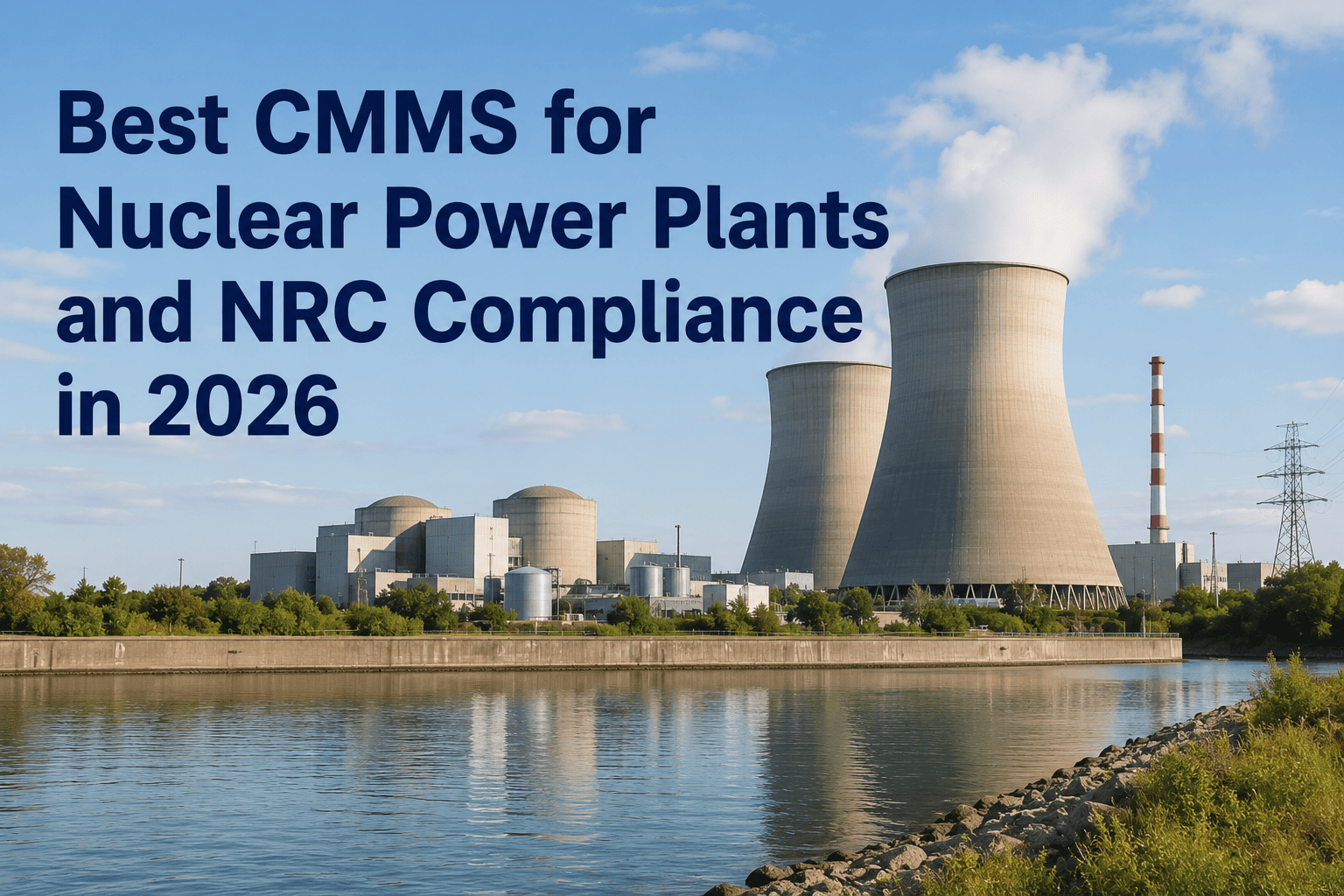
Nuclear power plant maintenance operates under regulatory scrutiny that makes every other industry look lenient. A missed surveillance requirement under 10 CFR 50.65 is not just a PM lapse — it is a reportable event to the NRC that triggers enforcement action, increased inspection frequency, and potentially operating license conditions. In-Service Inspection scheduling for ASME Section XI components, Surveillance Requirement tracking for Technical Specifications, and Maintenance Rule (a)(1) performance monitoring require a CMMS that understands nuclear regulatory language, not generic work-order software adapted with custom fields. The nuclear plants maintaining zero NRC violations and INPO index scores above 95 in 2026 are running CMMS platforms designed specifically for 10 CFR 50 Appendix B quality requirements, not commercial off-the-shelf systems retrofitted with compliance bolt-ons. If your nuclear facility is managing ISI intervals and SR completions from spreadsheets or legacy systems that predate the current regulatory environment, see how Oxmaint brings nuclear-grade CMMS capability without the enterprise software cost or complexity.
Nuclear Power CMMS — NRC Compliance & Maintenance Rule 2026
Nuclear Maintenance Software Must Meet NRC Standards, Not Just Manage Work Orders
Nuclear CMMS must track ISI schedules, SR completions, Maintenance Rule (a)(1) monitoring, 10 CFR 50 Appendix B traceability, and corrective action programs — capabilities that distinguish nuclear-capable platforms from generic industrial CMMS.
Zero
Acceptable NRC maintenance rule violations
10K+
Surveillance requirements per unit per fuel cycle
Appendix B
Quality assurance program baseline standard
INPO 95+
Industry excellence benchmark index score
Why Nuclear CMMS Requirements Are Fundamentally Different
Regulatory Traceability and QA Records
Every maintenance action, PM completion, surveillance test, and corrective action must be traceable to qualified procedures, trained personnel, and calibrated tools per 10 CFR 50 Appendix B. The CMMS is the quality record system, not just a scheduling tool.
Surveillance Requirement Tracking
Technical Specification surveillance requirements have hard regulatory deadlines with grace periods measured in hours, not days. Missing an SR completion window is a Licensee Event Report and potential plant shutdown. The CMMS must enforce SR intervals with countdown alerts.
Maintenance Rule Performance Monitoring
10 CFR 50.65 requires performance monitoring of safety-significant systems. The CMMS must track unavailability, reliability targets, (a)(1) status changes, and goal-setting for systems crossing performance thresholds — not just record work orders.
ISI and Component Aging Management
ASME Section XI In-Service Inspection intervals, 10 CFR Part 54 license renewal commitments, and aging management programs require multi-decade tracking of component inspection history, NDE results, and acceptance criteria — far beyond typical CMMS asset lifecycles.
Top 7 Nuclear-Capable CMMS Platforms in 2026
Purpose-built for nuclear power with SR tracking, Maintenance Rule (a)(1) monitoring, ISI interval management, 10 CFR 50 Appendix B record retention, and corrective action program integration. Cloud-hosted with nuclear cybersecurity controls. 4-8 week deployment typical.
Technical Specification surveillance requirement tracking with grace period alerts
Maintenance Rule (a)(1) performance monitoring and goal-setting
ISI schedule management for ASME Section XI components
10 CFR 50 Appendix B quality record traceability
Corrective action program integration
NRC inspection-ready reporting and audit trails
Pricing: Custom based on unit count and modules (typically $500-1500/month base)
Enterprise EAM with nuclear-specific modules for work management, SR tracking, and regulatory compliance. Deep integration with plant DCS and radiation protection systems. Requires substantial implementation resources and ongoing IT support. Industry standard for major nuclear fleets.
Nuclear work management with outage planning
Surveillance requirement and PM scheduling
Regulatory compliance tracking and reporting
Integration with plant systems and radiation monitoring
Materials management and 10 CFR 21 tracking
Pricing: $200-400/user/month + $100K-1M+ implementation
Full ERP integration for procurement, materials, and financial controls. Nuclear extensions available for SR tracking and regulatory compliance. Requires heavy customization but provides seamless integration when SAP is already the enterprise platform.
Deep ERP integration for materials and procurement control
Work order management and PM scheduling
Configurable for nuclear regulatory requirements
Financial integration for maintenance cost tracking
Pricing: Part of SAP license + nuclear modules ($250-500/user/month typical)
Oracle-based work and asset management with nuclear industry configurations. Strong on regulatory reporting and compliance documentation. Best fit for organizations already standardized on Oracle technology stack.
Work management with nuclear workflow templates
Regulatory compliance and reporting
Asset lifecycle management
Integration with Oracle ERP and financial systems
Pricing: $180-350/user/month + implementation services
Enterprise asset management with nuclear-specific configurations. Strong regulatory reporting capabilities and multi-site management. Complex implementation but suitable for large nuclear portfolios.
Multi-site asset and work management
Nuclear regulatory compliance tracking
Supply chain and materials management
Financial integration and cost control
Pricing: $170-320/user/month + implementation
Asset performance management focused on reliability engineering and risk-based inspection. Strong on predictive analytics but less comprehensive on day-to-day work order management. Best as complement to primary CMMS.
Reliability-centered maintenance and RBI
Predictive analytics for component failure
Risk assessment and prioritization
Integration with condition monitoring systems
Pricing: Custom enterprise pricing (typically $150K+ annually)
Established nuclear CMMS with decades of industry use. Functional for basic work management and PM scheduling but dated interface and limited mobile capability. Many plants are migrating away but some maintain for historical continuity.
Work order and PM management
Materials and inventory control
Basic regulatory reporting
Historical data continuity for legacy users
Pricing: $120-200/user/month (maintenance mode for many installations)
Nuclear CMMS Implementation
Deploy NRC-Compliant Maintenance Management in Weeks, Not Years
Oxmaint Nuclear Edition provides surveillance requirement tracking, Maintenance Rule monitoring, ISI scheduling, and 10 CFR 50 Appendix B record-keeping in a platform designed specifically for nuclear regulatory requirements — without the enterprise software implementation timeline or cost structure.
Nuclear CMMS Feature Comparison: Compliance Capabilities
| Compliance Feature |
Oxmaint Nuclear |
IBM Maximo Nuclear |
SAP PM Nuclear |
Oracle WAM |
| SR tracking with grace periods |
Yes, native |
Yes |
Custom config |
Custom config |
| Maintenance Rule (a)(1) monitoring |
Yes, native |
Yes |
Custom |
Module |
| ISI interval scheduling |
Yes |
Yes |
Custom |
Yes |
| 10 CFR 50 App B traceability |
Yes |
Yes |
Configurable |
Yes |
| Corrective action integration |
Yes |
Yes |
Custom |
Limited |
| NRC inspection reporting |
Yes |
Yes |
Custom |
Custom |
| Deployment timeline |
4-8 weeks |
6-18 months |
8-18 months |
6-12 months |
| Base cost per month |
$500-1500 |
$20K-100K+ |
$25K-120K+ |
$18K-80K+ |
Critical Nuclear Maintenance Workflows Your CMMS Must Support
01
Surveillance Requirement Scheduling and Completion Tracking
Technical Specification SRs have regulatory deadlines with defined grace periods. The CMMS must schedule surveillances, alert before grace period expiration, track completion within required windows, and generate Licensee Event Reports for missed SRs. Historical SR completion data must be auditable for NRC inspections.
02
Maintenance Rule (a)(1) Performance Monitoring
Systems and components designated as Maintenance Rule (a)(1) require unavailability and reliability performance monitoring against established goals. The CMMS must track failures, calculate performance metrics, alert when goals are not met, and document goal-setting and monitoring reviews.
03
ASME Section XI In-Service Inspection Scheduling
Class 1, 2, and 3 pressure boundary components require periodic ISI per ASME Section XI on 10-year inspection intervals with specific examination categories and methods. The CMMS must manage multi-decade ISI schedules, track NDE results, and ensure components are not missed across inspection periods.
04
10 CFR 50 Appendix B Quality Record Management
All maintenance activities affecting safety-related systems require quality records showing procedure compliance, personnel qualifications, calibrated tool usage, and independent verification. The CMMS must capture these quality attributes and maintain records per regulatory retention requirements.
05
Refueling Outage Work Package Management
Refueling outages require coordination of thousands of work orders, critical path scheduling, radiation dose tracking, and containment closure readiness. The CMMS must manage outage planning, execution tracking, and post-outage critiques with integration to radiation protection and outage management systems.
Frequently Asked Questions
What is 10 CFR 50.65 Maintenance Rule and why does my CMMS need it?
The Maintenance Rule requires nuclear plants to monitor performance of safety-significant systems and take corrective action when targets are not met.
A compliant CMMS like Oxmaint Nuclear automatically tracks unavailability and reliability metrics, alerts when thresholds are crossed, and documents goal-setting for (a)(1) systems.
Can a commercial CMMS be adapted for nuclear regulatory requirements?
Commercial CMMS platforms lack the native SR tracking, grace period alerts, ISI interval management, and quality record traceability that nuclear regulations require. Attempting to adapt generic software with custom fields typically results in compliance gaps and audit findings.
How does nuclear CMMS differ from power plant CMMS for fossil generation?
Nuclear CMMS requires 10 CFR 50 Appendix B quality traceability, Technical Specification surveillance tracking, Maintenance Rule performance monitoring, and NRC inspection-ready reporting that fossil plants do not face. The regulatory burden is orders of magnitude higher.
What is typical deployment time for nuclear CMMS implementation?
Enterprise platforms like Maximo and SAP typically require 6-18 months for full nuclear implementation.
Oxmaint Nuclear Edition can be deployed in 4-8 weeks with pre-configured nuclear workflows and compliance features.
Does nuclear CMMS integrate with corrective action programs like NSRB and CAP?
Yes, nuclear-capable CMMS platforms integrate with corrective action programs to link maintenance deficiencies, apparent cause evaluations, and corrective actions. This integration is essential for demonstrating effective corrective action implementation under 10 CFR Part 50 Appendix B.
Nuclear Power Plant Maintenance Excellence
Your Nuclear Plant Deserves CMMS Software Built for NRC Standards
Oxmaint Nuclear Edition delivers surveillance requirement tracking, Maintenance Rule monitoring, ISI scheduling, 10 CFR 50 Appendix B traceability, and corrective action integration in a platform purpose-built for nuclear regulatory compliance — without enterprise software cost or complexity.
Zero
Target NRC violations