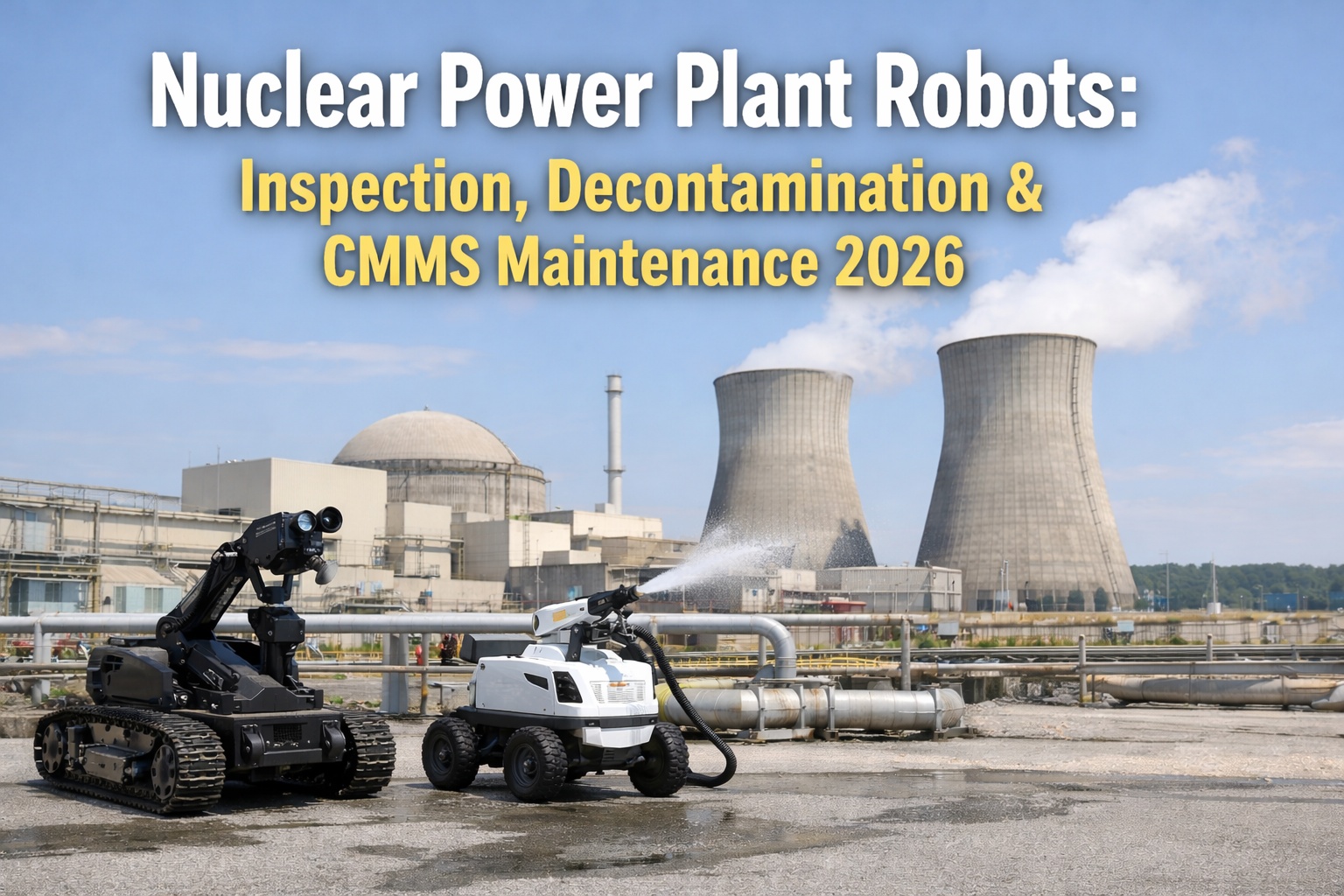
Nuclear Power Plant Robots: Inspection, Decontamination & CMMS Maintenance 2026
By shreen on February 17, 2026
Nuclear power plants present inspection challenges unlike any other industrial environment — containment buildings with radiation levels that limit human exposure to minutes, spent fuel pools requiring underwater navigation, and steam generator tubes too narrow for human entry. These are precisely the environments where robotic inspection systems prove indispensable. When integrated with a CMMS platform like Oxmaint, every robot deployment becomes a closed-loop maintenance event — sensor readings auto-populate asset histories, radiation maps update in real time, and threshold breaches generate work orders before minor anomalies escalate into regulatory findings. Schedule a consultation to explore how Oxmaint connects robotic inspection data to your nuclear facility maintenance workflows.
The Nuclear Inspection Challenge That Demands Robotic Solutions
Nuclear facilities operate under the strictest safety regulations in any industry, yet their inspection programs face fundamental physical limitations. Radiation exposure limits worker access to minutes per task, containment structures create communication dead zones, and critical components sit behind biological shields that make visual inspection nearly impossible. Here is what the data reveals about the current state of nuclear plant inspections.
87%
Reduction in worker radiation exposure when robotic systems perform routine containment inspections
4.2x
Faster inspection cycle completion compared to traditional human-entry methods in high-radiation zones
99.4%
Defect detection accuracy achieved by AI-powered visual inspection robots in steam generator tube analysis
Robotic inspection systems eliminate these constraints entirely. They operate continuously in high-radiation environments, navigate confined spaces humans cannot access, and transmit findings directly to your CMMS in real time. Sign up for Oxmaint to see how robotic inspection data integrates with nuclear asset management workflows.
Ready to reduce radiation exposure while improving inspection coverage? Oxmaint connects every robot checkpoint to your asset records so anomalies trigger work orders automatically.
Different nuclear environments demand specialized robotic platforms. From underwater ROVs in spent fuel pools to snake-like crawlers in steam generator tubes, each robot type addresses specific inspection challenges. When connected to Oxmaint CMMS, all inspection data flows into a unified asset health dashboard regardless of robot platform.
Pipe Crawler Robots
Magnetic-wheeled units that navigate inside steam generator tubes, detecting wall thinning, pitting corrosion, and circumferential cracking using eddy current sensors.
Radiation Mapping Drones
Aerial platforms equipped with gamma spectrometers for rapid contamination surveys across containment buildings and turbine halls during outages.
Underwater ROVs
Submersible inspection vehicles for spent fuel pool surveys, reactor vessel internals examination, and underwater weld integrity verification.
Decontamination Robots
Automated surface cleaning units with high-pressure spray systems and vacuum collection for removing radioactive contamination from floors and walls.
Teleoperated Manipulators
Remote-controlled arms for hot cell operations, sample collection, valve manipulation, and precision repair tasks in high-radiation areas.
Quadruped Patrol Robots
Four-legged autonomous units that navigate stairs, grating, and obstacles while capturing thermal, visual, and radiation data across facility patrols.
Nuclear Facility Inspection Zones and Patrol Strategy
Effective robotic inspection requires zone-based deployment planning — dividing your facility based on radiation levels, access restrictions, and asset criticality. Each zone demands specific robot configurations, sensor loadouts, and patrol frequencies. Book a demo to discuss zone planning for your specific facility layout.
Nuclear Facility Patrol Zones and Robot Deployment Strategy
A
Containment Building Interior
Reactor vessel inspectionCoolant system monitoringRadiation field mappingStructural integrity assessment
Highest radiation zone requiring radiation-hardened robots with extended autonomous operation. Patrol frequency varies by operating mode — weekly during power operation, continuous during refueling outages. Robots must withstand integrated doses exceeding 10,000 Gy.
Underwater ROV operations requiring specialized buoyancy control and lighting systems. Robots navigate between fuel racks capturing visual data while monitoring water temperature and radiation levels. Critical for fuel handling compliance documentation.
C
Steam Generator and Heat Exchanger Systems
Tube wall thicknessEddy current testingSupport plate conditionForeign object search
Miniature pipe crawlers navigate thousands of narrow tubes per outage, detecting degradation mechanisms including pitting, stress corrosion cracking, and wear. Inspection data feeds directly to tube plugging decisions and remaining life calculations.
D
Turbine Building and Balance of Plant
Turbine bearing vibrationCondenser tube inspectionFeedwater system monitoringValve leak detection
Lower radiation but high asset density. Quadruped robots patrol between major equipment capturing thermal and vibration baselines. Dense checkpoint coverage on rotating machinery enables predictive maintenance before bearing failures cascade into forced outages.
E
Auxiliary Systems and Radioactive Waste Areas
HVAC filter monitoringWaste tank level verificationContamination boundary surveysLeak detection
Moderate radiation with strict contamination control requirements. Robots equipped with surface contamination monitors verify radiological boundaries while capturing equipment condition data. Patrol data supports environmental compliance reporting.
Sensor-to-Defect Pairing for Nuclear Applications
Each inspection robot carries sensors matched to the specific defects that threaten nuclear asset integrity. The right sensor-to-defect pairing ensures every checkpoint captures data your CMMS can process, trend, and act upon automatically.
Leak repair order with location coordinates and estimated flow rate
Every sensor reading is timestamped, geo-tagged to the inspection point, and linked to the specific asset ID in Oxmaint — creating an auditable inspection trail for NRC documentation.
See how sensor data flows into NRC-compliant asset records. Walk through the complete checkpoint-to-work-order pipeline with our nuclear industry specialists.
Capturing inspection data is straightforward. The competitive advantage comes from what happens in the seconds after a robot completes a checkpoint — how that data reaches the right people, in the right format, with the right urgency. Here is the pipeline that transforms robotic patrols into closed-loop maintenance action inside Oxmaint.
1
Robot Reaches Inspection Waypoint
The robot navigates to the pre-programmed checkpoint using facility-specific positioning systems — underwater acoustic beacons for ROVs, visual fiducials for containment crawlers, or LiDAR SLAM for patrol robots. It stabilizes and orients sensors toward the target asset.
2
Multi-Sensor Data Acquisition
Thermal, visual, radiation, eddy current, and ultrasonic sensors execute the checkpoint-specific inspection protocol. The robot's hardened electronics process raw signals into structured measurements while validating data quality before transmission.
3
Secure Data Transmission to Oxmaint
Validated readings stream to Oxmaint's API via plant network infrastructure with cybersecurity protocols appropriate for nuclear facilities. Each data packet includes asset ID, checkpoint coordinates, timestamp, sensor type, and calibrated measurement values.
4
Threshold Comparison and Alert Classification
Oxmaint compares incoming values against asset-specific acceptance criteria and regulatory limits. A tube wall thickness reading at 50% degradation triggers different response than one at 80%. Severity classification drives priority, notification routing, and response deadlines.
5
Auto-Generated Work Order with Evidence Package
Threshold breaches create work orders pre-loaded with inspection images, measurement data, location coordinates, and recommended corrective actions. The order routes to the assigned crew based on craft requirements, radiological work permits, and outage schedule constraints.
Six Principles for Effective Nuclear Robot Deployment
Deploying inspection robots in nuclear environments requires planning that accounts for radiation exposure, regulatory requirements, and the unique constraints of controlled areas. These six principles, refined through actual nuclear deployments, form the foundation of successful robotic inspection programs.
01
Match Robot Hardening to Radiation Environment
Standard industrial robots fail within hours in high-radiation fields. Specify radiation-hardened electronics rated for the integrated dose expected over the robot's service life. Containment-grade robots require tolerance exceeding 10,000 Gy total integrated dose.
02
Design for Decontamination from Day One
Every robot surface that enters a contamination area must be cleanable or disposable. Smooth geometries without crevices, removable covers over joints, and sealed electronics enclosures simplify post-patrol decontamination and reduce radioactive waste generation.
03
Integrate with Radiological Work Control
Robot deployments require the same radiological planning as human entries — ALARA reviews, dose estimates, contamination controls. Oxmaint tracks robot dose accumulation alongside human worker exposure to maintain facility dose budgets.
04
Build Communication Redundancy for Shielded Areas
Concrete biological shields and steel containment liners block radio signals. Deploy hardwired tethers for critical inspections, acoustic modems for underwater operations, and mesh relay networks for patrol robots navigating through shielded structures.
05
Plan Recovery Procedures Before Deployment
Robots can fail in locations humans cannot easily access. Pre-plan retrieval methods for every patrol route — tether-based extraction, secondary recovery robots, or acceptable abandonment procedures for extreme cases with dose justification.
06
Validate Sensor Calibration Against NRC Standards
Inspection data submitted to regulators must trace to certified calibration standards. Establish calibration protocols for every robot sensor and document traceability in Oxmaint before any regulatory inspection deployment.
Transform Robot Inspections into NRC-Ready Documentation
Oxmaint connects your inspection robots directly to asset records. Eddy current scans, radiation surveys, and visual defects auto-populate equipment histories and generate regulatory-compliant work orders — so your team acts on sensor intelligence while maintaining audit-ready documentation.
The case for robotic inspection is not theoretical — it shows up in documented outcomes. Here is a comparison of what changes when facilities replace traditional human-entry inspections with sensor-equipped robots integrated into Oxmaint CMMS.
Traditional Human Entry vs. Robotic Inspection with CMMS
Inspection Aspect
Human Entry Method
Robot + Oxmaint
Radiation Exposure
Workers accumulate dose during every entry
Zero human dose for routine inspections
Access Duration
Limited to minutes in high-dose areas
Unlimited operation time in any radiation field
Data Consistency
Varies by inspector experience and conditions
Repeatable, calibrated measurements every time
Documentation Speed
Hours or days for report compilation
Real-time data in CMMS within seconds
Confined Space Access
Many areas physically inaccessible to humans
Miniature robots reach all tube, tank, and void spaces
25-40%
of critical assets inspected per outage cycle
90%+
inspection coverage with robotic systems
Implementation Roadmap: Pilot to Full Deployment
Nuclear facilities that succeed with robotic inspection follow a phased rollout — starting with a focused pilot, proving value through documented results, and expanding based on data. Schedule a consultation to get a deployment timeline customized for your facility's outage schedule and regulatory commitments.
Facility walkdown and zone classificationRadiation survey for robot specificationRegister pilot zone assets in Oxmaint
Weeks 5-8
Robot Configuration
Configure sensor loadouts per zone requirementsProgram inspection routes and waypointsEstablish Oxmaint API connection and alert rules
Weeks 9-12
Supervised Pilot Operations
Execute monitored inspections during outageValidate data accuracy against baseline methodsRefine thresholds and work order routing
Month 4+
Expansion and Optimization
Deploy across additional zonesIntegrate with outage planning workflowsBuild predictive models from inspection history
Documented Performance After Deployment
When robotic inspection systems and CMMS integration work together, the improvements are measurable and significant. The following metrics reflect documented outcomes from nuclear facilities that have completed at least two operating cycles with robotic inspection programs.
Performance Improvements with Robotic CMMS Integration
87%Reduction in collective radiation dose for routine inspections
4.2xFaster inspection cycle completion compared to human-entry methods
92%Increase in steam generator tube inspection coverage per outage
62%Reduction in inspection-related outage critical path time
The integration of robotic inspection data with our CMMS transformed how we plan outages. Instead of discovering degradation during the outage, we now enter with a complete picture of equipment condition and pre-staged repair plans. The reduction in emergent work alone justified the entire program investment.
— Outage Manager, Commercial Nuclear Station
Calculate your facility's potential radiation dose savings. Create a free Oxmaint account and our nuclear specialists will model the impact for your specific inspection requirements.
Your inspection robots capture eddy current scans, radiation maps, and visual assessments. Oxmaint transforms every reading into an asset history entry, a trend line, or a prioritized work order — automatically. Zero dose for routine inspections. Complete audit trails for NRC documentation. One platform connecting robotic capabilities to maintenance outcomes.
Which robotic inspection platforms integrate with Oxmaint?
Oxmaint integrates with any robot platform that supports REST API data export. This includes major nuclear inspection systems from Westinghouse, Framatome, GE Hitachi, as well as general-purpose platforms like Boston Dynamics Spot configured for nuclear environments. The integration is data-format agnostic — structured JSON packets containing asset IDs, sensor values, and timestamps flow directly into asset records. Sign up for Oxmaint to explore API documentation for your specific robot platform.
How does Oxmaint handle cybersecurity requirements for nuclear facilities?
Oxmaint supports deployment configurations that meet NRC cybersecurity regulations. Data transmission uses encrypted channels, and the platform can operate in network-isolated modes where robot data uploads through air-gapped transfer procedures. Our nuclear industry team works with your IT security group to configure integration methods appropriate for your facility's cyber security plan.
Can robot inspection data support NRC regulatory submissions?
Yes — when properly documented with calibration records, inspection procedures, and qualified reviewer sign-offs. Oxmaint generates reports formatted for regulatory submission, including ISI summary reports, steam generator tube examination reports, and inservice inspection documentation packages. Book a demo to see how inspection data flows into regulatory report templates.
What happens if a robot fails inside containment during an inspection?
Pre-planned recovery procedures are essential for any nuclear robot deployment. Most inspection robots include tether-based retrieval capability, and secondary recovery robots can retrieve stranded units. For extreme cases, facilities maintain abandonment procedures with dose justification documentation. Oxmaint tracks robot maintenance and reliability data to identify degradation before in-field failures occur.
How quickly can we deploy our first robotic inspection capability?
A focused pilot covering one inspection scope — such as containment walkdowns or a subset of steam generator tubes — typically reaches operational status within 8-12 weeks. Full deployment across all inspection scopes usually completes over 2-3 operating cycles as teams gain experience and refine procedures. Schedule a consultation to discuss a deployment timeline aligned with your outage schedule.