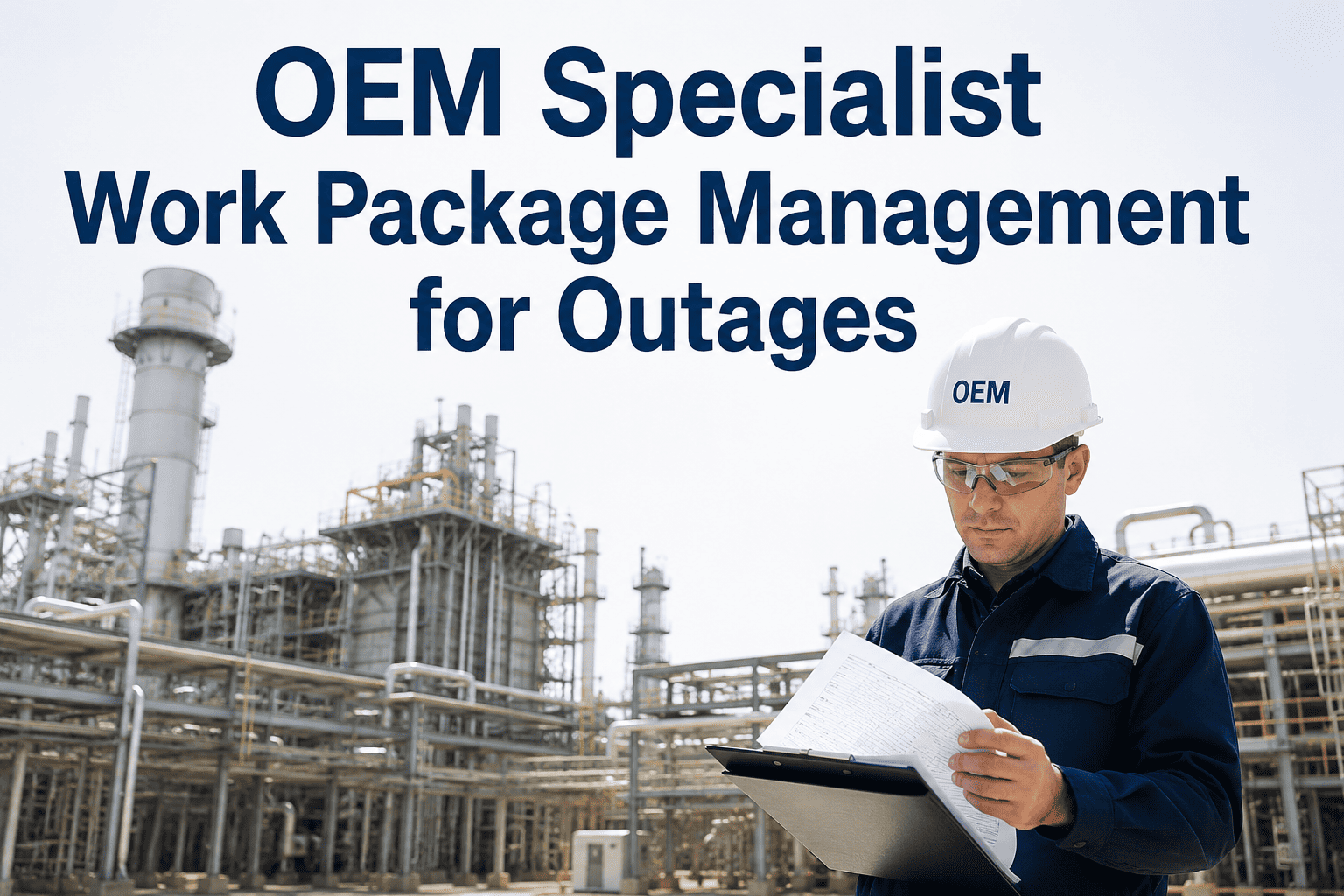
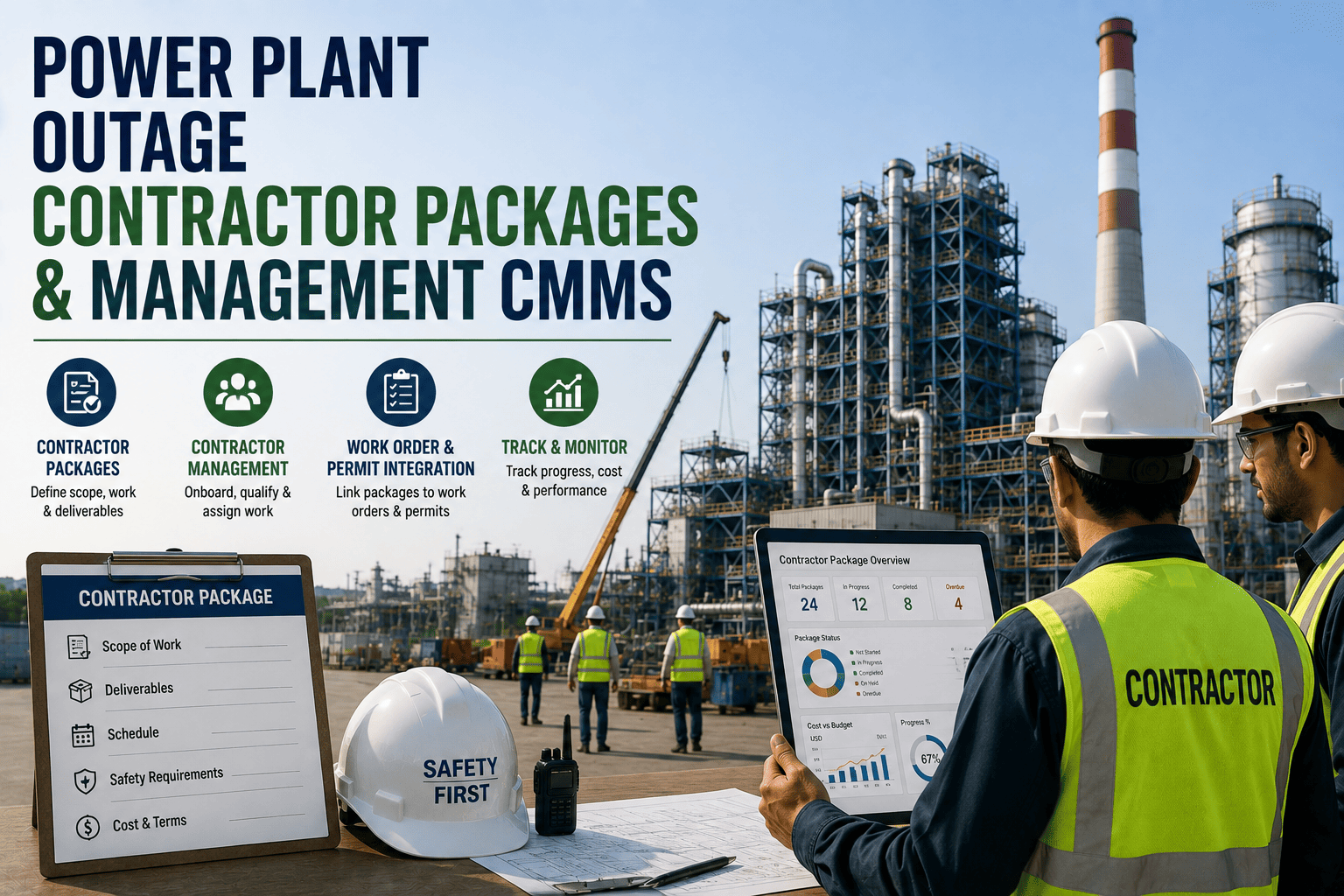
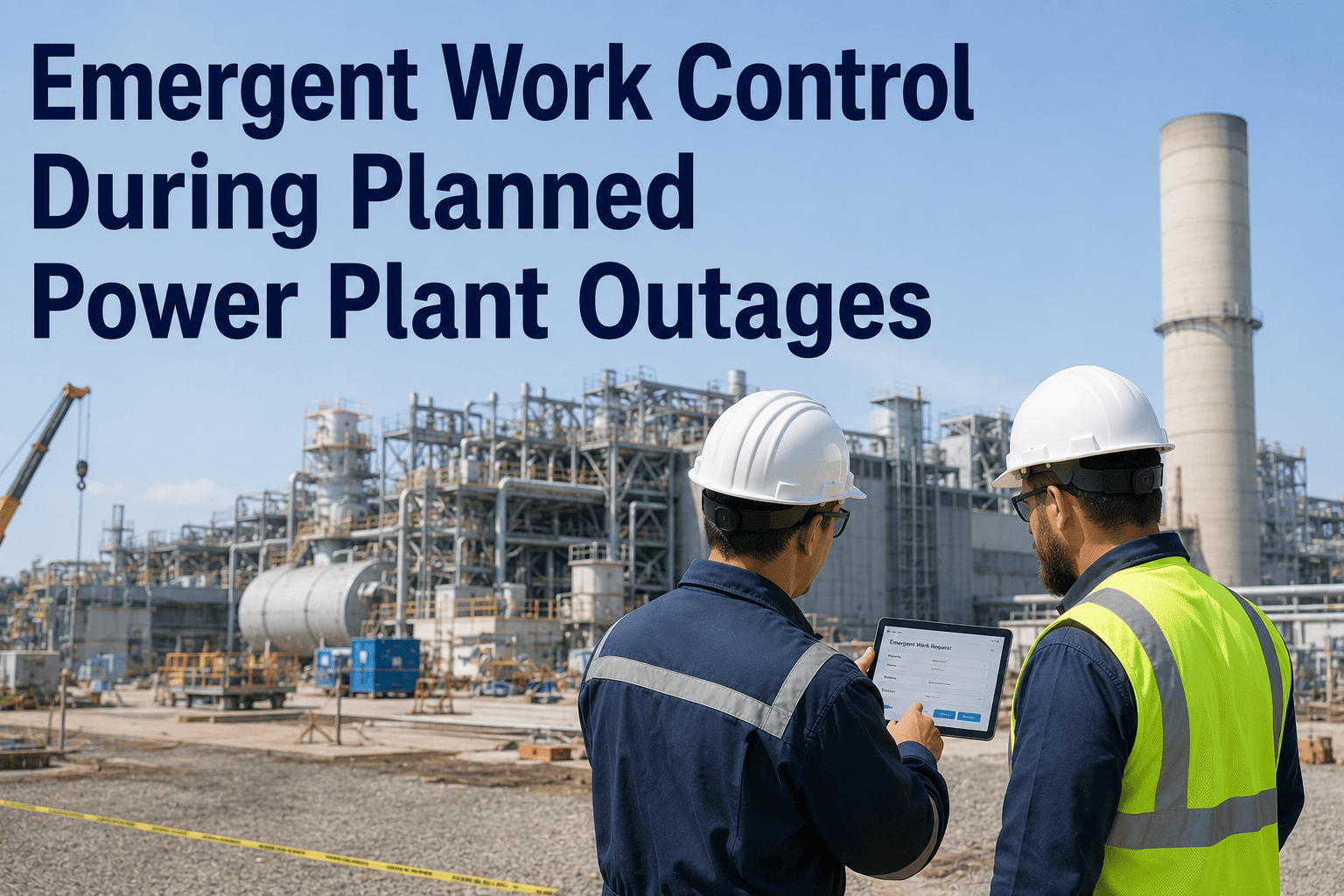
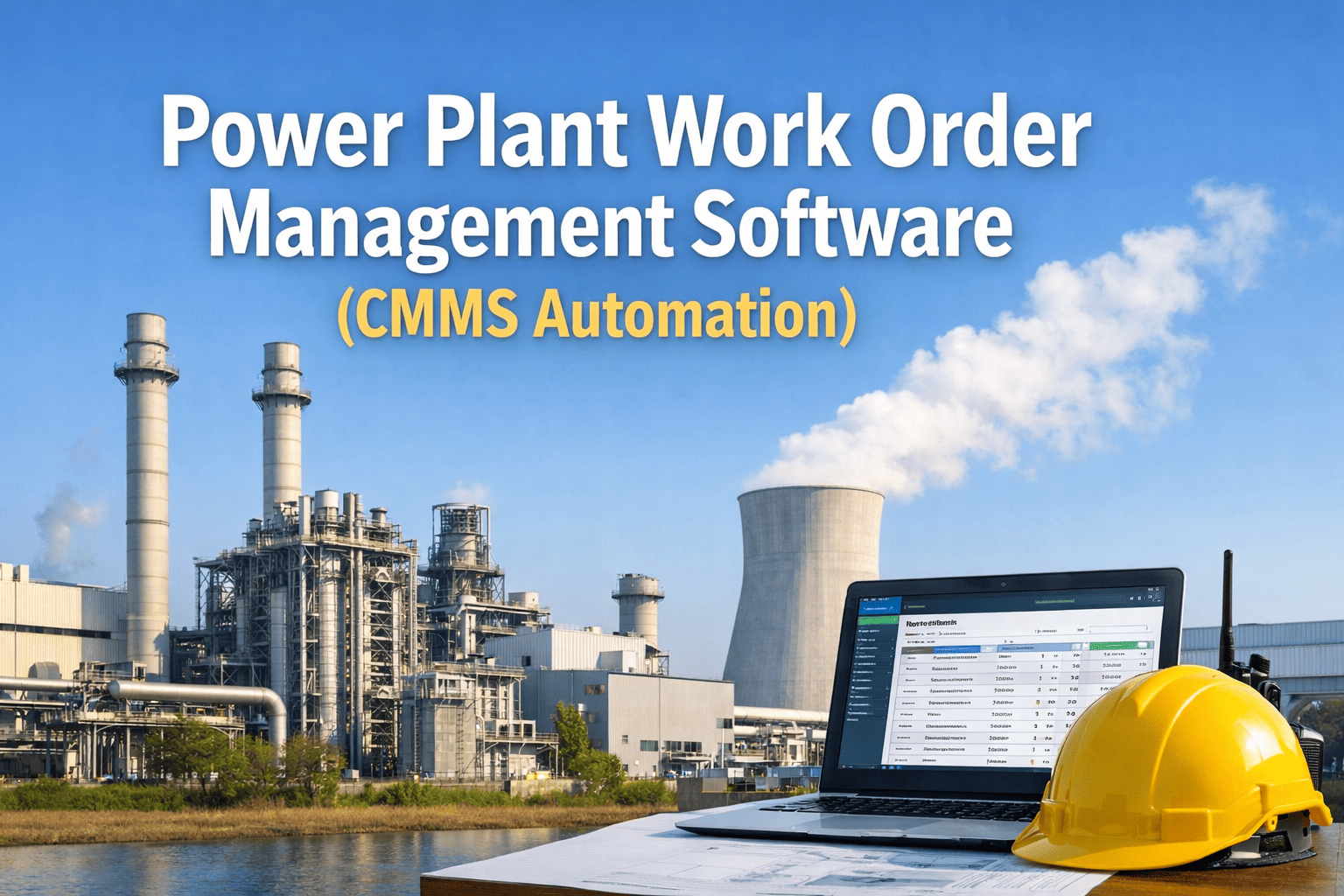
OEM specialist contracts are the highest-cost, highest-consequence, and most poorly managed work category in a power plant outage. A major turbine or generator outage may involve three to six OEM specialists arriving in sequence — rotor balance team, retaining ring inspection crew, stator rewinding team, controls calibration specialist — each with their own work package, tooling requirements, access sequencing needs, and digital documentation deliverables. When OEM work packages are managed through email chains, PDF attachments, and site visit logbooks, critical sequencing failures occur: a specialist arrives before the unit has been sufficiently cooled and cleared, or a subsequent work package begins before the preceding team has issued its inspection report and the results have been reviewed by the plant's engineering authority. This guide covers how to structure, track, and close OEM specialist work packages for outages using a CMMS framework that prevents sequencing errors, enforces hold points, and builds a permanent inspection record that survives personnel turnover. Start your free Oxmaint account to manage your next OEM outage digitally, or book a consultation with our outage planning team.
What Makes OEM Work Package Management Different From Standard Contractor Management
Standard Contractor Work
Sequencing
Generally parallel-capable — multiple contractors can work in different plant areas simultaneously
Mobilization Pattern
Single callout, single crew, continuous presence until job complete
Hold Points
Typically QA witness points for welding and pressure testing
Documentation
Standard completion report, photos, parts list
IP and Data Sensitivity
Low — standard maintenance data
OEM Specialist Work
Sequencing
Strictly sequential — later work packages cannot begin until preceding work package report is reviewed and hold point is released by engineering authority
Mobilization Pattern
Multiple specialist crews arriving and departing in sequence — each with unique tooling and certification requirements
Hold Points
Multiple engineering hold points between every OEM work package — mandatory review gates before next package starts
Documentation
OEM inspection report, dimensional measurements, thermographic records, NDT results, OEM warranty compliance documentation
IP and Data Sensitivity
High — OEM inspection data must be stored in plant records, not only in OEM's system
Critical Hold Points in OEM Outage Work Packages
A hold point is a mandatory stop in the work sequence where progress cannot continue until a defined review and approval action has been completed and recorded. Hold points in OEM outage work packages protect the plant from proceeding to reassembly on a component whose inspection results have not been reviewed — an outcome that has caused multiple return-to-service failures and warranty disputes in power generation outage history.
Disassembly Phase
As-Found Condition Documentation Hold
Before any cleaning, grinding, or component removal proceeds, the OEM specialist must produce a complete as-found condition record — measurements, photographs, NDT results, and thermal imaging of any suspect areas. Plant engineering authority must review and sign off before disassembly continues.
Hold point owner: Plant Engineering Authority
Inspection Phase
Inspection Report Review Hold
After complete inspection and NDT of all components, the OEM submits a formal inspection report with finding classifications — acceptable, repair required, replace required — with technical justification for each finding. Plant engineering and the OEM contract manager must jointly review findings and agree on disposition before repair scope is finalized.
Hold point owner: Plant Engineering Authority + OEM Contract Manager
Repair Phase
Scope Change Authorization Hold
When inspection reveals additional repair scope not included in the original work package — cracking beyond the original extent, degradation in components not initially included — a formal scope change authorization must be issued before additional repair work proceeds. Unauthorized scope expansion is a common source of OEM cost overruns and warranty disputes.
Hold point owner: Plant Maintenance Manager + Procurement
Reassembly Phase
Pre-Reassembly Cleanliness Hold
Before any rotating assembly or internal component reassembly begins, foreign material exclusion inspection must confirm that no debris, tooling, rags, or materials remain inside the machine. Turbine and generator foreign material ingestion events during reassembly are among the most expensive single events in power plant outage history.
Hold point owner: OEM Lead + Plant Maintenance Supervisor
Completion Phase
As-Left Documentation and Warranty Activation Hold
Before the OEM specialist crew demobilizes, all as-left dimensional records, torque certification logs, leak test results, and alignment readings must be submitted and accepted by the plant. Warranty activation is linked to completeness of as-left documentation — incomplete records at demobilization create warranty gap risk if failures occur within the warranty window.
Hold point owner: Plant Engineering Authority + OEM Field Supervisor
Enforce Every Hold Point Automatically — Never Miss a Review Gate
Oxmaint's outage work package management enforces hold points as mandatory gates in the work order sequence. No subsequent work package can be started until the current hold point has been formally released by the designated approver — with timestamp, approver identity, and attached documentation all recorded in the asset's permanent history.
OEM Work Package Documentation Requirements
Required OEM Specialist Documentation by Work Package Phase
Building a Permanent OEM Outage History in Your CMMS
Year 1
Baseline Established
First digitized OEM outage produces as-found and as-left measurement records stored against the asset ID. Component photographs tagged to specific measurement points. Inspection findings classified and stored. This single outage record has more permanent value than ten years of paper-based outage logbooks.
Year 3
Trend Comparison Available
Second outage as-found measurements are compared against prior as-left records. Component wear rates calculated from dimensional data. Inspection findings classified as new, progressed, or resolved. Engineering team can now identify which components are degrading faster than expected and adjust next outage interval accordingly.
Year 6+
Predictive Outage Planning
Three or more outage cycles of OEM inspection data enable engineering-grade prediction of component life remaining. Outage scope can be pre-planned based on historical wear rates rather than discovered during the outage — converting reactive scope surprises into planned scope with pre-ordered parts and pre-negotiated OEM contracts at lower cost.
Every OEM Outage Should Build Your Plant's Most Valuable Asset — Its Inspection History
OEM specialist work that is not digitally documented and stored in your CMMS is work that was paid for twice — once for the repair, and again when the next outage team has no baseline to compare against. Oxmaint makes OEM inspection records a permanent, searchable, auditable part of your asset history from the first job you manage in the platform.
Frequently Asked Questions
How do you sequence multiple OEM specialists in a single outage without conflicts?
Multi-OEM outage sequencing requires a master work package plan that maps every OEM team's arrival date, work scope, access requirements, tooling staging areas, and departure date against a single timeline — with explicit hold points between each OEM's departure and the next team's mobilization. The most common sequencing failure is the next OEM team arriving before the preceding team's documentation has been reviewed and the hold point formally released. Digital work package management in a CMMS prevents this by blocking the next work package from opening until the hold point is released, enforcing the sequence regardless of pressure to accelerate the outage timeline.
Oxmaint's work order sequencing allows you to define predecessor-successor relationships between OEM work packages so that the sequence is enforced automatically, not manually monitored by an outage coordinator who is managing thirty other parallel work streams.
What should be in a pre-outage OEM work package kickoff meeting?
An effective OEM work package kickoff — held 60 to 90 days before planned outage start — should cover: scope of work with exclusion boundaries explicitly defined, hold point schedule with responsible parties named, documentation deliverable list with submission deadlines and acceptance criteria, tooling and equipment certification requirements, site safety and access protocols, escalation contacts on both the plant and OEM side, scope change authorization process, and the consequences of documentation delivery failure at demobilization. The kickoff meeting outputs should be formalized in a written work package brief that becomes part of the contract record — not just the kickoff meeting minutes. Power plants that skip formal kickoff meetings for OEM outage work report 40 to 60% higher rates of scope change disputes and documentation deficiency findings at job close.
How do you prevent OEM specialists from storing critical inspection data only in their own systems?
This is one of the most overlooked risks in OEM outage contract management. When an OEM specialist stores as-found data, dimensional measurements, and NDT results only in their proprietary service portal, the plant loses access to that data if the OEM relationship changes, the OEM is acquired, or the OEM's portal is discontinued. Contract language must explicitly require delivery of all inspection data in a plant-owned format — PDF inspection reports with raw measurement data tables, not just access credentials to a third-party portal — with delivery deadlines tied to hold point release approvals. For major plant assets including large steam turbines and generators, insisting on data delivery in a CMMS-compatible format such as Excel, CSV, or XML is reasonable and increasingly standard in utility procurement.
Book a consultation to review how Oxmaint structures OEM documentation intake for assets in your fleet.
What is the difference between an OEM hold point and a witness point in outage management?
A hold point is a mandatory stop where work cannot proceed until an authorized person has completed a review and formally released the hold — regardless of schedule pressure or resource availability. Work must physically stop until the release signature is obtained. A witness point is a notification requirement where the plant or regulator must be given the opportunity to observe a specific activity — but if the witness does not attend within a specified time window, work can proceed without them. Hold points are used for the highest-consequence inspection gates in OEM outage work, such as pre-reassembly cleanliness verification and as-found condition documentation sign-off. Witness points are more commonly used for weld visual inspection and torque verification activities where plant presence is valuable but not strictly required for work progression. Understanding this distinction prevents both schedule delays from treating witness points as hold points and compliance failures from treating hold points as witness points.
How should power plants handle OEM scope discoveries that extend outage duration beyond the planned window?
When an OEM inspection reveal requires additional scope that will extend the outage beyond the planned return-to-service date, the plant must immediately activate a structured decision process — not a hallway conversation with the OEM lead. The decision process should evaluate: the consequence of operating with the discovered defect versus the cost of repair, whether a temporary repair or reduced-load operation is technically permissible under the relevant code and OEM warranty terms, what the revised return-to-service date is with and without the additional scope, and what notification requirements apply to the grid operator and fuel supplier. A CMMS-linked scope change workflow that forces this evaluation into a documented record — rather than a verbal agreement with the OEM — is the difference between a manageable outage extension and a retrospective dispute about who authorized what and when it was agreed. The digital record also supports insurance and contractual force majeure claims if the extended outage triggers downstream financial consequences.