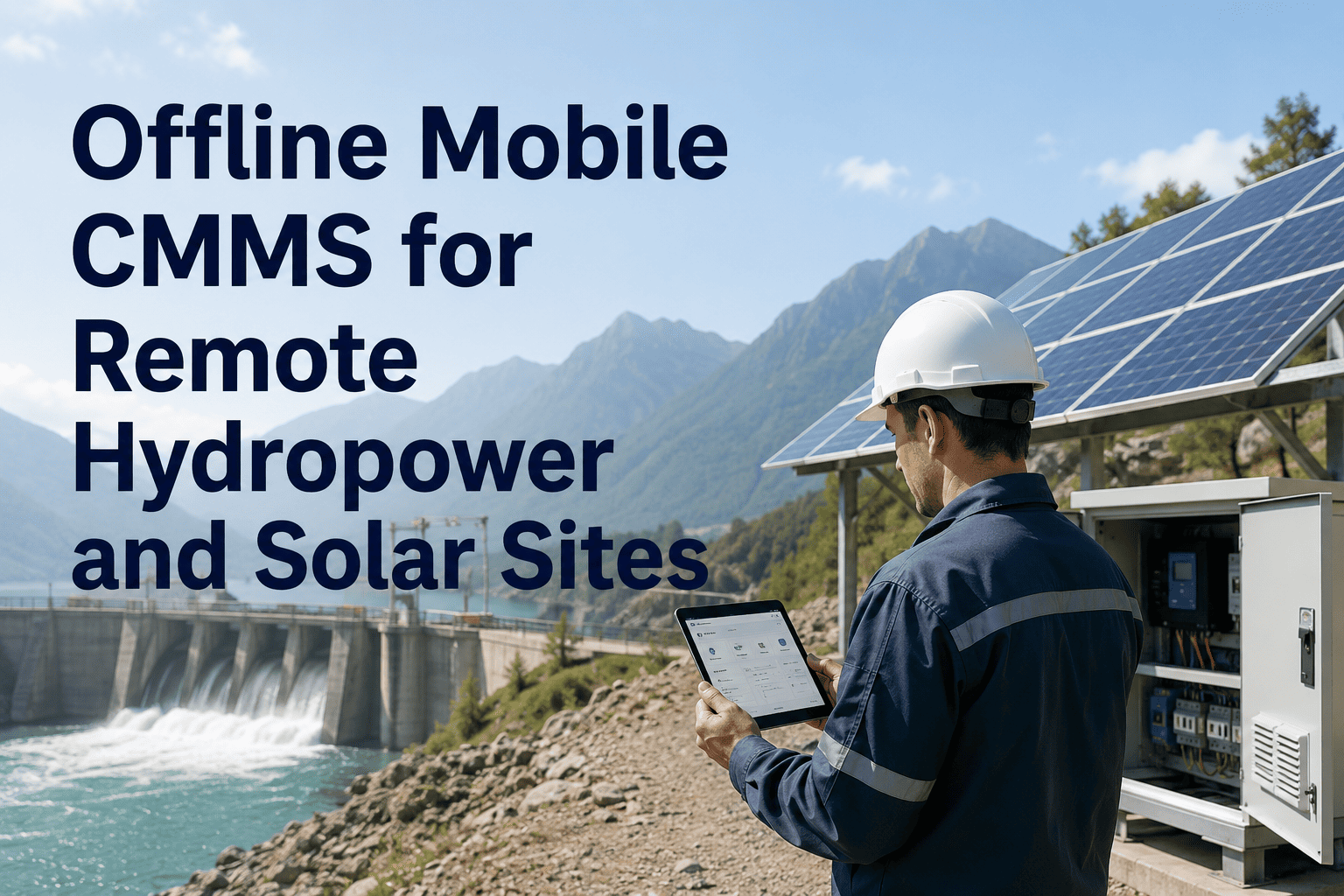
A hydropower station tucked in a mountain gorge. A solar farm across 500 acres of high desert. A run-of-river plant with no paved road and two bars of LTE on a clear day. These are not edge cases — they are where a growing share of the world's clean power is generated. And they are exactly where a connectivity-dependent CMMS stops working. Technicians lose work orders, inspection data goes on paper, asset histories accumulate gaps, and compliance records turn into a reconstruction project the next time an auditor visits. OxMaint's offline-capable mobile CMMS gives remote hydropower and solar maintenance teams full access to work orders, asset records, checklists, and maintenance history — with or without signal — and syncs every data point the moment connectivity returns, with zero loss and full timestamp integrity. Start your OxMaint free trial and deploy offline-ready maintenance workflows at your remote site in days.
67%
of remote site maintenance data recorded on paper never reaches the CMMS
58 min
saved per technician per day with mobile CMMS vs. desktop-only systems
34%
productivity gain from smartphone-enabled field maintenance teams
0
data loss on sync — every timestamped record preserved on reconnect
The Offline Problem Is Bigger Than You Think
Four Ways a Connectivity-Dependent CMMS Fails Remote Sites
Data Recorded Twice — or Not at All
Technicians write readings on paper when the CMMS app fails offline, intending to transcribe later. Studies show 67% of that paper data never reaches the system — permanently lost from the asset history that drives PM decisions.
Work Orders Delayed by Hours
A failed inverter or tripped generator at a remote site triggers a paper fault report. The work order gets entered into the CMMS hours later, back at the office — skewing response time metrics and creating a compliance gap between when the failure happened and when it was documented.
Asset History Full of Gaps
Every skipped CMMS entry is a gap in the asset's maintenance record. Over months, those gaps make failure trend analysis unreliable, PM intervals default to guesswork, and FERC or NERC compliance documentation requires reconstruction instead of export.
No Access to Procedures in the Field
Inspection checklists, lockout/tagout procedures, and OEM documentation are only accessible online. Technicians improvise or stop work entirely when network is unavailable — increasing both safety risk and variation in task execution across shifts.
OxMaint · Offline CMMS · Remote Site Maintenance
Full CMMS Capability. Zero Signal Required.
OxMaint's offline sync engine caches your entire site's work orders, asset records, checklists, and procedures before technicians head to the field. Every action is captured locally and synced with full timestamp accuracy the moment connectivity returns.
Built For These Sites
Remote Renewable Sites Where OxMaint's Offline Mode Changes Daily Operations
Hydropower
Run-of-River and Reservoir Plants
Underground powerhouses, penstock walkways, and gate control galleries are signal dead zones. OxMaint offline mode gives hydro technicians full access to turbine PM checklists, bearing temperature logs, draft tube inspection tasks, and FERC Part 12 compliance records — cached before each shift.
- Turbine and runner inspection checklists cached offline
- Penstock wall thickness log captured without connectivity
- Gate and spillway PM records synced on return to office
- FERC Part 12 evidence assembled from synced records
Solar
Utility-Scale Ground-Mount Farms
A 500-acre solar farm may have 80,000 panels and 40 inverter stations spread across terrain with patchy mobile coverage. OxMaint's offline app gives field teams access to per-inverter fault history, tracker alignment inspection tasks, and IV curve test logs — without needing a signal at each row.
- Inverter work orders with fault history cached per unit
- String inspection checklists available at any row
- Tracker alignment readings captured offline, synced at boundary
- Panel soiling and cleaning records logged in the field
How Offline Sync Works
From Cache to Field to Sync — What Happens at Every Step
A
Pre-Shift Cache
The OxMaint mobile app downloads the full day's work orders, asset records, inspection checklists, and attached documents while the device is on WiFi at the control building. The cache updates every time the device has connectivity — not just at shift start.
B
Full Field Operation — No Signal
Technicians complete work orders, log readings, capture photos, record checklist results, and close tasks exactly as they would online. Every action is written to local device storage with a precise timestamp — the system behaves identically with or without connectivity.
C
Automatic Sync on Reconnect
The moment the device detects connectivity — returning to the substation, cresting a ridge with signal, or connecting to a site hotspot — OxMaint syncs all captured data to the cloud automatically. No manual upload, no file transfer, no action required from the technician.
D
Full Audit Trail Preserved
Every synced record carries the original timestamp from when the action occurred in the field — not the sync time. Asset histories, compliance records, and work order completion times are accurate to the minute, regardless of when the device reconnected.
Remote Site Maintenance
Paper-Based Field Recording vs. OxMaint Offline CMMS
Frequently Asked Questions
Offline Mobile CMMS for Remote Hydropower and Solar Sites
What data does OxMaint cache for offline use at a remote site?
OxMaint caches open and upcoming work orders, the full asset register with maintenance history, inspection checklists, attached documents (procedures, OEM manuals, P&IDs), and spare parts inventory — the complete working dataset for a full maintenance shift. Cache size is configurable per site.
Start free and configure your first site's offline cache.
What happens if two technicians edit the same work order while offline?
OxMaint's sync engine uses a last-write-wins conflict resolution model with field visibility — when two offline edits to the same record conflict on sync, both versions are flagged for supervisor review rather than silently overwriting. This prevents data loss in multi-technician offline scenarios common at large solar farms.
Does the offline timestamp match the time the action was taken in the field?
Is OxMaint's offline mode available on both Android and iOS devices?
Yes. OxMaint's mobile application with full offline capability is available on both iOS and Android. The offline sync engine is identical across both platforms. Most remote site teams use rugged Android tablets for field use — OxMaint's interface is optimized for both form factors without requiring specialized hardware.
How does offline CMMS support FERC Part 12 and NERC compliance at hydro sites?
FERC Part 12 and NERC reliability standards require documented maintenance records per asset with accurate completion dates. OxMaint's offline sync preserves field-accurate timestamps on every work order and inspection record — giving compliance reviewers documentation that matches actual maintenance timing rather than office-entry timing.
See how OxMaint compliance exports work — start free.
OxMaint · Offline CMMS · Hydropower · Solar · Remote Sites
No Signal. No Problem. Full Maintenance Records at Every Remote Site.
Offline work orders. Synced the moment you're back in range. Full asset history with no gaps. Compliance exports that hold up to FERC review. Deploy OxMaint at your remote hydropower or solar site in days — no IT project required.