Power plants run on energy — high-voltage electrical systems, pressurized steam lines, hydraulic actuators, and stored mechanical force that can kill in an instant. OSHA 1910.147, the Control of Hazardous Energy standard, exists for one reason: to ensure that every technician who opens a panel, clears a jam, or services rotating equipment walks away alive. Yet across the U.S. power generation sector, lockout/tagout violations remain a top-five citation category year after year, with inadequate written procedures topping the list. This free OSHA 1910.147 LOTO procedure template for power plants gives your team a compliant, field-ready starting point — covering energy isolation, verification steps, group lockout protocols, and CMMS-linked sign-off. Start using Oxmaint free to digitize and track every LOTO procedure across your plant.
3
million
Workers covered by OSHA 1910.147 annually
120
fatalities
Prevented per year by LOTO compliance
$156K
avg fine
OSHA willful LOTO violation penalty
50%
of incidents
Involve workers who bypassed written procedures
What OSHA 1910.147 Requires for Power Plant LOTO Procedures
OSHA 1910.147 mandates a written, machine-specific energy control procedure for every piece of equipment where unexpected energization could injure a worker. In power plants, this means turbines, boiler feed pumps, motor-operated valves, electrical switchgear, and any equipment with stored hydraulic, pneumatic, thermal, or gravitational energy. Generic LOTO forms do not satisfy the standard — your procedure must identify each energy source, the isolation point, the type of lockout device, and the verification method for that specific piece of equipment.
01
Equipment-Specific Scope
Each procedure must identify the machine by name, ID, and location. A blanket plant-wide LOTO form fails the specificity requirement of 29 CFR 1910.147(c)(4)(ii).
02
All Energy Sources Listed
Electrical, hydraulic, pneumatic, thermal, chemical, mechanical, and gravitational energy must each be identified with isolation point, magnitude, and hazard type.
03
Step-by-Step Sequence
Isolation steps must be in exact sequence. Out-of-sequence isolation on pressurized steam systems can cause pressure buildup, pipe rupture, or back-feed energization.
04
Verification Before Work
The procedure must include a "try-start" or test point verification confirming zero energy state before any servicing begins. This step is mandatory, not optional.
05
Release / Restoration Sequence
Re-energization must follow a documented removal sequence — locks off in reverse order, guards reinstalled, workers cleared, and a supervisor sign-off before power is restored.
06
Annual Review and Audit
1910.147(c)(6) requires periodic review of each procedure at least annually, plus retraining whenever there is reason to believe the procedure is not being followed correctly.
Stop managing LOTO procedures in binders and spreadsheets.
Oxmaint gives your team digital, equipment-linked LOTO checklists with technician sign-off, timestamp, and audit trail — built for OSHA inspections.
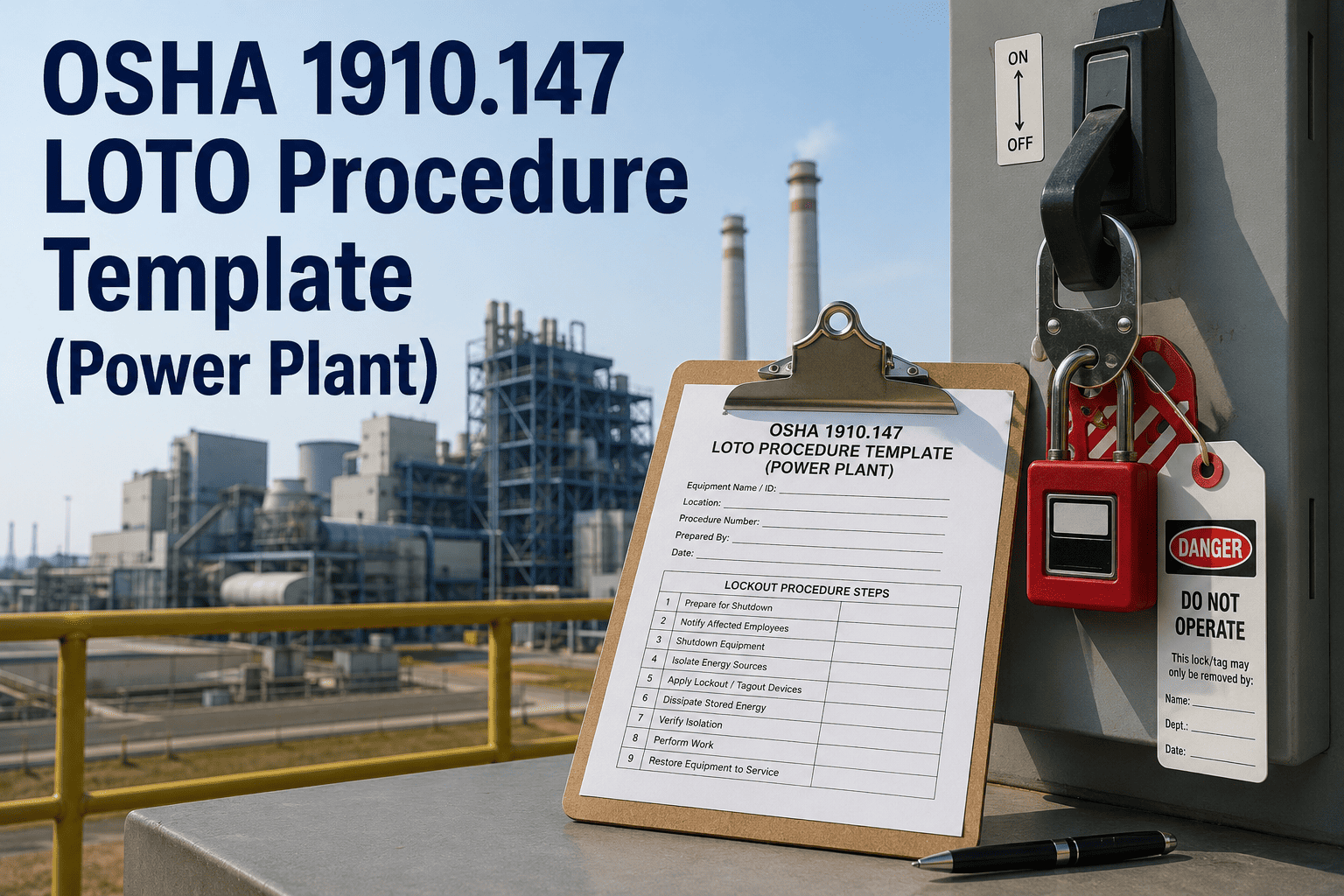
OSHA 1910.147 LOTO Procedure Template — Power Plant
Use this template as the foundation for each machine-specific LOTO procedure at your facility. Fill in the shaded fields for every piece of equipment. All sections are required for full 1910.147 compliance.
Section 1 — Equipment Identification
| Equipment Name |
Boiler Feed Pump / Turbine / MOV / [Enter Name] |
Asset ID / Tag No. |
[Asset Number] |
| Plant / Unit |
[Unit 1 / Unit 2 / BOP] |
Location / Bay |
[Building / Elevation / Grid Ref] |
| Procedure Applies To |
[All service tasks / Specific task — describe] |
Procedure ID |
[LOTO-PP-XXX] |
| Written By |
[Name / Title] |
Approved By |
[Safety Manager / Plant Engineer] |
| Date Issued |
[MM/DD/YYYY] |
Next Review Date |
[MM/DD/YYYY — max 12 months] |
Section 2 — Energy Source Inventory
| Energy Type |
Magnitude / Rating |
Isolation Point / Device |
LOTO Device Type |
Residual Hazard / Bleed Method |
| Electrical — MCC |
4.16 kV / 480 V |
MCC Bucket [ID] / Breaker [ID] |
Padlock + Hasp |
Test with voltage meter at terminal block |
| Electrical — Control Power |
120 VAC / 24 VDC |
Control panel fuse block [ID] |
Padlock + Hasp |
Verify at I/O terminal strip |
| Steam — High Pressure |
[psig / Temperature] |
Isolation valve [Tag No.] |
Valve lock + Tag |
Open drain valve [Tag No.], confirm zero pressure |
| Pneumatic — Actuator Supply |
[psig] |
Instrument air isolation valve [Tag No.] |
Valve lock + Tag |
Bleed actuator via local vent fitting |
| Hydraulic |
[psig] |
Hydraulic isolation valve [Tag No.] |
Valve lock + Tag |
Cycle actuator to relieve stored pressure |
| Gravitational / Stored Mechanical |
[Mass / Spring Pre-load] |
Block / pin / support device |
Physical block + Tag |
Install rated mechanical support before entry |
Section 3 — Isolation Sequence (Step-by-Step)
1
Notify Operations — Obtain clearance from shift supervisor before beginning isolation. Record permit number: ___________
2
Shut down equipment using normal stopping procedure. Confirm equipment is at rest and all motion has stopped.
3
Open / de-energize electrical isolation device at MCC / disconnect [ID]. Apply personal padlock. Verify breaker is in OPEN position.
4
Close steam isolation valve [Tag No.]. Install valve lock and hang LOTO tag with name, date, and work description.
5
Open drain valve [Tag No.] to relieve trapped steam pressure. Wait until pressure gauge reads zero and steam/condensate flow ceases.
6
Isolate pneumatic/hydraulic supply at valve [Tag No.]. Bleed actuators at local vent. Confirm zero pressure on local gauge.
7
Install gravity/mechanical blocking device if any component can move under its own weight. Do NOT rely on LOTO alone for gravitational energy control.
V
VERIFICATION — Zero Energy State Test: Attempt to start equipment using normal start push button or HMI command. Confirm no motion, no voltage, no pressure response. If equipment responds — STOP. Do not proceed. Re-evaluate isolation.
Section 4 — Group Lockout Protocol (Multi-Craft / Multi-Shift)
Authorized Employee Sign-On
| Name |
Craft / Trade |
Lock Serial No. |
Date/Time On |
Date/Time Off |
| [Name] |
[Electrical / Mechanical] |
[SN] |
[MM/DD HH:MM] |
[MM/DD HH:MM] |
| [Name] |
[Instrument Tech] |
[SN] |
[MM/DD HH:MM] |
[MM/DD HH:MM] |
| [Name] |
[Operator / Contractor] |
[SN] |
[MM/DD HH:MM] |
[MM/DD HH:MM] |
Shift Transfer Rules
Outgoing technician must NOT remove personal lock until incoming technician has applied their own lock to the hasp
Group lockbox key must be physically transferred — not left in device or passed verbally
Incoming technician must re-verify zero energy state at shift start before resuming work
Supervisor must sign transfer log — email or verbal transfer is not acceptable for compliance
Section 5 — Restoration / Re-Energization Sequence
R1Confirm all tools, test equipment, and temporary jumpers are removed from the work area.
R2Reinstall all guards, covers, and protective devices that were removed during service.
R3Ensure all workers are clear of the equipment and hazard zone — conduct a headcount.
R4Each authorized employee removes their personal lock from the hasp in reverse isolation order.
R5Supervisor verifies all locks removed, signs restoration log, and notifies operations control room.
R6Operations re-energizes equipment per normal startup procedure. Observe for abnormal conditions on first start.
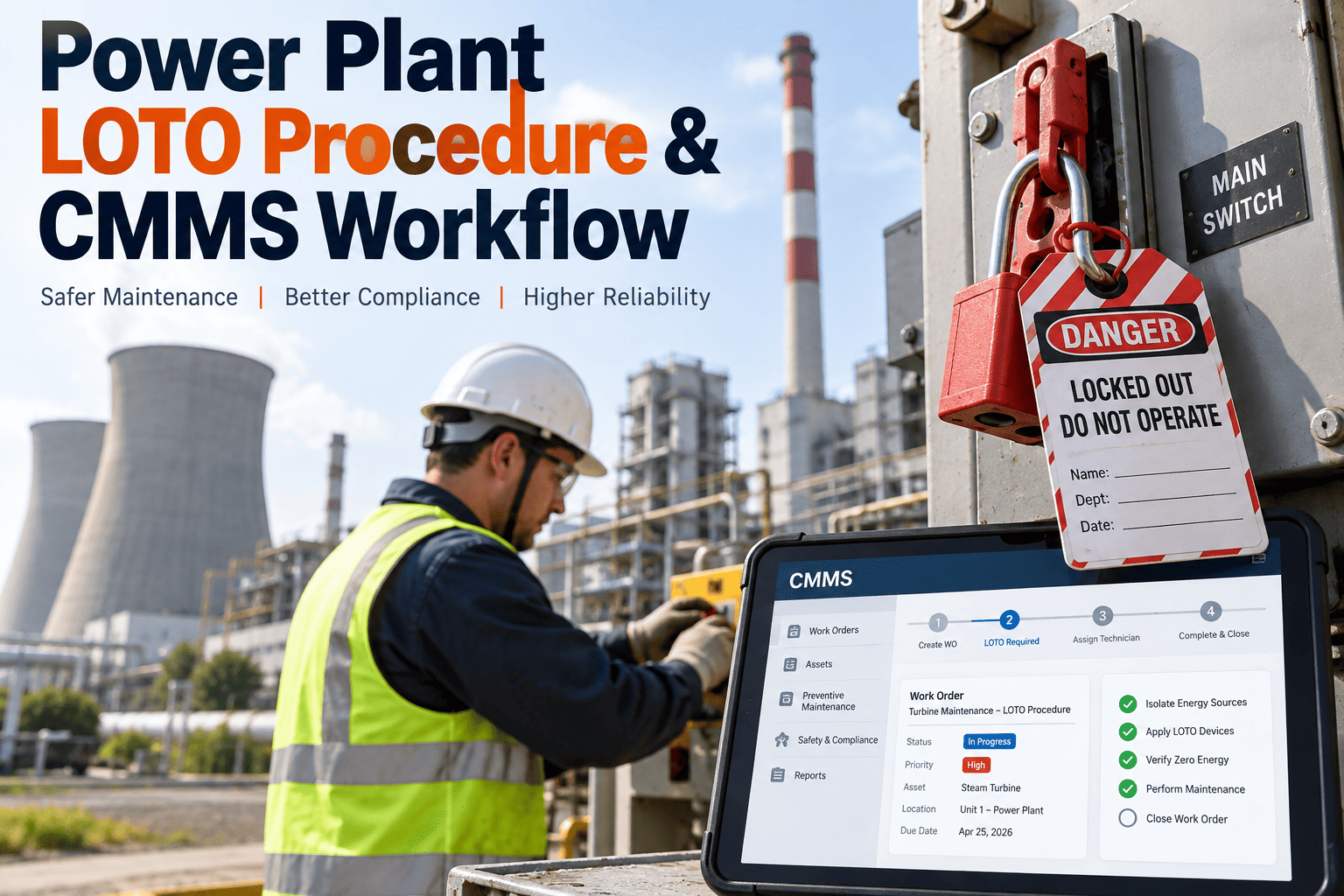
Section 6 — CMMS Work Order Sign-Off
| Work Order No. |
[WO Number from CMMS] |
Job Start Date/Time |
[MM/DD/YYYY HH:MM] |
| Lead Authorized Employee |
[Name / ID] |
Restoration Complete |
[MM/DD/YYYY HH:MM] |
| Safety Supervisor Signature |
________________________ |
Operations Concurrence |
________________________ |
| Procedure Followed Without Deviation? |
Yes / No — If No, document deviation in CMMS notes |
Incident / Near-Miss Reported? |
Yes / No — If Yes, attach incident report No. |
Power Plant-Specific LOTO Challenges and How to Solve Them
Complex Energy Sources
Power plants combine electrical, thermal, pneumatic, hydraulic, and gravitational energy in single equipment trains. A single BFP isolation may require 6 to 10 separate lockout points. Your procedure must map every source — not just the obvious electrical one.
Multi-Craft Coordination
Electrical, mechanical, and I&C technicians often work the same equipment simultaneously. Group lockout with a lockbox and hasp is mandatory. Verbal agreements between crafts do not satisfy 1910.147 requirements.
Shift Handoffs
Outages span multiple shifts. LOTO transfer at shift change is one of the highest-risk moments in plant maintenance — and one of the most commonly cited OSHA violations. A documented shift transfer protocol is non-negotiable.
Contractor Interface
Contractors must participate in your LOTO program, not just their own. 1910.147(f)(2) requires the host employer and contractor to coordinate LOTO procedures when both are working on the same equipment.
Your LOTO procedures deserve more than a binder on a shelf.
Oxmaint links LOTO checklists directly to work orders — technicians sign off on mobile, every step is timestamped, and your audit trail is always ready for OSHA review.
Frequently Asked Questions
Does OSHA 1910.147 require a written procedure for every piece of equipment?
Yes, with one exception: equipment that has a single, clearly identifiable lockout point, uses only electrical energy, and can be locked in the off position without stored energy may qualify for a simplified approach. Power plant equipment almost never meets all three criteria, so written machine-specific procedures are effectively mandatory for the entire plant.
Talk to our team about building your procedure library digitally.
How often must LOTO procedures be reviewed and updated?
OSHA requires a periodic inspection of each energy control procedure at least once per year. The inspection must be performed by an authorized employee other than the one using the procedure. Results must be documented, including the machine reviewed, the date, the employees involved, and the name of the inspector.
Oxmaint can automate annual review reminders for your entire procedure library.
What is the difference between lockout and tagout in power plants?
Lockout uses a physical device (padlock) to positively prevent re-energization. Tagout uses only a warning tag and relies on human compliance — it provides less physical protection. OSHA requires lockout whenever equipment can be locked out. Tagout alone is only permitted when the energy-isolating device cannot accept a lock, and additional protective measures must be implemented. In power plants, lockout is the standard for all significant isolations.
Can contractors use the facility's LOTO template, or must they use their own?
Either approach can work, but the host employer and contractor must communicate and coordinate their programs before work begins. If procedures differ, both parties must understand which applies. The host employer is responsible for ensuring contractor compliance with 1910.147 on their site. Most power plants require contractors to follow plant LOTO procedures and use plant-issued locks during outage work.
Manage contractor LOTO compliance alongside your own team in Oxmaint.
What records must be kept for LOTO compliance in a power plant?
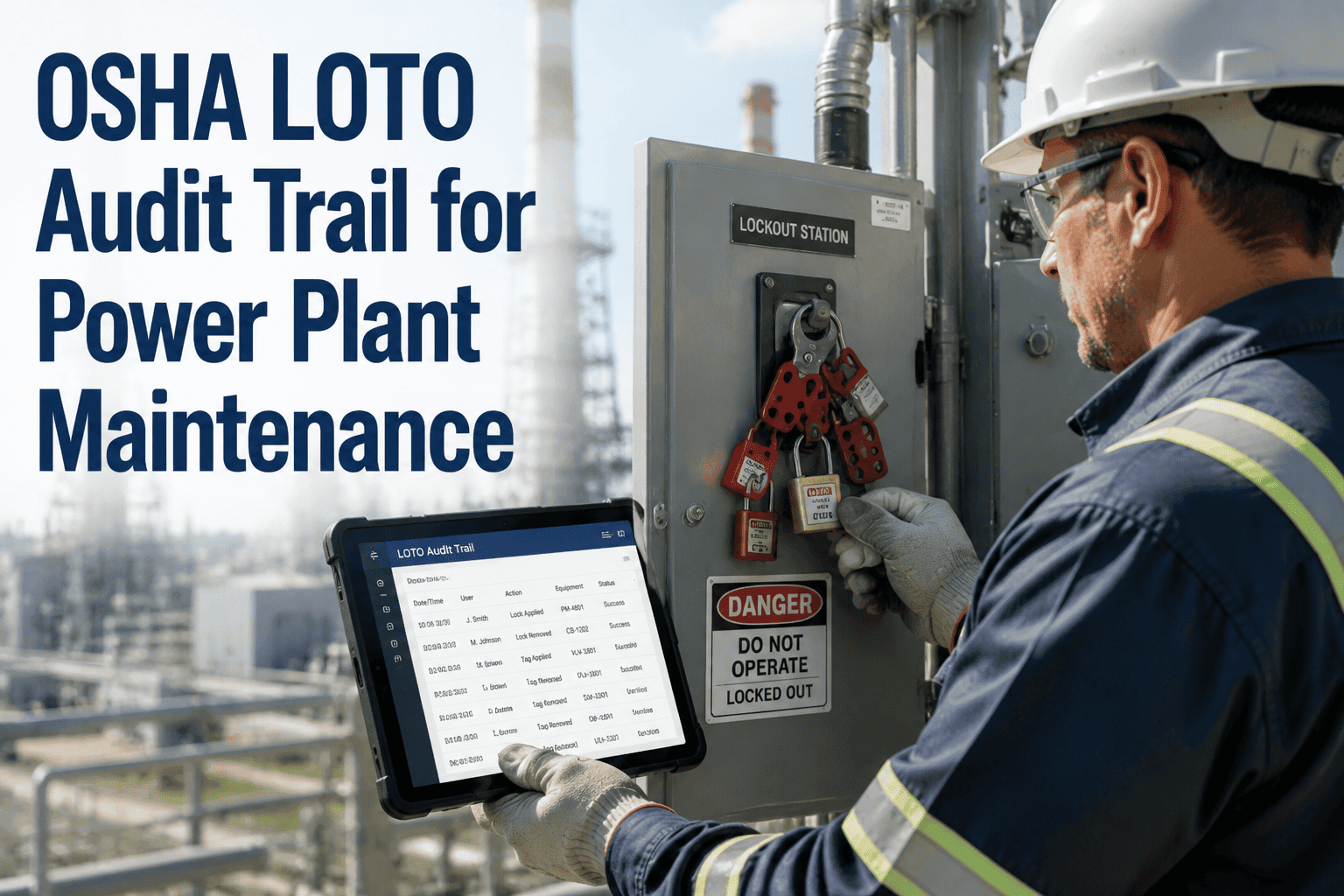
You must retain: the written procedure document, annual inspection records (date, equipment, employees, inspector name), training records for all authorized and affected employees, and any deviation documentation. OSHA inspectors routinely request these during plant audits. Digital CMMS records with timestamps are far stronger evidence of compliance than paper logs.
Build a LOTO Program That Protects People and Passes Audits
Oxmaint transforms your LOTO procedures from static documents into live, trackable work tasks — with technician sign-off, photographic evidence, and automatic escalation when steps are skipped. Every procedure. Every isolation. Every shift. Documented.