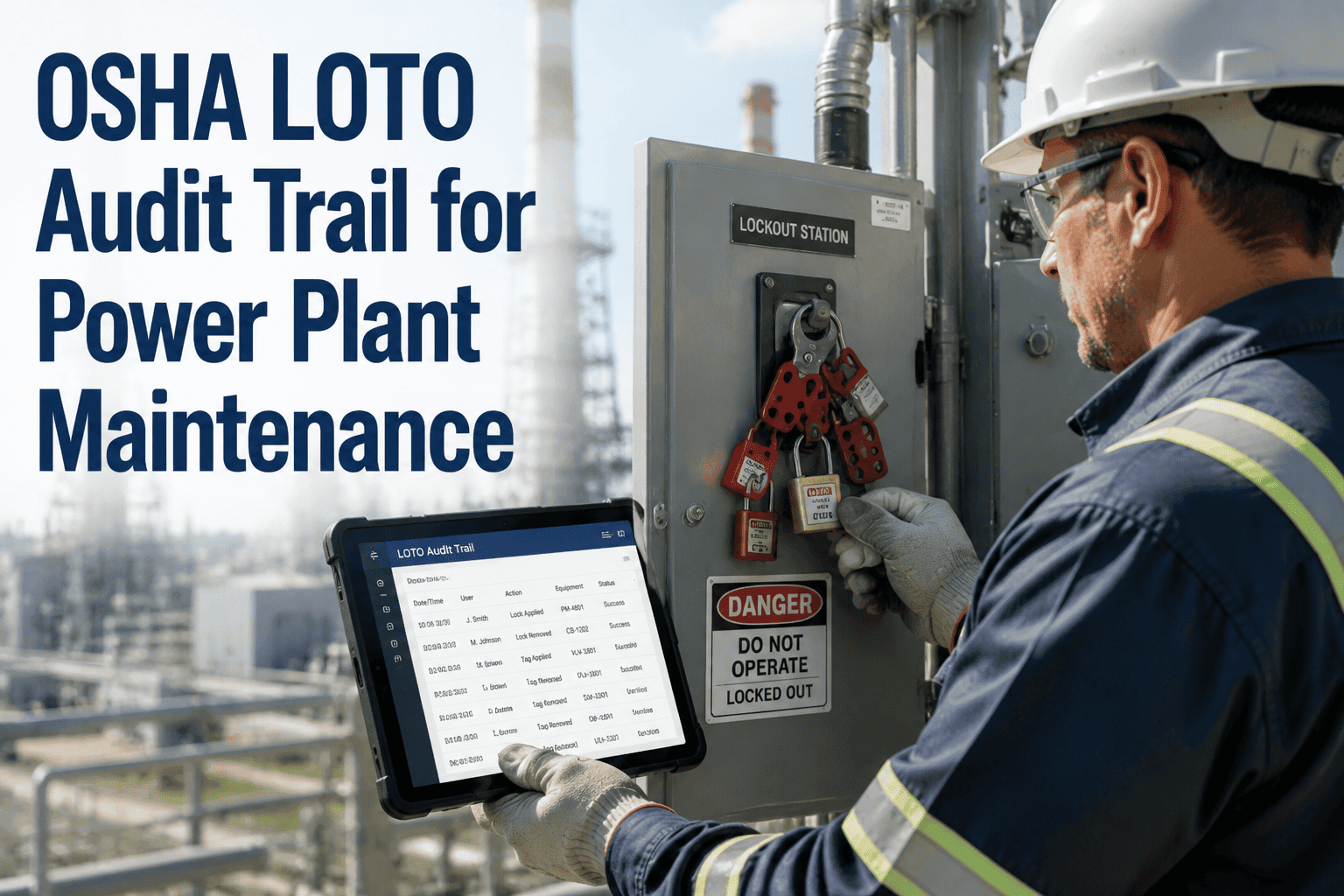
In a power plant, lockout/tagout is the line between a routine repair and a fatality — and OSHA judges your program less by the locks hanging on the panel than by the records behind them. The energy control standard demands written procedures, trained employees, and certified annual inspections, each documented down to who did what and when. When those records live on clipboards and in filing cabinets, an inspector's request can expose gaps that were invisible day to day. Building the audit trail as the work happens is how plants stay both safe and defensible, which is where Oxmaint's compliance tracking comes in.
OSHA LOTO Audit Trail for Power Plant Maintenance
Tie every lockout to a work order, capture who isolated what and when, and keep certified procedures, training, and inspection records ready the moment an OSHA inspector walks in.
The Program Is the Paperwork
OSHA's energy control standard rests on three pillars, and an inspector can ask for evidence of each. A wall of locks proves nothing on its own — what holds up is documented procedures, trained people, and inspections that are certified in writing. In power generation, the same three pillars apply whether work falls under the general LOTO rule or its near-identical power-generation counterpart.
Written, equipment-specific steps covering scope, purpose, authorization, the energy types to control, and how to isolate and verify them.
Role-based training so each worker understands the program, with certification recording every employee's name and training dates.
An annual, certified review of each procedure by an authorized employee who does not use that procedure, correcting any deviation found.
The Six Steps Every Lockout Must Record
A compliant lockout follows a fixed sequence, and each step is a point where the audit trail is either built or broken. The final step — verification — is one of the most frequently cited failures, because a skipped "try" means no one confirmed the machine was truly dead.
Identify every energy source and tell affected employees the lockout is coming.
Power down the equipment in an orderly way using the established procedure.
Operate the energy-isolating devices to disconnect from all sources.
Each authorized employee applies their own lock and tag — no sharing.
Discharge, relieve, or restrain any residual or stored energy.
Attempt to restart to confirm a zero-energy state — the most-cited step when skipped.
Make Every Lockout Traceable
Oxmaint links each lockout to its work order and procedure, capturing who isolated the equipment, when, and that verification happened — so the audit trail writes itself with every job.
Three Records OSHA Will Ask to See
When an inspection or incident review starts, your defense is documentation. These are the three certifications the standard requires, with the exact fields each one must contain to satisfy an auditor.
- Scope, purpose, and authorization
- Specific energy types to control
- Equipment covered by the procedure
- Isolation and verification steps
- Each employee's name
- Dates training was completed
- Role-appropriate content
- Retraining after changes or gaps
- Machine or equipment inspected
- Date of the inspection
- Employees included in the review
- Person who performed it
Who Needs What: The Three Employee Roles
The standard defines workers by their relationship to the locked-out equipment, and each tier needs different training and records. Treating them identically is a common citation, because an affected employee trained as if they were authorized still cannot safely apply a lock.
Applies the locks and tags to service the equipment. Needs hands-on, machine-specific training and is reviewed in every annual inspection.
Operates the machine or works in the area being serviced. Must recognize a lockout in progress and never attempt to restart the equipment.
Works in or passes through the broader area. Needs awareness training on the prohibition against tampering with locked-out energy controls.
Turn LOTO Compliance Into a Living Record
See how procedures, training currency, and certified annual inspections live in one place — so a citation-triggering gap surfaces on your dashboard, not during an OSHA visit.
Where LOTO Programs Get Cited
The violations that draw penalties are rarely exotic — they are the everyday lapses that documentation would have caught. Knowing the common failure points is the fastest way to harden your own program before an inspector finds them first.
No written, equipment-specific energy control procedure exists for the machine being serviced.
Employees cannot articulate their responsibilities, or roles are trained at the wrong tier.
The annual periodic inspection was not done, not certified, or done by the procedure's own user.
The "try" step was skipped, so no one confirmed the equipment reached a zero-energy state.
How Oxmaint Builds Your LOTO Audit Trail
Oxmaint connects the lockout to the work order and the worker, so every required record is captured as the maintenance happens rather than reconstructed before an audit.
Attach the equipment-specific energy control procedure to each job so the right steps travel with the work.
Record who isolated the equipment, when, and that verification was performed, building a timestamped trail.
Auto-generate annual periodic inspections and capture certifications with machine, date, employees, and inspector.
Track each employee's training and retraining dates by role, flagging gaps before they become citations.
Frequently Asked Questions
Keep Your People Safe and Your Records Ready
A strong LOTO program protects lives and proves itself on demand. Bring your procedures, lockouts, inspections, and training into one system and face every audit with the trail already in hand.