Heat rate is where the maintenance program meets the P&L. A 50 Btu/kWh degradation on a 500 MW coal unit at 85% capacity factor is roughly $1.5-2.5 million a year in extra fuel — and every one of those 50 Btu is sitting against a maintenance activity someone could schedule. Fouled condenser tubes, air-heater seal leakage, a drifted combustion O₂, a worn mill, dirty economizer, running an extra ID fan that doesn't need to be on — this guide pins the top heat-rate drivers to the maintenance activities that fix them. OXMAINT AI is the AI-powered power plant maintenance software that tags every PM, finding and WO to the heat-rate driver it affects, so the fuel-cost line and the maintenance program read from the same spreadsheet.
POWER PLANT HEAT RATE MAINTENANCE OPTIMIZATION · PERFORMANCE & EFFICIENCY · 2026
Power Plant Heat Rate Maintenance Optimization Guide
Ten drivers of heat rate, each pinned to the maintenance activity that recovers it. OXMAINT AI tags every PM and finding to its driver, tracks the fuel-cost impact live, and keeps the heat-rate curve and the maintenance program on one record.
10
controllable heat-rate drivers
50
Btu/kWh = $1.5-2.5M/yr on a 500 MW unit
4
cold-end + hot-end + air + aux systems
1
daily deviation report the plant acts on
The Heat-Rate Waterfall — Where The Btus Go
Heat rate degradation is a stack. The ideal Carnot limit sits at the top; each physical loss layer brings the number down to the net heat rate the plant bills. The maintenance program lives in the controllable layer; OXMAINT AI tags every PM to the layer it moves.
01
Carnot limit
Thermodynamic ceiling — fixed by the hot & cold reservoir temperatures. Nothing to maintain here.
~2,500 Btu/kWh ideal
02
Design heat rate
Cycle design losses — turbine stages, feedwater heater approach, condenser design, parasitic power. Fixed at commissioning.
+6,500 Btu/kWh
03
Controllable degradation
Fouling, leakage, drift, operational choices. This is the maintenance program's layer — typically 150-400 Btu/kWh across a mid-life unit.
+250 Btu/kWh typical
04
Net heat rate (billed)
What the fuel bill actually says. The gap between this and design is what the maintenance program is paid to close.
~9,250 Btu/kWh
The Top Ten Controllable Heat-Rate Drivers
Ranked by typical Btu/kWh impact on a mid-life sub-critical pulverized-coal unit. The numbers shift with fuel, load factor and cycle design — the ranking rarely does. OXMAINT AI tags every finding to its driver so the plant sees which bucket is bleeding.
01Condenser fouling / high backpressure80-150 Btu/kWh
02Air-heater seal leakage40-80 Btu/kWh
03Boiler excess air / O₂ drift30-70 Btu/kWh
04Mill & coal fineness25-55 Btu/kWh
05Economizer / water-wall fouling20-50 Btu/kWh
06Feedwater heater performance (TTD/DCA)15-40 Btu/kWh
07Boiler & cycle casing leakage15-30 Btu/kWh
08Auxiliary power (ID/FD/BFP overrun)10-30 Btu/kWh
09Turbine passing / valve leakage10-25 Btu/kWh
10Steam line heat loss / insulation5-15 Btu/kWh
Driver × Maintenance Activity Cross-Matrix
Every driver pairs with a specific set of maintenance activities. The matrix below documents the primary activity owner per driver; OXMAINT AI uses it as the routing policy so every WO affects a tracked driver.
Driver
On-line clean
Off-line clean
Inspect / NDE
Controls tune
Component replace
Condenser
Ball cleaning
Hydroblast
Eddy-current
Vacuum controller
Tube plug / retube
Air heater
Soot blow
Element wash
Seal gap survey
Drive torque
Seal replace
Combustion
Grid traverse
O₂ / excess air
Burner nozzle
Mills
Fineness sieve
Classifier set
Grinding element
Economizer / water wall
Soot blow optimize
Chemical clean
Deposit sampling
Tube panel
FWH
Tube clean
TTD / DCA trend
Level control
Tube plug / retube
Aux power
Fan performance
VFD / damper
Fan / BFP overhaul
Four System Dives — The Loss Pattern Behind The Number
The four systems with the biggest heat-rate leverage each have a signature loss pattern a performance engineer reads the same way every month. OXMAINT AI holds the signature as the asset's trend view.
COLD END
Condenser & vacuum
Backpressure trending above curve for the inlet temperature. Causes: fouling, air in-leakage, condenser pump drift. Signature: backpressure vs inlet-temperature curve rising month over month.
Ball cleaning → hydroblast → air in-leakage walk → eddy-current on next outage
HOT END
Boiler combustion
Stack O₂ and CO drifting outside window; LOI (loss on ignition) at ESP rising. Causes: burner wear, mill fineness falling, air-fuel ratio drift. Signature: grid traverse non-uniformity.
Daily O₂ probe check → weekly fineness sieve → quarterly grid traverse
AIR SIDE
Air heater leakage
O₂ rising across the air heater at constant furnace exit. Causes: seal wear, element pluggage, differential expansion. Signature: inlet vs outlet O₂ delta climbing over months.
Monthly O₂ delta → quarterly seal survey → outage seal replace / element wash
AUXILIARIES
ID/FD/BFP power
Aux power as % of gross MW creeping. Causes: running an extra fan that doesn't need to be on, damper drift, BFP cavitation. Signature: aux % vs load curve shifting up.
Weekly aux % vs load check → monthly fan performance → damper calibration
The Fuel-Cost Math — What A Btu/kWh Is Really Worth
A heat-rate program is paid in fuel dollars. The chart below sizes the annual fuel-cost impact per 50 Btu/kWh of degradation on a 500 MW unit at 85% capacity factor, across three fuel-cost scenarios.
ANNUAL FUEL COST PER 50 Btu/kWh · 500 MW · 85% CF
Low-cost fuel · $2/MMBtu
$1.5M
Mid-cost fuel · $3/MMBtu
$2.2M
High-cost fuel · $4/MMBtu
$2.9M
Gas peaker · $6/MMBtu
$4.4M
Every PM Is A Line On The Fuel Bill — If It's Tagged Right.
OXMAINT AI tags every work order to the heat-rate driver it affects. The condenser ball-cleaning WO rolls up to the cold-end bucket; the burner nozzle swap rolls up to combustion. The maintenance program and the fuel-cost line read from the same spreadsheet.
Daily Deviation Board — What The Performance Engineer Sees
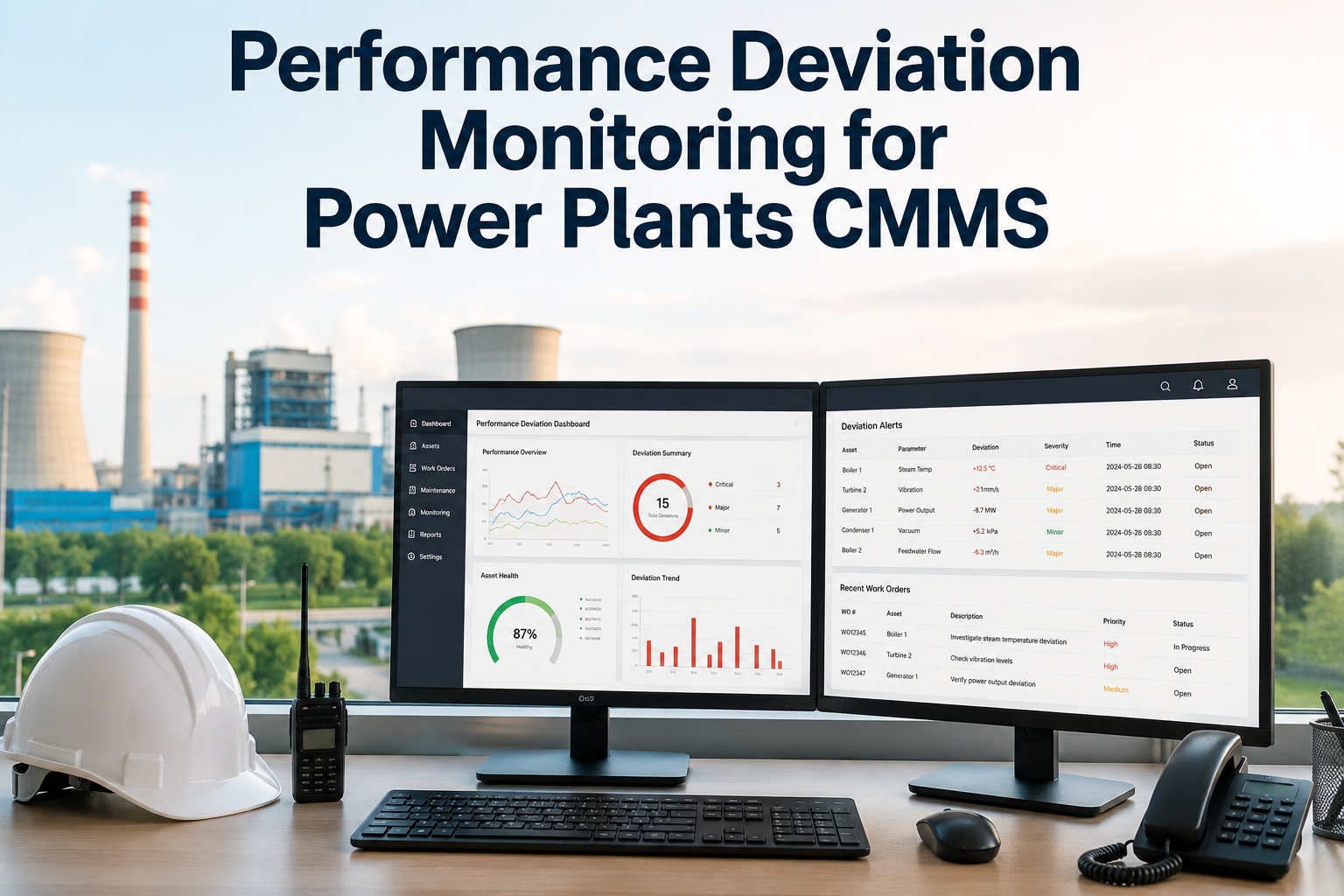
Heat-rate deviation lives on a daily report. The engineer gets one screen: current HR, deviation from target, which driver is bleeding, which WO is already raised against it. OXMAINT AI renders it live.
HEAT-RATE DEVIATION BOARD · UNIT 3 · DAILY 15:00
$2.1M
annualized fuel impact
Cold end · condenserBP +0.4 inHg vs curve; ball cleaner down 11 d+95 Btu/kWh · WO 71422
Air heaterO₂ delta +0.9%; seal survey due+45 Btu/kWh · WO 71418
Combustion / millLOI 6.1% · Mill C fineness falling+28 Btu/kWh · WO 71411
Feedwater heatersTTD / DCA within band+0 Btu/kWh · clean
Aux powerAux % vs load on curve+12 Btu/kWh · monitor
Six Habits Of A Working Heat-Rate Maintenance Program
The plants that keep heat rate near design do six things in common. OXMAINT AI embeds all six as defaults so the habits survive turnover.
01
Driver tag on every WO
Every work order carries the heat-rate driver it affects. No WO closes untagged.
02
Daily deviation report
One screen, one meeting, every weekday morning. The gap vs target drives the day's priorities.
03
Curve-based signals
Backpressure vs inlet temperature. Aux % vs load. Signals read against a curve, not a single setpoint.
04
Outage HR scoping
Every planned outage carries a heat-rate recovery scope — condenser clean, seal replace, mill overhaul.
05
Post-outage re-base
After every outage, the target curve resets to actual-achieved. No credit left on the table.
06
Operator training loop
Half the gap at any moment is operations — aux running too hard, soot-blow timing, excess air. Shift briefings close that half.
How OXMAINT AI Runs The Heat-Rate Program
The driver policy, 10-driver register, cross-matrix, system trend views, daily deviation board and outage recovery scope all live natively in the OXMAINT AI power plant maintenance software — open an account and tag your first driver bucket in OXMAINT AI.
Driver Policy
Ten controllable drivers set up as the asset-tag hierarchy; every WO rolls up to one of them.
Signature Trends
Backpressure-vs-inlet, O₂-delta, TTD/DCA, aux-% vs load — the curves live on the asset record, not a separate PI screen.
Daily Deviation Report
One-screen output showing current HR, gap vs target, bucket contribution and active WO against each driver.
Btu-to-Dollars Rollup
Each driver's deviation converted to annualized fuel cost at the plant's current fuel price. The maintenance review is a P&L review.
Outage HR Scope
Planned outage scope pre-tagged for the Btu it is designed to recover. Post-outage re-base is automatic.
Shift Brief Export
The yesterday-today one-pager for the operations shift brief — which driver bled, what the plant can do today.
Frequently Asked Questions
What's a realistic heat-rate recovery target for a mid-life unit?
80-150 Btu/kWh is a working target for a mid-life sub-critical pulverized-coal unit that hasn't run a dedicated heat-rate program before. More comes from the big-ticket items — condenser retube, air-heater element replacement — and must be scoped as capital. OXMAINT AI tags the controllable layer separately so the quick-win program is visible.
Which driver gives the fastest payback?
Condenser cleanliness almost always. On-line ball cleaning restored or an overdue off-line hydroblast often buys 50-100 Btu/kWh for a few shifts of planned outage. The scope is small, the measurement is clean, the fuel impact lands in weeks.
How does this interact with the predictive maintenance program?
Predictive catches the failure before the outage; heat-rate optimization catches the degradation before the failure. Same sensors, different trend. OXMAINT AI runs both views on one asset record so the same vibration signal rolls up to both reliability and heat-rate programs.
What's the operations side of the gap?
Typically 30-50% of the controllable gap at any moment is operations — soot-blow timing, excess air set point, aux running too hard, FW chemistry drift. The daily deviation report is as much an operations tool as a maintenance one, and the shift brief is where it closes.
Pin Every Btu To A Maintenance Activity.
Load the ten-driver policy into the OXMAINT AI power plant maintenance software — signature trends, daily deviation board, Btu-to-dollars rollup, outage recovery scope and the shift brief export. The maintenance program and the fuel-cost line finally live on the same page.