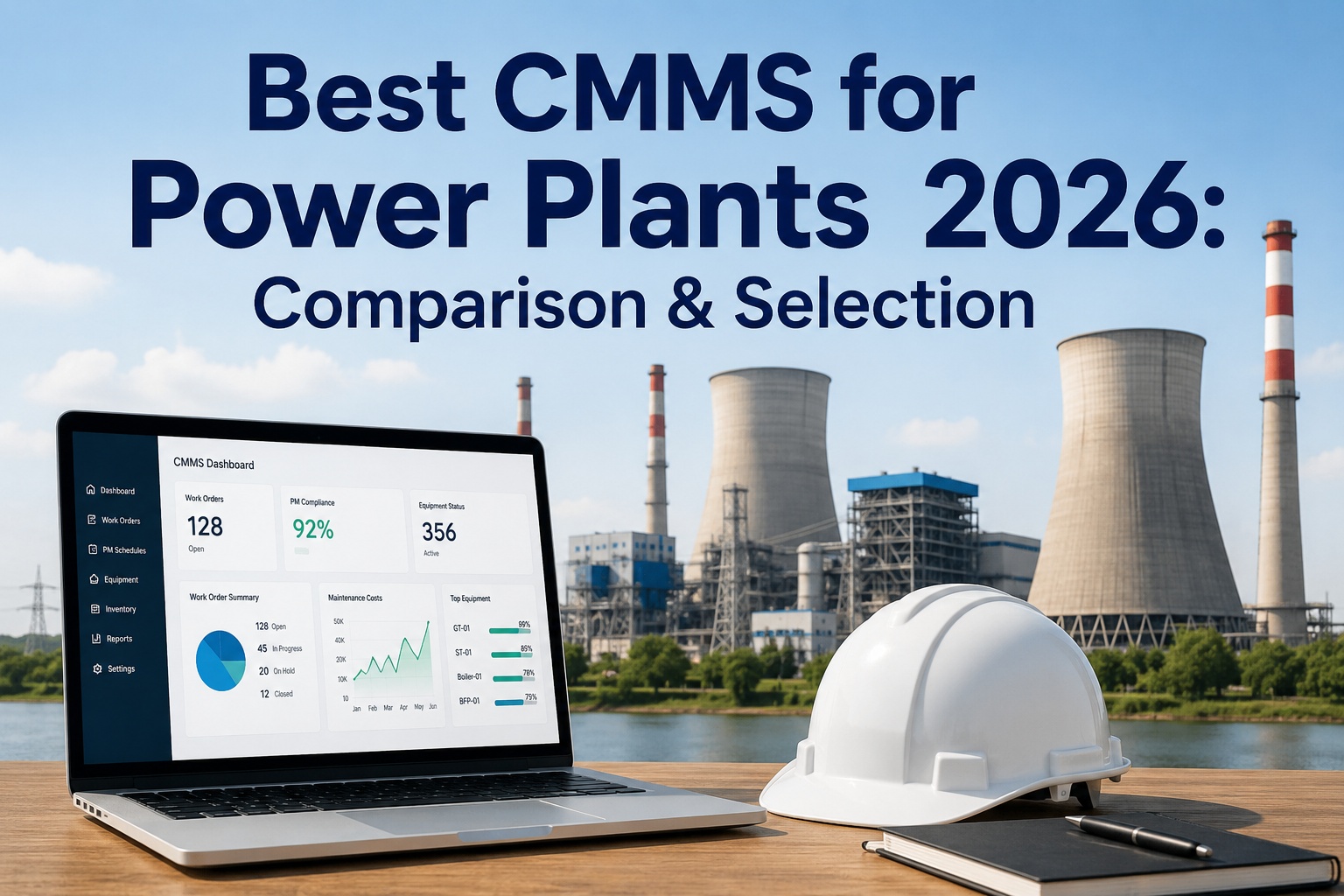
Power plant maintenance teams rarely lack for enterprise software — most large utilities already run SAP PM, Oracle EAM, or IBM Maximo as part of a broader ERP deployment. The question plant managers actually face is not whether to have a maintenance system, but whether the one they have is slowing their team down. ERP maintenance modules are engineered for financial consolidation, procurement workflows, and enterprise reporting — not for the speed and granularity that a control room operator or PM planner needs at 2 AM during a forced outage. Dedicated CMMS platforms close that gap: faster work order creation, mobile-first field execution, and maintenance-specific analytics that ERP platforms require expensive customization to replicate. This guide helps plant managers understand when a dedicated CMMS outperforms ERP, when integration is the right answer, and what selection criteria actually matter in a utility environment. Book a 30-minute session to see how Oxmaint fits alongside your existing ERP or as a standalone solution for your plant.
Bottom Line Up Front
If your team creates work orders in the field, tracks PM compliance by asset, and needs maintenance KPIs in real time — a dedicated CMMS outperforms ERP maintenance modules in speed, usability, and deployment time. If your plant has complex procurement, multi-entity financials, and capital project tracking tightly integrated, ERP integration is the pragmatic answer. Most plants benefit from both: CMMS for execution, ERP for finance.
3–5x
faster work order creation in dedicated CMMS vs SAP PM — field team benchmark
6–18 mo
typical ERP maintenance module implementation vs 4–8 weeks for CMMS deployment
60–70%
of ERP maintenance module features go unused by plant maintenance teams — Gartner research
40%
lower total cost of ownership for dedicated CMMS vs equivalent ERP PM module licensing + customization
The Core Difference: What Each System Is Built For
The confusion between CMMS and ERP stems from one fact: both can technically manage maintenance work orders. But that technical overlap masks a fundamental architectural difference. ERP systems are built around financial transactions — every maintenance action is modeled as a cost center posting, a material movement, or a procurement request. Dedicated CMMS platforms are built around asset reliability — every interaction is modeled as a work order, an inspection, a failure mode, or an uptime metric. That difference shows up in every user interaction, every report, and every integration requirement.
Work Order Creation Speed
5–15 screen navigation steps; requires training for field staff
2–3 taps on mobile; voice-to-text description supported
Mobile Field Execution
Requires companion app or browser fallback; offline support varies
Native mobile app with full offline capability and photo capture
PM Schedule Configuration
Powerful but requires basis-level configuration; multi-week setup
Maintenance-specific PM builder configurable in hours
Asset Failure Analysis
Available via BI reporting layer; not native to maintenance module
Built-in MTBF, failure mode trending, and downtime cost tracking
Financial Integration
Requires API integration or middleware
Native — maintenance costs post directly to GL and cost centers
Procurement Workflow
Basic parts request; purchase order handled externally
Full P2P workflow within same system as maintenance module
Implementation Time
6–18 months for full maintenance module deployment
4–8 weeks for single plant; 8–12 weeks for multi-site
Total Licensing Cost
High — bundled with enterprise platform; maintenance module add-on fees
Predictable per-user or per-site pricing; no ERP license dependency
When a Dedicated CMMS Outperforms ERP
Three scenarios consistently favor a dedicated CMMS over an ERP maintenance module — and all three are common in power generation environments.
Scenario 1
Field Teams Are Not Using the ERP System
SAP PM and Oracle EAM are designed for maintenance planners at desks, not for technicians in switchyards or boiler rooms. When field teams default to paper, whiteboard, or personal notebooks to track actual work — and enter data into ERP only for compliance — the ERP is functioning as a reporting system, not a maintenance system. A mobile-first CMMS closes this gap without replacing the ERP.
Scenario 2
PM Compliance Is Below Target Despite Having a System
Plants running SAP PM with PM completion rates below 80% are typically suffering from a usability problem, not a process problem. When creating a work order requires 12 steps and technical knowledge of ERP navigation, planners batch-create orders weekly instead of daily. Dedicated CMMS platforms reduce friction to the point where field-initiated work orders become the norm.
Scenario 3
Maintenance KPIs Require Custom BI Reports
If your plant manager needs a report request submitted to the IT team to get MTTR, MTBF, or overdue PM data, the maintenance system is not serving maintenance management. Dedicated CMMS platforms surface these KPIs as standard dashboards accessible without BI configuration or report scheduling.
Decision Support
Not Sure If CMMS or ERP Integration Is Right for Your Plant?
Oxmaint works as a standalone CMMS and integrates with SAP, Oracle, and Maximo via API. Book a session with a power plant specialist to map the right architecture for your maintenance program.
When ERP Integration Is the Right Answer
A dedicated CMMS is not always the full answer. For plants where financial reconciliation, inventory management, and maintenance cost tracking must remain unified, the pragmatic solution is CMMS-ERP integration rather than replacement.
Capital Project Accounting Is Tied to Maintenance Records
When major overhaul costs, capital replacements, and maintenance labor must post to project accounting codes in the ERP, keeping maintenance initiated in CMMS and financial reconciliation in ERP — with a bidirectional API sync — is more efficient than forcing either system to do both jobs.
Centralized Procurement and Parts Management
Multi-plant utilities often manage spare parts procurement through a central warehouse system inside SAP or Oracle. A CMMS that triggers parts requests which route to ERP for P2P processing preserves the procurement controls while freeing maintenance execution from ERP navigation complexity.
Regulatory and Financial Reporting Require a Single Source
FERC, NERC, or utility commission reporting that requires maintenance cost data reconciled to financial statements must have a single authoritative system for financials. CMMS data synced to ERP satisfies both requirements — field usability for the maintenance team, financial integrity for the compliance team.
Selection Criteria That Actually Matter for Power Plants
| Selection Criterion |
Why It Matters in Power Generation |
What to Ask Vendors |
| Mobile Offline Capability |
Substations, boiler rooms, and switchyards often have no connectivity |
Does the mobile app store and sync full work order data offline, including photos? |
| PM Compliance Dashboard |
NERC and FM Global auditors ask for PM compliance percentages by asset class |
Is PM compliance by asset type available without custom reporting? |
| Failure Mode Tracking |
Repeat failures on critical assets need RCA triggers, not just closed work orders |
Can the system flag repeat failures and link to failure mode categories? |
| Multi-Unit Asset Hierarchy |
Power plants need location-based hierarchy: Plant → Unit → System → Component |
How many hierarchy levels does the asset structure support? |
| ERP Integration Capability |
Most large plants need CMMS data to flow to SAP or Oracle for financials |
What native connectors or API documentation exists for SAP PM and Oracle EAM? |
| Compliance Document Attachment |
NFPA, NERC CIP, and OSHA records must attach to specific work orders |
Can documents, photos, and permits attach at the work order and asset level? |
Frequently Asked Questions
Can Oxmaint run alongside SAP PM without replacing it?
Yes. Oxmaint integrates with SAP PM via API — maintenance execution and field inspection happen in Oxmaint, while cost postings and procurement approvals sync back to SAP. This is the most common deployment pattern for large power plants that already have SAP in production.
How long does CMMS deployment take for a 500 MW power plant?
A single-plant deployment covering asset setup, PM schedule configuration, and mobile onboarding typically runs four to six weeks. ERP integration adds two to four weeks depending on the complexity of the data mapping and API access provisioning from the IT team.
Does switching to a dedicated CMMS mean losing historical ERP maintenance data?
No. Historical work order and asset data can be imported into Oxmaint via CSV or API migration. Most plants retain ERP as the financial record system and migrate active maintenance history into the CMMS for ongoing operational use.
What NERC or regulatory documentation does a CMMS support in a power plant?
Oxmaint generates timestamped work order records, PM compliance reports by asset class, and inspection audit trails that satisfy NERC CIP maintenance evidence requirements, NFPA inspection documentation, and OSHA maintenance record-keeping standards for industrial facilities.
Is Oxmaint suited for small plants without a dedicated IT team?
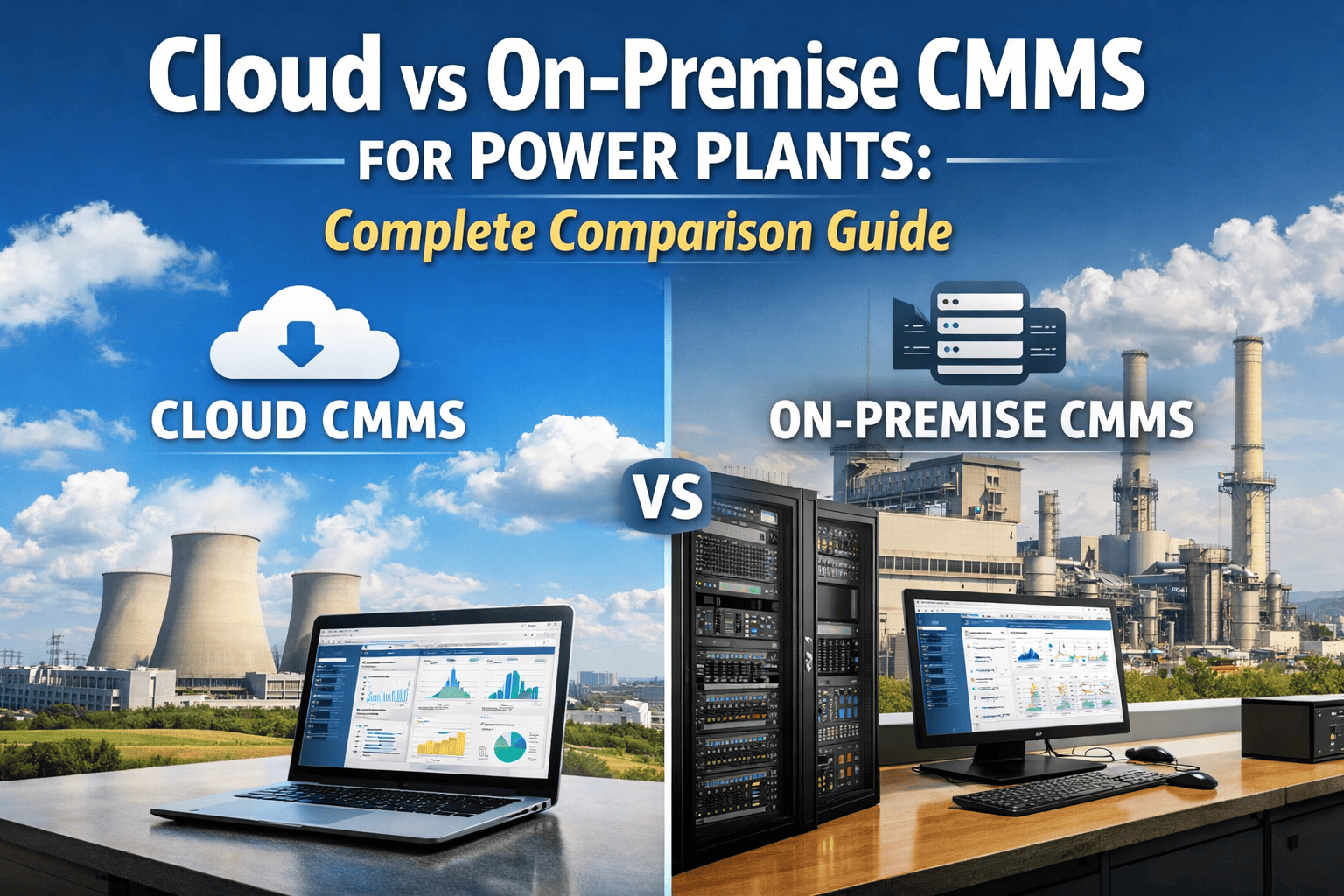
Yes. Oxmaint is configured through a no-code setup interface — asset import, PM schedule setup, and user onboarding require no IT resources. Cloud hosting means zero infrastructure management. A plant with one maintenance planner can be fully operational in under two weeks.
The Right Maintenance System for Your Plant — Without a Multi-Year ERP Project
Oxmaint deploys in weeks, integrates with your existing ERP, and gives field teams the mobile-first experience that drives actual PM compliance — not just data entry after the fact.