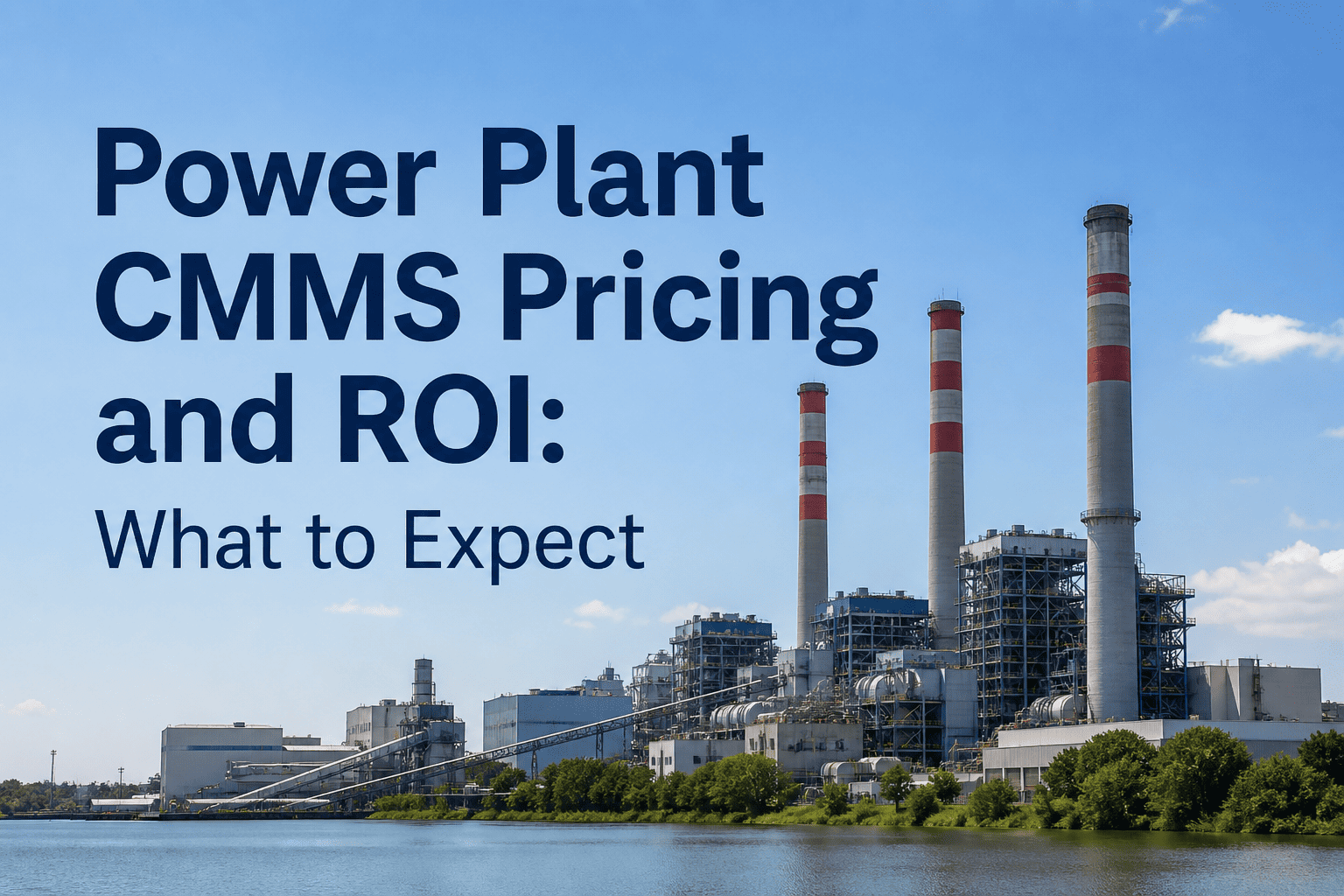
When a power plant's finance team asks what a CMMS will cost and what it will return, the honest answer requires understanding two numbers most vendors won't give you upfront: the total cost of ownership — which goes well beyond the subscription price — and the true cost of your current maintenance operation, which most plants underestimate by 35–45% because they only count direct labour and parts. A CMMS subscription for a mid-size power plant typically runs $8–$25 per user per month for a cloud-native platform, with implementation, data migration, and integration adding $10,000–$60,000 depending on complexity. But the return side of that equation is where the real conversation happens: a single prevented unplanned outage at a 200 MW gas plant recovers $300,000–$600,000 in lost generation revenue — more than a year of CMMS subscription cost in a single event. Plants running entirely reactive maintenance recover CMMS investment in 4–8 months. Plants with existing preventive programmes typically see payback in 10–18 months. The gap between what a CMMS costs and what it returns is not theoretical — it is arithmetic based on your plant's actual downtime cost, emergency labour rate, expedited parts spend, and compliance preparation hours. This guide gives you the framework to run those numbers and the specific inputs your CFO will need to approve the investment. Start a free OxMaint trial and run your own plant's numbers with real operational data from day one.
Power Plant CMMS Pricing and ROI: What It Actually Costs, What It Actually Returns, and How to Present the Business Case to Your CFO
Transparent pricing benchmarks, total cost of ownership breakdown, ROI calculation framework, and the four numbers your finance team will ask for — answered.
CMMS Pricing Models Explained: Per-User, Per-Asset, and What Each Means for Power Plants
Most CMMS platforms use one of three pricing structures — and each has different implications for a power plant where the ratio of assets to users is high and the asset population is complex.
Total Cost of Ownership: What to Budget Beyond the Subscription
The subscription price is only one component of year-one CMMS spend. These additional cost categories determine whether your budget request to finance is realistic or a surprise waiting to happen.
| Cost Category | Cloud-Native CMMS (e.g., OxMaint) | Enterprise EAM (e.g., IBM Maximo) | What Drives the Range |
|---|---|---|---|
| Software licence (Year 1) | $5,000 – $40,000 | $80,000 – $300,000+ | User count, feature tier, site count |
| Implementation and configuration | $0 – $15,000 | $50,000 – $200,000+ | Data migration complexity, custom workflows, integration scope |
| Data migration (asset register, history) | Included or $2,000 – $8,000 | $20,000 – $80,000+ | Source system quality, record volume, transformation required |
| Sensor / SCADA integration | $0 – $10,000 | $30,000 – $100,000+ | Protocol compatibility, number of data streams, middleware required |
| Training | Included / self-serve | $10,000 – $50,000 | Number of user roles, site count, training delivery format |
| Ongoing support (Year 2+) | Included in subscription | 15–25% of licence annually | Support tier (standard vs. dedicated CSM) |
| Time-to-value (weeks until ROI begins) | 1–4 weeks | 26–78 weeks | Deployment model, configuration complexity, change management |
Get a Plant-Specific Cost and ROI Estimate for OxMaint
Tell us your plant's asset count, technician headcount, and current downtime frequency — and we will build a realistic cost and ROI projection you can take to your finance team.
The ROI Calculation Framework: Four Numbers Your CFO Will Ask For
A credible CMMS business case for a power plant finance team is built on four plant-specific inputs — not vendor projections. These are the numbers to gather before your budget presentation.
Lost generation revenue + emergency labour premium + expedited parts cost + restart fuel cost. For a 200 MW gas plant, this typically runs $180,000–$420,000 per outage event. Even a 30% reduction in unplanned events delivers seven-figure annual savings.
Plants running reactive maintenance pay 1.5× to 2× base labour rates on emergency call-outs. Multiplied by annual unplanned events and average technician count on call-out, this number typically runs $120,000–$400,000 per year for a mid-size plant — and it virtually disappears with a predictive maintenance programme.
Expedited freight and emergency supplier premiums on parts ordered outside of planned procurement typically add 2.4× the standard cost of those parts. In a plant spending $600,000 annually on emergency parts orders, the premium above standard procurement is $840,000 in recoverable cost — addressable by planned parts ordering triggered by predictive maintenance lead time.
Regulatory inspections, insurance audits, and NERC CIP documentation cycles consume 80–400 engineering and technician hours per audit cycle in plants managing compliance manually. At loaded labour rates of $65–$120 per hour, this is $5,200–$48,000 per audit cycle in staff cost alone — before any penalty risk from incomplete records is factored in.
What a Realistic ROI Looks Like at Different Plant Sizes
ROI scales with plant complexity, current maintenance maturity, and how aggressively predictive maintenance replaces reactive response. These benchmarks use conservative 20–30% improvement assumptions consistent with verified industry operator data.
| Plant Profile | Estimated Annual CMMS Cost | Key Savings Drivers | Conservative Annual Saving | Payback Period |
|---|---|---|---|---|
| Small peaker (50–100 MW), 10–15 technicians | $8,000 – $18,000 | Downtime reduction, overtime reduction | $120,000 – $280,000 | 4–8 months |
| Mid-size gas plant (150–400 MW), 25–50 technicians | $18,000 – $45,000 | Predictive maintenance, compliance, parts planning | $380,000 – $850,000 | 6–12 months |
| Large combined cycle (400–800 MW), 50–100 technicians | $40,000 – $90,000 | Multi-unit outage coordination, IoT predictive, compliance automation | $900,000 – $2.1M | 8–14 months |
| Multi-site generation fleet (3+ plants) | $80,000 – $200,000 | Fleet-wide analytics, standardised PM, procurement consolidation | $2M – $6M+ | 10–18 months |
Frequently Asked Questions
The Cost of Your Current Maintenance Programme Is Higher Than You Think. The CMMS That Fixes It Costs Less Than One Prevented Outage.
Start a free trial, build your plant's asset register, and run your first ROI report — before you commit to anything. If the numbers don't support the investment, we will tell you. If they do, you will have the CFO presentation ready before the trial ends.