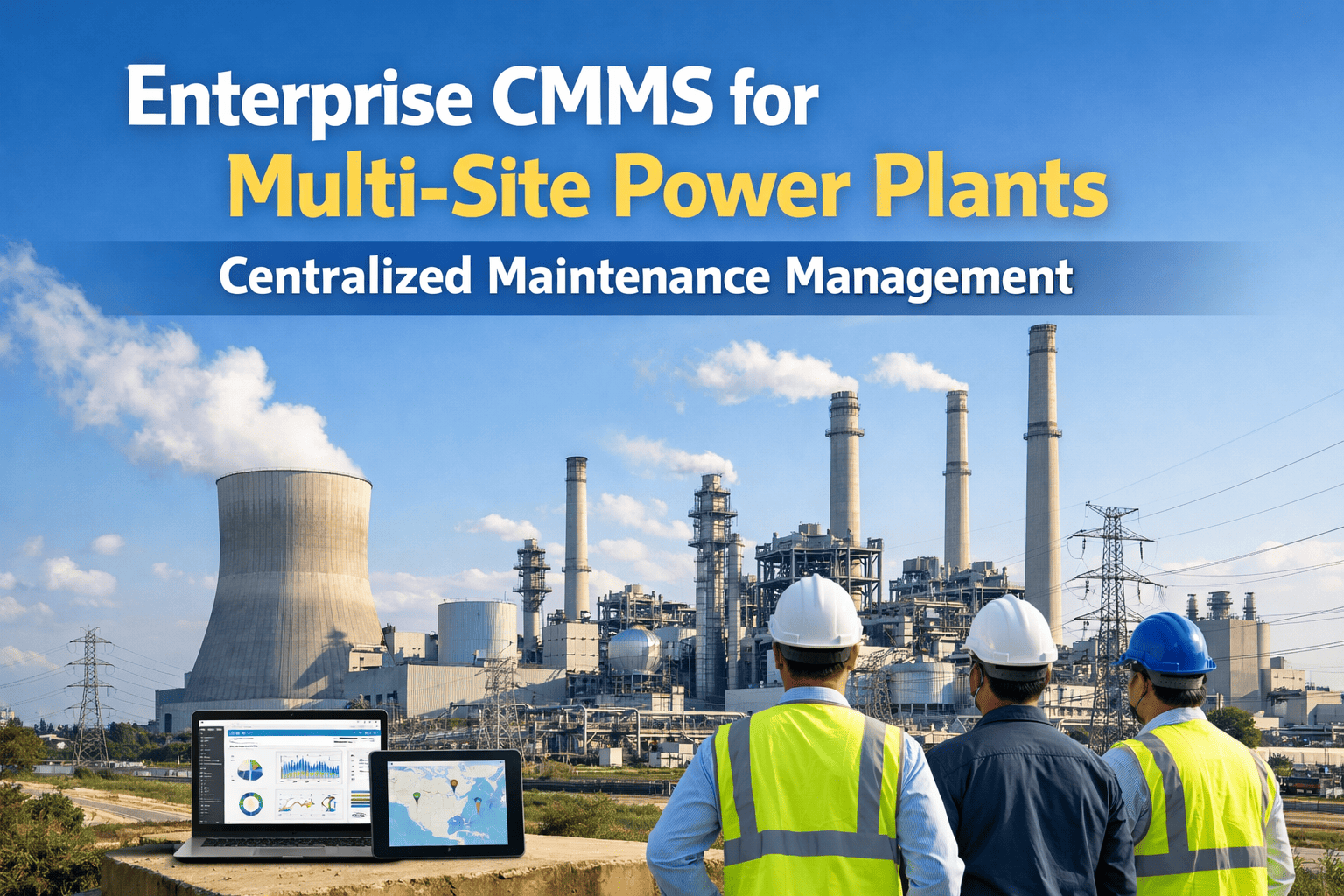
Multi-Site Maintenance Management for Power Plants

By Johnson on April 27, 2026

power-plant-multi-site-maintenance-management-software

Picture a regional power producer with a 1.8 GW portfolio: two combined-cycle gas plants in the south, one hydro facility in the mountains, a 220 MW solar farm in the desert, and a 180 MW wind installation on the coast. Four asset types, four maintenance philosophies, four different spreadsheets, and a corporate VP who has to call four plant managers every Monday to get a single fleet availability number — only to discover the numbers do not reconcile. This is the daily reality for IPPs and utilities running mixed-generation portfolios in 2026, and it is precisely the operational fragmentation that a multi-site CMMS is built to eliminate. Power producers consolidating onto a unified maintenance platform are reporting 38% lower total maintenance costs within 18 months and 61% fewer forced outages compared to their previous two-year baseline. Start a free trial of Oxmaint to see fleet-wide visibility on your own portfolio, or book a 30-minute walkthrough with our multi-site deployment team.

Case Study Snapshot

The Portfolio: Five Sites, Four Generation Types, One Maintenance Problem

The case study below tracks a mid-sized independent power producer through a 6-month transition from siloed site management to unified multi-site CMMS operation. The portfolio composition mirrors what most regional utilities, IPPs, and renewable platforms actually look like in 2026 — a deliberate generation mix balancing baseload thermal, dispatchable hydro, and intermittent renewables.

820 MW
Combined-Cycle Gas
2 sites · Southern region
Thermal
340 MW
Hydroelectric
1 site · Mountain corridor
Hydro
220 MW
Utility-Scale Solar
1 site · Desert basin
Solar
180 MW
Onshore Wind
1 site · Coastal ridge
Wind
240 MW
Battery Energy Storage
Co-sited with solar
BESS
Before The Rollout

The Five Operational Failures That Drove The Decision

Every multi-site CMMS rollout starts with a list of pain points — the operational failures that the corporate team has tolerated for years and finally cannot afford to tolerate any longer. The IPP in this case study identified five specific failure patterns during their pre-deployment audit. Most multi-site power producers will recognize at least four of them in their own operation.

01
Reconciliation Mondays
The corporate VP called every plant manager every Monday to manually compile fleet availability, EFOR, and maintenance backlog into a single board-ready slide. Numbers from gas, hydro, solar, and wind never reconciled because each site used different definitions and different software.
02
Spare Parts Trapped By Site
A $48,000 inverter capacitor sat unused at the solar site while an identical part was being air-freighted to a co-sited BESS module 200 meters away. No cross-site inventory visibility meant no way to redirect existing stock before placing emergency orders.
03
Compliance Audit Chaos
NERC CIP audit prep at the gas plants took three full weeks of manual binder assembly. FERC license documentation at the hydro site lived in a separate document management system. EPA reports for the BESS site had no shared format with anything else in the portfolio.
04
Tribal Knowledge Silos
The senior turbine technician at Plant A had solved a recurring HRSG fault three times. The same fault appeared at Plant B six months later — and Plant B's team spent two weeks rediscovering the fix because no shared knowledge base existed across the gas portfolio.
05
Contractor Rate Leakage
Each site negotiated its own contractor rates. Procurement discovered that the same wind turbine OEM service crew was being paid 22% more at the wind site than at a comparable contract elsewhere — because nobody was comparing rate sheets across the portfolio.
The Architecture

What "One CMMS, Five Sites" Actually Means In Practice

The architectural promise of a multi-site CMMS sounds simple: one platform, all sites, full visibility. The technical reality is more nuanced — each site retains its own asset registry, PM schedule, and compliance dashboard, while the corporate layer aggregates analytics, inventory, and reporting across every facility. Local autonomy plus portfolio visibility — not central tyranny.

Corporate Layer
Portfolio Dashboard
Fleet availability rollup
Cross-site inventory pool
Unified compliance reporting
Cross-portfolio benchmarking

Site 1
Gas Plant Alpha
410 MW · NERC CIP
Turbines · HRSG · BOP
Site 2
Gas Plant Beta
410 MW · NERC CIP
Turbines · HRSG · BOP
Site 3
Hydro Station
340 MW · FERC
Penstock · Runner · Gates
Site 4
Solar + BESS
220 MW + 240 MW · EPA
Inverters · Panels · Cells
Site 5
Wind Farm
180 MW · OSHA
Gearbox · Blades · Pitch

See Your Whole Portfolio On One Dashboard

Oxmaint connects every plant in your generation fleet — thermal, hydro, solar, wind, BESS — onto a single multi-site CMMS with corporate-level reporting, shared inventory pools, and cross-site analytics that finally make Monday morning fleet reviews painless.

Capability Matrix

What A Mature Multi-Site Power Plant CMMS Must Do — By Plant Type

A multi-site platform that tries to apply one PM template to a gas turbine, a hydro runner, and a wind gearbox will fail at all three. The matrix below shows which capabilities each plant type demands from the shared CMMS — and which capabilities the corporate layer aggregates across the entire fleet.

Capability Gas / CCGT Hydro Solar Wind BESS
Operating-hour PM triggers Yes Yes Optional Yes Optional
SCADA / DCS data ingestion Yes Yes Yes Yes Yes
Outage / shutdown planning Critical Critical Limited Yes Limited
Digital LOTO + permits Critical Critical Yes Critical Critical
Mobile + offline-capable app Yes Critical Yes Critical Yes
Geo-distributed asset tracking Limited Limited Critical Critical Yes
Cross-site inventory pool Yes Yes Yes Yes Yes
Compliance template library NERC / OSHA FERC / NERC EPA / OSHA OSHA EPA / NFPA
Warranty claim documentation Useful Useful Critical Critical Critical
Rollout Timeline

The 90-Day Multi-Site Deployment Path The IPP Followed

A common reason multi-site CMMS rollouts fail is the attempt to bring all sites live simultaneously. The IPP in this case study used a wave deployment — one site at a time, on a 90-day fleet-wide schedule. Oxmaint multi-site rollouts typically follow a similar wave pattern, with each site live in 30–60 days on a rolling basis.

Days 1–15
Foundation
Corporate asset hierarchy locked. Standard failure code library deployed. Compliance template set selected. Single sign-on and role-based access configured.
Days 16–30
Wave 1: Gas Plant Alpha
First gas plant goes live. Asset registry imported, SCADA integration tested, technicians on mobile, NERC CIP templates active. Live by day 30.
Days 31–50
Wave 2: Gas Beta + Hydro
Lessons from Alpha applied. Hydro added in parallel with FERC inspection workflow. Cross-site inventory pool activated between Alpha, Beta, and the hydro store.
Days 51–75
Wave 3: Solar + BESS + Wind
Renewables onboarded with geo-distributed asset tracking and warranty workflow. BESS thermal monitoring tied into PM auto-trigger. Wind farm offline-capable mobile validated.
Days 76–90
Portfolio Layer Activation
Corporate dashboard goes live. Fleet availability rollup, cross-portfolio EFOR benchmarking, unified compliance package generation, and shared parts inventory dashboard turned on.
Outcomes At Day 180

Six Months In: What Changed Across The Portfolio

Six months after corporate dashboard activation, the IPP captured a baseline-vs-current comparison across every operational metric the board had been tracking. The improvements span every site type and every cost center — but they only show up because the fleet finally has a single source of truth for maintenance data.

38%
Total maintenance cost reduction
Cross-site contractor rate normalization plus shared inventory eliminated rush ordering and rate leakage
61%
Forced outage frequency drop
Cross-site failure pattern sharing surfaced repeat HRSG and gearbox issues weeks earlier than before
2 days
NERC CIP audit prep time
Down from 3 weeks of manual binder assembly. Compliance evidence generated as a byproduct of the work
$340K
Inventory cost recovered
Cross-site parts visibility eliminated duplicate stocking and emergency air-freight charges in year one
2.1%
EFOR fleet-wide
Down from a baseline of 5.2% across the gas fleet — directly tracked to faster anomaly response
8x
First-year ROI
Avoided forced outages and inventory savings far exceeded the multi-site platform licensing cost
Frequently Asked Questions

Multi-Site Power Plant CMMS: Common Questions

Yes — when the platform supports asset-class-specific PM templates, compliance libraries, and trigger types within a unified hierarchy. Each site keeps its local workflows while corporate gets aggregated analytics. Book a session to see a mixed-portfolio configuration walkthrough.
Most multi-site fleet rollouts complete in 30–60 days per site on a wave-deployment schedule. A 5-site portfolio is typically fully live in 90 days, including the corporate dashboard layer. Start a free trial to begin with a single pilot site.
Each site retains full operational control of its own PM schedules, work order workflows, and compliance dashboards. Corporate sees aggregated reporting and can pool inventory, but does not override local maintenance decisions. Talk to our team about role-based access design.
The platform shows real-time stock levels at every site to every authorized planner, plus transfer workflows to move parts between sites with full chain-of-custody tracking. Emergency air-freight orders typically drop 40–60% in the first year. See how cross-site inventory works in a free trial.
No — the mobile app is fully offline-capable. Technicians complete inspections, capture photos, and record measurements without a network, and everything syncs once the device reconnects. Book a demo to see the offline workflow in action.
Each site applies its own template library — NERC CIP for gas and hydro, FERC for hydro licensing, EPA and NFPA for BESS, OSHA fleet-wide. The corporate layer assembles unified audit packages on demand. Oxmaint includes pre-built compliance templates for every major power generation regulator.

Stop Reconciling Five Spreadsheets Every Monday

Oxmaint's multi-site CMMS is built specifically for power producers running mixed-generation portfolios. One platform, every plant type, full corporate visibility — with rollouts measured in weeks, not the 12–24 months legacy systems demand. See it running on a portfolio configuration that mirrors yours.
Share This Story, Choose Your Platform!