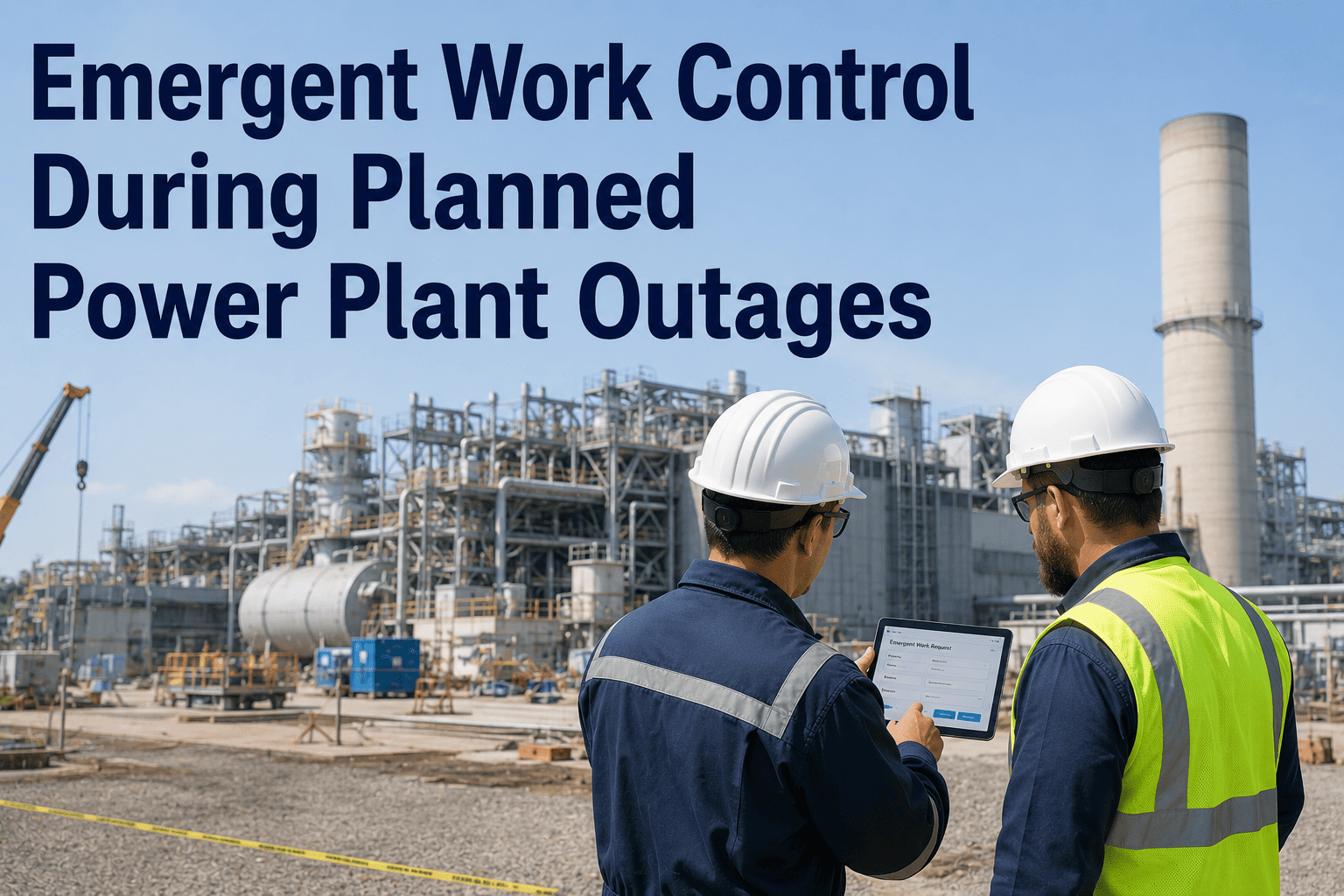
An outage is the one window a power plant gets to do the work it can't touch while generating — and every day of it is a day of lost output. That makes outage planning a balancing act between doing enough work and finishing on time, and it lives or dies on one thing: how well operations and maintenance coordinate. When isolations aren't ready, scope creeps in late, or nobody can see real progress, the outage overruns. This article covers the planning timeline, the operations-maintenance interface, and how to run the whole outage as coordinated work in OXMAINT AI — or book a demo of outage planning in OXMAINT AI.
POWER PLANT OUTAGE PLANNING · OPERATIONS & MAINTENANCE COORDINATION · 2026
Power Plant Outage Planning: Operations & Maintenance Coordination
Late isolations, scope added at the last minute, and no live view of progress are how an outage slips — and each slipped day is lost generation. OXMAINT AI is the AI-powered CMMS that holds the outage scope as scheduled work, ties each job to its permit and isolation, and shows progress in real time — so operations and maintenance work from one plan and the unit returns to service on schedule.
1 · Scope
2 · Plan
3 · Execute
4 · Return
Months
outage planning starts a year or more before the unit comes down
Freeze
a scope freeze before the outage is what stops it ballooning
Ops+Mtce
the coordination between operations and maintenance decides the schedule
RTS
return to service on time is the whole measure of success
The Outage Planning Timeline
A good outage is mostly won before the unit comes down. The planning runs on a countdown — scope first, then schedule, resources and a freeze, long before anyone turns a wrench. Start free and build your outage scope in OXMAINT AI.
T−12 mo+
Scope Development
Build the work list from PM due, known defects, inspections and improvement projects.
T−6 mo
Plan & Schedule
Work packages built, durations estimated, the critical path identified.
T−3 mo
Resources & Procurement
Contractors contracted, labour levelled, parts and long-lead items ordered.
T−30 d
Scope Freeze
The work list is locked — late additions go through a strict change process only.
T−0
Execution
Unit down, isolate, work the plan, test — tracked against the schedule daily.
RTS
Return to Service & Review
De-isolate, restart, and capture lessons learned for the next outage.
Where Operations and Maintenance Meet
The outage schedule is really a relay between two teams. Operations owns the plant's safe state — shutdown, isolation, permits, and return to service. Maintenance owns the work in between. Every handoff between them is a point the outage can gain or lose time. Book a demo of the ops-maintenance handoff in OXMAINT AI.
Operations
Shut down & cool the unit
Isolate & apply LOTO
Issue permits to work
De-isolate & return to service
↓ permit & isolation
↑ hand back
Maintenance
Mobilise crews & stage parts
Accept permit & execute work
Test, punch-list & complete
Hand the equipment back
The two biggest time losses hide in these handoffs — equipment not isolated when the crew arrives, and work “done” that isn't ready to hand back. Both are coordination problems, not labour problems.
The Pillars of a Controlled Outage
Outages that finish on time share the same disciplines. Each pillar controls one of the ways an outage slips.
Scope Control
A defined, frozen work list — everything planned, late additions controlled, nothing “while we're in there”.
Critical Path
The longest chain of dependent work identified, so effort and attention go where delay costs most.
Resource Readiness
Crews, contractors, parts and tools confirmed and staged before the unit comes down.
Permit & Isolation
Isolations and permits planned and ready, so no job waits for the plant to be made safe.
Progress Visibility
Live status against the schedule, so a slip is seen and recovered the same day, not at the end.
Return-to-Service Plan
The restart sequence planned from the start, so the last day isn't a scramble.
Why Outages Overrun
When an outage slips, it's usually one of these — and every one is a planning or coordination gap, not bad luck.
×
Scope Creep
Work added after the freeze that was never planned, resourced or scheduled.
×
Late Isolations
Crews standing idle because the equipment wasn't isolated and permitted in time.
×
Missing Parts
A long-lead item not ordered in time, stopping a job mid-outage.
×
No Progress View
Slips discovered only at the daily meeting or the end, too late to recover.
×
Discovery Work
Hidden defects found once equipment is opened, with no contingency in the plan.
×
Rushed Return
A restart sequence improvised at the end, causing faults and retests.
How OXMAINT AI Runs the Outage
OXMAINT AI is the AI-powered maintenance management software that holds the outage on one platform — the scope as work orders, the schedule and critical path, the permits and isolations, and the live progress. Put your next outage on it when you start free and plan the scope in OXMAINT AI.
Scope as Work Orders
Every outage job a work order, built from PM due, defects and projects, and frozen as the scope.
Schedule & Critical Path
Durations, dependencies and the critical path so the plan is realistic and recoverable.
Permit & LOTO Control
Each job tied to its permit and isolation, so work and the plant's safe state stay in step.
Resource & Parts
Crews, contractors and parts tied to the jobs, so resource gaps show up before the outage.
Live Progress
Real-time status from the field against the schedule, so a slip is caught and recovered the same day.
Outage History
Scope, durations and findings retained, so each outage plans better than the last.
The Outage Is Won on the Plan, Not the Floor.
Scope frozen, resources staged, isolations ready, progress visible — that's what gets the unit back on time. OXMAINT AI keeps operations and maintenance on one plan from scope to return to service, so the outage runs to schedule instead of running long.
EXPERT REVIEW
Written for power-generation operations, maintenance-planning and outage teams. Outage planning and execution sit within the plant's own operating, safety and isolation procedures — shutdown, lockout/tagout, permit to work and return to service are safety-critical activities carried out by qualified, authorised personnel, and the plant's procedures and the relevant codes govern how they're done. The planning horizon, phases and disciplines here are a general framework; the real timeline, scope-change rules and milestones depend on the plant, the unit type and the outage. OXMAINT AI is a maintenance management platform that holds the scope, schedule, permits and progress — it is not a plant control system, an isolation authority, or a substitute for the plant's outage procedures and qualified staff.
Frequently Asked Questions
When should power plant outage planning start?
Well ahead of the outage — major outages are often planned a year or more in advance, because scope has to be developed, work packages built, the critical path worked out, and long-lead parts and contractors secured before the unit comes down. The earlier the scope is set, the more of the outage is won before day one.
Start free and build your outage plan in OXMAINT AI.
What is a scope freeze and why does it matter?
A scope freeze is a cut-off date after which no new work is added to the outage except through a strict change-control process. It matters because every late addition is work that wasn't planned, resourced or scheduled — and uncontrolled scope is the single most common reason outages overrun. The freeze protects the schedule the whole plan is built on.
How do operations and maintenance coordinate during an outage?
Operations controls the plant's safe state — shutting down, isolating, applying LOTO, issuing permits, and returning equipment to service. Maintenance does the work under those permits. The outage runs smoothly only when the handoffs line up: equipment isolated and permitted before the crew arrives, and work truly complete before it's handed back. Those handoffs are where time is won or lost.
What is the critical path in an outage?
It's the longest chain of dependent tasks that determines the outage's minimum duration — if any job on it slips, the whole outage slips. Identifying the critical path tells the team where delay is most expensive and where to focus resources and recovery effort, rather than spreading attention evenly across work that has slack.
How does a CMMS help with outage planning?
It holds the whole outage in one place — the scope as work orders, the schedule and dependencies, the permits and isolations, the resources and parts, and live progress from the field. That shared, real-time view is what keeps operations and maintenance on the same plan and lets a slip be caught and recovered the same day instead of at the end.
Book a demo of outage progress tracking in OXMAINT AI.
Bring the Unit Back On Time, Every Outage.
Run power plant outages on OXMAINT AI: the scope built and frozen as work orders, the schedule and critical path set, permits and isolations tied to every job, resources staged, and live progress from the floor — so operations and maintenance work from one plan and the unit returns to service on schedule.