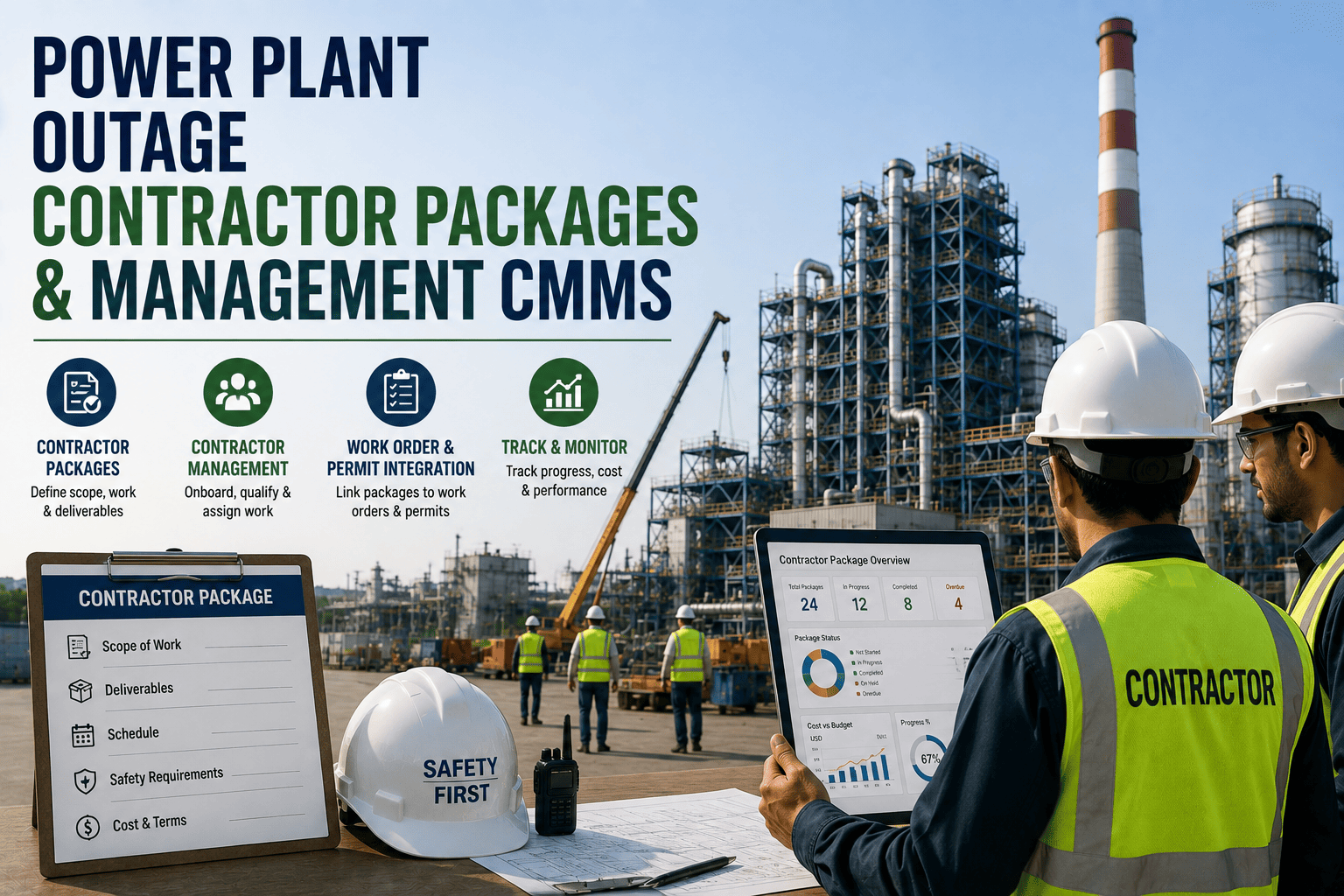
A major power plant outage involves 15 to 40 specialist contractor teams working simultaneously in the same physical space within the same compressed time window — and without a single coordinated platform, that coordination breaks down the moment a handover goes unacknowledged, a permit expires, or a vendor misses a mobilization window. OxMaint's outage contractor management software gives every team — internal planners, OEM specialists, NDT inspectors, and civil crews — a live view of their assignments, permit status, and schedule dependencies, so your outage runs on decisions and data, not on phone calls and spreadsheets.
68% of Power Plant Outages Run Over Schedule — Contractor Mismanagement Is the #1 Root Cause
Late vendor mobilization, missed permit windows, and zero real-time visibility into who is working on what turn planned outages into expensive overruns. OxMaint closes every one of those gaps before the unit shuts down.
Why Contractor Management Breaks Down During Power Plant Outages
Power plant outages compress millions of dollars of coordinated work into days or weeks. Every contractor team — turbine OEM crews, scaffolding suppliers, electrical contractors, NDE inspectors — is dependent on others finishing before they can start. When that dependency chain is managed over email and printed schedules, slippage is not a risk. It is a guarantee. The six failure modes below account for the majority of outage overruns across the sector.
Late Vendor Mobilization
Contractors who receive assignments days before outage start arrive without certified personnel, missing equipment, or incomplete safety documentation. One late mobilization puts the entire critical path at risk.
Permit Bottlenecks
Work permits managed on paper stall contractor starts by hours. On a 10-day outage, four-hour permit delays per crew per day translate directly into schedule slippage that compounds across every shift.
No Real-Time Progress Visibility
Outage managers who rely on morning walkdowns to assess contractor progress cannot respond to slippage in time to protect the critical path. By the time a delay is visible, recovery is already two shifts too late.
Unqualified Contractor Personnel
Without a live qualification register, contractors rotate uncertified individuals to safety-critical tasks. OSHA violations and rework are the direct consequence of missing credential verification at the gate.
Scope Addition Chaos
Work discovered during the active outage requires emergency vendor mobilization and mid-outage schedule reconstruction when not managed through a structured change process built into the coordination platform.
Post-Outage Documentation Gaps
Contractor work orders closed on paper mean the next outage planning cycle starts from scratch. The same scope surprises and vendor onboarding costs repeat every cycle because nothing is captured systematically.
Stop Running Your Outage Contractors on Spreadsheets
OxMaint gives every contractor team live access to their assignments, permits, and schedule dependencies — and gives your outage managers real-time visibility into what is complete, what is at risk, and what needs an immediate decision.
What OxMaint's Contractor Management Module Delivers
OxMaint is built around the reality that power plant outages involve dozens of external teams, thousands of interdependent tasks, and zero tolerance for access conflicts or documentation failures. The platform handles contractor coordination from pre-qualification through final handback — with every action logged, timestamped, and visible to your outage management team in real time.
Every Vendor Sees Only What They Need
External contractors access a role-limited portal showing assigned work packages, scheduled start times, predecessor task status, material readiness, and permit requirements — without seeing any other plant data. Contractors update their own progress; your outage manager sees the complete picture.
Credential Verification Before Work Begins
Contractor certifications, safety training records, and insurance documents are stored against each vendor profile. Expired credentials block task assignment automatically — so uncertified personnel cannot be assigned to safety-critical work without a supervisory override on record.
Work Cannot Start Without an Active Permit
Permits are linked directly to work packages. Contractors cannot mark a task started without an active permit on record. When a permit is revoked, all dependent tasks are flagged automatically — eliminating the single biggest source of safety incidents during active outages.
Discovered Work Integrated in Minutes
When inspection reveals unexpected damage, the new work package is added in OxMaint, assessed for critical path impact, and assigned to the responsible contractor — generating the work order, triggering the permit process, and updating the schedule without leaving the platform.
Contractor Scorecards Built from Every Outage
On-time task completion rate, rework frequency, safety incident count, and documentation compliance are tracked per vendor across every outage. When it is time to award the next contract, you have objective performance data — not just the loudest reference.
No Replacement of Your Current Systems
OxMaint connects to existing plant historians, CMMS platforms, and ERP systems via OPC-UA, Modbus TCP, and REST API. For plants using Primavera or MS Project for scheduling, OxMaint imports the schedule structure and exports live progress updates — no duplicate data entry required.
The Outage Contractor Lifecycle — How OxMaint Manages Every Phase
Effective contractor management does not begin when the unit shuts down. It begins 26 weeks before the outage start date and continues through final documentation closure. The lifecycle below shows exactly where OxMaint eliminates the coordination gaps that cause cost overruns and schedule extensions.
Vendor Pre-Qualification & Scope Assignment
All contractor teams are pre-qualified in OxMaint — certifications verified, insurance confirmed, safety briefings logged. Work scopes are assigned as structured packages with preliminary resource requirements so vendors can begin personnel planning and equipment staging well before mobilization day.
Material Readiness & Access Planning
OxMaint runs automated material readiness checks against every contractor work package — triggering procurement alerts for missing parts up to 10 weeks before the outage start. Access conflict detection identifies where multiple contractor teams need the same physical space or scaffold structure at the same time, flagging scheduling conflicts 24–48 hours before they become on-site disruptions.
Real-Time Coordination & Progress Tracking
Every contractor team updates their task progress through the OxMaint portal — outage managers see completion status, permit states, and critical path exposure in real time without walkovers or phone calls. Scope additions discovered during inspection are processed through OxMaint in minutes, not hours of coordination calls, with immediate critical path impact assessment and contractor assignment.
Documentation & Performance Capture
Every completed work package closes with full documentation — labor hours, parts used, inspection findings, and as-found vs as-left equipment condition. Contractor performance scores are automatically calculated and stored. When the next outage planning cycle begins, every lesson and every vendor scorecard is already in the system.
Contractor Management: OxMaint vs. Spreadsheet vs. Generic Project Tools
Most power plants still coordinate outage contractors through a combination of spreadsheets, standalone project scheduling software, and email — none of which were designed for the permit-to-work requirements, credential tracking, and real-time task visibility that a major plant outage demands.
| Capability | Spreadsheet / Email | Generic Project Tool | OxMaint CMMS |
|---|---|---|---|
| Contractor portal access | Email only | No role-limiting | Secure, role-limited portal |
| Credential verification | Manual check | Not available | Auto-block on expiry |
| Permit-to-work integration | Separate paper system | Disconnected | Linked to work packages |
| Real-time progress visibility | Morning meetings only | Manual updates | Live dashboard |
| Scope addition management | Coordination calls | Manual re-scheduling | Instant critical path update |
| Vendor performance tracking | Not available | Not available | Automatic scorecard per outage |
| Post-outage knowledge capture | Starts from scratch | Partial, manual | Full structured capture |
| Integration with plant CMMS | No | No | OPC-UA, Modbus, REST API |
The ROI of Getting Contractor Management Right
The financial case for structured contractor management in power plant outages is direct and measurable. Every day of outage overrun costs $180,000–$320,000 in replacement power purchases and lost capacity revenue. Every permit bottleneck that stalls a contractor crew for four hours is four hours of paid labor producing zero progress. Every unqualified contractor incident is a regulatory event with fines, rework cost, and schedule extension attached.
Frequently Asked Questions
Your Next Outage Is Already Being Planned — Is Your Contractor Coordination Ready?
The 26-week planning window before a major outage is when contractor coordination failures are preventable. OxMaint structures every step — from vendor pre-qualification through scope management, permit control, real-time progress tracking, and post-outage documentation — so your team arrives at outage day with every contractor confirmed, every credential verified, and every work package ready to execute.