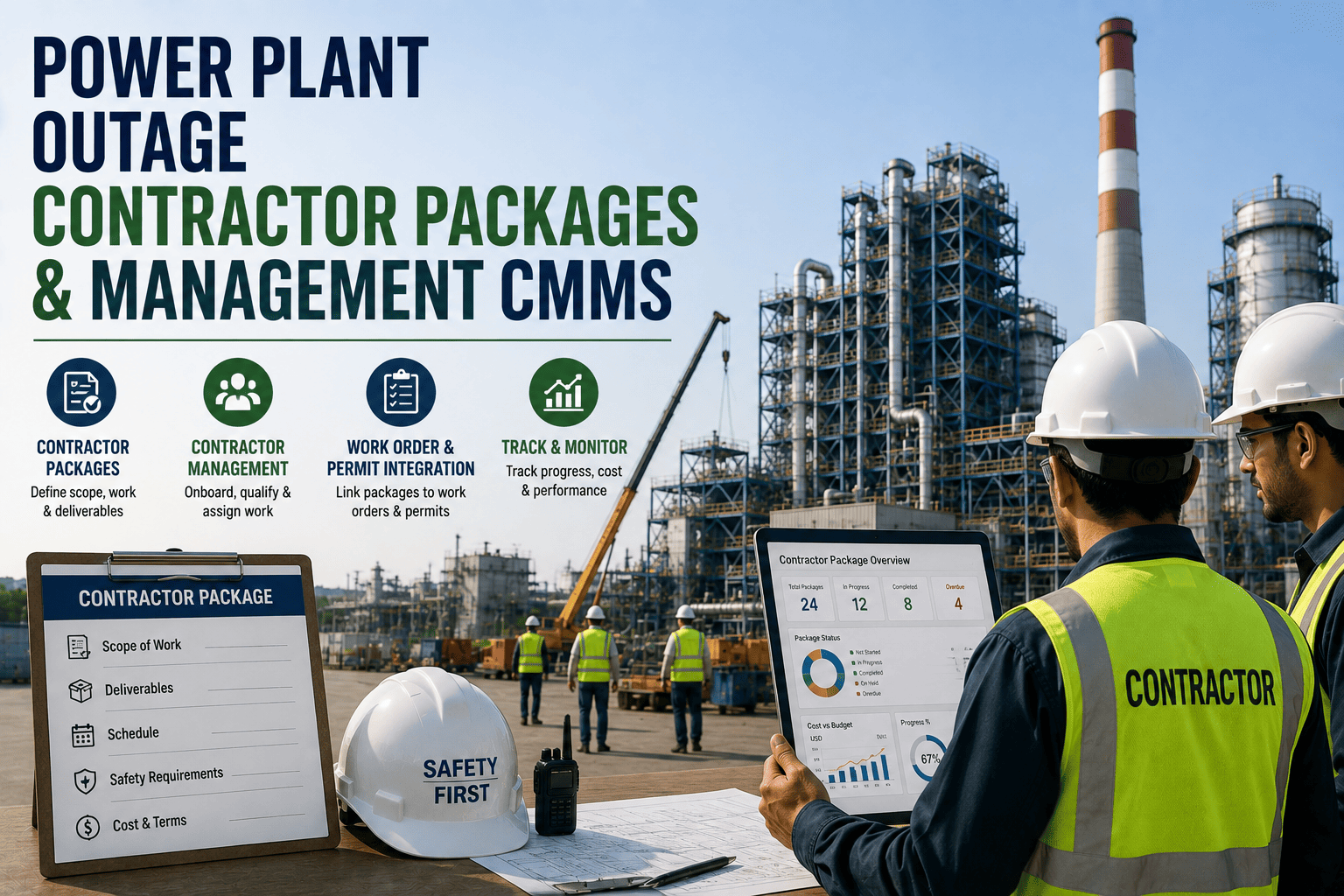
Power plants run on two things: equipment and the people who service it — and when your contractor coordination lives in spreadsheets, email chains, and memory, every unplanned outage costs you 3–5x what a scheduled repair would have. OxMaint's CMMS gives plant managers a single platform to onboard vendors, track certifications, assign work orders to third-party crews, monitor service performance, and stay audit-ready — without juggling five disconnected tools. If your plant manages OEM service contracts, rotating specialist crews, or multi-vendor outage windows, book a 30-minute demo to see exactly how it works for your asset base.
Vendor & Contractor Management in Power Plant CMMS: Streamline Service and Compliance
Most power plants use 15–40 third-party vendors annually. Without a centralized system, contractor coordination becomes your biggest hidden maintenance risk — not the equipment itself.
Why Contractor Coordination Is a Hidden Maintenance Risk
The average power plant interacts with dozens of third-party vendors every year — OEM service teams, rotating machinery specialists, electrical testing contractors, scaffold crews, safety compliance auditors, and more. Each of these relationships carries cost exposure, compliance risk, and schedule dependency. When that coordination is managed through email, phone calls, and disconnected spreadsheets, the gaps are invisible until they become expensive: a contractor arrives without the right certification, a service visit goes undocumented, a warranty claim is rejected because the work records aren't traceable.
5 Core Capabilities of CMMS Vendor & Contractor Management
Contractor Onboarding & Certification Tracking
Every contractor working in a power plant environment must meet minimum safety, insurance, and qualification standards — and those standards expire. A CMMS stores each vendor's certifications, insurance certificates, safety training records, and qualification documents with automated expiry alerts. Work orders cannot be assigned to a contractor whose credentials are lapsed, creating a compliance gate that prevents the most common audit finding in contractor management.
Third-Party Work Order Management
Contractor work orders in a CMMS carry the same structure as in-house work orders — asset location, scope of work, parts consumed, labor hours, safety permits, and completion sign-off — but with a separate approval workflow that routes through your vendor management team before dispatch. This creates a complete, attributable service record for every third-party task performed on your assets, making warranty claims, insurance disputes, and regulatory audits straightforward.
OEM Long-Term Service Agreement (LTSA) Tracking
Gas turbine and steam turbine OEM contracts define specific inspection intervals, scope items, and performance guarantees tied to equivalent fired hours, start counts, and trip events. A power plant CMMS maps LTSA milestones directly to asset runtime counters — automatically generating pre-outage preparation work orders, parts procurement triggers, and contractor scheduling prompts at the right intervals. No missed inspections, no voided warranty claims from interval overruns.
Vendor Performance Scoring
CMMS data captures the metrics that define contractor quality: on-time completion rate, first-time quality rate, rework frequency, cost variance against quoted scope, and safety incident history. Over time, this builds a performance profile for every vendor in your roster — making contract renewal decisions data-driven rather than relationship-driven, and identifying underperformers before they cause a costly outage delay.
Outage Coordination: In-House + Contractor Crews
Major planned outages involve simultaneous work streams across in-house technicians, OEM crews, specialty contractors, and scaffold teams — all with dependencies, hold points, and regulatory inspections. A CMMS with outage planning capability integrates all crew types into a single coordinated schedule with critical-path visibility, resource leveling, and real-time progress tracking. Plants report 25–35% reductions in planned outage duration through better preparation and parallel task sequencing.
Manage Every Vendor Relationship in One Platform
OxMaint tracks contractor certifications, work orders, OEM LTSA milestones, and performance scores — all connected to your asset registry and outage schedule.
Vendor Management vs. CMMS-Integrated Contractor Management
Compliance & Documentation: What Regulators Actually Look For
NERC CIP standards, OSHA 1910.119 (Process Safety Management), and state PUC requirements all include specific documentation requirements for third-party work performed on critical assets. The documentation trail that regulators expect to see includes contractor qualification records, work authorization, scope confirmation, as-found and as-left equipment condition, safety permit issuance and closure, and inspector sign-off for hold points.
Electronic Access Controls
Contractor access to cyber-sensitive areas must be documented with training verification and authorization records auto-captured in the CMMS work order before site entry is permitted.
Contractor Safety Performance
PSM-regulated facilities must evaluate and document contractor safety performance. CMMS incident logging and safety training records satisfy this requirement with no manual reporting overhead.
Certificate of Insurance Tracking
Certificate expiry alerts and work order assignment blocks prevent uninsured contractors from performing work — eliminating the liability exposure from a single unverified service visit.
LTSA Documentation
OEM warranty coverage depends on documented adherence to prescribed inspection intervals and approved procedures. CMMS records provide the timestamped evidence that protects warranty claims.
ROI of Centralized Vendor Management in Power Plant CMMS
| Management Area | Without CMMS | With CMMS | Documented Impact |
|---|---|---|---|
| Emergency contractor spend | Uncontrolled, premium rates | Planned mobilization windows | 30% cost reduction (18 months) |
| Compliance audit prep time | 40–80 hours manual assembly | One-click report generation | 75% time savings |
| Outage duration — planned | Delays from unready contractors | Pre-staged, credentialed crews | 25–35% shorter outages |
| OEM warranty claim success | Gaps in documentation record | Complete timestamped trail | Claims backed by full evidence |
| Contractor quality over time | Subjective renewal decisions | Data-driven performance scores | Underperformers identified early |
Frequently Asked Questions
Yes. OxMaint tracks OEM LTSA scope items and independent contractor work orders on the same platform, with separate approval workflows and performance scoring for each. OEM milestones are triggered by asset runtime counters while third-party work orders follow your standard dispatch workflow. Sign up free to configure your vendor roster and connect it to your asset registry from day one.
OxMaint stores each contractor's certification expiry dates and blocks work order assignment if any required credential is lapsed or missing. Automated alerts notify your vendor management team 30, 14, and 7 days before expiry so renewals are never a last-minute scramble. Book a demo to see the credential gate in action for your compliance framework.
The platform scores vendors on on-time completion rate, rework frequency, cost variance against quoted scope, safety incident history, and response time to emergency callouts. These scores accumulate across every completed work order, giving you an objective performance profile at contract renewal. Start your free trial to begin building your vendor performance database from your first work order.
OxMaint integrates all crew types — technicians, OEM specialists, and independent contractors — into a single outage plan with critical-path scheduling, resource leveling, and real-time completion tracking. Dependency hold points and regulatory inspection gates are embedded in the schedule. Book a demo to see outage coordination configured for a multi-crew power generation environment.
Every contractor work order in OxMaint captures authorization records, training verification, scope confirmation, safety permit issuance and closure, and inspector sign-off — all timestamped and linked to the specific asset. Audit reports are generated with one click, not assembled manually over days. Sign up free to see the compliance documentation workflow built into every work order.
Your Contractors Should Be an Asset, Not a Risk
OxMaint gives power plant managers the tools to onboard vendors properly, assign work with confidence, track performance systematically, and generate compliance documentation without the manual overhead. Every service visit becomes a traceable, auditable record that protects your plant and your warranty coverage.