A turbine bearing fails. A boiler feed pump shuts down. A transformer trips. In each case, the maintenance team is reactive — logging what happened, not preventing what was coming. This is what Reliability-Centered Maintenance (RCM) was built to end. Oxmaint's CMMS embeds RCM methodology directly into your maintenance execution layer — mapping failure modes, scoring asset criticality, and auto-generating consequence-driven work orders so your team stops maintaining by calendar and starts maintaining by risk. Book a 30-minute walkthrough to see RCM-aligned maintenance in action at your plant.
Reliability-Centered Maintenance · Power Plants · CMMS Implementation
Reliability-Centered Maintenance for Power Plants: The Complete RCM Guide
RCM answers a different question than traditional PM. Not "when should we maintain this?" — but "what are we trying to prevent, and what is the most cost-effective way to prevent it?" That shift changes every maintenance decision that follows.
85%
Failure modes are NOT age-related — traditional time-based PM cannot prevent them
15%
Failure modes actually justify time-based PM intervals
25–30%
Maintenance cost reduction achieved with RCM vs. blanket PM schedules
60%+
RCM programs fail to stay relevant after 2 years without CMMS integration
The Foundation
What RCM Actually Is — and What It Is Not
Most maintenance teams confuse RCM with preventive maintenance optimization. They are not the same. RCM is a structured analytical methodology that determines the right type of maintenance for each failure mode — which may be preventive, predictive, condition-based, or deliberately run-to-failure.
RCM Asks
What is this asset supposed to do?
How can it fail to perform that function?
What causes each failure mode?
What happens when each failure occurs?
How bad is each consequence — safety, production, cost?
What can be done to predict or prevent each failure?
What if no proactive task can be found?
Traditional PM Assumes
All assets benefit from scheduled restoration
More frequent PM means more reliable operation
The same interval applies across all assets
Calendar time drives maintenance decisions
PM compliance equals reliability
Failure risk is uniform across asset age
Maintenance cost is a fixed overhead — not a variable you can optimize
Start with Your Critical Assets
Apply RCM Where It Delivers the Most — Not Everywhere at Once
Oxmaint maps failure modes to criticality scores and auto-generates the right maintenance strategy for each asset class. Set up takes one production shift. No consultants required.
The Seven-Question Framework
The RCM Process — Step by Step for Power Plants
RCM follows a structured seven-question logic for each asset system. The output is not a schedule — it is a maintenance strategy matched to the specific failure consequences of each individual asset.
Q1
What are the asset's functions?
Define what the asset is supposed to do in its current operating context — not what it was designed to do generically. A boiler feed pump in a 300 MW coal plant has a very specific functional requirement that must be defined before any failure analysis can begin.
Q2
In what ways can it fail to perform?
Functional failures — states in which the asset cannot fulfill the function defined in Q1. A pump that delivers 60% of required flow is a functional failure, even if the pump itself is still running. This distinction is critical.
Q3
What causes each functional failure?
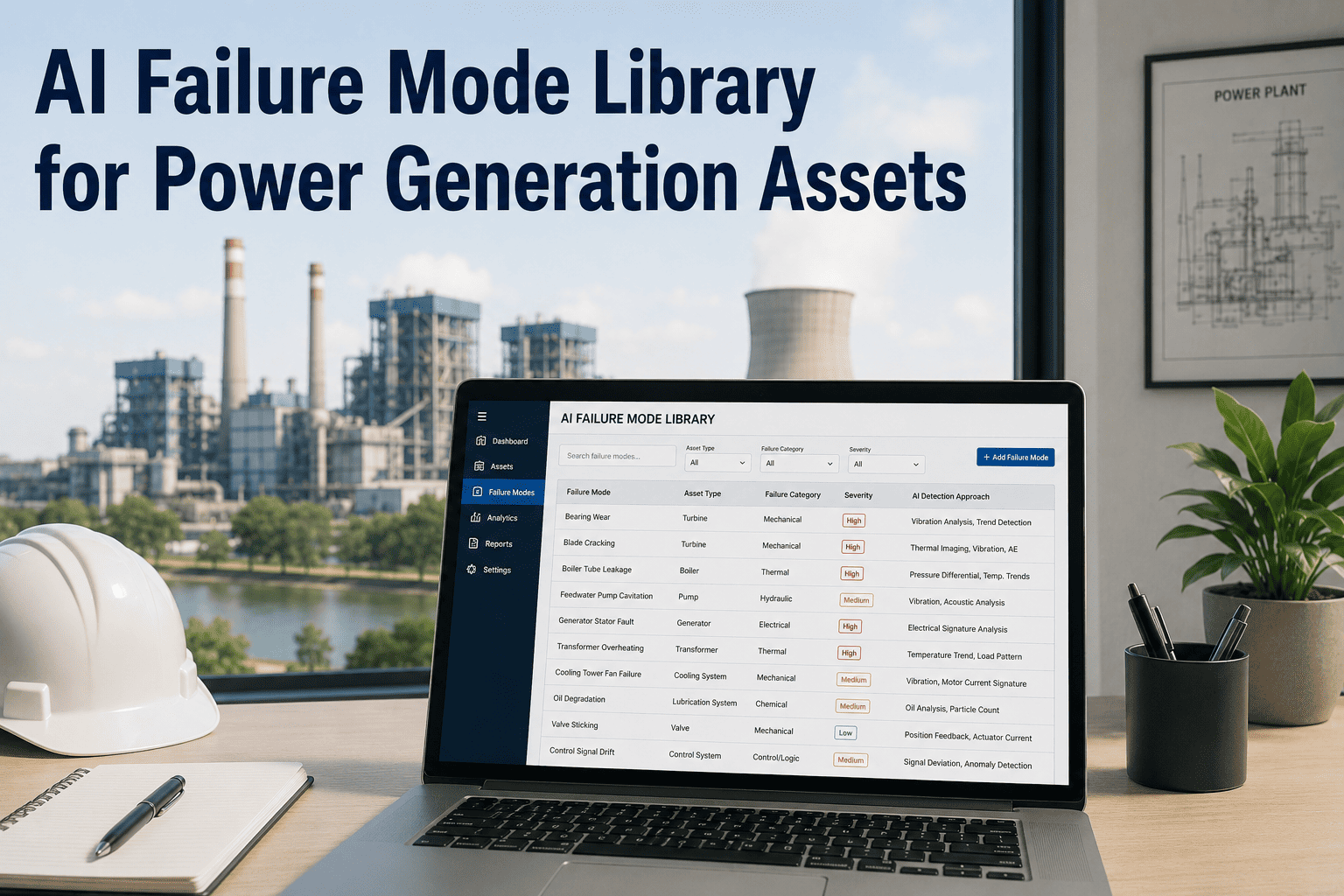
Failure modes — the specific events that cause each functional failure. Bearing wear, seal degradation, impeller erosion, suction strainer blockage. Each mode has a different probability, a different detection method, and a different appropriate task.
Q4
What happens when each failure occurs?
Failure effects — what actually happens during and immediately after the failure mode occurs. Describe the evidence of failure, the impact on production, and any safety or environmental consequences. This detail determines which consequence category applies.
Q5
How does each failure matter?
This is the most consequential output in the entire RCM process. Consequences are classified as: safety/environmental, operational (production loss), non-operational (cost only), or hidden. This classification determines the level of maintenance effort that is economically and technically justifiable.
Q6
What can be done to predict or prevent it?
Task selection — the right maintenance intervention for the specific failure mode and consequence level. Condition-based monitoring, scheduled restoration, scheduled discard, failure-finding inspection, or redesign. Only tasks that are technically feasible and worth doing are selected.
Q7
What if no proactive task can be found?
For hidden or safety-related failures where no condition-based task exists, the default action may be redesign or a defined run-to-failure policy — not a time-based PM that provides no real protection. RCM is honest about what maintenance can and cannot prevent.
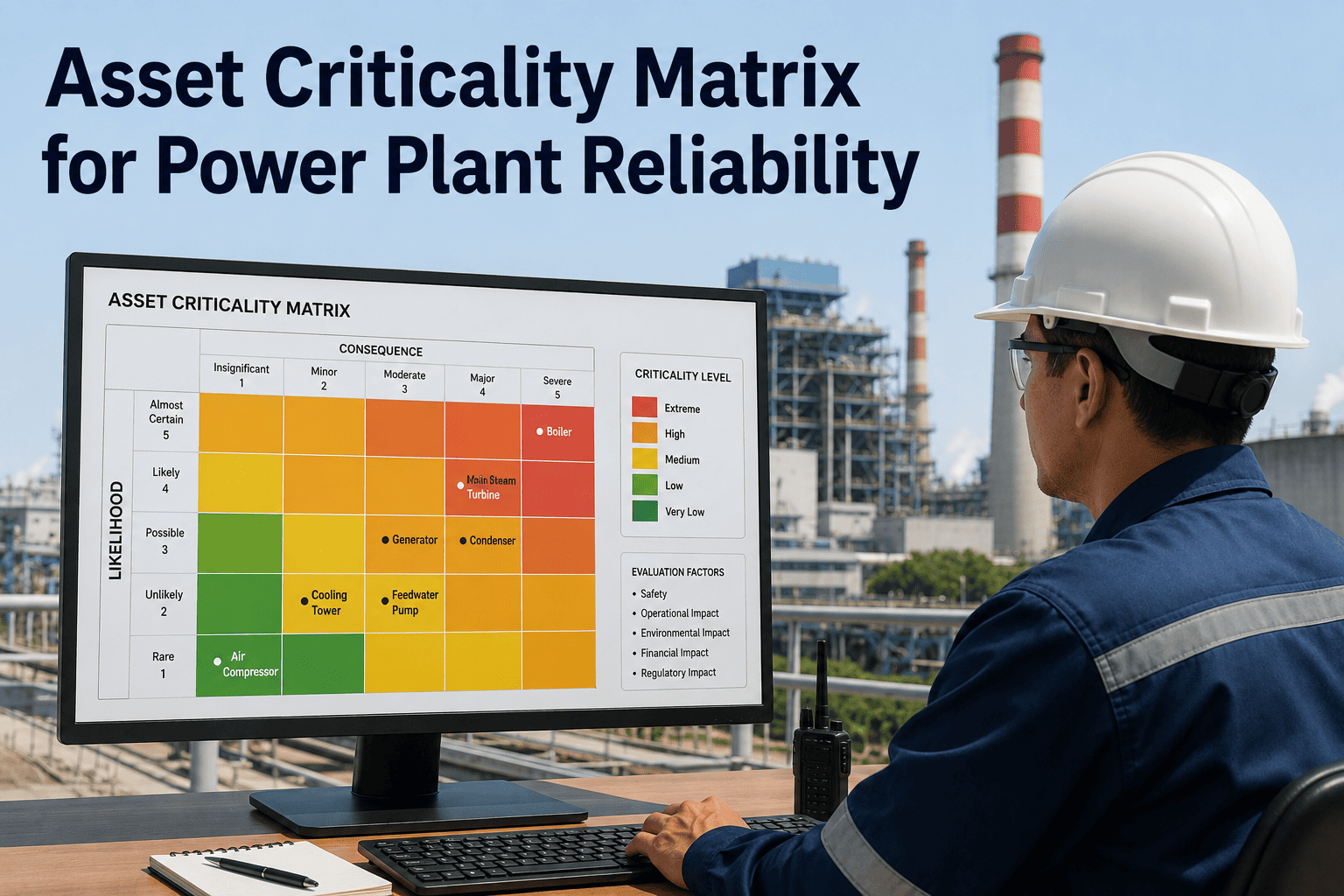
Asset Criticality
How RCM Ranks Power Plant Assets by Consequence Severity
Not every asset in a power plant deserves the same maintenance effort. RCM forces an honest ranking by consequence — so your maintenance budget concentrates on the failures that actually threaten production, safety, or major repair costs.
| Consequence Category |
Power Plant Examples |
Maintenance Strategy |
Oxmaint Trigger |
| Safety / Environmental |
Turbine overspeed protection, pressure relief valves, fuel system isolation |
Failure-finding inspection at defined intervals — regardless of detected condition |
Fixed interval work order — safety override |
| Operational — High Impact |
Main turbine bearings, boiler feed pump, condenser cooling water system |
Condition-based monitoring — vibration, temperature, pressure trending — with predictive work orders |
Sensor threshold + trend trigger |
| Operational — Moderate Impact |
Auxiliary cooling pumps, fuel handling conveyors, instrumentation loops |
Scheduled restoration at manufacturer or RCM-defined intervals with condition check |
Runtime-hour or calendar PM |
| Non-Operational — Cost Only |
Lighting circuits, non-critical instrumentation, minor ventilation fans |
Run-to-failure with corrective maintenance — no PM is economically justified |
Corrective work order on demand |
| Hidden Failure |
Backup protection relays, emergency diesel generators, standby pumps |
Failure-finding task at defined interval — the asset must be tested to confirm it will function when needed |
Functional test work order — fixed interval |
From Analysis to Execution
Why RCM Without CMMS Integration Fails — Every Time
Over 60% of RCM programs fail to maintain relevance after two years — not because the analysis was wrong, but because the outputs were never connected to the maintenance execution system technicians actually use.
The Gap
RCM as a Shelf Document
A 200-page RCM study that produces a failure mode library and task list — stored in a SharePoint folder. Technicians never see it. Work orders are still generated by the old calendar-based system. The analysis becomes irrelevant within 18 months as conditions change and the document is never updated.
The Solution
RCM Embedded in Oxmaint
Failure mode libraries loaded directly into asset records. Consequence scores drive PM strategy selection. Work orders generated automatically at RCM-defined intervals. Technician findings feed back into failure history, keeping the analysis live and improving it over time — not archiving it.
The Feedback Loop
RCM That Improves Over Time
When technicians close work orders in Oxmaint, their findings — measured vibration, parts replaced, actual condition observed — feed back into the asset history. RCM logic refines over every cycle. Which inspections consistently find nothing? Which failure modes are occurring earlier than predicted? The CMMS answers both.
Common Questions
RCM for Power Plants — Frequently Asked Questions
How is RCM different from a standard preventive maintenance program?
Traditional PM assumes all assets benefit from scheduled restoration on a calendar basis. RCM proves that only 15% of failure modes are age-related and actually respond to time-based PM. The remaining 85% require condition-based, predictive, or run-to-failure strategies. RCM stops applying expensive PM where it cannot prevent failure.
See how Oxmaint maps failure modes to strategies automatically.
Where should a power plant start its RCM implementation?
Start with the 20% of assets that represent 80% of your unplanned downtime cost — main turbines, boiler feed pumps, transformers, and protection systems. Apply full RCM analysis to these first, prove ROI, then expand. Attempting to analyze every asset simultaneously is the most common implementation failure.
Our team helps you identify your highest-impact assets in a 30-minute call.
How does a CMMS support ongoing RCM execution?
The CMMS is where RCM moves from analysis to action. It schedules consequence-driven work orders, captures technician findings, and builds the failure history that keeps the RCM analysis accurate and current. Without CMMS integration, RCM outputs become static documents disconnected from daily maintenance operations.
Start your free Oxmaint trial to see RCM-aligned work order execution.
What is a hidden failure and why does RCM treat it differently?
A hidden failure is one that is not evident to the operating crew during normal operation — backup protection relays, emergency generators, and standby systems. These require failure-finding inspections at defined intervals to confirm they will perform when needed. RCM is the only methodology that formally recognizes and systematically addresses this failure category.
Oxmaint tracks functional test compliance per asset with dedicated work order templates.
How long does it take to implement RCM in a power plant?
A full plant-wide RCM study can take 6–18 months depending on plant size and scope. However, a focused RCM implementation targeting the top 10–15 critical assets can produce measurable results in 30–60 days when analysis outputs are loaded directly into an integrated CMMS. Start targeted, expand as ROI is demonstrated.
Book a demo to see how Oxmaint compresses RCM implementation time.
RCM Analysis Meets CMMS Execution
Stop Maintaining by Calendar. Start Maintaining by Consequence.
Every missed failure mode analysis, every PM applied to an asset that cannot benefit from it, and every RCM study that ends as a shelf document is money spent on maintenance that cannot improve reliability. Oxmaint connects your RCM analysis directly to work order execution — so failure mode insights become daily maintenance actions, not archived documents.