When a gas turbine compressor starts shedding blades, the technician dispatched to diagnose it is only as fast as the knowledge they carry to the asset. If the failure mode library lives in a veteran engineer's memory, a vendor manual from 2008, or a lessons-learned document buried in a shared drive, the diagnosis takes hours — and the repair decision takes longer. A structured, searchable failure mode library changes this equation entirely: the right failure context reaches the right technician before they arrive, and every new finding makes the library smarter. OXmaint's AI-powered failure mode library does exactly this for power generation assets — turbines, boilers, generators, transformers, and pumps — building an institutional knowledge base that accelerates diagnosis, improves PM planning, and survives workforce turnover. If your reliability team is still relying on tribal knowledge to diagnose failures, start building your failure mode library on OXmaint today.
35%
Faster fault diagnosis when technicians access a structured failure mode library before reaching the asset
60%
Of forced outages have a documented precursor failure mode that was either missed or not acted on in time
4x
Improvement in first-time fix rate when repair decisions are informed by asset-specific failure mode history
12 min
Average time for an AI-assisted failure mode search to return the correct diagnosis path for a known fault pattern
Why This Problem Persists
Institutional Knowledge Walks Out When Engineers Retire
The power generation industry is facing a wave of experienced engineer retirements. When a 25-year turbine specialist leaves, they take with them thousands of hours of failure pattern recognition that no onboarding document replaces. New technicians encounter the same failure modes their predecessors solved years ago — and solve them again slowly, at full outage cost, without the institutional context that would have cut the diagnosis time in half.
A structured failure mode library in OXmaint captures that knowledge in a form that survives turnover. Every diagnosed failure, every effective repair, every anomaly that predicted a future event — all indexed against the specific asset and available to every technician who touches it next.
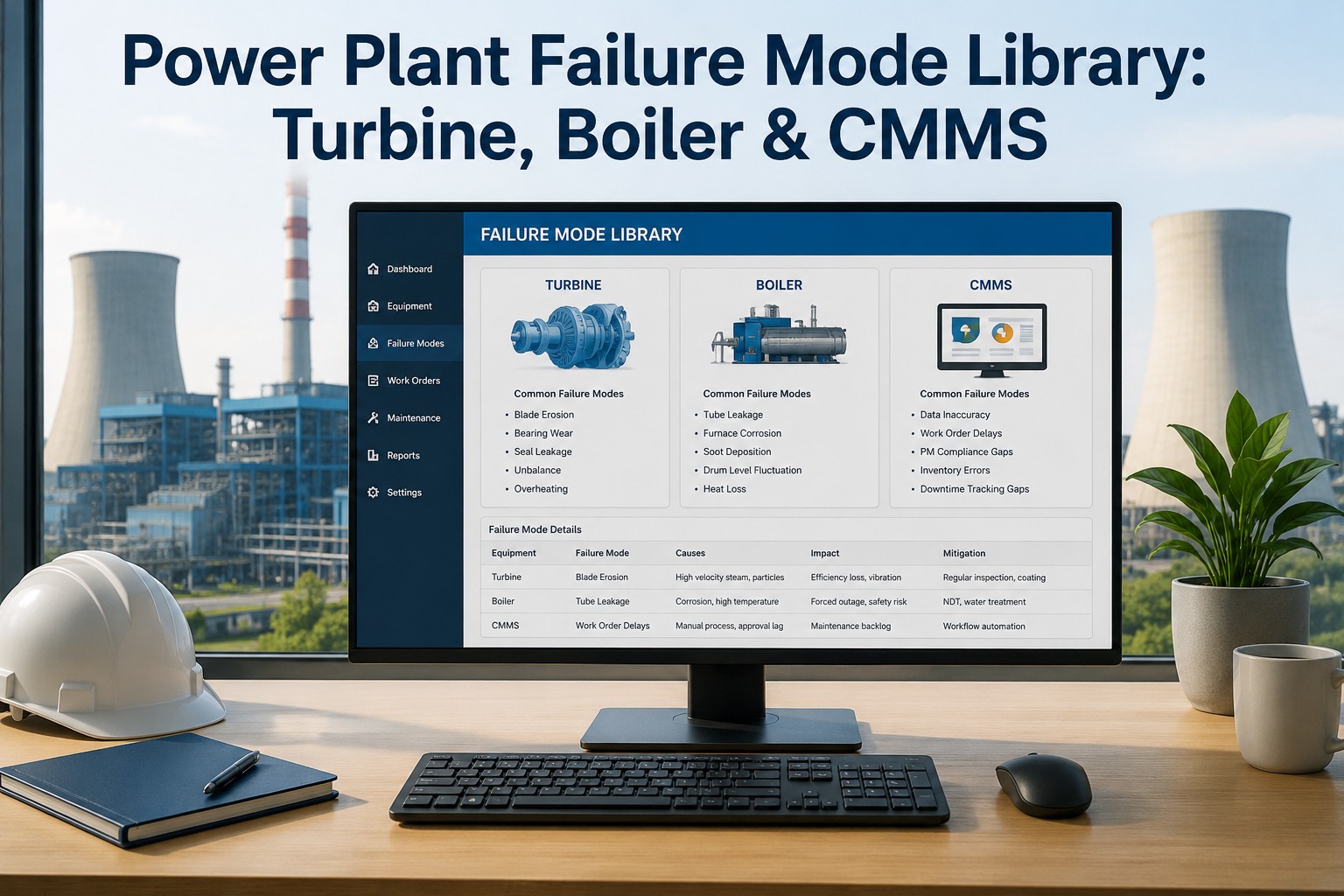
Failure Modes by Asset Class
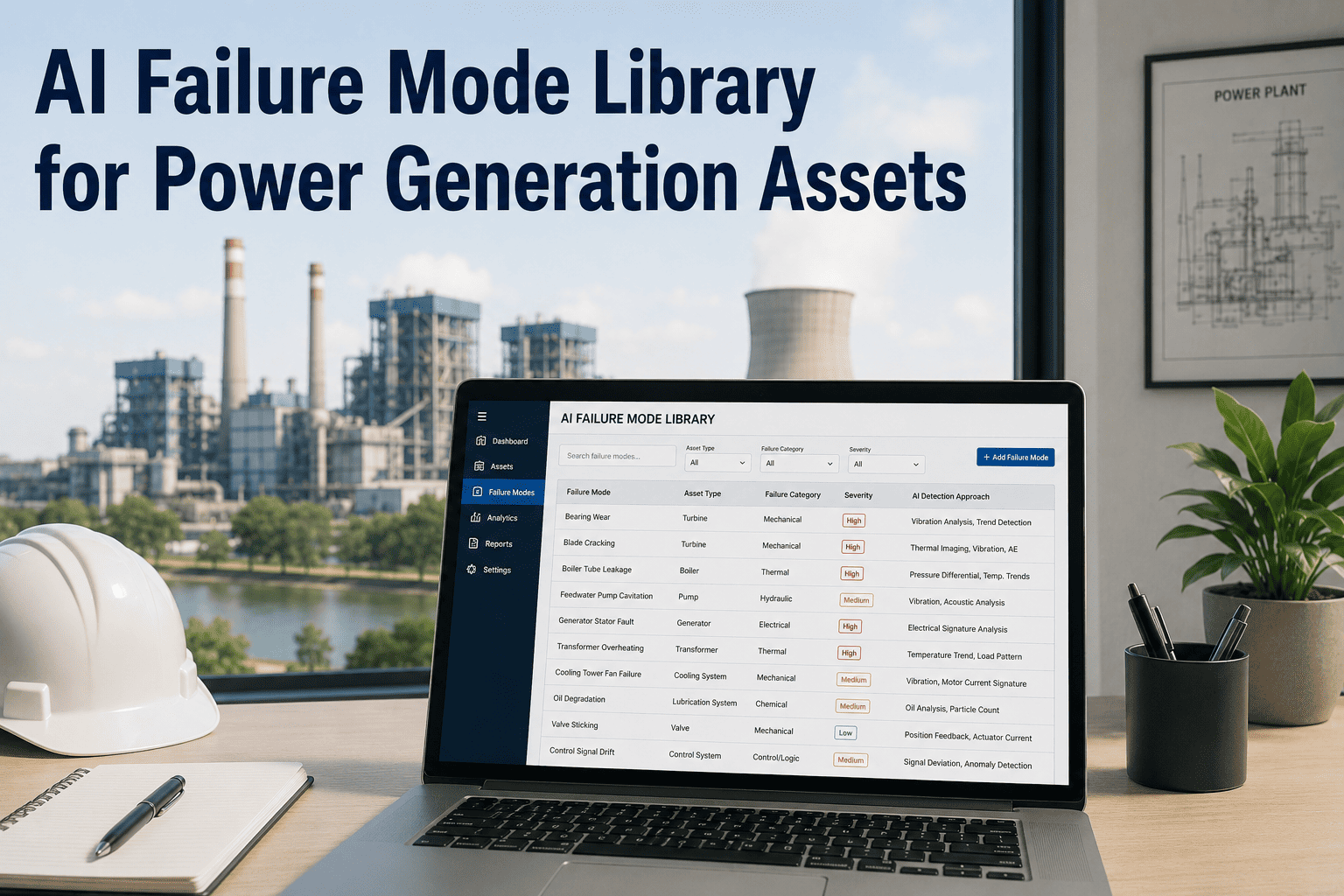
OXmaint's library covers the critical failure modes for every major power generation asset type — with AI-assisted search to surface the right mode from sensor readings, symptoms, or operating conditions.
Compressor Blade Erosion
Vibration increase, efficiency drop, axial thrust change
High
Hot Section Oxidation
Exhaust temperature spread, efficiency loss, borescope findings
High
Bearing Degradation
Vibration frequency, oil temperature, metal particle count
Medium
Combustor Liner Cracking
CO emissions spike, combustion dynamics, borescope
High
Seal Degradation
Lube oil consumption, shaft vibration, hydrogen purity drop
Medium
Tube Overheating
Steam temperature rise, tube wall thinning, flue gas deviation
Critical
Waterside Corrosion
pH deviation, feedwater iron, tube pitting on inspection
High
Fireside Erosion
Ash flow patterns, tube wall UT readings, sootblower coverage
Medium
Refractory Failure
Casing hotspot, flue gas bypass, thermal camera reading
High
Drum Level Instability
Level oscillation, carryover indicators, steam purity
Medium
Build Your Plant's Failure Mode Library
OXmaint's AI-assisted library indexes every diagnosed failure against the asset — so the next technician who sees the same symptoms gets the diagnosis path in seconds, not hours.
How AI Accelerates Failure Mode Identification
01
Symptom-to-Mode Search
A technician enters observed symptoms — elevated bearing temperature, increased vibration at 2x running speed, slight lube oil discoloration — and OXmaint's AI searches the library for matching failure modes on that specific asset class. Ranked results include probability, supporting evidence, and recommended next diagnostic steps.
02
Sensor Pattern Matching
When condition monitoring data crosses threshold or shows a pattern deviation, OXmaint matches the sensor signature against failure mode patterns in the library — flagging the most likely failure modes and pre-populating the work order with the relevant diagnostic procedure. No manual cross-referencing required.
03
Library Self-Improvement
Every closed work order with a confirmed failure mode adds a new data point to the library. Repair outcomes, diagnostic steps that ruled modes out, and time-to-confirmation all feed back into the library — making the failure mode suggestions more accurate with each additional diagnosed event at your plant.
04
PM Recommendation Engine
Failure mode history informs PM task generation. If bearing degradation has appeared three times in 18 months on a specific turbine, OXmaint's AI flags the PM interval as insufficient and recommends a revised schedule — before the fourth bearing event becomes a forced outage.
What a Structured Failure Mode Library Delivers
35–50%
Faster troubleshooting documented when robot and sensor pre-diagnosis delivers failure mode context to technicians before asset access
Industry deployment benchmarks, 2024
28%
Reduction in repeat failures within 12 months for assets with structured failure mode documentation and PM adjustment cycles
Reliability engineering studies, 2023
4x
Faster onboarding for new reliability engineers when institutional failure mode knowledge is searchable rather than person-dependent
Plant operations benchmark, 2024
Frequently Asked Questions
Does OXmaint come with a pre-built failure mode library or does the team have to build it from scratch?
OXmaint includes a seed library of common failure modes for turbines, boilers, generators, transformers, and pumps — structured around industry-standard FMEA frameworks. Your team enriches it over time with plant-specific findings, repair history, and sensor patterns. You get immediate value on day one and compounding value as your asset history builds.
Sign up free to see the base library.
Can we import existing FMEA documents or maintenance history into OXmaint?
Yes. OXmaint supports import of structured maintenance history, existing FMEA documents, and work order exports from common CMMS platforms. Your team's accumulated knowledge doesn't have to be rebuilt from zero — it gets structured into the library format and made searchable.
Book a demo to review the import process for your current data format.
How does the AI differentiate between similar failure modes with overlapping symptoms?
OXmaint's failure mode search ranks results by probability based on the combination of symptoms entered, not just individual matches. When two modes share overlapping signals, the system surfaces both with their distinguishing diagnostic steps — guiding the technician to the confirming test that differentiates them, rather than presenting a single answer that may be wrong.
Does the library connect to PM scheduling and work order generation?
Directly. Failure modes in the library link to their associated preventive maintenance tasks in OXmaint. When a failure mode is confirmed through a work order, the system checks the current PM schedule for that mode and flags any interval mismatches — automatically recommending PM updates before the next occurrence. The library and the PM schedule are the same system, not two separate tools.
Is the failure mode library accessible to field technicians on mobile devices?
Yes. OXmaint is fully mobile-accessible. A technician at the asset can search the failure mode library, pull up the relevant diagnostic steps, update the work order with their findings, and confirm or rule out failure modes — all from a phone or tablet without returning to a desktop. The library is most valuable when it's in the technician's hands at the point of failure.
AI-Powered Reliability
Stop Diagnosing the Same Failures Twice
OXmaint's AI failure mode library captures every diagnosed failure, makes it searchable, and delivers the right repair context to every technician — before they arrive at the asset.