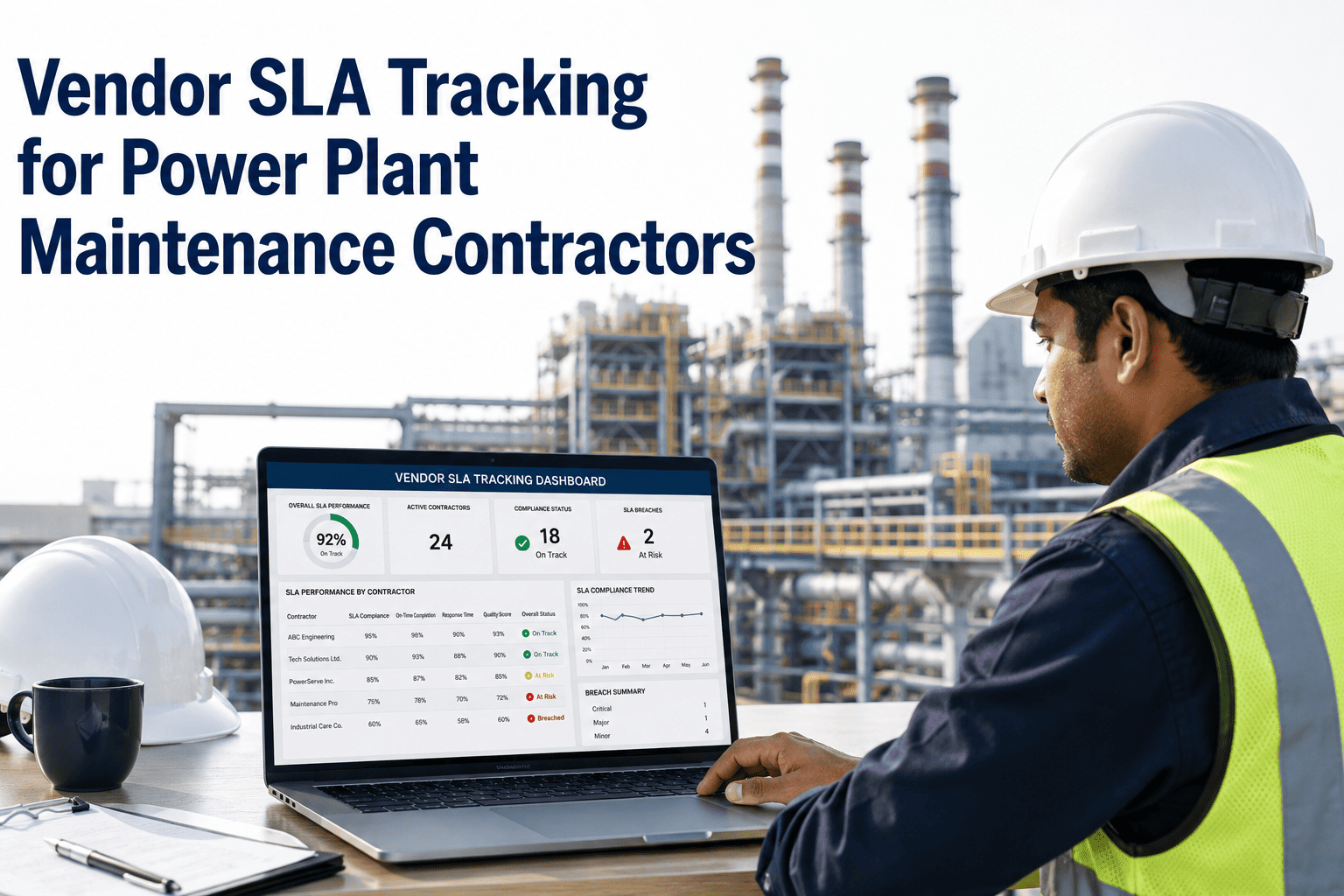
When a high-pressure turbine seal fails at 2 AM and the contracted OEM service team arrives six hours after their SLA response commitment, most plants know they have a problem — but very few can prove it contractually. Vendor and contractor management at power plants routinely falls into a blind spot: internal maintenance is tracked in the CMMS, but outsourced critical repairs live in email threads, purchase orders, and informal conversations. That blind spot is expensive. Plants that cannot measure vendor response time, first-time fix rate, and parts delay frequency have no negotiating position at contract renewal and no basis to challenge invoices when work required a second visit. The same gap creates regulatory exposure when an OEM service record cannot be produced during a compliance review. Structured vendor SLA tracking — covering response time commitments, repair quality outcomes, warranty claims, and parts lead times — is what transforms a contractor relationship from unaccountable to measurable. Start your OxMaint free trial and bring every vendor SLA, contractor work order, and repair record into one system today.
Vendor Management · SLA Tracking · Contractor Performance · Power Plant CMMS
Power Plant Vendor SLA Tracking for Critical Repairs
Response time commitments, repair quality scores, warranty tracking, parts delay visibility, and contractor performance data — all in one system your operations team can use to hold every vendor accountable.
Vendor Performance Scorecard — Q2
Turbine OEM A
96%
92%
A
Pump Contractor B
78%
88%
B+
Electrical Vendor C
61%
74%
C
Controls Specialist D
94%
96%
A+
The Accountability Gap
Five Critical Repair Scenarios Where Untracked Vendor SLAs Become Plant Liabilities
01
Emergency Response Commitments Not Met
Your turbine OEM contract specifies 4-hour emergency response. The actual arrival time averages 7 hours. Without a time-stamped work order that records both the call time and the site arrival time, that SLA breach is invisible — and the same vendor gets renewed at the same rate.
02
Recall Jobs Billed as New Work Orders
A pump repaired in March fails again in June. Without a link between the original repair work order and the return visit, the second job bills as a new repair. Plants that cannot identify recall jobs cannot enforce warranty terms or demand credits for failures within the defect liability period.
03
Parts Delays Not Documented
Extended outages caused by vendor parts lead times that exceed contracted delivery windows cannot be disputed without date-stamped records. Most plants absorb production losses that are legally recoverable under parts supply SLA terms — because they cannot prove the delay duration against the contracted commitment.
04
Contractor Credential Expiry Untracked
A contractor whose safety certification lapsed three months ago continues working on high-voltage equipment because no system flagged the expiry. When an incident occurs, that credential gap creates direct liability for the plant — and the contractor's insurance may not cover it.
05
No Data for Contract Renewal Negotiations
Contract renewal arrives and the plant has no objective performance data — just memory of the last few jobs and the loudest complaints. Vendors with poor SLA compliance get renewed because the data to justify a change has never been collected. Good vendors lose leverage because their performance cannot be quantified to justify rate increases.
KPIs That Matter
Six Vendor Performance Metrics Every Power Plant Should Track Automatically
Response Time Compliance
Percentage of emergency work orders where vendor arrived on site within the contracted response window. Target varies by priority tier: emergency 4 hours, urgent 8 hours, routine 48 hours.
Industry benchmark: 90%+ for tier-1 critical equipment vendors
First-Time Fix Rate
Percentage of repair jobs closed without a return visit within 30 days for the same fault. Below 85% indicates systemic diagnostic quality issues or parts stocking problems that require contract discussion.
Industry benchmark: 85–92% depending on equipment type
Parts Lead Time vs. Committed
Average actual parts delivery time measured against the delivery window specified in the supply agreement. Tracks both emergency consignment stock availability and standard procurement lead times per part category.
Flag any vendor averaging 20%+ over committed lead time
On-Time Completion Rate
Percentage of work orders completed within the estimated duration communicated at job start. Systematic overruns inflate maintenance windows and reduce unit availability beyond what CMMS-based availability tracking would predict.
Target: 80%+ completion within 110% of estimated duration
Cost per Repair vs. Baseline
Actual invoice value per repair work order benchmarked against the contracted rate for that equipment category. Identifies systematic over-billing patterns that are invisible when invoices are reviewed individually rather than against a data set.
Review any vendor with 15%+ variance above contract rate
Warranty Claim Rate
Percentage of completed repairs where the equipment failed again within the warranty period and a warranty claim was opened. High warranty claim rates reveal workmanship quality issues that free of charge but add significant planning and downtime overhead.
Target: fewer than 5% of completed repairs return under warranty
OxMaint · Vendor Management · SLA Tracking · Contractor Performance
Turn Every Vendor Relationship from Gut Feel to Scorecard Data
OxMaint tracks response time, fix rate, parts delays, and warranty claims per vendor automatically — from the same work orders your maintenance team already closes. No separate tool. No manual data entry.
Response Time Tiers
Standard SLA Response Time Framework for Critical Power Plant Equipment
Use this framework as the baseline for your vendor contracts. OxMaint records call time, site arrival time, and work start time for every contractor job — automatically calculating compliance against whichever tier applies.
| Priority Tier |
Equipment Examples |
Response Target |
Completion Target |
| Critical — P1 |
Main turbine bearing, high-pressure boiler tube, generator exciter failure, main transformer |
2–4 hours on site |
Within 24 hours or continued escalation |
| Urgent — P2 |
Boiler feed pump, condensate pump, fuel supply equipment, cooling water system |
4–8 hours on site |
Within 72 hours |
| Routine — P3 |
Balance-of-plant HVAC, non-critical instrumentation, general electrical, lubrication systems |
Next business day |
Within 5–10 business days |
| Planned — P4 |
Outage-only work, capital refurbishments, scheduled OEM inspections, warranty service |
Scheduled window |
Per outage scope plan |
Frequently Asked Questions
Power Plant Vendor SLA Tracking — Common Questions
What metrics should be in a power plant vendor SLA for critical equipment repairs?
At minimum, the SLA should specify on-site response time by priority tier, first-time fix rate target, parts availability commitments for consignment stock, and warranty period with defect liability terms. Adding an annual performance review clause tied to scorecard data gives the plant contractual leverage at renewal — and motivates compliance year-round.
Track all four metrics automatically in OxMaint — free trial.
How does OxMaint calculate vendor SLA compliance from work order data?
OxMaint records the work order creation time, vendor notification time, on-site arrival time, and completion time. It compares each against the SLA targets configured for that vendor and equipment category, then aggregates compliance percentages into the vendor scorecard automatically. No manual calculation or separate tracking system is needed.
See the vendor scorecard live in a 30-minute demo.
Can OxMaint track contractor certification and credential expiry for compliance purposes?
Yes. OxMaint stores certification documents against each contractor record and sends alerts before expiry dates, with configurable lead times. Any work order assignment to a contractor with an expired certification triggers an automatic flag before the work starts — preventing the scenario where unqualified personnel are on site without anyone realizing the credential gap.
How do plants use OxMaint vendor performance data during contract renewal negotiations?
OxMaint generates a vendor performance export covering the full contract period — response time compliance, fix rate, recall frequency, cost per repair, and parts delay history — in a format suitable for a supplier review meeting. Plants using this data in negotiations consistently report stronger rate outcomes and improved contractual SLA terms compared to renewals based on informal feedback.
Start free and build your first vendor scorecard today.
What is considered an acceptable first-time fix rate for a turbine OEM contractor?
For turbine and rotating equipment OEM contractors working on critical assets, a first-time fix rate below 85% within a 30-day return window is typically considered a performance concern. Rates consistently below 80% should trigger a formal review, as they indicate either diagnosis quality problems or inadequate parts availability on the service truck — both of which are addressable through contract terms and vendor management.
OxMaint · Vendor SLA · Contractor Performance · Critical Repairs · Free to Start
Every Vendor Should Earn Their Contract. OxMaint Gives You the Data to Prove It.
Automated SLA tracking. Real-time scorecards. Credential expiry alerts. Warranty claim logs. Everything you need to hold every contractor accountable — and have the numbers to prove it when renewal time comes.