Predictive Maintenance for Power Plant Robots Using AI, IoT & Vibration Analysis
By shreen on February 20, 2026
Power plants lose an estimated $50 billion annually to unplanned equipment failures — yet most facilities still rely on calendar-based maintenance schedules that ignore real-time asset health. When AI-driven vibration analysis, IoT sensor networks, and autonomous robots converge inside a single CMMS platform, maintenance teams shift from reactive firefighting to precision-timed interventions that prevent turbine trips, boiler tube leaks, and generator bearing failures weeks before they occur. Schedule a free demo to see how Oxmaint connects robotic inspection data with predictive AI for your power generation assets.
73%
Of power plant failures are detectable weeks in advance with vibration and thermal AI
$2.4M
Average annual savings per plant from AI-driven predictive maintenance programs
45%
Reduction in unplanned downtime after deploying IoT vibration monitoring
5x
Faster fault diagnosis when AI correlates vibration, thermal, and acoustic data
Why Calendar-Based Maintenance Fails Power Plants in 2026
Traditional time-based maintenance schedules force technicians to inspect and service equipment on fixed intervals regardless of actual condition. A turbine bearing running perfectly gets the same attention as one showing early-stage spalling — wasting labor hours on healthy assets while degrading components slip through the cracks between scheduled checks. The result is simultaneous over-maintenance of stable equipment and under-maintenance of failing equipment.
IoT vibration sensors and AI analytics eliminate this guesswork. Continuous monitoring captures real-time spectral signatures from every critical rotating asset, while machine learning models trained on historical failure patterns flag anomalies the moment degradation begins. When this data flows into Oxmaint CMMS, work orders generate automatically — timed precisely to the window between early detection and functional failure.
Common Failure Modes Missed by Scheduled Maintenance
Bearing inner race defects — develop between quarterly inspections, cause catastrophic turbine trips
Cooling fan imbalance — slow degradation crosses critical threshold between semi-annual overhauls
Key Insight
Plants using AI-powered vibration analysis detect 73% of mechanical failures 2-6 weeks before breakdown — compared to only 18% detection rate with periodic manual rounds. Continuous IoT monitoring paired with machine learning transforms raw vibration spectra into severity scores, remaining useful life estimates, and auto-prioritized CMMS work orders.
Core Predictive Maintenance Technologies for Power Plant Robots
VIB — Vibration Analysis
Tri-Axial Spectral Vibration Monitoring
Continuous tri-axial accelerometers mounted on turbines, generators, pumps, and fans capture velocity and acceleration spectra from 0.5Hz to 20kHz. AI models trained on ISO 10816 severity thresholds classify imbalance, misalignment, looseness, bearing defects, and gear mesh faults in real time — feeding severity scores directly into Oxmaint work order queues.
What It Detects
+ Bearing inner/outer race spalling 3-6 weeks before failure
+ Shaft misalignment from thermal growth or foundation settling
+ Rotating imbalance from blade erosion or fouling deposits
+ Gear mesh degradation in gearbox-coupled generators
THR — Thermal Imaging AI
Radiometric Infrared with Anomaly Detection
Robot-mounted FLIR cameras capture 640x512 radiometric thermal frames across electrical panels, bearings, steam systems, and cooling equipment. On-board AI compares each frame against baseline thermal signatures, flagging hotspots that exceed delta-T thresholds. Thermal trends sync with Oxmaint asset histories for long-term degradation tracking.
What It Detects
+ Overheating electrical connections and loose bus bar joints
+ Bearing lubrication failure via temperature rise patterns
+ Steam trap failures and insulation degradation
+ Cooling system blockages reducing heat exchanger efficiency
IOT — IoT Sensor Networks
Wireless Mesh Monitoring with Edge Computing
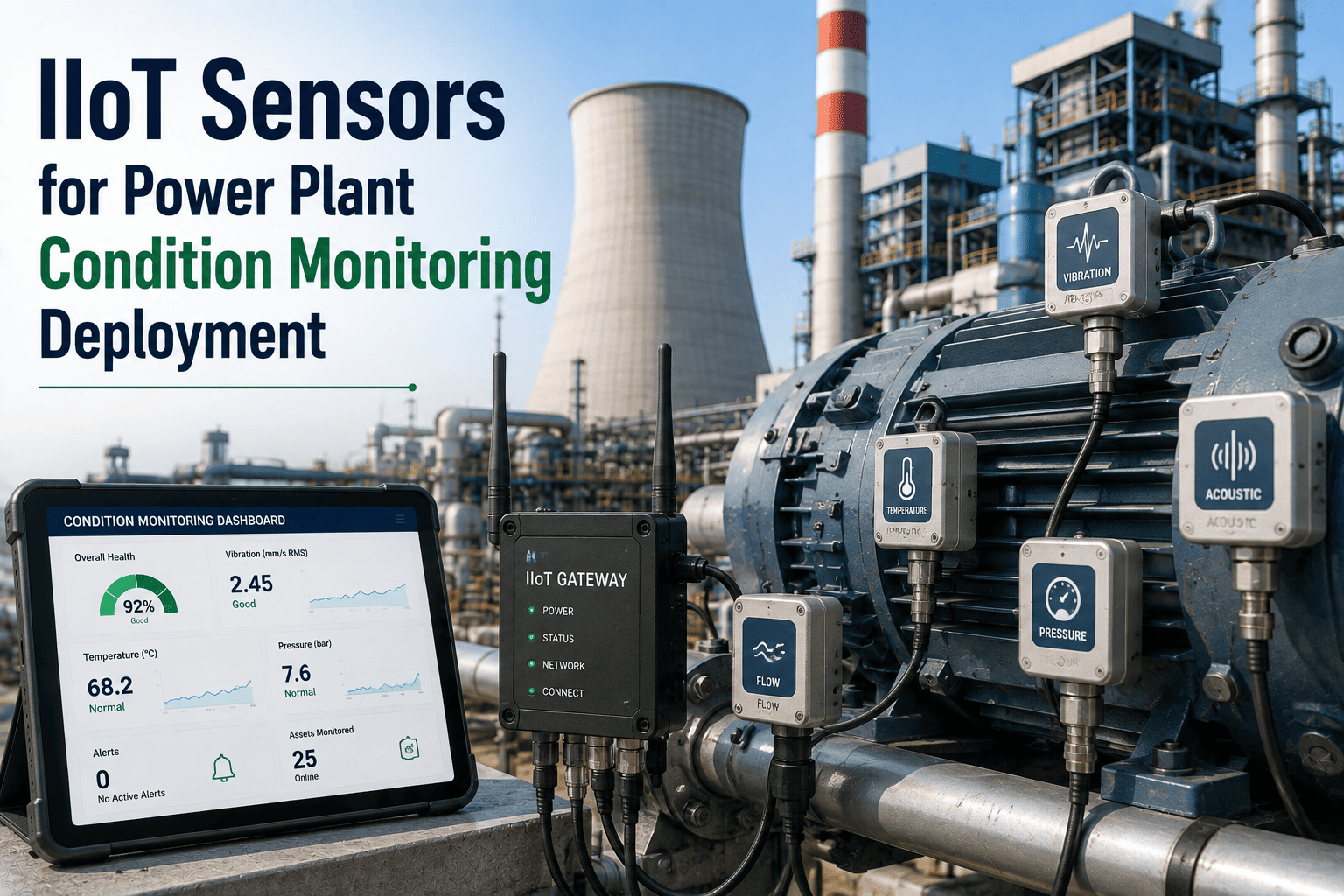
Hundreds of battery-powered IoT nodes measure vibration, temperature, pressure, and humidity across turbines, boilers, condensers, and balance-of-plant equipment. Edge gateways pre-process raw signals locally, streaming compressed feature vectors to cloud AI models that score asset health every 60 seconds — with anomaly alerts pushing directly into Oxmaint dashboards and mobile apps.
What It Detects
+ Gradual efficiency degradation across heat cycle components
+ Pressure anomalies indicating valve or seal degradation
+ Boiler tube wall thinning through acoustic emission correlation
See how AI vibration analysis generates auto-prioritized work orders. Book a live walkthrough and our team will demonstrate predictive maintenance workflows tailored to your power generation asset fleet.
AI-Powered Vibration Analysis: How It Works in Power Plants
Modern AI vibration analysis goes far beyond simple threshold alarms. Machine learning models ingest spectral data from every monitored asset, learn normal operating signatures across load conditions, and classify fault types with confidence scores — delivering actionable diagnostics rather than raw waveforms.
Predictive AI Pipeline: From Sensor to Work Order
1
Data Acquisition
IoT sensors and robot payloads capture vibration, thermal, and acoustic signals at 25.6kHz sampling rate across all critical rotating assets.
2
Feature Extraction
Edge computing extracts RMS velocity, peak acceleration, crest factor, kurtosis, and envelope spectra — compressing raw waveforms into diagnostic feature vectors.
3
AI Classification
Neural networks classify fault type — imbalance, misalignment, bearing defect, looseness — with confidence scores and remaining useful life estimates.
4
CMMS Integration
Classified faults push to Oxmaint as prioritized work orders with spectral evidence, severity score, recommended action, and estimated repair window attached.
Sensor-to-Failure Mode Mapping for Power Plant Assets
Each power plant asset type has distinct failure signatures. This matrix maps the most effective sensor combinations and AI models to the critical equipment in your facility — ensuring the right monitoring strategy for every asset class.
Asset-Sensor-Failure Matrix for Power Generation
Asset Type
Primary Sensors
Detectable Failures
AI Model Output
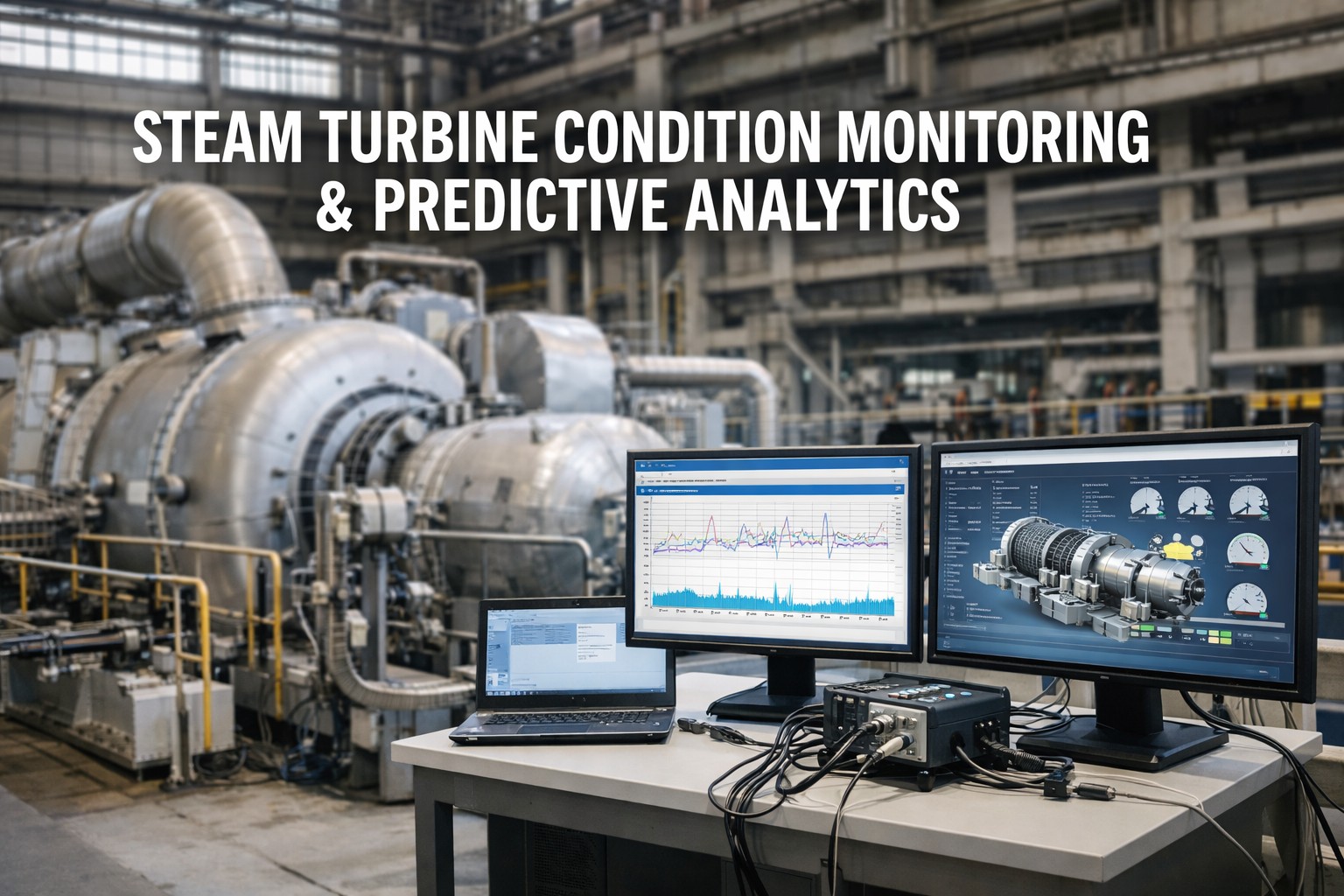
Steam Turbines
Vibration + Thermal + Acoustic
Blade erosion, bearing wear, seal degradation, rotor bow
Health index calculation, risk-based inspection scheduling
Oxmaint supports custom sensor mapping — configure unique thresholds and AI models per asset class through the platform's asset configuration module.
Oxmaint CMMS Features Built for Robotic Predictive Maintenance
Auto Work Order Generation
When AI vibration models detect a fault exceeding configured severity thresholds, Oxmaint automatically creates a prioritized work order with the spectral evidence, fault classification, recommended repair action, and estimated time-to-failure attached — no manual data entry required.
AI-TriggeredZero Manual Entry
Multi-Sensor Asset Health Dashboard
A unified dashboard correlates vibration spectra, thermal trends, acoustic maps, and visual inspection images on a single asset record. Health scores update continuously as new robot and IoT data streams arrive — giving reliability engineers a complete condition picture without switching between systems.
Real-TimeMulti-Modal Fusion
Robot Mission Scheduling
Define autonomous inspection routes directly from Oxmaint based on asset criticality rankings, PM schedules, and historical fault frequency. The CMMS pushes mission plans to Spot, ANYmal, or Unitree platforms — and receives structured inspection results back into asset records automatically.
CMMS-Driven RoutesMulti-Platform
Compliance and Audit Reporting
Every robot inspection, sensor reading, AI classification, and resulting work order is logged with timestamps, GPS coordinates, and technician sign-offs. Generate NERC, OSHA, and ISO 55000 compliance reports directly from Oxmaint — with full evidence traceability from sensor data to completed repair.
Audit-ReadyFull Traceability
Deploying quadruped robots with multi-sensor payloads reduced our turbine hall inspection time from 6 hours to 45 minutes per circuit. But the real transformation was when AI vibration analysis caught a generator bearing defect 4 weeks before our next scheduled outage — saving an estimated $1.8 million in emergency repair and lost generation costs.
Transform Power Plant Maintenance with AI, IoT, and Robotics
Oxmaint CMMS unifies vibration analysis, thermal imaging, acoustic monitoring, and robotic inspection data into a single predictive maintenance platform — auto-generating work orders, tracking asset health trends, and delivering compliance-ready reporting for every critical power generation asset.
How does AI vibration analysis differ from traditional vibration monitoring?
Traditional vibration monitoring relies on technicians collecting spot measurements with handheld analyzers and manually interpreting spectra. AI-powered analysis uses continuous IoT sensors capturing data 24/7, with machine learning models that automatically classify fault types, calculate severity scores, and estimate remaining useful life — delivering diagnostics in seconds rather than days. Sign up free to explore AI-driven vibration diagnostics in Oxmaint.
What types of power plant robots support predictive maintenance sensors?
Quadruped robots like Boston Dynamics Spot, ANYbotics ANYmal X, and Unitree B2 all support modular multi-sensor payloads including thermal cameras, vibration sensors, acoustic imagers, and LiDAR scanners. Spot has the widest third-party sensor ecosystem, ANYmal X is ATEX Zone 1 certified for hazardous areas, and Unitree B2 offers the highest payload capacity. Oxmaint CMMS integrates with all three platforms.
Can Oxmaint automatically generate work orders from robot sensor data?
Yes. Oxmaint ingests multi-sensor data streams from robot platforms and IoT networks, applies AI classification models, and auto-generates prioritized work orders when anomalies exceed configured thresholds. Each work order includes the spectral evidence, thermal images, fault classification, severity score, and recommended repair action. Schedule a demo to see the auto work order pipeline in action.
What is the typical deployment timeline for robotic predictive maintenance?
Most power plants move from initial site assessment to production autonomous patrols within 6-8 weeks. The first two weeks cover route mapping and sensor selection, weeks 3-4 focus on CMMS integration and threshold configuration, and weeks 5-6 involve pilot missions with data validation. Full-scale production deployment begins in week 7 with continuous optimization ongoing.
Does predictive maintenance with robots meet NERC and OSHA compliance requirements?
Yes. Every robot inspection, sensor reading, and resulting maintenance action logged in Oxmaint includes timestamps, GPS coordinates, and technician sign-offs — creating a complete audit trail. The platform generates compliance-ready reports for NERC reliability standards, OSHA safety requirements, and ISO 55000 asset management frameworks directly from inspection data. Sign up free to see the compliance reporting module.