
Reliability engineering for power plants is the disciplined application of RCM (Reliability-Centered Maintenance), FMEA (Failure Mode and Effects Analysis), and CMMS technology to maximize asset availability, control maintenance costs, and prevent catastrophic failures in critical equipment like turbines, boilers, and generators. By shifting from reactive firefighting to a structured power plant reliability program, facilities typically reduce unplanned downtime by 30–50% and extend the operational life of high-value assets by years. This guide breaks down how to implement RCM and FMEA on power plant systems, build a failure mode library, and optimize maintenance tasks using a modern CMMS. To see how AI-driven maintenance software transforms these frameworks into daily practice, you can Start Free Trial of OxMaint today.
Is your power plant losing $50K+ per day to unplanned turbine and boiler downtime?
Reactive maintenance costs power generation facilities up to 10x more than planned maintenance. RCM and FMEA frameworks—operationalized through a reliability CMMS—cut forced outages by up to 40% and recover millions in lost generating capacity.
How to run FMEA on boilers and turbines
Failure Mode and Effects Analysis (FMEA) identifies how power plant assets fail, the impact of those failures, and the maintenance tasks required to prevent them. A typical boiler FMEA uncovers 15–25 critical failure modes; a steam turbine analysis often reveals 30+.
| Asset / System | Failure Mode | Effect | RPN | Recommended Task |
|---|---|---|---|---|
| Steam Turbine | Bearing vibration / wear | Shaft damage, forced outage | 320 | Vibration analysis (predictive), oil analysis quarterly |
| Boiler | Tube scaling / fouling | Efficiency drop, tube rupture | 280 | Ultrasonic thickness testing, sootblowing optimization |
| Condenser | Tube leakage (cooling water) | Condenser vacuum loss | 180 | Eddy current testing, water chemistry monitoring |
| Generator | Stator winding insulation degradation | Catastrophic generator failure | 300 | Partial discharge monitoring, IR thermography |
| Feedwater Pump | Seal failure / cavitation | Loss of feedwater, unit trip | 150 | Flow monitoring, MTBF tracking, scheduled seal replacement |
RPN (Risk Priority Number) = Severity × Occurrence × Detection. Scores above 250 demand immediate predictive maintenance integration.
A 6-month timeline to build a power plant reliability program
Implementing an RCM FMEA power plant strategy does not happen overnight. A phased rollout over six months ensures reliability teams build accurate failure libraries while maintaining daily operations.
Asset Criticality Ranking
Audit all plant assets and rank by operational impact and redundancy. Tag turbines, generators, and boilers as critical (Class A), auxiliary pumps as semi-critical (Class B).
FMEA Workshops
Cross-functional teams map failure modes for top 20% of assets. Assign Severity, Occurrence, and Detection scores to calculate RPN for each component.
RCM Task Optimization
For each failure mode, assign the right maintenance strategy: predictive (condition-based), preventive (time-based), run-to-fail, or redesign.
CMMS Integration
Migrate tasks, triggers, and PM schedules into a reliability CMMS. Begin capturing work order history to refine failure frequencies and adjust RPN scores.
Formula: Optimizing maintenance tasks with RCM logic
Reliability-Centered Maintenance dictates that the maintenance task chosen must be technically feasible and worth doing. Use this formula to determine if a predictive maintenance task is justified over a reactive or preventive approach.
A 180-asset power plant spends $42K/yr on reactive turbine bearing replacements. An unplanned bearing failure during peak load costs $85,000 in lost generation and repairs. By implementing condition-based vibration monitoring via CMMS (Task Cost: $4,000/yr) with a failure prevention probability of 0.85, the Task Value equals $68,250—yielding a payback period of under 3 weeks.
See OxMaint on your assets — book a 30-min demo
Discover how power plants map RCM and FMEA workflows into OxMaint to automate PMs, predict failures, and eliminate spreadsheet-based maintenance.
How OxMaint powers your power plant reliability engineering
OxMaint turns static FMEA spreadsheets and paper work orders into a dynamic, AI-driven reliability CMMS. By connecting failure modes to automated maintenance triggers, power plants eliminate blind spots and audit their compliance readiness in real time.
AI-Powered Predictive Maintenance
Integrate IoT sensor data (vibration, temperature, pressure) to predict turbine and boiler failures weeks before they happen. Outcome: Cut unplanned downtime by 30–50%.
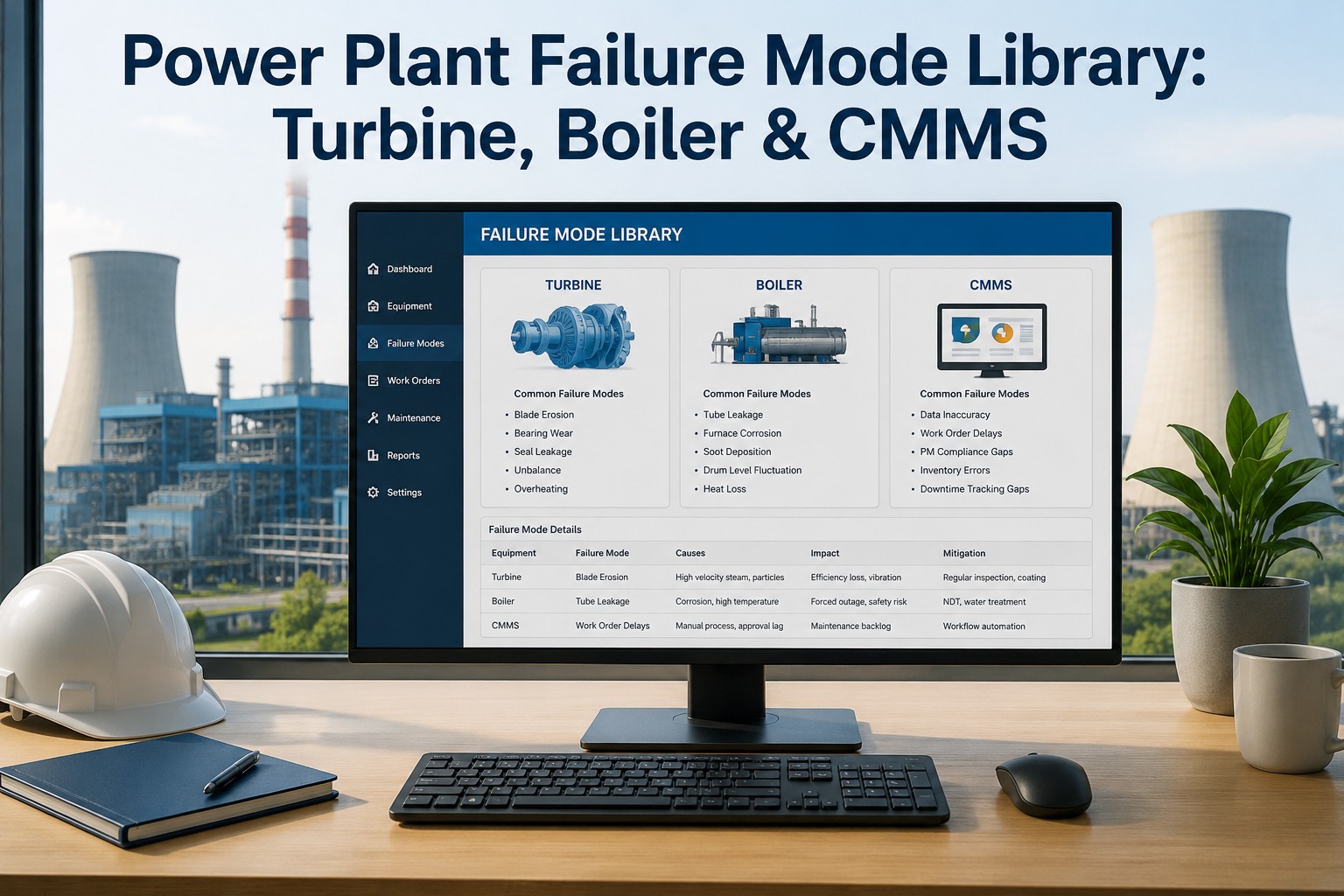
Dynamic Failure Mode Library
Digitalize your FMEA analysis. As technicians close work orders, OxMaint updates failure histories and recalculates RPN scores automatically. Outcome: 100% audit-ready compliance.
Automated RCM Work Order Triggers
Map condition-based and time-based maintenance tasks directly to assets. OxMaint auto-generates PMs based on runtime hours or meter readings. Outcome: Eliminate missed PMs.
Spare Parts & Inventory Tracking
Link critical failure modes to required spare parts. When a predictive alert fires, OxMaint reserves the part and notifies procurement. Outcome: Reduce emergency part spend by 25%.
Power plant reliability engineering FAQs
What is reliability engineering in a power plant?
Reliability engineering in a power plant is the process of using data, maintenance frameworks (like RCM and FMEA), and software to ensure critical assets like turbines and boilers operate without failure. The goal is to maximize availability and generation output while minimizing maintenance costs. OxMaint provides the CMMS infrastructure to track and execute these strategies daily.
How does RCM apply to power plant turbines?
RCM (Reliability-Centered Maintenance) applies to turbines by identifying critical failure modes—such as blade erosion, bearing wear, or vibration anomalies—and assigning the most effective maintenance task to each. Instead of over-maintaining, RCM dictates condition-based monitoring for turbines, saving thousands in unnecessary PM hours. You can map these RCM workflows directly into OxMaint by booking a demo to see the setup.
What is the difference between FMEA and RCM?
FMEA (Failure Mode and Effects Analysis) is an analytical tool used to identify how assets fail, the effects of those failures, and to rank the risks using a Risk Priority Number (RPN). RCM is a broader framework that uses FMEA data to decide what maintenance tasks to perform and when. In short, FMEA finds the problems; RCM defines the solutions.
Why do power plants need a reliability CMMS?
A reliability CMMS bridges the gap between engineering theory and daily maintenance execution. It automates work order generation based on FMEA triggers, tracks asset history for ISO 55000 compliance, and provides analytics to prove ROI. Without a CMMS, RCM and FMEA analysis remains trapped in spreadsheets and is rarely executed in the field.
How much does power plant maintenance software cost?
The cost of a CMMS for power plants varies based on asset count and predictive sensor integrations, but it typically ranges from $100 to $500 per user per month. However, the ROI is rapid: preventing a single forced turbine outage can save $50,000–$500,000 in lost generation, meaning the software often pays for itself in under 30 days. Start Free Trial to explore the platform.
Ready to modernize your power plant reliability program?
Join the maintenance teams using OxMaint to prevent failures, optimize tasks, and drive OEE improvements across their generation assets.
Free 14-day trial · No credit card


.png)