Nuclear power maintenance sits at the intersection of production pressure, safety-related SSC scope, and the NRC's 10 CFR 50.65 Maintenance Rule — where every recurring task, every performance goal, and every pre-maintenance risk assessment must survive regulatory review. This guide covers the Rule structure, the SSC classification pyramid, the seven RCM questions applied to nuclear equipment, strategy selection, and the regulatory framework any credible program maps against. Start free on OxMaint to load the SSC hierarchy, or book a demo.
Nuclear · RCM · 2026
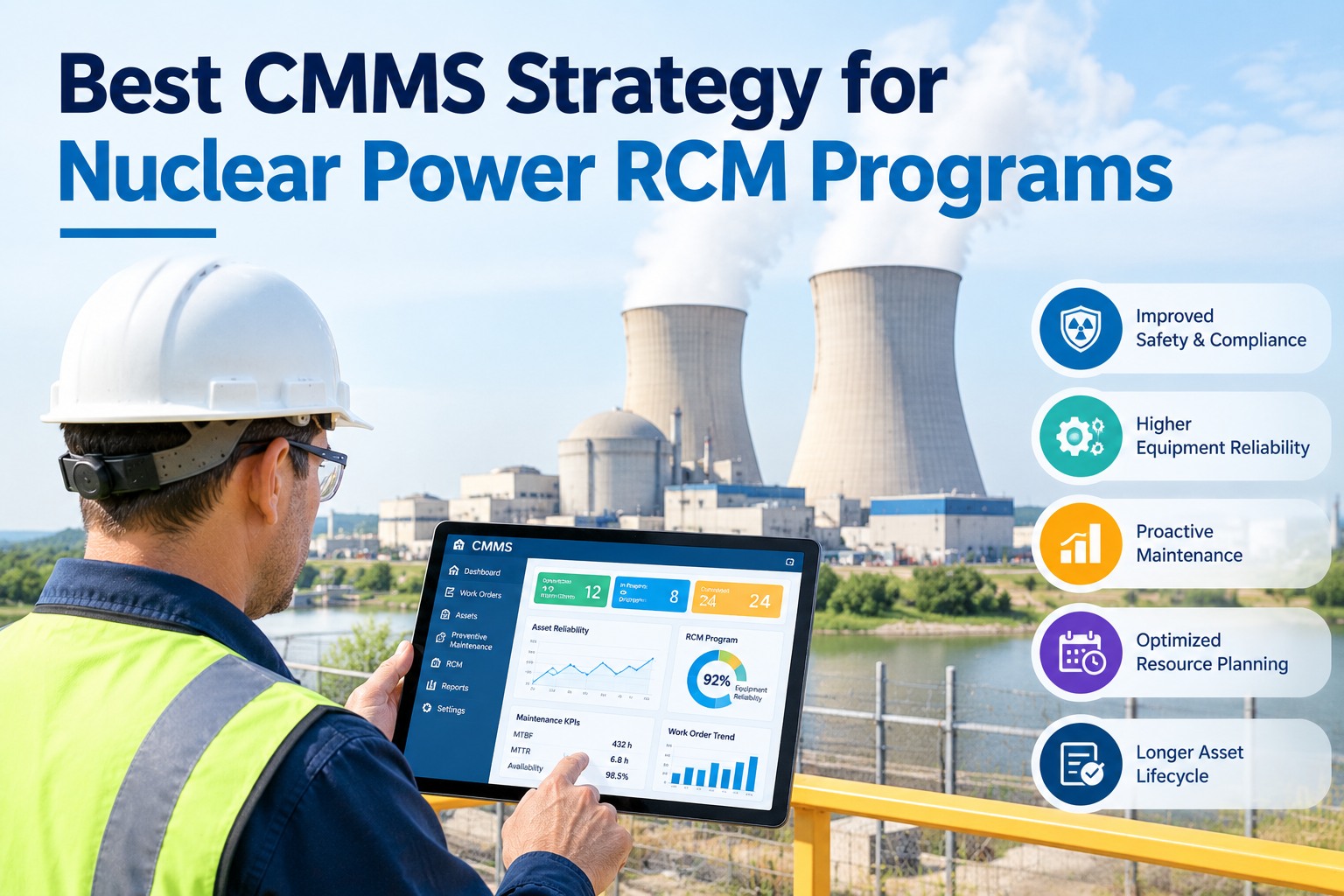
Smarter Nuclear Maintenance Strategy · RCM Under the Maintenance Rule
10 CFR 50.65 · SSC classification · risk-informed strategy selection.
10 CFR 50.65
The Maintenance Rule
NRC regulation requiring monitoring of SSC performance against established goals
NUMARC 93-01
Implementation Guide
Industry guidance endorsed by NRC RG 1.160 for Maintenance Rule implementation
18
QA Criteria
10 CFR Part 50 Appendix B criteria governing safety-related maintenance records
SSC
Structures, Systems & Components
The nuclear-standard asset taxonomy — every scope decision hinges on classification
The 10 CFR 50.65 Rule Structure · Four Clauses You Manage Against
The Maintenance Rule has four operative clauses, and every element of an RCM program at a nuclear plant maps to one of them. The breakdown below is the reference structure — knowing which clause governs which decision is what separates a passing program from a Notice of Violation.
§ 50.65 (a)(1)
Goal Setting & Corrective Action
For SSCs whose performance goals are not being met, licensee must establish goals and take corrective action to restore SSC to effective control. The "problem-plant" clause.
§ 50.65 (a)(2)
Preventive Maintenance Adequate
For SSCs where PM demonstrably controls performance, monitoring against goals is not required. The "good-plant" clause — most well-managed SSCs live here.
§ 50.65 (a)(3)
Periodic Evaluation
Program evaluated at least every refueling cycle. Adjustments made based on industry OE, plant-specific performance, and PRA insights where applicable.
§ 50.65 (a)(4)
Risk Assessment Before Maintenance
Before any maintenance activity on scoped SSCs, licensee must assess and manage the increase in risk. The "before-you-touch-it" clause enforced through configuration risk management.
The SSC Classification Pyramid · Scope Determines Treatment
Every SSC at a nuclear plant sits somewhere on the classification pyramid, and where it sits determines the maintenance treatment required. Getting the classification wrong at the top is a Maintenance Rule finding; getting it wrong at the bottom is wasted resource. The pyramid below is the field-standard scoping structure.
Tier 1
Safety-Related SSCs
Reactor coolant boundary · shutdown systems · residual heat removal · containment · emergency core cooling · engineered safety features
Full 10 CFR 50 Appendix B QA program · maintenance rule scoped · goal-monitoring or PM-effective demonstration
Tier 2
Risk-Significant Non-Safety
Nonsafety SSCs whose failure would prevent safety-related SSCs from performing their function · certain BOP items with safety-function tie-ins
Maintenance Rule scoped · goal-monitoring or (a)(2) PM-effective demonstration · risk-informed PM strategy
Tier 3
Scram / Unnecessary Actuation
SSCs whose failure could cause a scram or unnecessary actuation of safety systems
Maintenance Rule scoped per (a) intent · reliability tracking required · availability targets
Tier 4
Balance of Plant Nonsafety
Turbine, generator, feedwater (non-safety portions), plant support systems with no safety function tie-in
Outside Maintenance Rule scope · standard commercial reliability practices · RCM optional but often applied
The 7 RCM Questions · Applied to a Nuclear SSC
The classic seven-question RCM analysis structure applies to nuclear equipment, with each question answered in the specific language of the safety-related or risk-significant SSC under review. Below is the framework and how each question interprets in nuclear operations.
Q1
Function
What is the SSC required to do — including safety function, availability requirement, and any regulatory technical specification limit?
Q2
Functional Failure
What does it mean for this SSC to fail to perform that function — total loss, degraded function, spurious actuation, common-cause failure across trains?
Q3
Failure Modes
What causes each functional failure — mechanical wear, aging degradation, environmental qualification limit exceeded, calibration drift, common-mode?
Q4
Failure Effects
What happens when it fails — including safety function impact, operational transient, downstream system dependency, PRA sequence contribution?
Q5
Failure Consequences
How much does it matter — hidden vs evident, safety consequence, operational consequence, economic consequence, regulatory consequence?
Q6
Preventive Task
What proactive task will detect or prevent the failure — condition monitoring, restoration, discard, failure-finding, or combination?
Q7
Default Strategy
If no cost-effective proactive task exists — run-to-failure with acceptance, design change, or redesign for redundancy per Appendix B.
Load Your SSC Hierarchy Into OxMaint — Free Forever
Sign up on OxMaint's free forever plan and build the SSC hierarchy with Maintenance Rule scoping, PM cadence per classification tier, and (a)(4) risk-assessment workflow built into the pre-maintenance flow. No card, no time limit.
Strategy Selection Matrix · The Right Maintenance Approach Per Failure Mode
The RCM analysis outputs a maintenance strategy per failure mode. The matrix below is the standard selection logic — which strategy is applicable and worthwhile depends on failure pattern, detectability, and consequence tier.
| Strategy | When Applicable | Nuclear Example |
|---|
| Condition Monitoring |
Failure gives measurable warning · P-F interval sufficient to plan intervention |
Vibration + thermography on RHR pumps · oil analysis on EDG · MOV signature testing |
| Time-Directed Restoration |
Aging pattern with known life · restoration cost less than replacement |
Refueling-outage refurb of key MOVs · seal replacement per environmental qualification schedule |
| Time-Directed Discard |
Component has defined life · restoration not cost-effective |
Battery replacement per manufacturer life · EQ-qualified elastomer replacement per aging analysis |
| Failure-Finding |
Hidden function · failure not evident under normal operation |
Standby EDG start test · quarterly IST of standby pumps · valve stroke testing per ASME OM |
| Run-to-Failure |
Consequence acceptable · no cost-effective proactive task · redundancy in place |
Certain BOP-only motors with full redundancy · non-safety instruments with alternate reading paths |
| Design Change |
No proactive task adequate · run-to-failure consequence unacceptable |
Modification for redundancy · EQ-driven material upgrade · aging management program response |
The Regulatory & Industry Framework · What Any Nuclear RCM Program Maps Against
A nuclear RCM program earns its authority by mapping every scope decision, every performance goal, and every pre-maintenance risk assessment to a specific regulatory or industry anchor. The eight anchors below are the ones every NRC inspector, INPO evaluator, and internal QA auditor recognizes on sight.
NRC
10 CFR 50.65
The Maintenance Rule itself — mandatory monitoring of SSC performance against established goals for scoped SSCs.
NRC
10 CFR 50 App B
18 quality assurance criteria governing how safety-related maintenance records are created, controlled, and retained.
NRC
Reg Guide 1.160
Endorses NUMARC 93-01 as an acceptable method for implementing the Maintenance Rule.
NRC
Reg Guide 1.182
Guidance for (a)(4) risk assessment and management of maintenance activity risk before execution.
NEI / EPRI
NUMARC 93-01
Industry implementation guide for the Maintenance Rule, endorsed by RG 1.160 — the operational how-to.
EPRI
MR Users Group
Maintenance Rule Users Group publications and 2026 joint work with NEI on updated risk-significant SSC guidance.
INPO
INPO 90-008
Maintenance Programs in the Nuclear Power Industry — industry excellence benchmark for maintenance program design.
ASME
ASME OM Code
Operation and Maintenance of Nuclear Power Plants — pump and valve inservice testing (IST) requirements.
The (a)(4) Pre-Maintenance Risk Assessment Workflow
10 CFR 50.65(a)(4) requires that before any maintenance activity on scoped SSCs, the licensee assesses and manages the resulting increase in risk. The four-step workflow below is the field-standard configuration-risk-management flow every planned nuclear work order runs through.
Step 01
Scope Confirmation
Confirm the SSC(s) affected by the planned maintenance are within Maintenance Rule scope. If in scope, (a)(4) assessment is mandatory.
→
Step 02
Configuration Risk Model
Apply configuration risk model — PRA-informed or deterministic — to quantify risk increase from the planned SSC unavailability window.
→
Step 03
Compensatory Measures
If risk increase exceeds threshold — implement compensatory measures: parallel work restrictions, redundant train protection, weather/grid checks.
→
Step 04
Authorization & Documentation
Formal authorization with risk assessment attached to WO. All actions traceable in the record for NRC inspection or SDP review.
How OxMaint Supports Nuclear RCM & Maintenance Rule Compliance
SSC hierarchy, Maintenance Rule scoping, performance-goal tracking, PM strategy per RCM output, (a)(4) risk assessment workflow, and Appendix B documentation all run on one platform designed for regulated maintenance environments — with every record timestamped, technician-attributed, and preserved for NRC inspection or SDP review.
Hierarchy
SSC Classification Structure
4-tier SSC pyramid — Safety-Related / Risk-Significant / Scram / BOP — with Maintenance Rule scope flag and Appendix B QA flag per record.
Goals
(a)(1) / (a)(2) Tracking
Performance goals per SSC or train. Automatic classification into (a)(1) corrective-action track or (a)(2) PM-effective demonstration.
Strategy
RCM Output → PM Cadence
RCM 7-question analysis output drives the PM library — condition monitoring / time-directed / failure-finding / run-to-failure per failure mode.
Risk
(a)(4) Assessment Workflow
Pre-maintenance risk assessment built into the WO workflow — no Maintenance-Rule-scoped WO executes without assessment attached.
Records
Appendix B QA Documentation
Every safety-related WO produces a timestamped, technician-attributed, completion-documented record retrievable for NRC inspection.
Evaluate
Refueling-Cycle (a)(3) Review
Program-level evaluation aligned to refueling cycle. Industry OE, plant-specific performance, and PRA insights integrated into strategy adjustment.
Build the Maintenance Rule Foundation Your Program Will Be Audited Against
Free forever plan — no card, no time limit. Load the SSC hierarchy, scope each item into the Rule, tag PMs to their (a)(1)/(a)(2) track, and every WO carries the (a)(4) assessment its scope demands. Or book 30 minutes and we'll walk your plant's Maintenance Rule program end-to-end.
Frequently Asked Questions
What is the 10 CFR 50.65 Maintenance Rule and what does it require?
10 CFR 50.65 is the NRC's Maintenance Rule, issued in 1991, which requires every licensee to monitor the performance and condition of structures, systems, and components against established goals to provide reasonable assurance those SSCs can fulfill their intended safety functions. The Rule has four operative clauses. (a)(1) applies when performance goals are not being met — licensee must establish goals and take corrective action. (a)(2) applies when preventive maintenance demonstrably controls performance — goal-monitoring not required. (a)(3) requires periodic program evaluation at least every refueling cycle. (a)(4) requires risk assessment and management before any maintenance activity on scoped SSCs. Industry implementation guidance is provided by NUMARC 93-01, endorsed by NRC Regulatory Guide 1.160.
How does SSC classification determine maintenance treatment?
Every SSC sits in one of four classification tiers, and each tier drives different treatment. Tier 1 Safety-Related — reactor coolant boundary, shutdown systems, RHR, containment, ECCS, engineered safety features — requires full 10 CFR 50 Appendix B QA program plus Maintenance Rule scoping. Tier 2 Risk-Significant Non-Safety — nonsafety SSCs whose failure prevents safety-related SSCs from performing their function — is Maintenance Rule scoped with risk-informed PM strategy. Tier 3 Scram / Unnecessary Actuation — SSCs whose failure could cause a scram or unnecessary actuation — is scoped per (a) intent with reliability tracking. Tier 4 Balance of Plant Nonsafety — turbine, generator, non-safety feedwater portions — is outside Maintenance Rule scope but often subject to commercial RCM. Getting the classification wrong at the top is a Notice of Violation candidate; getting it wrong at the bottom is wasted resource.
What does the (a)(4) pre-maintenance risk assessment actually require?
Before any maintenance activity on Maintenance-Rule-scoped SSCs, the licensee must assess and manage the increase in risk resulting from the planned SSC unavailability. The workflow has four steps. Scope confirmation — is this SSC in the Rule scope. Configuration risk model — apply the PRA-informed or deterministic model to quantify the risk increase from the planned unavailability window. Compensatory measures — if risk increase exceeds threshold, implement parallel work restrictions, redundant train protection, weather and grid checks. Formal authorization — risk assessment attached to the work order, traceable in the record for NRC inspection or Significance Determination Process review. The NRC's 2025 clarification on TIMaSC noted that PRA should not itself constitute the safety analysis, but PRA insights inform the (a)(4) risk-management decision.
How does RCM apply to nuclear equipment specifically?
The classic seven-question RCM framework applies, with each question answered in the specific language of the safety-related or risk-significant SSC under review. Q1 Function includes safety function, availability requirement, and technical specification limits. Q2 Functional Failure covers total loss, degraded function, spurious actuation, and common-cause failure across trains. Q4 Failure Effects extends to PRA sequence contribution. Q5 Failure Consequences includes hidden versus evident, safety, operational, economic, and regulatory. Q6 Preventive Task outputs feed into one of six strategies — condition monitoring, time-directed restoration, time-directed discard, failure-finding, run-to-failure with acceptance, or design change per Appendix B. The selection matrix is the same as commercial RCM, but the consequence tier and documentation requirements sit at a fundamentally different level.
Book a demo to see the RCM output flow into the PM library.
What CMMS capabilities does a nuclear plant actually need for Maintenance Rule compliance?
Beyond standard CMMS functionality, four capabilities are essentially non-negotiable. First, SSC hierarchy with Maintenance Rule scope flag and 10 CFR Part 50 Appendix B QA flag per record — the classification structure is the foundation everything else builds on. Second, timestamped, technician-attributed, completion-documented WO records preserved for the retention period NRC inspection may reference. Third, (a)(4) risk assessment built into the pre-maintenance workflow — no scoped WO executes without assessment attached. Fourth, performance goal tracking with automatic (a)(1) vs (a)(2) classification and refueling-cycle (a)(3) program evaluation. A CMMS that cannot produce the specific documentation records NRC and independent auditors will request is not just operationally inadequate — it is a compliance liability.
Sign up free to load the SSC hierarchy today.