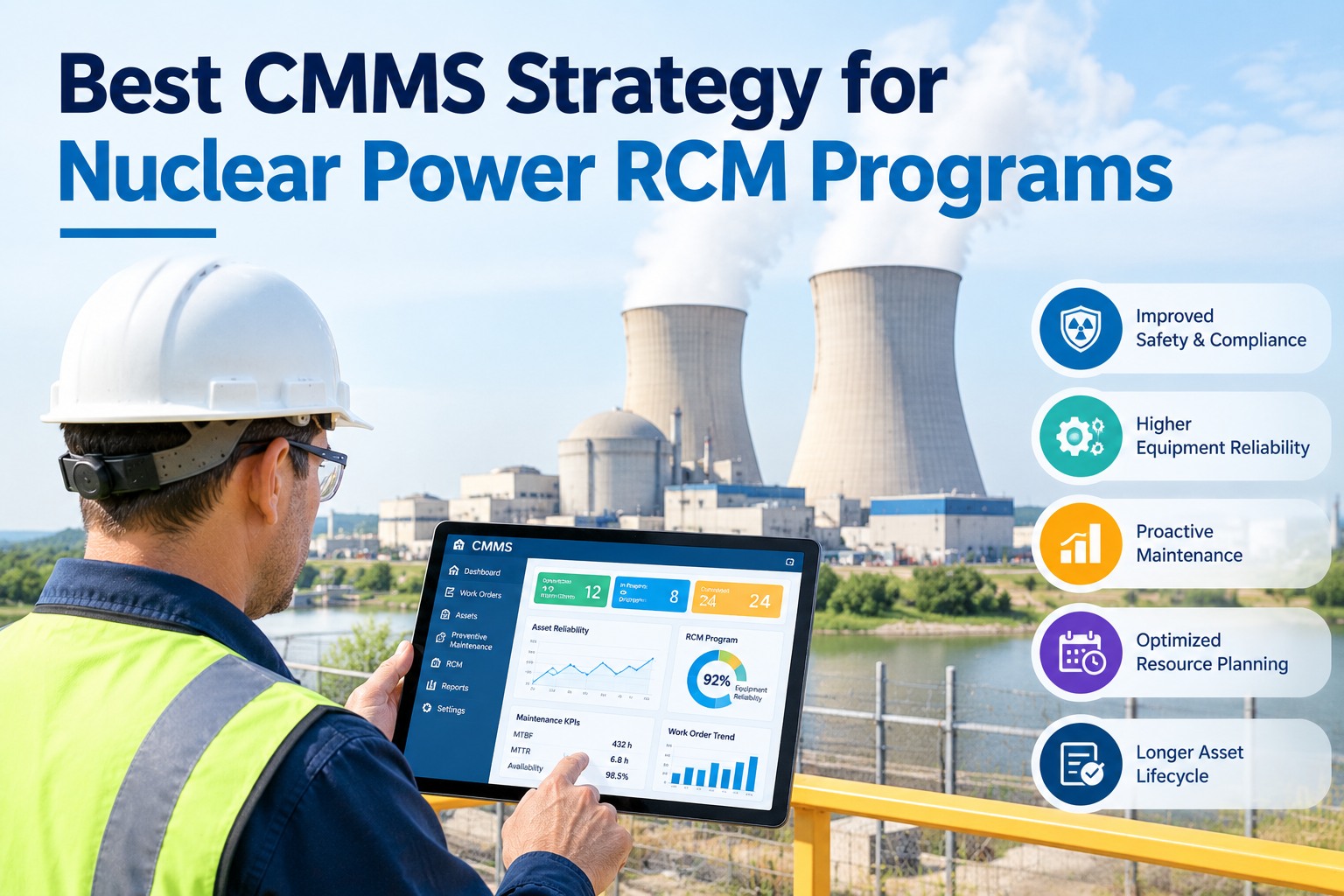
In a nuclear plant, maintenance isn't a cost center — it's a licensing condition. The NRC's Maintenance Rule (10 CFR 50.65) requires licensees to monitor whether their maintenance is actually keeping safety-related structures, systems, and components able to perform their function, and to manage the risk of every activity before it's performed. Reliability-Centered Maintenance is how leading plants meet that bar without drowning in unnecessary PMs: it links every critical failure mode to the one strategy that addresses it, and a CMMS is what turns that analysis into work orders, monitored KPIs, and the documented, defensible record the Rule demands. This guide walks the seven RCM questions, the nuclear regulatory overlay, and how to make a CMMS carry the whole program. Start free or book a demo.
The Best CMMS Strategy for Nuclear RCM: Every Failure Mode Linked to a Task, Every Task to the Rule
Nuclear RCM only delivers when the analysis leaves the binder and lives in the work-management system — failure modes tied to PM triggers, KPIs monitored against Maintenance Rule goals, and an audit trail that proves effectiveness. Here's how the best-run plants wire RCM into their CMMS.
Why Nuclear RCM Is a Different Discipline
Generic RCM asks "what's the cheapest way to preserve function?" Nuclear RCM asks that and "can we prove to a regulator that our maintenance is effective?" The Maintenance Rule is performance-based — it doesn't dictate specific tasks, it demands that you monitor SSC performance against established goals and correct course when equipment underperforms. That reframes RCM from an efficiency exercise into an evidence engine: every strategy decision has to be justified, documented, and monitored. The plants that do this well don't run RCM and compliance as two programs — they run one, in one system. Sign up free — no credit card and your failure-mode library, PM triggers, and performance data live where the work orders already are.
The Seven RCM Questions — Asked the Nuclear Way
RCM is defined by SAE JA1011: a process only qualifies as RCM if it answers seven specific questions for every asset in scope, in order, with documented decision logic. Skip a question or assign a task without consequence analysis, and it isn't RCM — it's habit with a label. In a nuclear context, question five (consequences) carries the regulatory weight, because a safety consequence changes everything downstream. Schedule a 30-minute demo to see these seven captured as structured records against your asset hierarchy.
Consequence Decides Strategy — Not Asset Age
The central RCM insight is that time-based PM is often the wrong answer — research on maintenance data has long shown the majority of failure modes are random, not age-related, so a calendar PM burns labor without preventing the failure. RCM instead matches each failure mode to the strategy that actually addresses its consequence. Here's the mapping, from routine to critical. Create your free account and attach the chosen strategy directly to each failure mode in the library.
The RCM Analysis Was Excellent. It Just Never Reached the Work Orders.
A reliability team spends months on a rigorous RCM study — functions, failure modes, strategies, all documented. Then it sits in a spreadsheet while the CMMS keeps generating the same legacy PMs it always did. The analysis proved nothing because it never drove the work. OxMaint closes that gap: failure modes link to work orders, PM triggers fire on runtime or sensor data, and every completed task feeds the performance record that proves the strategy works.
Start With Criticality — Not the Whole Plant
Full RCM on every SSC in a nuclear plant would take years and isn't warranted — most equipment doesn't need it. The discipline is to rank assets by consequence of failure first, focus the deep analysis on the risk-significant SSCs, and apply lighter PM optimization elsewhere. This mirrors the Maintenance Rule's own risk-informed logic: the highest scrutiny goes where a failure matters most to safety. Schedule a live walkthrough to build a criticality-ranked asset hierarchy that scopes your program.
Where the CMMS Carries the Program
RCM produces decisions; a CMMS is what makes them real and keeps them honest. The best nuclear strategy uses the work-management system as the single home for the failure-mode library, the PM triggers, the KPI monitoring the Maintenance Rule requires, and the audit trail that proves effectiveness. That's the difference between a reliability program you run and one you can defend. Sign up free in minutes and build the whole loop in one place.
Rank by criticality, run the seven questions on the assets that matter, link every failure mode to a task, and let the CMMS monitor the KPIs and hold the evidence — that's a nuclear RCM program that cuts unplanned downtime and proves its own effectiveness. Sign up free or schedule a demo to see it on your critical systems.
Our RCM studies were genuinely good — and genuinely stranded. The strategies lived in spreadsheets while the maintenance system ran the same PMs from a decade ago. Moving the failure-mode library into OxMaint and tying it to work orders was the unlock: PM triggers now match what the analysis actually called for, and I can show a monitored KPI against a Maintenance Rule goal instead of a stack of paper. When we pruned the PMs RCM flagged as useless, the labor we got back paid for the whole effort inside a cycle.
Frequently Asked Questions
Turn RCM Analysis Into a Program You Can Defend.
OxMaint gives nuclear reliability teams the asset hierarchy, failure-mode library, runtime- and sensor-based PM triggers, and KPI monitoring to link every failure mode to a task — and prove, against Maintenance Rule goals, that your maintenance is effective. Launch an RCM pilot on your most critical systems and scale on the results. Start free — no credit card, unlimited users, forever. Or book a demo.