Spillway gates are among the most safety-critical hydraulic structures at any dam facility — a failure during peak inflow can have catastrophic downstream consequences. Monthly operational testing is not just a best practice; it is a regulatory requirement under FERC Part 12, state dam safety programs, and dam owner safety manuals. Yet many facilities still rely on paper logs, inconsistent inspection routes, and manual hoist records that leave compliance gaps. This guide provides a complete, field-ready spillway gate monthly operational test checklist covering mechanical, electrical, hydraulic, and structural verification tasks — structured so your operators can execute consistently every cycle. Facilities using a digital CMMS like OxMaint report faster test completion, automatic sign-off capture, and audit-ready records generated in seconds. Start your free OxMaint trial and schedule your first spillway gate PM in under an hour.
Spillway Gate · Monthly PM · Free Checklist
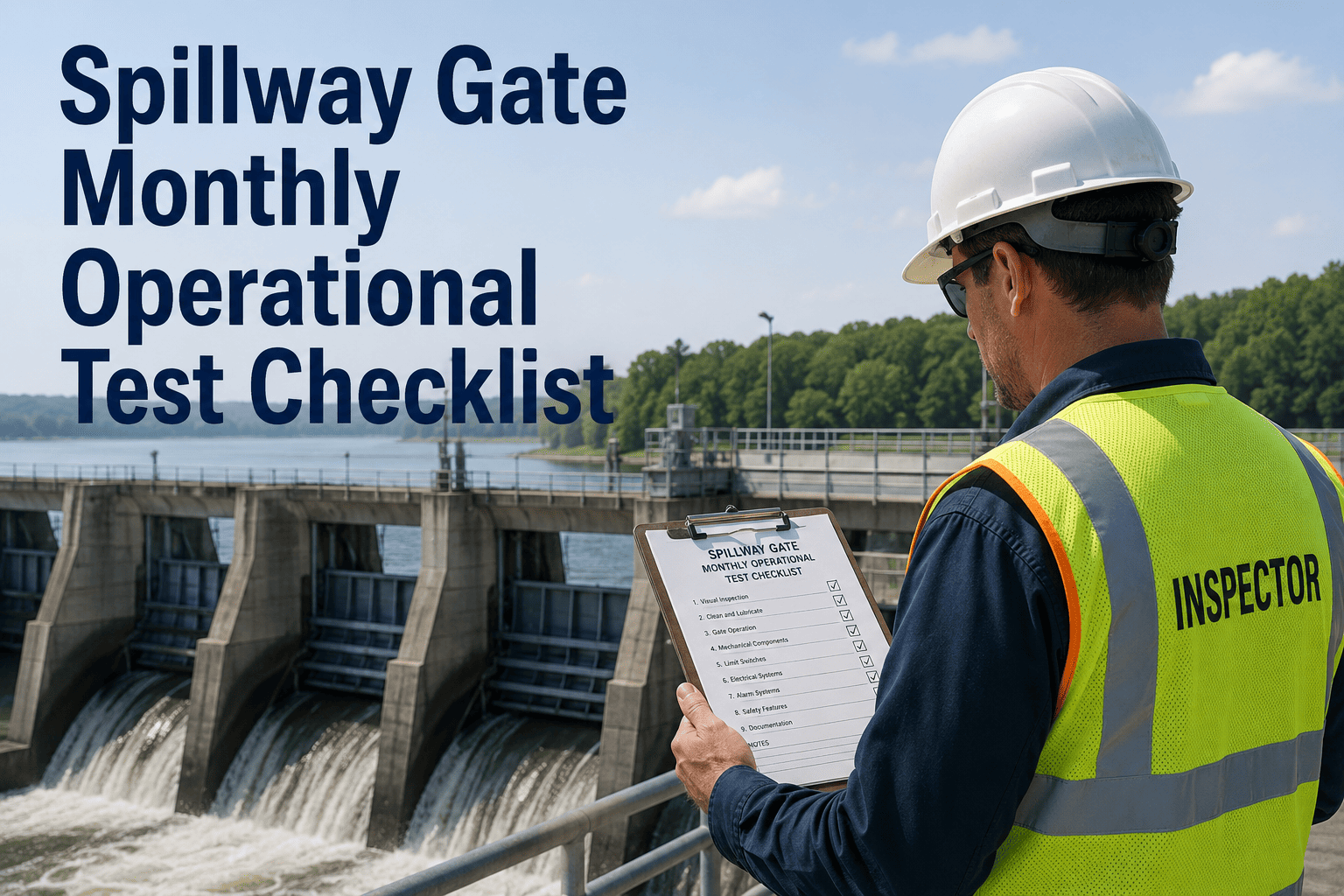
Spillway Gate Monthly Operational Test Checklist
Every lift, lower, seal verification, hoist check, and sign-off your team needs — structured for field use and CMMS tracking.
100%
Gate operability required under FERC EAP protocols
30+
Verification tasks per monthly test cycle
72 hrs
Typical notice before emergency gate operation required
3x
Faster audit response with digital CMMS records
Why Monthly Testing Matters
What Happens When Spillway Gate Tests Are Skipped
A spillway gate that was last tested six months ago is an unknown — not a reliable asset. Corrosion, seal degradation, hoist gear wear, and electrical control faults can all develop between cycles without visible warning. The consequences of discovery during an actual flood event are irreversible.
Mechanical Seizure
Corrosion and debris accumulation on trunnion pins, roller tracks, or wire ropes can lock a gate in the closed position when emergency opening is needed most.
Hoist Failure
Wire rope fatigue, gearbox oil degradation, and brake lining wear progress silently. Monthly load cycling reveals weakening before full-load failure occurs.
Seal Leakage
Elastomeric seals harden and crack with UV exposure and thermal cycling. Undetected seat leakage erodes embedded metals and inflates downstream flow measurement error.
Regulatory Non-Compliance
FERC, state dam safety offices, and USACE all require documented operational test records. Missing logs trigger formal notices of violation with mandatory corrective action timelines.
The Complete Checklist
Spillway Gate Monthly Test — All Verification Tasks
This checklist covers all gate types — radial (Tainter), vertical lift, drum, and flap gates — with tasks grouped by system. In OxMaint, each task becomes a trackable work order item with photo capture, meter readings, and digital technician sign-off.
✓Full gate lift cycle — raise gate to fully open position and hold
Record travel time and motor amperage at full open
✓Full gate lower cycle — lower to fully closed and verify seat contact
Confirm gate seats uniformly across full sill width
✓Trunnion pin / roller track visual inspection
Check for corrosion, spalling, and lubrication coverage
✓Wire rope or lifting chain inspection — kinks, broken wires, elongation
Reject and replace if more than 2 broken wires in any lay length
✓Hoist gearbox oil level and condition check
Top up or schedule change if oil is milky or contaminated
✓Brake mechanism inspection and adjustment test
Verify brake holds gate load at mid-travel position
✓Structural skin plate and stiffener visual inspection
Document any new corrosion, pitting, or weld cracks
✓Trash rack and approach channel debris clearance
Remove all floating debris within 10 m of gate bay
✓Gate position indicator calibration check
Confirm indicator reading matches physical gate position at open and closed
✓Motor current draw verification — compare to baseline nameplate amperage
Flag if draw exceeds 110% of rated full-load amperage
✓Limit switch operation test — fully open and fully closed positions
Confirm motor de-energizes at both travel limits
✓Local and remote control panel operation test
Verify gate responds correctly to both local pushbutton and SCADA command
✓Emergency manual override (hand crank / hydraulic backup) function test
Confirm gate moves under backup power or manual operation
✓Overload relay and motor protection settings review
Verify trip settings have not been bypassed or adjusted
✓Control panel wiring, terminal, and connection inspection
Check for loose terminals, corrosion, and insulation damage
✓Position transducer or encoder signal check
Confirm SCADA-displayed position matches physical gate position
✓Backup power supply (UPS or generator) test for gate control circuit
Simulate main power loss and confirm backup activates within spec
✓Side seal inspection — J-seal, P-seal, or bulb seal condition
Check for cracking, tearing, compression set, and contact loss
✓Bottom sill seal inspection and seat leakage measurement
Record leakage flow rate; compare to previous month and design allowance
✓Seal retainer bolts and clamp bars — visual tightness check
Re-torque any loose fasteners per maintenance specification
✓Embedded metal seat inspection — corrosion, pitting, weld condition
Photograph any new degradation for trending record
✓Gate bay wall joint and waterstop visual inspection
Check for concrete cracking, spalling near seal contact zone
✓Seal lubrication application where specified by OEM
Apply silicone or graphite lubricant only per design spec
✓Record gate travel time (open and close) with timestamp
Compare to design specification and prior month baseline
✓Photograph gate in fully open and fully closed positions
Upload photos to CMMS work order with date/time metadata
✓Record all abnormal findings with corrective action status
Open follow-up work orders for any deficiencies found
✓Operator and supervisor digital sign-off on completed checklist
Both signatures required for regulatory records compliance
✓Submit completed report to dam safety records system or CMMS
Store for minimum retention period per FERC or state requirement
No Credit Card · Live in 60 Minutes
Turn This Checklist Into Automated Monthly Work Orders
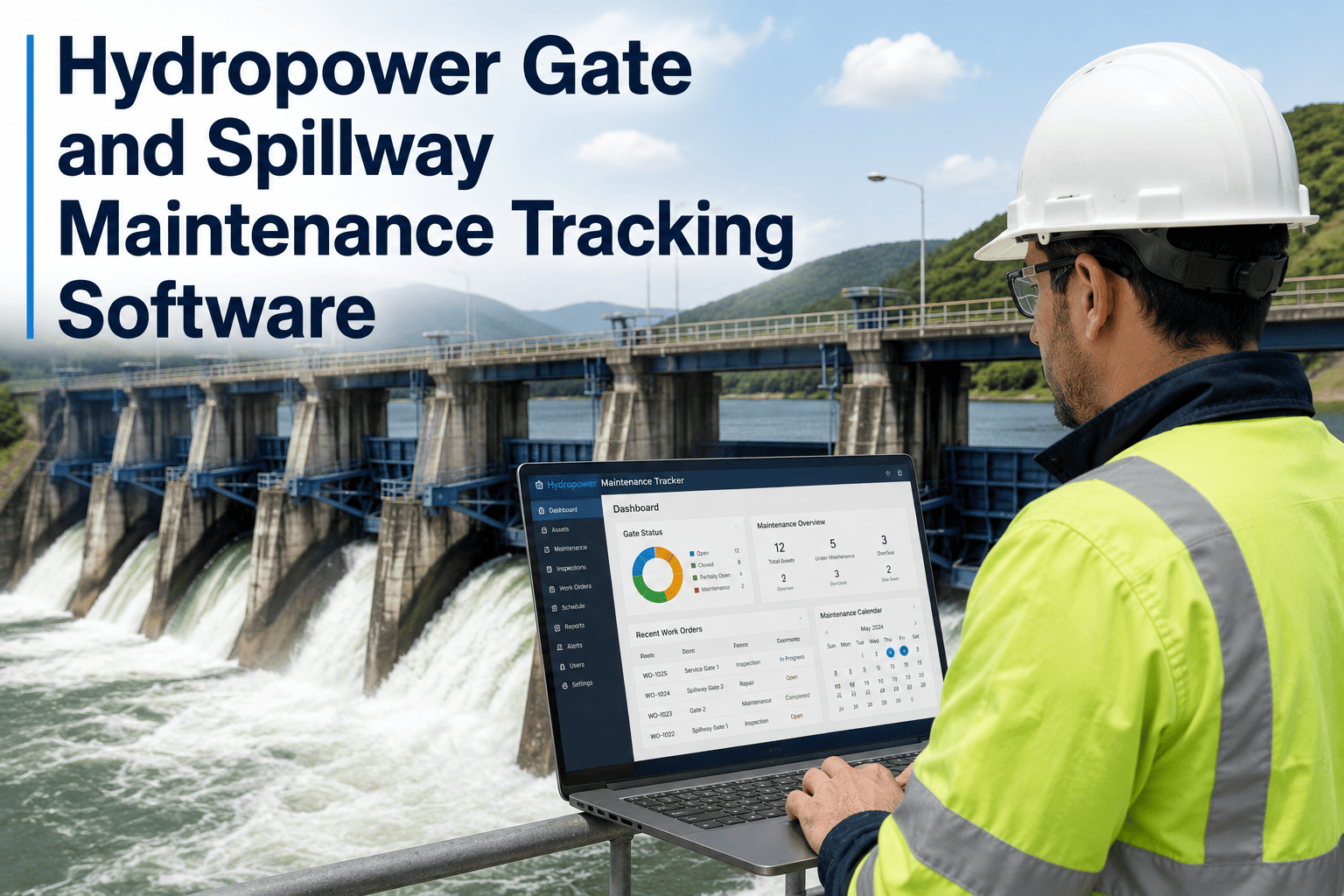
OxMaint schedules every spillway gate test task automatically, routes it to the right certified operator, and generates FERC-ready PDF reports on demand — no binder filing required.
Paper vs. Digital
Manual Records vs. CMMS-Tracked Gate Testing
Manual / Paper Records
Test dates recorded on paper — easy to lose or falsify
No automatic alert when monthly test window is approaching
Photo evidence inconsistent — often missing from audit files
Corrective actions not tracked — deficiencies close without follow-up
Regulatory audit prep takes days of manual document search
VS
OxMaint CMMS
GPS-timestamped work order closed with digital operator signature
Automatic overdue alert fires 3 days before test window closes
Photo capture required per task — attached to permanent record
Deficiency work orders linked to inspection — tracked to closure
One-click audit report export — all records in seconds
How It Works
From Checklist to Compliant Record in 4 Steps
01
Build Your Gate PM Template
Import this checklist into OxMaint or build a custom template by gate type, asset ID, and test frequency in minutes.
→
02
Auto-Schedule Monthly Test
OxMaint creates work orders on your schedule and assigns them to certified operators automatically every cycle.
→
03
Complete on Mobile in the Field
Operators check tasks, add photos and meter readings, and close the work order with a digital signature from the gate site.
→
04
Instant Compliance Report
Download audit-ready PDF records covering every test, every finding, and every sign-off — on demand, any time.
Common Questions
Spillway Gate Monthly Testing — FAQs
How often must spillway gates be operationally tested?
Most FERC-licensed facilities and state dam safety programs require full operational tests at least monthly for gated spillways. High-hazard dams may require more frequent testing or post-storm verification cycles. OxMaint lets you configure test frequency down to the specific gate and trigger alerts before each window closes.
Set up your test schedule in OxMaint today.
What records do I need to keep for spillway gate tests?
At minimum: test date and time, operator name, gate travel time, any deficiencies found, corrective action status, and supervisor sign-off. FERC typically requires records retained for the life of the project. CMMS-generated records with photo attachments and timestamps satisfy all standard audit requirements.
What do I do if the gate fails to travel fully during a monthly test?
Immediately document the failure in your CMMS, do not attempt repeated operation that could damage mechanical components, and notify your dam safety engineer. Issue an emergency work order for root cause investigation before the next scheduled operational period.
See how OxMaint handles deficiency tracking — book a demo.
Can this checklist be customized for our specific gate type?
Yes. OxMaint templates are fully configurable by gate type (radial, vertical lift, drum, flap), asset ID, and site-specific manufacturer requirements. Custom measurement fields, required photo prompts, and dual-signature workflows can all be configured without any custom development.
Does OxMaint integrate with existing SCADA or dam monitoring systems?
Free to Start · Audit-Ready Records
Stop Filing Paper Gate Test Logs. Start Generating Compliance Records Automatically.
Every task in this checklist can be scheduled, completed on mobile, and reported with full audit trail in OxMaint. No spreadsheets, no missing signatures, no compliance gaps.