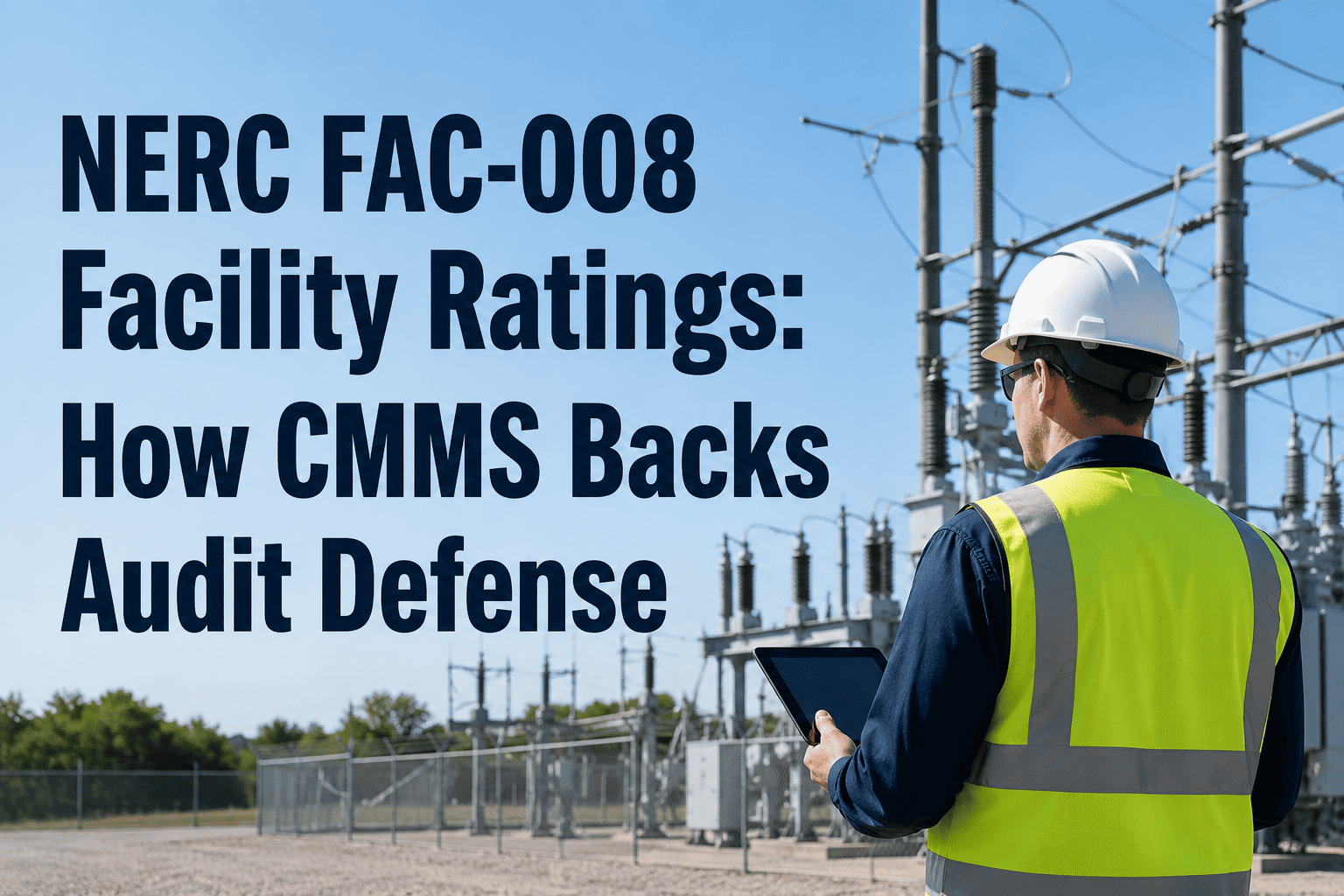
NERC FAC-008 requires every Transmission Owner and Generator Owner to establish, document, and maintain a defensible methodology for determining facility ratings — the thermal and electrical limits that govern how hard your equipment can be pushed. Most violations don't happen because operators don't know the rules; they happen because equipment changes go undocumented, rating reviews are skipped during busy outage seasons, and audit-time record retrieval turns into a scramble through disconnected spreadsheets and email chains. A CMMS built for FAC-008 compliance closes every one of these gaps by linking maintenance work orders directly to rating documentation — so every equipment change automatically triggers a rating review task, every update carries a full audit trail, and your entire ratings program is exportable in minutes, not days. Sign up free on OxMaint to see how automated work order traceability and equipment change workflows protect your facility ratings program at audit time.
NERC FAC-008 Facility Ratings: Audit Defense Starts With Your CMMS
Undocumented equipment changes are the #1 FAC-008 violation trigger. Learn how a structured CMMS turns rating methodology into an audit-ready, continuously maintained program — not a year-end fire drill.
What FAC-008 Actually Requires — Requirement by Requirement
FAC-008 is not a single rule — it is six interconnected requirements that build on each other. A compliance gap in any one triggers findings across the chain.
Turn Every Maintenance Work Order Into an Audit Evidence Record
OxMaint links equipment change work orders to FAC-008 rating review tasks automatically. When a transformer is replaced, a review task is generated, assigned, and tracked — with the originating WO, new rating, methodology reference, effective date, and approver signature all indexed under FAC-008 in a single exportable record.
Where FAC-008 Programs Break Down — and How CMMS Fixes Each Gap
Every FAC-008 enforcement case follows a predictable pattern. These are the four systemic gaps that auditors find most often — and the CMMS workflows that close them.
A substation transformer is replaced during a forced outage. The new unit has a different thermal rating. The maintenance team closes the work order and moves on. Nobody triggers a FAC-008 rating review. The old rating stays on file. Three years later, an auditor asks for the rating update record for that transformer — and there isn't one.
OxMaint assigns asset class flags to equipment types that require FAC-008 review on change. When a work order for a flagged asset is completed, a review task is automatically generated, assigned to the compliance coordinator, and linked to the originating WO — creating a mandatory, traceable review step that cannot be bypassed.
The FRM document is in a SharePoint folder. Some ratings use it. Others were calculated by a retired engineer using a personal spreadsheet model from 2009. Auditors ask for the calculation file behind a specific rating — and it doesn't match the current FRM. The finding: the FRM was not consistently applied.
Each rating record in OxMaint includes a mandatory methodology reference field — with version number, effective date, and approver — that links back to the current FRM. Every rating calculation must cite the governing FRM version, creating a verifiable chain between policy and execution across every asset.
Auditors give entities 24–72 hours to produce documentation during on-site reviews. If rating records are spread across email archives, local drives, and a legacy database that requires IT support to query, retrieval becomes a crisis — and incomplete production is treated as non-retention regardless of whether the data physically exists somewhere.
All FAC-008 records in OxMaint are tagged by standard, requirement number, and asset. A full compliance package — methodology, all rating records, change history, review tasks, effective dates, and approval signatures — is filterable and exportable as a structured report in under 10 minutes from any browser.
Equipment ratings are updated internally but the Transmission Operator and Reliability Coordinator are not notified within the required timeframe. If grid operators are making dispatch decisions using stale facility ratings, both the reliability risk and the R4 violation risk compound simultaneously.
OxMaint's notification workflow triggers an outbound communication task when a rating update is finalized, with a timestamped delivery record and recipient confirmation — satisfying the R4 notification requirement with a documented, auditable record of who was notified, when, and with what rating value.
FAC-008 Audit Evidence — What Auditors Request and Where OxMaint Stores It
Regional Entity auditors follow a consistent evidence request pattern. This table maps each standard request to the OxMaint record type that satisfies it.
| Auditor Request | Requirement | OxMaint Record Type | Retrieval Time |
|---|---|---|---|
| Current Facility Rating Methodology document | R1 | FRM document record with version history and effective dates | Instant export |
| All rating calculations for transmission assets | R2 | Asset rating records with methodology version citation and engineer approval | Filtered by asset class |
| Equipment changes that triggered rating reviews in last 3 years | R3 | Equipment change WO log with linked rating review task records | Date-range filter export |
| Proof ratings were communicated to TOP/RC | R4 | Outbound notification records with delivery timestamp and rating value | Standard report |
| Most Limiting Series Element identification for each facility | R5 | MLSE designation field on each facility asset record with engineering basis | Asset-level export |
| Full retention record for ratings program going back 3+ years | R6 | Immutable audit log of all rating records, changes, reviews, and approvals | Full program export |
FAC-008 Frequently Asked Questions
Every Equipment Change Is an Audit Risk. OxMaint Closes It Automatically.
From the moment a qualifying work order closes to the moment an auditor requests your FAC-008 records, OxMaint ensures every required step was taken, documented, and is retrievable in minutes — not weeks. Build a ratings program that defends itself.