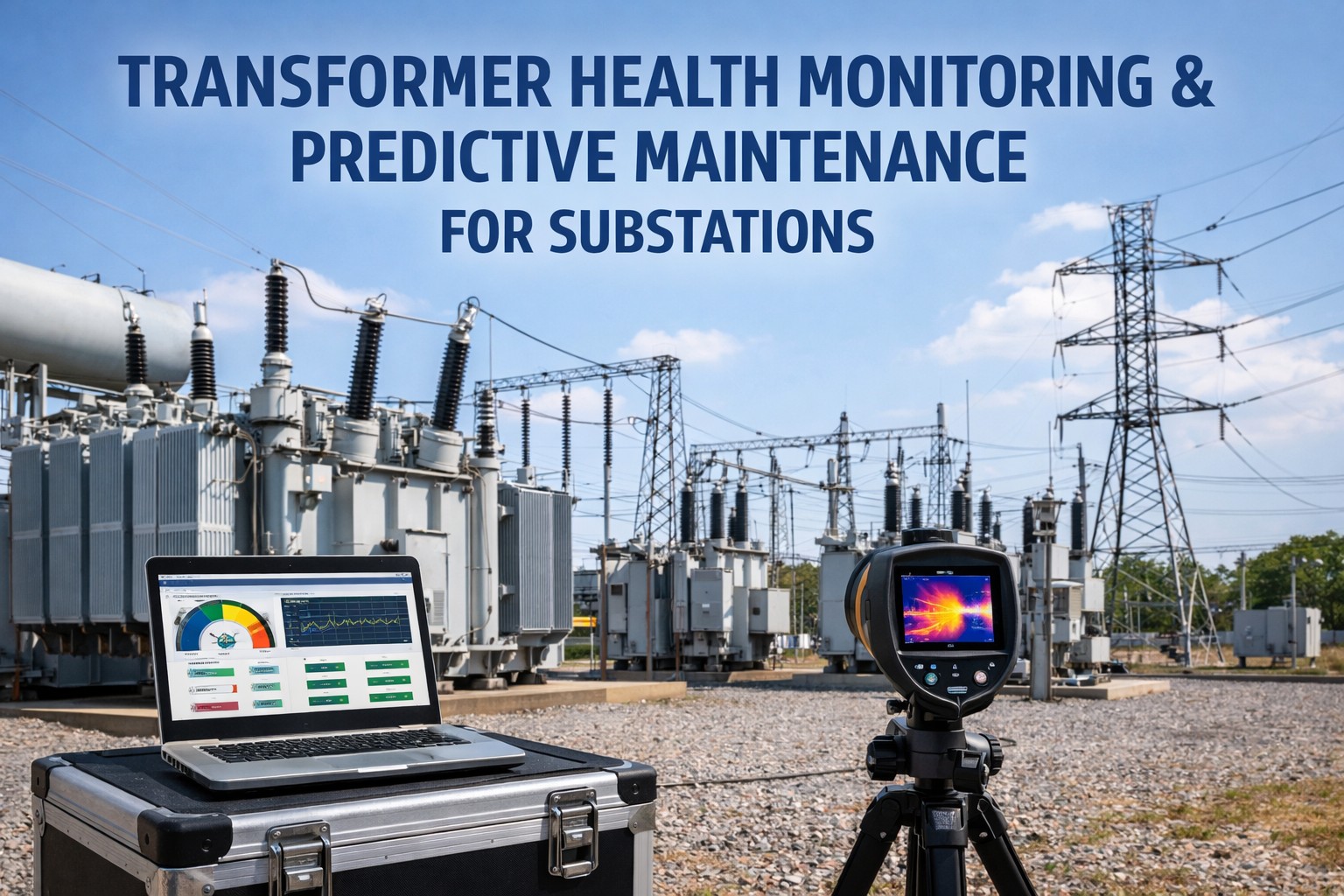
A substation is only as reliable as its least-maintained component. Circuit breakers that protect against fault currents, protective relays that coordinate tripping sequences, instrument transformers that supply accurate metering data, SF6 gas-insulated switchgear operating under continuous dielectric pressure, and station battery systems that must deliver full power to protection circuits on demand — each of these assets can fail silently, degrading over months before the failure becomes visible during an event. The traditional approach of fixed-schedule inspection cycles cannot detect the gradual deterioration that precedes most substation failures. Predictive maintenance, built on continuous sensor monitoring and AI-driven anomaly detection, changes the maintenance paradigm from calendar-driven to condition-driven — intervening at the moment data indicates risk, not the moment a failure occurs. Sign up on OxMaint to connect your substation assets to a predictive maintenance platform built for grid operations.
Substation Equipment Predictive Maintenance & Breaker Monitoring Guide
A complete guide to condition-based and predictive maintenance strategies for circuit breakers, protective relays, instrument transformers, SF6 switchgear, and station battery systems.
Fixed Schedules Cannot See Inside Your Substation Equipment
A circuit breaker inspected on a 3-year cycle and declared healthy can develop a coil current anomaly in month four that indicates imminent failure by month eight — and that failure will be invisible to every inspection scheduled after it. Machine learning models trained on over 120,000 substation failure cases can forecast transformer insulation breakdown 6–8 months in advance with 92% accuracy, but only when sensor data is being collected continuously. The calendar does not care about your asset condition. The asset condition does not care about your calendar.
Circuit Breaker Predictive Monitoring
Circuit breakers represent the highest-cost maintenance category in most substation budgets — circuit breaker maintenance costs exceed 40% of total substation expenses. They are also the asset class where condition monitoring delivers the fastest measurable ROI, because breaker failures during fault events cascade into zone-wide outages and equipment damage that dwarfs the cost of the monitoring program itself.
Protective Relay Maintenance & Testing
Protective relays are the substation decision-making layer — they must detect abnormal conditions and send accurate, timely trip signals to circuit breakers when faults occur. A relay that has drifted in its pickup settings, developed response time lag, or failed a firmware update silently will perform correctly during every routine test and fail precisely when the grid needs it most.
Applies test currents and voltages to relay input terminals to verify pickup thresholds, timing characteristics, and logic functions. Must be performed at commissioning and after any setting change. IEEE C37.90 and IEC 60255 govern relay testing requirements. Results logged as baseline for future deviation detection.
Modern numerical relays produce self-diagnostic data including power supply health, measurement circuit accuracy, and event records. OxMaint ingests this diagnostic stream and flags deviations from baseline — detecting firmware issues, measurement drift, and hardware degradation between formal test cycles.
Relay response time under test conditions should remain consistent within manufacturer tolerances across successive tests. A pattern of gradually increasing response time — even within the acceptable range — is a leading indicator of contact or processor degradation. OxMaint tracks test-over-test trends and generates a work order when the trajectory indicates threshold breach before the next scheduled test.
Relay settings must coordinate with upstream and downstream protection devices to ensure selective fault isolation. When new generation is added, load growth changes fault current levels, or system topology changes — relay coordination must be revalidated. OxMaint tracks coordination review dates and triggers revalidation work orders when system changes are logged.
Instrument Transformer Condition Monitoring
Current transformers (CTs) and voltage transformers (VTs) supply the measurement inputs that relays, meters, and SCADA systems depend on. An instrument transformer with degraded insulation or ratio error does not just create a metering inaccuracy — it supplies incorrect inputs to protection relays, causing them to operate incorrectly or fail to operate during actual faults.
SF6 Gas-Insulated Switchgear Monitoring
SF6 gas-insulated switchgear (GIS) provides exceptional space efficiency and insulation performance, but SF6 leakages make up 40–50% of minor failure frequency and up to 90% of GIS maintenance events. Continuous gas monitoring is not optional for a GIS installation — it is the primary mechanism by which the asset reliability is maintained. Beyond gas monitoring, GIS requires condition monitoring across three additional dimensions: partial discharge, mechanical performance of the circuit breaker mechanism, and humidity levels that affect dielectric integrity.
Continuous gas density measurement with temperature compensation distinguishes actual gas loss from apparent density changes caused by thermal variation. SF6 leakage rates must not exceed 0.5% per year per IEC standards. Advanced monitoring algorithms calculate the leakage rate and project the time to critical pressure loss — allowing planned intervention rather than emergency refill after a low-gas alarm trips the equipment offline.
Partial discharge within GIS insulation indicates developing defects — free metallic particles, protrusions, or insulation surface contamination — that will progress to dielectric breakdown if unaddressed. Electrical and acoustic sensors placed at maximum 20-meter intervals detect PD activity in real time. Early PD detection is the only warning available for insulation faults that leave no other measurable signature.
GIS circuit breaker mechanisms degrade through operating cycles — coil current waveform changes, timing deviation, and drive spring force variation all indicate mechanical wear. Non-invasive hall sensors and auxiliary switch signals monitor trip and close coil current, motor current, and operating times without taking the equipment offline. Results are stored as COMTRADE files for trend analysis.
Station Battery System Health Monitoring
Station batteries are the last line of defense in a substation. When AC supply fails during a fault event, the station battery must deliver full DC power to protection relay trip circuits, SCADA communications, and emergency lighting — without hesitation, without warning. A battery system that has lost capacity through sulfation, plate corrosion, or electrolyte degradation will appear healthy on a visual inspection and fail under load when the grid needs it most.
(6–18 months)
(2–6 months)
(Weeks to failure)
Predictive vs Preventive Maintenance — All 5 Substation Asset Classes
| Asset Class | Traditional Preventive Approach | Predictive Monitoring Approach | Key Monitoring Parameter | Lead Time Before Failure |
|---|---|---|---|---|
| Circuit Breaker | 3–5 year inspection cycle; offline timing tests only | Continuous coil current, timing, thermal, vibration monitoring | Coil current waveform + contact resistance | 8–12 weeks advance warning |
| Protective Relay | Annual secondary injection test; fixed settings review | Continuous self-diagnostic monitoring + test trend analysis | Response time trend + self-diagnostic flags | Detected between test cycles |
| Instrument Transformer (CT/VT) | Ratio and insulation tests on fixed annual or biennial cycle | Trending insulation power factor, partial discharge, oil DGA | Insulation power factor trend + PD level | 6–12 months advance warning |
| SF6 Switchgear (GIS) | Manual gas density checks; scheduled PD surveys | Continuous gas density, PD, humidity, mechanical monitoring | Gas leakage rate + PD event trend | Months before dielectric failure |
| Station Battery | Monthly visual inspection; annual discharge test | Continuous float voltage, impedance trending, thermal monitoring | Cell impedance vs baseline + thermal delta | 6–18 months advance warning |
| Lead times are indicative based on published research and utility case studies. Actual results depend on sensor density, data history, and asset operating conditions. | ||||
Scroll horizontally to view all columns on mobile
How OxMaint Connects Substation Condition Data to Maintenance Action
Predictive maintenance generates value only when a detected risk produces a documented, completed maintenance action — not just a dashboard alert. OxMaint closes the loop between sensor data and field execution, automatically generating work orders when AI risk thresholds are crossed, routing them to qualified technicians, and enforcing completion documentation that satisfies both operational and regulatory requirements.
OxMaint connects to SCADA, protection relay self-diagnostics, GIS monitoring systems, and battery monitoring units via IEC 61850, Modbus, or API. Existing infrastructure — no new hardware required at most sites.
Historical sensor data trains asset-specific baseline models. Live data is continuously compared against each asset learned normal — deviations matching failure precursor signatures are flagged with a probability score.
When risk score crosses threshold, OxMaint creates a predictive maintenance work order — asset ID, anomaly type, risk score, and recommended action pre-populated. Routed to qualified technician automatically.
Technician completes work on mobile — logs arrival time, parts used, and completes photo-documented closure. Immutable audit trail created. Asset health record updated in real time.
We had a GIS bay at a 132kV substation where the gas monitoring system was triggering low-gas alarms every 14 months. Each time, we refilled and reset the alarm — never knowing whether it was a slow leak or a real degradation trend. After connecting the monitoring data to OxMaint AI, the system identified that the leakage rate had increased by 40% over 18 months. We scheduled an investigation during the next planned outage and found a deteriorating flange seal. One planned repair, logged with full documentation. No emergency outage, no uncontrolled gas release, no SCADA event. That is what continuous monitoring connected to a maintenance system actually looks like.
Substation Predictive Maintenance — Frequently Asked Questions
What is the most cost-effective first step for a utility starting substation predictive maintenance?
How does breaker timing analysis detect developing mechanical failures?
What SF6 monitoring is required to meet IEC standards for GIS maintenance?
How often should station batteries be tested for capacity under IEEE standards?
Can OxMaint integrate with existing substation monitoring systems and relay management platforms?
Every Substation Asset Has a Failure Story. Start Reading It Before the End.
OxMaint monitors circuit breakers, protective relays, instrument transformers, SF6 switchgear, and station batteries through a single platform — connecting condition data to automatic work orders, field execution, and compliance-ready documentation. Start with your most critical assets today.