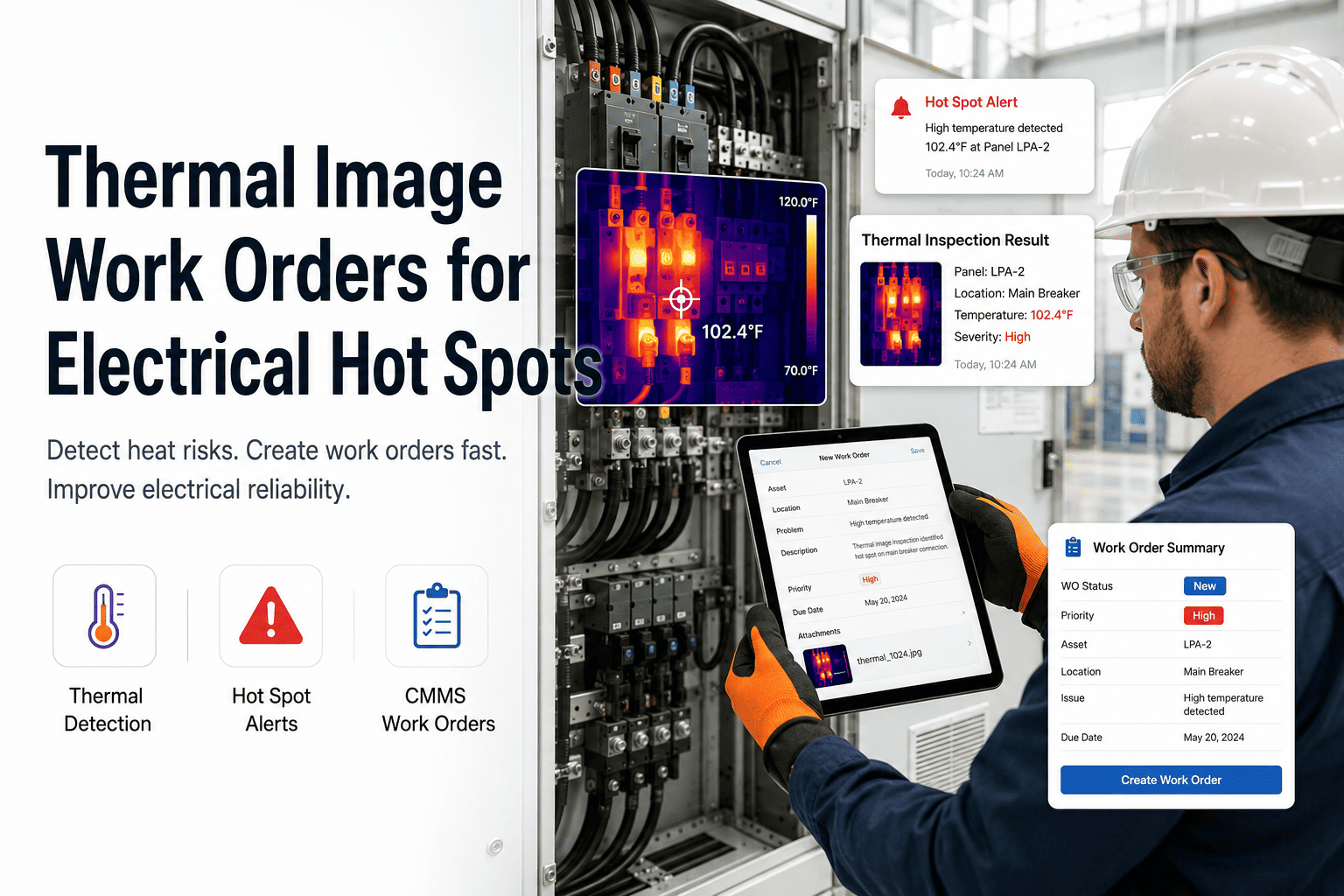
At a 480 MW coal plant, a high-resistance connection on a 33kV busbar had been developing for seven months before a thermal imaging survey finally identified it — running 84°C above ambient temperature. The subsequent scheduled repair during an opportunistic outage took four hours. Had the connection failed in service, the resultant arc flash would have destroyed the switchgear panel, required six to eight weeks for replacement equipment procurement, and cost an estimated $7.1 million in outage revenue and emergency capital expenditure. The thermal signature had been present every time the panel was energised. The problem was not the absence of heat — it was the absence of a systematic thermal image work order workflow that converts infrared findings into scheduled repairs before failure occurs. Sign up for Oxmaint to build thermal imaging into your plant's electrical inspection and work order workflow, or book a demo to see thermal work order management configured for your electrical asset inventory.
Thermal Image Work Orders for Electrical Hot Spots
A structured system for converting thermographic inspection findings into classified, prioritised, and tracked CMMS work orders — closing the gap between identifying an electrical hot spot and completing the repair before it becomes a failure.
Why Thermal Surveys Alone Don't Prevent Electrical Failures — The Work Order Gap
Most power plants now conduct annual or semi-annual thermographic surveys of their electrical equipment. The surveys routinely identify Class 2, 3, and even Class 4 hot spots. Yet electrical failures attributable to conditions that had been thermographically identified continue to occur. The gap is not in detection — it is in the workflow between detection and repair.
Certified thermographer surveys 240 panels and switchgear assemblies. 23 hot spots identified. PDF report with thermal images produced.
23-page PDF with thermal images lands in the maintenance manager's inbox. Three people are cc'd. No structured handoff. No work orders created automatically.
The maintenance planner manually reads the PDF, creates work orders for the findings they identify as urgent, and files the rest for "review later." This takes 2–3 days. Four Class 3 findings are not actioned this cycle.
No system tracks whether the unactioned findings from the survey have been repaired. They are not re-inspected until the next survey. The next survey may find them worse — or find the equipment has already failed.
Every Thermal Hot Spot Finding Should Become a Tracked Work Order Within 24 Hours — Not a Line in a PDF Report
Oxmaint converts thermographic survey outputs — from contractor PDF reports, radiometric image files, or mobile in-house inspections — into classified, prioritised, and tracked CMMS work orders linked to specific assets with the thermal image, temperature delta, and repair recommendation embedded in the work order record.
Electrical Assets That Require Thermographic Inspection and Work Order Management in a Power Plant
| Asset Type | Key Hot Spot Locations | Recommended Survey Frequency | Failure Consequence | Class 4 Response Time |
|---|---|---|---|---|
| HV Switchgear (11kV–132kV) | Busbar connections, cable terminations, CT secondary circuits | Semi-annual | Busbar fault, arc flash, extended outage | Immediate |
| Main Power Transformers | HV bushings, LV bushings, tap changer contacts, cooling fan terminals | Semi-annual | Transformer fire, total loss, 4–12 week replacement lead time | Immediate |
| MV Motor Control Centres | Incoming cable lugs, contactor connections, overload relay terminals | Quarterly | MCC fire, loss of critical auxiliaries | Immediate |
| Generator Bus Duct | Expansion joint connections, phase-to-ground conductor supports, isolated phase bus joints | Semi-annual | Generator trip, forced outage, costly bus duct repair | Immediate |
| LV Distribution Panels | Main incomer connections, MCCB terminals, neutral bar connections | Annual | Panel fire, loss of LV supply to control and protection systems | Within 30 days |
| Battery Chargers and UPS | DC bus connections, rectifier thyristor connections, battery terminal connections | Annual | Loss of DC control supply, protection system failure | Immediate |
| Cable Trays and Terminations | Cable bundle hot spots (overloading), termination block connections | Annual | Cable fire, multiple circuit loss | Within 30 days |
From Thermographic Image to Closed Work Order — Every Step in the Oxmaint Platform
Thermographic images — from in-house FLIR cameras, drone thermal surveys, or contractor survey outputs — are uploaded directly to the relevant asset record in Oxmaint via the mobile app or desktop interface. Each image is linked to the specific asset, tagged with the inspection date, ambient temperature, and equipment load at time of survey.
Oxmaint's AI thermography module reads the maximum temperature, reference temperature, and temperature delta from radiometric image files — or accepts manually entered delta values from standard thermal JPEGs. The finding is automatically classified to IEC/NETA severity class (1–4) based on the delta and asset type, determining the urgency of the generated work order.
A CMMS work order is created containing the thermal image with annotated hot spot location, the temperature delta and severity classification, the asset's previous thermal inspection record, the standard recommended corrective action for that finding type, required isolation and PTW category, and estimated repair time from the Oxmaint library for that fault type.
Class 1 findings are assigned a 90-day re-inspection work order. Class 2 findings are added to the next planned outage work scope. Class 3 findings generate a priority work order with a 30-day completion deadline. Class 4 findings trigger an immediate notification to the shift supervisor and electrical superintendent, with a recommendation to assess load reduction or planned de-energisation.
The work order requires a post-repair thermal or visual verification image before it can be closed. This ensures that connection torquing, terminal replacement, or cable retermination has actually resolved the hot spot — not simply that the repair task was marked complete on paper. The post-repair thermal image is stored alongside the original finding in the asset's permanent record.
Every thermal finding and repair creates a longitudinal data point in the asset's thermal health dashboard. Reliability engineers can see whether a connection's temperature delta is stable, improving post-repair, or trending upward across successive surveys — enabling a condition-based replacement decision before the connection reaches a Class 4 failure threshold for the second time.
Thermal Imaging Work Orders — Questions from Electrical and Reliability Teams
Oxmaint processes thermographic findings from all sources: contractor-supplied PDF reports with thermal images and delta temperature readings can be bulk-imported using Oxmaint's structured data entry interface, where a data entry operator converts each PDF finding into a structured work order in an average of three minutes per finding. Radiometric image files (RJPEG, R-JPEG) from FLIR, Fluke, and Optris cameras are processed natively by the AI module. For organisations conducting in-house surveys, the Oxmaint mobile app captures thermal images directly from paired thermal cameras and populates the work order template in the field. All three methods produce identical structured work order outputs. Book a demo to see bulk survey import for a 50-finding thermographic report.
For Class 3 and Class 4 findings on energised equipment requiring a planned isolation window, Oxmaint captures the finding in a deferred work order with the required isolation type (full outage, partial de-energisation, or live work with appropriate protection) pre-specified. The work order is flagged in the outage planning queue for inclusion in the next available isolation opportunity, with the thermal image and severity classification visible to the outage planner. The system tracks how long the finding has been open against its severity class deadline, escalating to the electrical superintendent if the deadline is passed without an isolation window being scheduled. Sign up to configure deferred thermal work orders with isolation window tracking.
Yes. Oxmaint's thermal work order records are structured to meet the documentation requirements of NETA MTS (Maintenance Testing Specifications), IEEE 1584 arc flash assessment programmes, and insurance-mandated thermography documentation from major power plant insurers including Zurich, FM Global, and Liberty Mutual. Each closed thermal work order produces a permanent record containing the original finding image, temperature data, severity classification, isolation and repair details, post-repair verification image, and completion date — in a format directly usable for insurance survey evidence, NETA compliance reports, and insurer thermography programme verification. Book a demo to review a sample thermal compliance report package.
Oxmaint's AI thermography module includes image quality assessment as a pre-processing step. Images below the minimum resolution threshold (160×120 pixels for basic hot spot detection) are flagged for re-capture rather than processed with a false-confidence result. For borderline-quality images, the AI provides a confidence score alongside the temperature reading — and recommends re-inspection under better conditions when confidence is below 70%. The system also checks for required reference temperature data: without a known ambient or reference point, temperature delta calculations cannot be made, and the system prompts for the missing input rather than generating a classification based on absolute temperature alone. Sign up to review image quality requirements for your camera equipment.
Yes. Oxmaint's thermal compliance dashboard shows every electrical asset in the plant's thermographic inspection programme, with the date of last thermal inspection, days since last inspection, next scheduled inspection date, and an overdue flag for assets that have passed their inspection interval without a completed survey on record. Plant electrical managers use this view to prioritise contractor survey scope, identify assets that have drifted out of inspection programme compliance, and generate the thermographic inspection schedule for the coming quarter. The dashboard exports as a structured report for insurance programme annual submissions. Book a demo to see the thermal compliance dashboard for your electrical asset inventory.
A Thermal Hot Spot Identified But Not Tracked Is a Failure Waiting to Be Scheduled
Oxmaint converts every thermographic finding — regardless of source — into a structured, classified, and tracked work order linked to the specific electrical asset, with the thermal image and repair deadline embedded in the record. No more untracked PDF findings. No more hot spots that age to failure.