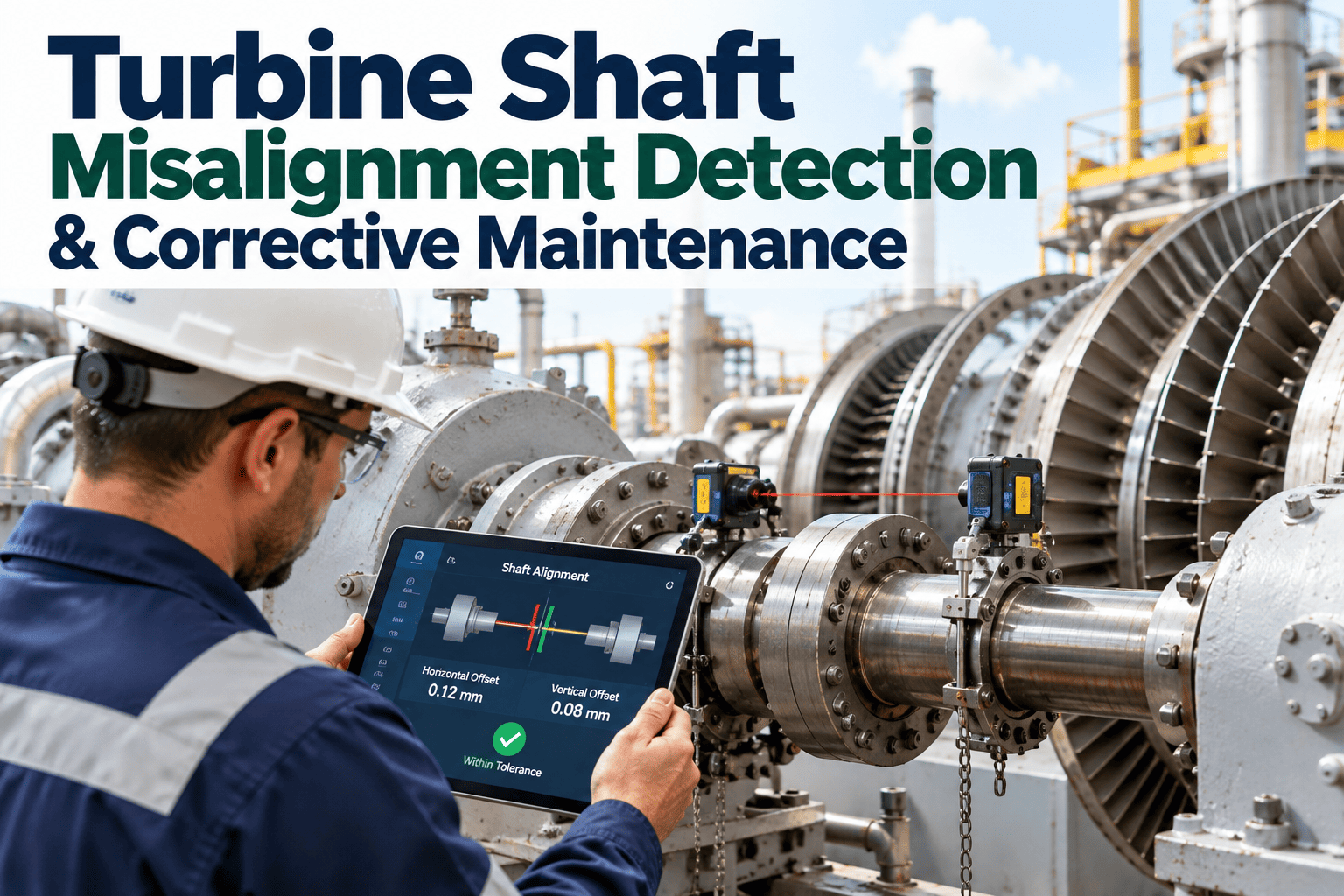
Turbine Shaft Misalignment Detection & Corrective Maintenance

By William Jerry on September 23, 2026

turbine-shaft-misalignment-detection-maintenance

Shaft misalignment doesn't announce itself. It shows up as a bearing that runs 8°C hotter, a coupling that's shedding elastomer dust, a 2× running-speed vibration peak the analyst almost missed. Left alone, it becomes a bearing failure, a seal failure, or a coupling that flies apart at 3,600 RPM. The maintenance discipline that catches it is a mix of vibration signature reading, thermography, laser alignment and a corrective workflow that verifies the fix before the machine goes back into service. This guide walks it using OXMAINT AI, the AI-powered CMMS for rotating equipment reliability teams.

Rotating Equipment · Turbines · Shaft Alignment

The Coupling Is Warm. The 2× Peak Is Rising. Is It Misalignment?

OXMAINT AI, the AI-powered CMMS/maintenance management software, connects the full shaft alignment workflow on one platform — vibration and thermography readings in, misalignment defects raised and prioritised, work orders assigned with laser alignment procedure, and post-work verification signed before return to service.

Vibration Signature Detection Laser Alignment WO Workflow Post-Work Verification Log
2×
running-speed vibration peak — the classic misalignment fingerprint
3 Types
of misalignment — parallel, angular, combined (the usual case)
4 Signals
that reveal it — vibration, temperature, coupling wear, oil analysis
Before/After
the two readings that make a corrective WO defensible

The 3 Misalignment Types — Know Which One You're Chasing

"Misalignment" is three different problems with three different signatures and three different corrections. Getting the type wrong wastes an alignment window. OXMAINT AI holds the type as a defect attribute — the WO carries the right procedure. Sign up free and configure your alignment defect library in OXMAINT AI.


Parallel Offset
Shaft centrelines parallel but offset — coupling shears radially each rotation
Signature: strong 2× radial vibration, both bearings


Angular
Shaft centrelines meet at coupling but at an angle — coupling flexes each rotation
Signature: strong 1× axial vibration, phase reversal across coupling


Combined
Parallel + angular together — the usual real-world case, requires 4-position alignment
Signature: mixed 1× and 2× radial + axial vibration

The 4 Detection Signals — What Actually Tells You

No single reading proves misalignment. Four signals together build the case. OXMAINT AI holds all four against the shaft asset so the pattern surfaces even when no single reading crosses an alarm threshold. Book a demo to see the signal integration live.

01
Vibration Spectrum
Dominant 1× and 2× running-speed peaks · phase analysis across coupling · axial component present
Tool: portable analyser or online sensor
02
Bearing Temperature
Running temperature rising against baseline · one bearing hotter than paired · thermography imaging
Tool: RTD trend + IR camera
03
Coupling Condition
Elastomer dust or debris in guard · wear pattern on jaw or spider · looseness at bolts
Tool: visual inspection at PM
04
Oil Analysis
Wear-particle trend rising — bronze/babbitt for journal, iron/nickel for anti-friction, seal debris
Tool: lab sample + ferrographic analysis

The Vibration Fingerprint — Reading the Spectrum

A vibration spectrum tells you what's wrong faster than any other diagnostic. Misalignment has a specific fingerprint: 1× and 2× peaks with axial content and phase reversal across the coupling. OXMAINT AI stores the reading against the machine so the trend surfaces before the alarm does. Start free and log your first vibration reading in OXMAINT AI.

Vibration Spectrum — Aligned vs Misaligned (Illustrative)
Aligned Baseline

1×

2×

3×

4×

5×
Misalignment Signature

1×

2×

3×

4×

5×
Aligned: 1× dominant, minor harmonics. Misaligned: elevated 2× peak (classic fingerprint) + strong 1× + axial content.

The Detection-to-Correction Workflow

Every alignment case walks the same rails — signal detected, defect raised, isolation planned, alignment executed, verification logged, return to service signed. OXMAINT AI moves the whole chain on one WO. Book a demo to see the corrective workflow live.

1
Signal Captured
Vibration reading + bearing temp trend + coupling inspection all logged against the machine's asset record
2
Defect Raised
Reliability engineer classifies misalignment type (parallel/angular/combined) and severity — WO opened
3
Isolation & Permit
LOTO applied, mechanical isolation confirmed, hot-work / confined-space permit issued if required
4
Pre-Work Baseline
Cold laser alignment reading captured — offset and angle values recorded before adjustment
5
Alignment Executed
Shims added/removed, feet-moved calculations applied, coupling re-fitted to OEM torque spec
6
Post-Work Verification
Second laser reading confirms tolerance · running vibration check after warm-up · both attached to WO
7
Return to Service
Signed release with before/after readings retained on the shaft's life-of-asset ledger

Before Reading. After Reading. Both Signed. Every Time.

OXMAINT AI enforces the pre-work and post-work alignment readings inside the WO — no shaft goes back into service without both attached, both signed and both retained forever.

Alignment Tolerance Table — What "Good" Looks Like

Tolerance depends on running speed. A tolerance that's fine for a 900 RPM pump kills a 3,600 RPM turbine coupling in months. OXMAINT AI holds tolerance per machine so the WO carries the right acceptance criteria. Sign up free and load your alignment tolerance library.

Running SpeedExcellent (mils)Acceptable (mils)Angular Face (mils/in)
Up to 1,200 RPM≤ 3.0≤ 6.0≤ 1.0
1,200–1,800 RPM≤ 2.5≤ 5.0≤ 0.8
1,800–3,600 RPM≤ 2.0≤ 4.0≤ 0.6
3,600–7,200 RPM≤ 1.5≤ 3.0≤ 0.4
Over 7,200 RPM≤ 1.0≤ 2.0≤ 0.3
Illustrative guide values — always use OEM tolerance spec for the specific machine and coupling type.

Thermal Growth — The Correction Most Teams Miss

A cold alignment that's perfect can be badly wrong at operating temperature. Turbine casings and pump housings grow at different rates when hot — the correct cold-alignment target compensates for that growth. OXMAINT AI holds the OEM thermal growth targets per machine so the alignment tech sets to the right cold offset. Book a demo to see thermal growth compensation live.

Cold Machine
Ambient temperature — measurement condition · target is offset from centreline, not on it
Reading: at rest, isolation applied
►
OEM Growth Data
Manufacturer's specified thermal growth (vertical + horizontal) per machine at operating temperature
Reading: from OEM manual · loaded to CMMS
►
Cold Target
Cold-alignment target = OEM growth reversed — machine drifts into perfect alignment when it warms up
Reading: applied via laser tool
►
Hot Verification
Running vibration after warm-up confirms the growth calculation was correct
Reading: online sensor or portable at temp

Failure Consequences — Why the Discipline Pays

A shaft alignment programme costs a fraction of what a single bearing failure or a wrecked coupling costs — and that's before counting the forced outage. Three consequence patterns show up repeatedly in mis-aligned rotating equipment. OXMAINT AI holds each as an escalation trigger. Start free and configure your escalation triggers in OXMAINT AI.

Bearing Failure
Loaded side of bearing wears faster · Babbitt fatigue · anti-friction race spalling · coastdown risk
Coupling Destruction
Elastomer shred · jaw wear · disc-pack failure · risk of coupling breakup at speed
Seal & Shaft Damage
Mechanical seal face wear · shaft fretting under seal · seal leak · secondary bearing contamination

What OXMAINT AI Gives a Rotating Equipment Team

Purpose-built for the shaft alignment discipline — one platform behind the vibration analyser, the laser tool, the WO and the ledger. Start free and load your rotating equipment fleet into OXMAINT AI.

Signal Integration
Vibration, temperature, coupling inspection and oil analysis all logged against the same shaft asset.
Type-Tagged Defects
Parallel, angular or combined — the WO carries the right corrective procedure per type.
Before/After Enforcement
WO closure blocked until pre-work and post-work laser readings are attached and signed.
Tolerance Per Machine
Speed-based tolerance library — the WO's acceptance criteria match the machine, not a generic table.
Thermal Growth Targets
OEM cold-offset targets loaded per machine — alignment tech sets to the right cold value.
Life-of-Asset Ledger
Every alignment event retained on the shaft — trend visible across years, not just this WO.
"

We used to have alignment done and shrug when the vibration came back four months later. Nobody had the before and after readings side-by-side to see whether the alignment was actually good, whether it drifted, or whether the pattern was always the same. When the CMMS started forcing the pre- and post-readings onto the same WO, and holding them against the shaft for its life, we finally had the evidence to argue about the root cause.

Rotating Equipment Reliability Engineer · Combined-Cycle Power Plant

Frequently Asked Questions

Can OXMAINT AI ingest data from our vibration analyser or online monitoring system?
Yes — readings can be imported from portable analysers (CSV/API) or streamed from online systems via OPC UA/Modbus. Every reading lands on the shaft's asset record for trending. Sign up free and connect your first analyser.
Does the platform integrate with laser alignment tools?
Most modern laser tools export CSV/JSON alignment reports. These attach to the WO as pre-work and post-work evidence with offset and angle values captured as structured data. Book a demo to see the laser tool integration.
How do we handle machines where OEM thermal growth data isn't available?
The platform supports both OEM-supplied targets and calculated growth from thermal analysis. Where neither exists, a cold-alignment target with a post-warm-up verification WO is the fallback. Start free and set up thermal targets.
Can we trend vibration over multiple years on the same machine?
Yes — readings retain on the asset for its full service life. Trend charts span every alignment event, every bearing swap, every coupling change. Book a demo to see the multi-year trend view.
How long does implementation typically take?
Most operators go live on the shaft alignment workflow within 2–3 weeks. Vibration data ingestion and OEM tolerance loading typically complete within the following month. Sign up free and start this month.

Detect. Correct. Verify. Repeat.

Move your shaft alignment programme onto OXMAINT AI — signal integration, type-tagged defects, before/after enforcement, thermal growth targets and a life-of-asset ledger per shaft.


Share This Story, Choose Your Platform!