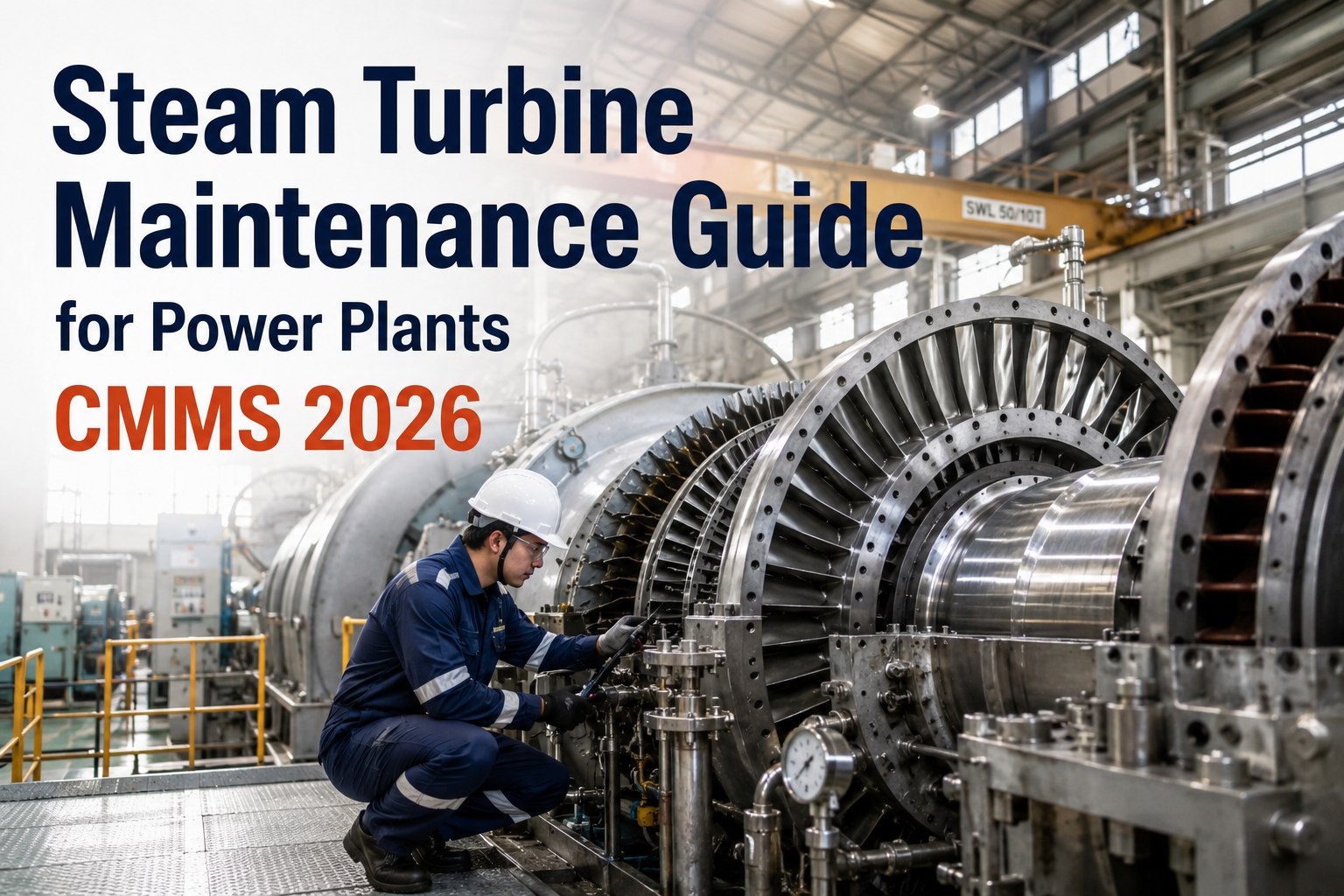
The turning gear is a small drive protecting a very expensive rotor. Its one job is to keep a hot turbine shaft rotating slowly as it cools, so it cools evenly instead of sagging into a bow. Let it fail on a shutdown and a bowed rotor means heavy vibration, blade rubs and a turbine that won't restart. This checklist keeps the gear, its lube supply and its drive ready — and OXMAINT AI, the AI-powered maintenance management software, schedules the checks and turns any fault into a work order.
Steam Turbine Systems · Turning Gear Maintenance Checklist · 2027
Turbine Turning Gear Maintenance Checklist for Power Plants
The turning gear earns its keep in the hours after a trip — barring the rotor over while it's too hot to stand still. This checklist covers engagement, lubrication, the drive and rotor rotation across shutdown, and OXMAINT AI keeps every check on schedule.
TRIP / SHUTDOWN
Rotor hot, stops driving
→
TURNING GEAR ON
Barring slowly, cooling even
→
COOLDOWN COMPLETE
Rotor straight, safe to stop
Why It All Comes Down to Rotor Bow
Every item here traces to one failure the turning gear prevents. A still hot rotor cools faster underneath than on top, so the shaft bows — and even a few thousandths throws the machine out of balance. Slow rotation averages the cooling all the way around. Start free and put turning-gear readiness on a tracked schedule in OXMAINT AI.
Uneven cooling
A still rotor loses heat faster at the bottom than the top, so the shaft bends toward the cooler side.
Rotor bow
That thermal distortion bows the shaft off its centreline — a bend measured in thousandths that unbalances the rotor.
Vibration & rubs
A bowed rotor spun up vibrates hard and can rub blades against the casing or seals — real, costly damage.
Failed restart
A bowed rotor may trip on high vibration and refuse to come up to speed until it's slow-rolled straight again.
The Turning Gear and Its Supporting Systems
The turning gear depends on lube oil at the bearings and a drive that engages reliably. A gap in any one is a gap in rotor protection, so the checklist covers all three. Book a demo to map your turbine auxiliaries in OXMAINT AI.
Turning / Barring Gear
The gear and clutch that engage the rotor and rotate it slowly — plus the auto-engage logic that must act on a trip.
Lube & Jacking Oil
Oil film and jacking/lift oil that let the rotor turn without metal-to-metal bearing contact at low speed.
Drive Motor & Controls
The electric (or hydraulic) drive, its backup supply and the controls that start, engage and monitor barring.
The Turning Gear Maintenance Checklist
Work the groups by when they apply — before engaging, while barring, during shutdown service, and the backup checks for a trip. In the OXMAINT AI software the same checklist runs on a handheld and files itself against the turbine. Start free and run this checklist from any phone in OXMAINT AI.
Do Not SkipNever Spin Up a Rotor That May Be Bowed
If the turning gear stopped during cooldown, the rotor may have bowed. Bringing it straight to speed risks severe vibration and rubs — slow-roll it on the turning gear until eccentricity returns to normal first.
!Turning gear lost during cooldown — treat the rotor as possibly bowed
!Eccentricity above limit — slow-roll, don't accelerate
!Unusual vibration on a restart attempt — stop and re-bar
!Follow the OEM's hot-restart and rotor-straightening procedure
A Turning Gear That Fails at 3am Is a Rotor Nobody Is Watching.
The turning gear matters most when the control room is quiet and the plant is cooling down. OXMAINT AI keeps its PM on schedule and turns a loss of rotation into a work order — so the small drive that protects the big rotor never gets forgotten.
Where Turning Gear Problems Start
Turning-gear failures build from a missed lube check, a weak backup supply or a PM that kept slipping — all things a tracked schedule catches early. Start free and catch these before the next shutdown in OXMAINT AI.
Oil supply loss
Low lube or jacking-oil pressure lets the rotor drag on its bearings — the fastest way to damage at barring speed.
Engagement failure
A worn clutch or sticking mechanism that won't engage on a trip leaves the hot rotor standing still.
No backup power
An untested emergency supply means a grid loss during cooldown stops the rotor at the worst moment.
Gear & clutch wear
Pitted teeth or a slipping clutch that went uninspected until it finally lets go under load.
PMs that slip
An auxiliary that only runs on shutdowns is easy to defer — until the shutdown it's needed on.
Dead alarms
Loss-of-rotation or low-oil alarms not tested, so a failure in the quiet hours goes unnoticed.
How OXMAINT AI Keeps the Turning Gear Ready
The turning gear is exactly the kind of asset a CMMS was made for — critical, low-profile and easy to overlook. OXMAINT AI schedules its PM, captures the shutdown checklist, raises a work order on any fault, and keeps its history tied to the turbine. Book a demo to see the turbine-auxiliary workflow in OXMAINT AI.
PM SCHEDULING
Turning-gear, lube and drive PM scheduled automatically with overdue escalation, so an auxiliary never slips.
SHUTDOWN CHECKLIST
The pre-engage, barring and shutdown checks run on a handheld and file as time-stamped records against the turbine.
ALARM → WO
Loss of rotation, low oil or high eccentricity opens a work order automatically, with the asset and reading attached.
ASSET HISTORY
Every inspection, oil change and repair tied to the turning gear and its turbine for trend and overhaul planning.
SPARES READY
Clutch parts, filters and lube tracked in inventory, so a shutdown repair isn't waiting on a part.
OVERHAUL RECORD
A complete, retrievable record for turbine overhauls, audits and reliability review across every outage.
Expert Review
This is a general framework for turning (barring) gear maintenance. The actual barring speed, oil pressures, eccentricity limits, cooldown duration and rotor-bow recovery steps come from the turbine OEM's manuals and your plant procedures, which take precedence — and a bowed rotor must never be accelerated to speed. OXMAINT AI schedules the checks, captures the checklist and keeps the turbine's history; it supports your teams' procedures, not OEM guidance, protective controls or operator judgement.
Frequently Asked Questions
What does the turning gear (barring gear) do on a steam turbine?
It slowly rotates the rotor during cooldown (and start-up warming) so it cools evenly instead of sagging toward its cooler underside — which is what prevents rotor bow. A small drive protecting a very expensive shaft.
Book a demo to see turbine-auxiliary PM in OXMAINT AI.
What is rotor bow and why does the turning gear prevent it?
A thermal bend in the shaft from a hot rotor cooling unevenly while it sits still — the bottom cools faster, so it curves. Even a tiny bow causes heavy vibration and rubbing on spin-up. The turning gear prevents it by rotating the rotor so every side cools at the same rate.
Book a demo to see how a CMMS protects against it.
Why is lube oil so important during turning-gear operation?
At barring speed the rotor turns too slowly to form a full oil film, so jacking (lift) oil keeps the shaft off the bearing metal. Lose oil pressure and you get metal-to-metal contact and fast bearing damage — which is why oil pressure is the first pre-engagement check.
Book a demo to see oil-supply and PM tracking in OXMAINT AI.
What happens if the turning gear fails during cooldown?
The rotor may stop while still hot and begin to bow. It must not be brought to speed — slow-roll it on the turning gear (once rotation and oil are back) until eccentricity is normal, per the OEM procedure. Hand-barring is the fallback if the drive is lost.
Book a demo to see loss-of-rotation alarms raise a work order.
How does a CMMS help with turbine turning-gear maintenance?
It schedules the gear, lube and drive PM so a shutdown-only auxiliary never slips, runs the checklist as a digital record against the turbine, and raises a work order automatically on loss of rotation or low oil — with full history for overhaul planning.
Book a demo to see the full turbine workflow in OXMAINT AI.
Keep the Small Drive That Saves the Big Rotor Ready for Every Shutdown.
Run turbine turning-gear maintenance on the OXMAINT AI maintenance management software — scheduled PM, a digital shutdown checklist, loss-of-rotation alarms that open work orders, and a full history for every overhaul. Protect the rotor before the next cooldown, not after a bow.