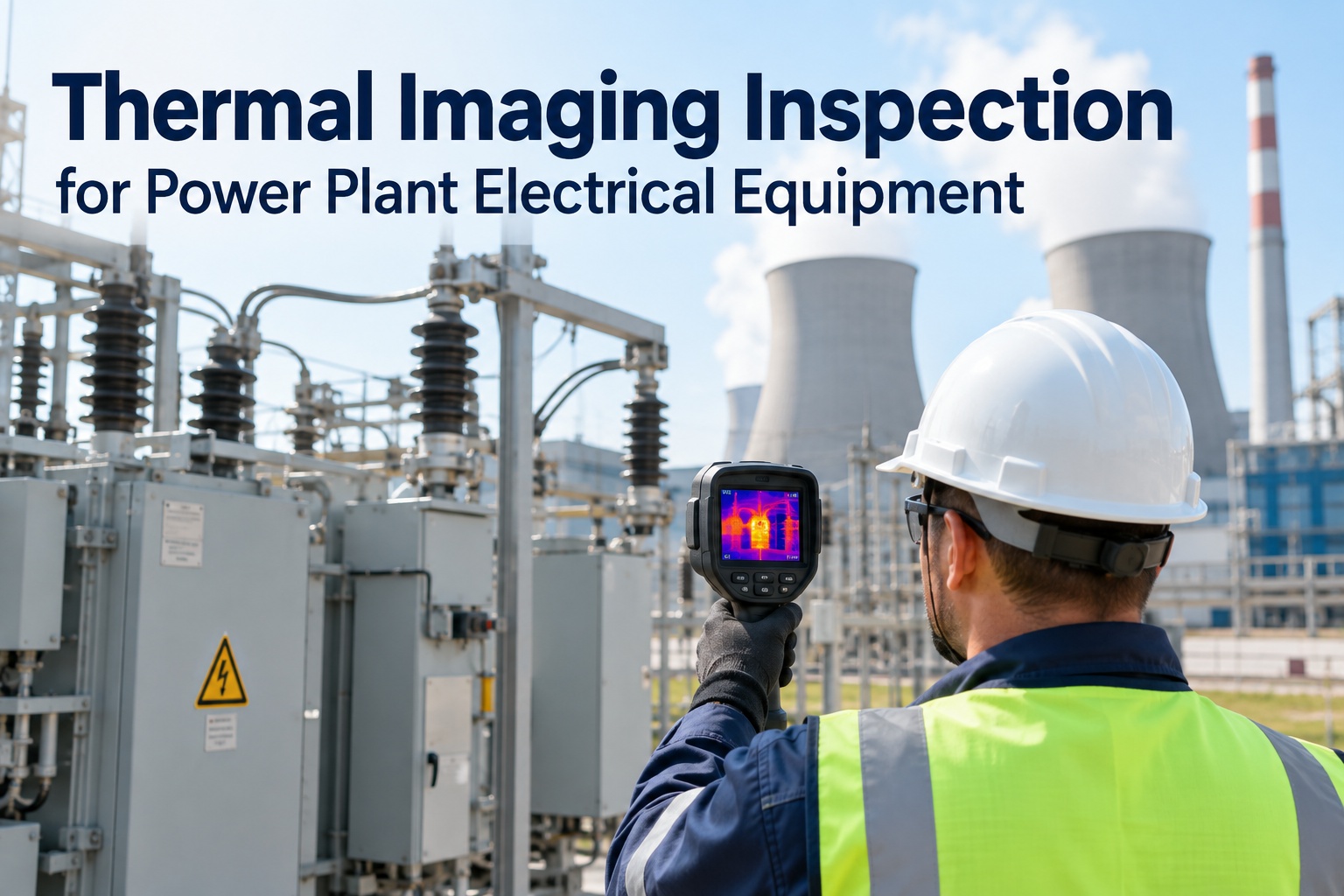
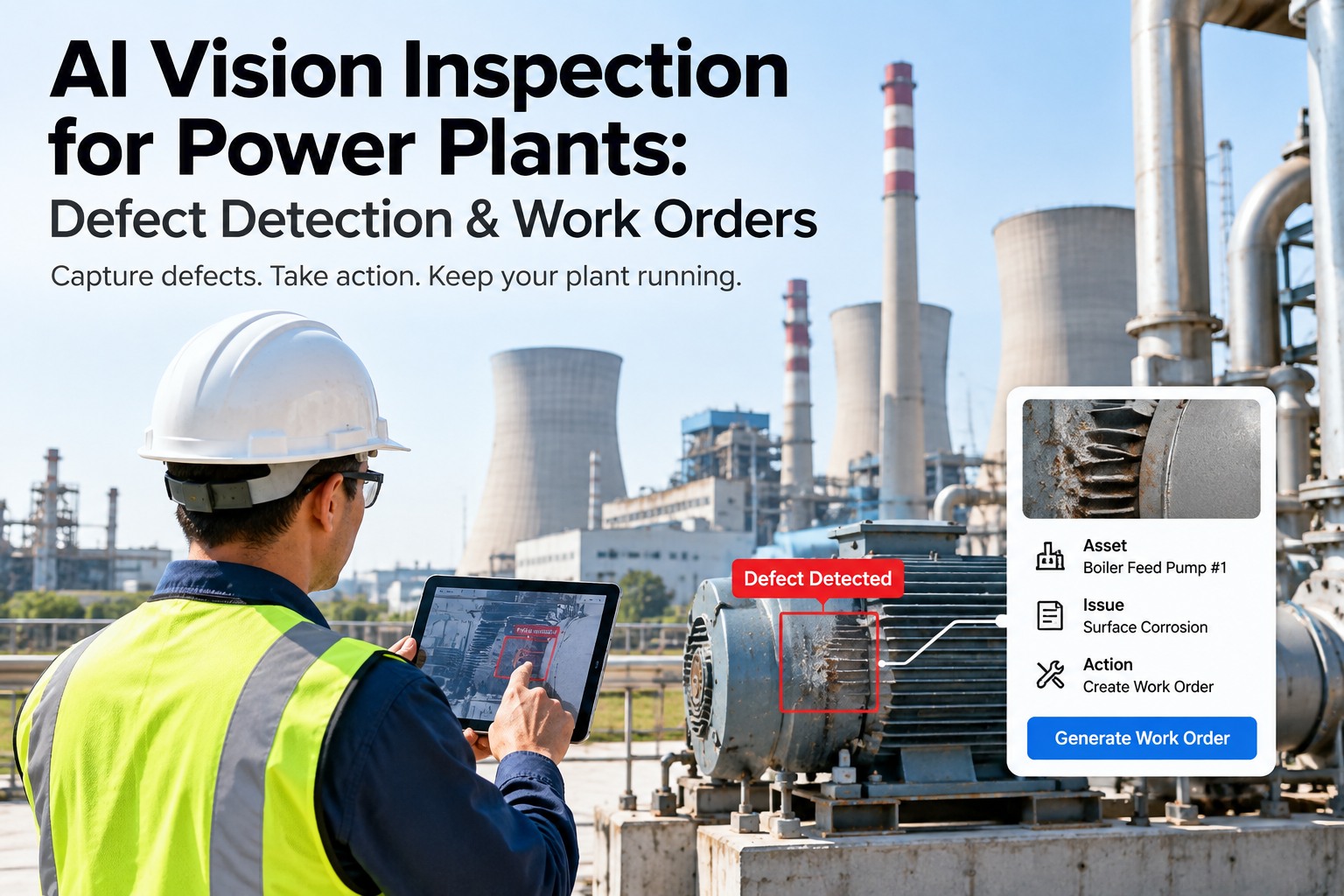
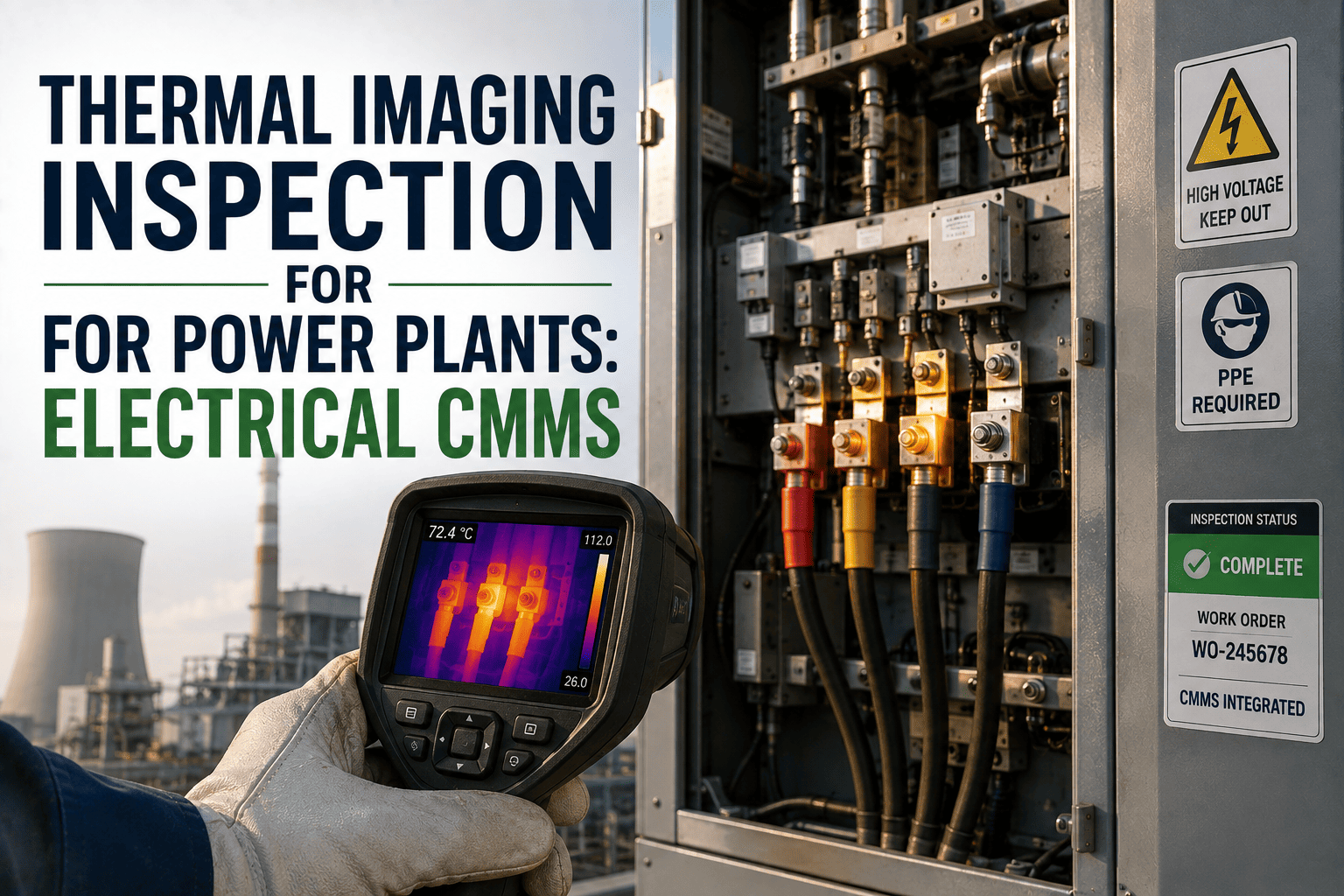
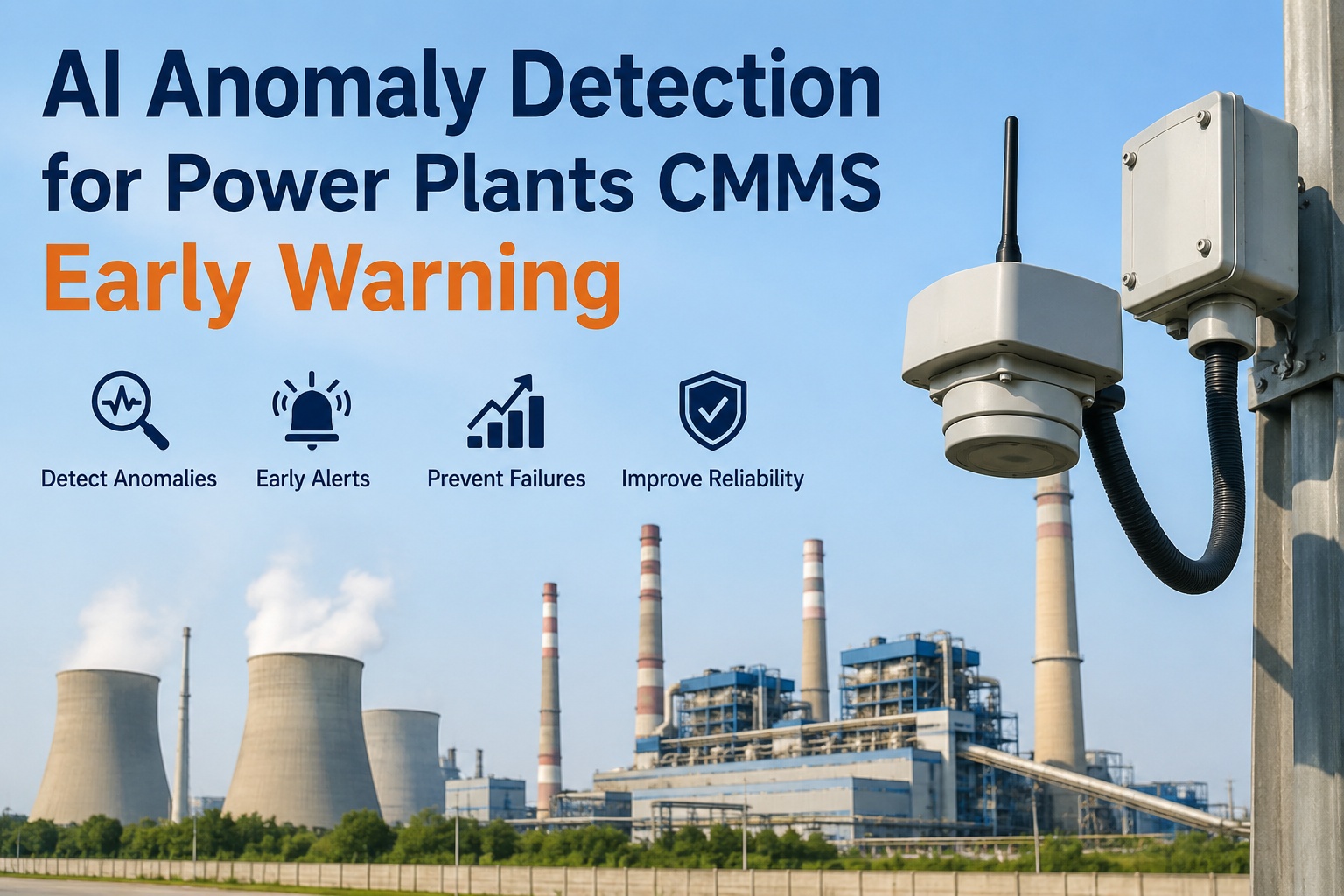
Power plant electrical failures rarely announce themselves — until a switchgear unit overheats, sparks, or trips an entire distribution bus offline. Traditional manual inspections catch maybe 40% of developing faults before they become emergencies. AI vision-based switchgear inspection changes this equation: camera-mounted thermal and optical sensors continuously monitor every panel, cabinet, and busbar — flagging anomalies the moment they appear and pushing automated work orders directly into your CMMS, so maintenance teams respond in minutes instead of discovering failures during outages.
AI Vision Switchgear Inspection in Power Plants: Real-Time Fault Detection with CMMS
How thermal cameras, smoke detectors, and AI anomaly models integrate with CMMS to catch overheating, arcing, and insulation breakdown before they cause catastrophic electrical failures.
Why Traditional Switchgear Inspection Fails Power Plants
Switchgear operates under continuous electrical stress — thermal cycling, load fluctuations, humidity ingress, and aging insulation all create failure pathways that manual quarterly inspections simply cannot track. By the time a technician sees visible scorching or smells burning insulation, the fault has usually progressed to the point of imminent failure.
Inspection Gaps Create Blind Spots
Manual rounds happen weekly or monthly. Thermal events, connection loosening, and insulation degradation develop continuously — often reaching critical thresholds between inspection cycles with no one watching.
No Automatic Work Order Trigger
Even when a tech spots a warm terminal or discoloration, the path from observation to work order is manual — subject to memory, shift handover gaps, and paperwork delays that allow faults to worsen.
High-Voltage Entry Risk
Energized switchgear inspections expose technicians to arc flash and electrocution hazards. NFPA 70E compliance requirements mean many inspections are deferred or inadequately performed for safety reasons.
No Fault History for Root Cause
Without continuous monitoring data, failure investigations rely on reconstructed timelines. Pattern analysis — identifying which assets fail repeatedly — is impossible without a structured data infrastructure.
How AI Vision Inspection Works: From Camera to Work Order
AI vision systems turn passive monitoring infrastructure into an active fault detection layer — continuously processing visual, thermal, and environmental data to generate actionable maintenance intelligence.
Continuous Capture
Fixed thermal and optical cameras mounted inside switchgear rooms capture 24/7 image and temperature streams across every panel and cabinet.
AI Anomaly Analysis
Edge-deployed models analyze each frame in real time — comparing thermal baselines, detecting smoke signatures, spotting arcing indicators, and flagging abnormal heat gradients.
Alert Classification
Anomalies are classified by severity — warning, critical, emergency — with asset location, fault type, and confidence score attached to each alert before it reaches any system.
CMMS Work Order Auto-Created
Classified alerts automatically generate prioritized work orders in OxMaint — assigned to the right team, with fault images attached, zero manual steps required.
What AI Vision Systems Detect in Switchgear
Modern AI inspection models are trained on thousands of switchgear fault signatures. They detect failure modes that are invisible to the naked eye during manual inspections.
Detects hotspots on busbars, cable terminations, and circuit breakers — typically 15–40°C above baseline — indicating loose connections, overloads, or failing components.
Thermal CameraOptical AI models identify smoke plumes within cabinet enclosures in under 3 seconds — far faster than point-type smoke detectors which require smoke to travel to a sensor.
Optical CameraUV-enhanced cameras detect corona discharge and partial discharge events on high-voltage equipment — early warning signals that appear months before insulation failure.
UV CameraVisual AI tracks color change, surface tracking, and carbonization on insulator surfaces — documenting progressive degradation across inspection intervals with photographic evidence.
Optical CameraHumidity mapping combined with thermal imaging identifies moisture ingress into sealed enclosures — a leading indicator of tracking faults and ground faults in high-voltage systems.
Thermal + HumidityMotion detection in restricted switchgear rooms logs all personnel entries — supporting access control compliance, safety audits, and post-incident investigations with timestamped records.
Optical + MotionAI Vision vs Traditional Inspection: By the Numbers
The performance gap between continuous AI monitoring and interval-based manual inspection is significant at every operational level — from fault detection speed to total maintenance cost.
| Inspection Dimension | Manual Inspection | AI Vision Monitoring | Outcome |
|---|---|---|---|
| Inspection Frequency | Weekly or monthly rounds | Continuous 24/7 | Always On |
| Fault Detection Speed | Hours to weeks after onset | Under 60 seconds | Real-Time |
| Thermal Hotspot Detection | Handheld IR camera, periodic | Fixed thermal camera, automated | Continuous |
| Work Order Creation | Manual entry after inspection | Auto-generated on alert | Zero Manual Steps |
| Technician Arc Flash Exposure | High — energized panel entry | None — no entry required | Eliminates Risk |
| False Positive Rate | High — subjective assessment | Under 2% with trained models | Precise |
| Maintenance Cost Trend | Reactive — emergency premium | Predictive — planned work | 45% Lower Cost |
Watch AI Vision Alerts Flow Into OxMaint Work Orders Live
See how power plant maintenance teams connect thermal camera alerts to automated CMMS work orders — cutting response time from hours to minutes in a 30-minute walkthrough.
OxMaint CMMS: Built for AI-Integrated Electrical Maintenance
AI vision systems generate alerts — OxMaint turns them into structured maintenance workflows. The CMMS layer is what converts raw sensor data into documented, auditable, cost-tracked maintenance outcomes.
Automated Work Order Creation
AI vision alerts trigger work orders instantly — with fault type, asset ID, location, severity, and attached camera images included automatically. No dispatcher required.
Asset Fault History Tracking
Every alert, work order, and resolution is logged against the specific asset. Pattern analysis surfaces repeat-fault equipment — enabling replace-vs-repair decisions backed by data.
Compliance and Audit Trails
Inspection records, alert timestamps, and resolution documentation auto-generate audit-ready reports for NERC, ISO 55001, and safety compliance requirements.
Escalation and SLA Management
Unacknowledged critical alerts escalate automatically to supervisors and shift leads — with full escalation history documented to demonstrate response governance.
Multi-Plant Dashboard
Aggregate switchgear alert volumes, open fault work orders, and PM compliance across multiple generating assets in a single real-time portfolio view.
Predictive PM Scheduling
Alert frequency and fault severity data feed adaptive PM schedules — increasing inspection frequency for high-risk assets automatically based on observed deterioration trends.
Operational Impact: What Changes After Deployment
Power plants that integrate AI vision inspection with OxMaint CMMS report measurable improvements across safety, cost, and operational reliability within the first year of operation.
Zero Undetected Thermal Events
Continuous thermal monitoring eliminates the between-inspection window where overheating events develop undetected — the primary cause of switchgear fires in power facilities.
Reduced Arc Flash Incidents
Remote visual monitoring removes the need for technicians to enter energized switchgear rooms for inspection — directly reducing OSHA recordable arc flash exposure incidents.
Faster Insurance Claim Documentation
Timestamped thermal images and fault progression records provide insurers with complete pre-failure documentation — accelerating claims and reducing dispute rates significantly.
Lower Emergency Repair Costs
Catching faults at the warning stage — a warm connection, early insulation degradation — allows planned repairs at standard rates rather than emergency contractor callouts at 2–3x cost.
Frequently Asked Questions
Stop Discovering Electrical Faults After They Fail
OxMaint connects AI vision alerts to automated work orders — giving your maintenance team real-time fault intelligence and a complete audit trail without manual steps. Start with one switchgear room or roll out across your entire plant.