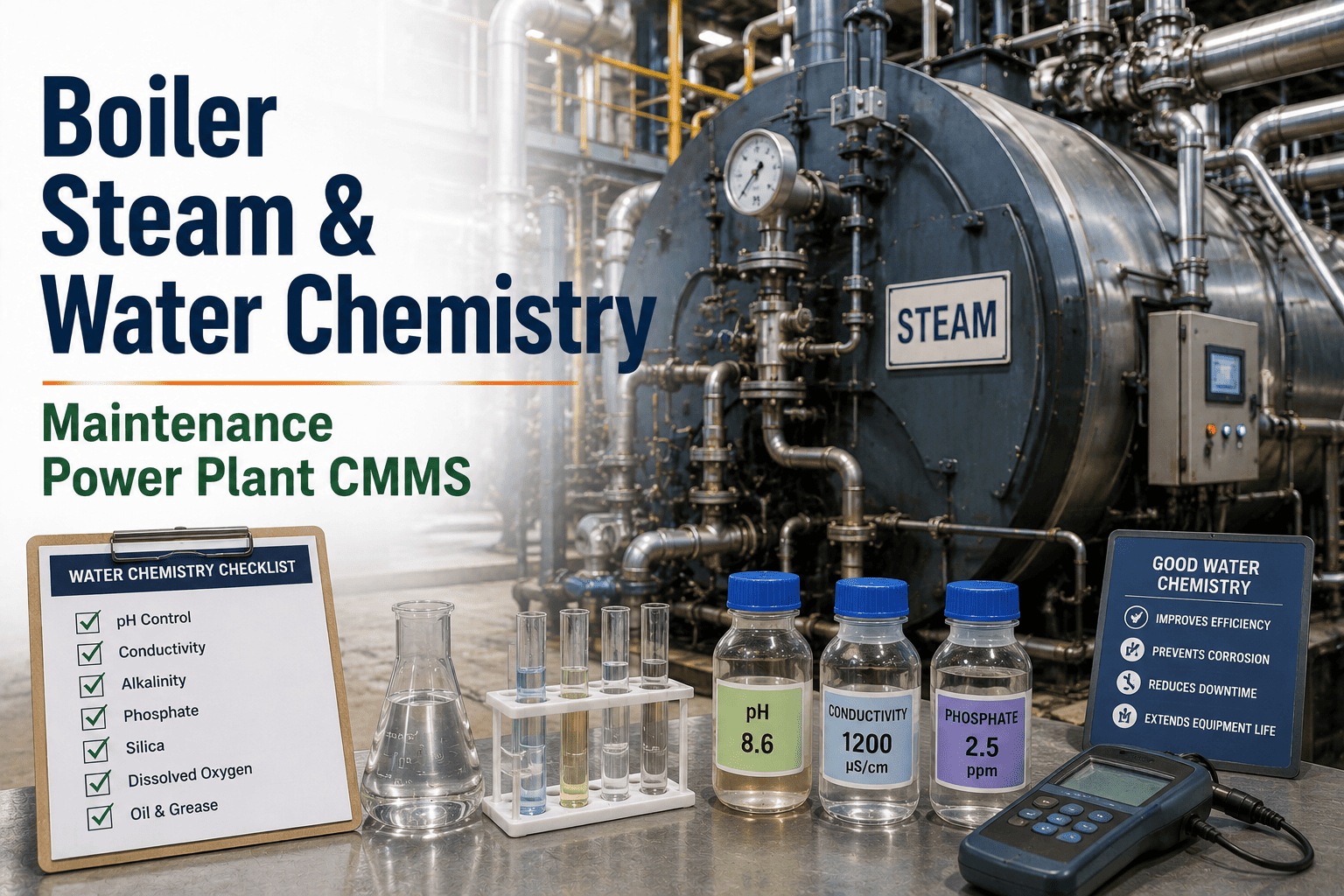
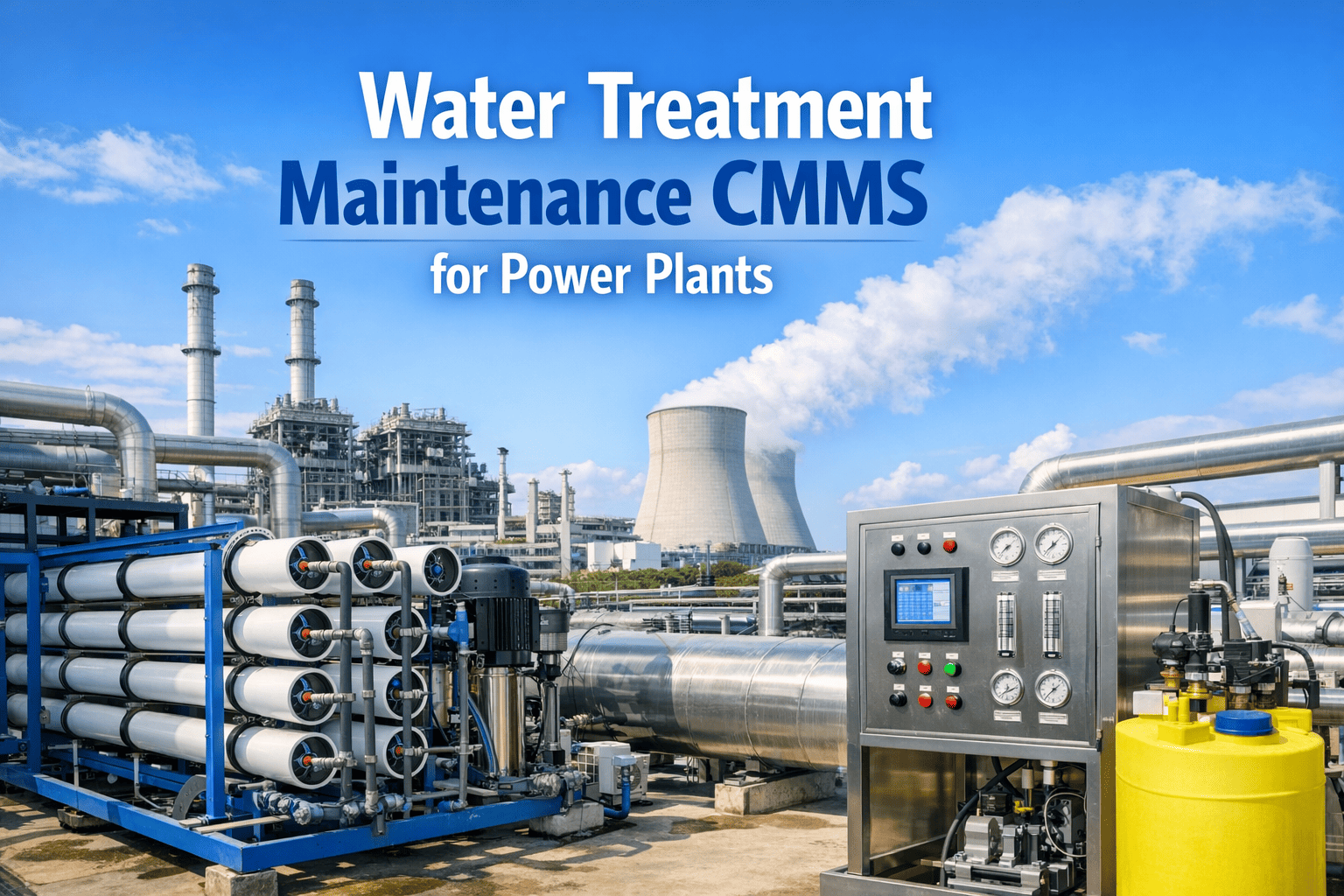
Water treatment plant maintenance in power generation is not a background task — it is a front-line reliability function. Boiler feedwater quality, cooling water chemistry, and DM plant output directly determine turbine lifespan, heat rate efficiency, and regulatory compliance. When RO membranes foul, resin beds exhaust, or chemical dosing drifts, the cost is not just a maintenance ticket — it cascades into forced outages, corrosion-driven asset damage, and failed water quality audits. Structured preventive maintenance workflows, scheduled through a CMMS like OxMaint, give power plant teams the control to stay ahead of these failure chains — not react to them. Book a 30-minute demo to see how OxMaint PM workflows are used by power plant teams to manage water treatment assets end-to-end.
Preventive Maintenance · Water Systems · Power Generation
Water Treatment Plant Maintenance for Power Generation
A complete preventive maintenance framework for RO systems, DM plants, chemical dosing units, resin beds, pumps, and boiler feedwater quality — built for power plant reliability teams managing water treatment as a critical asset class.
68%
of turbine corrosion failures trace to water chemistry deviations
3×
higher membrane life with scheduled RO flush and CIP protocols
40%
reduction in chemical overconsumption with dosing pump calibration PMs
₹1.2Cr+
average avoided cost per resin bed failure caught early by inspection
Why Water Treatment Maintenance Fails in Power Plants
Most water treatment failures in power generation are not sudden — they are slow drifts that go undetected because the PM schedule does not match the degradation rate of the equipment.
01
No Frequency-Based RO PM
RO membranes are treated as run-to-fail assets. SDI checks, pressure differential tracking, and CIP cycles are skipped until permeate flow drops — by which point fouling is severe and membrane replacement is unavoidable.
02
Resin Bed Exhaustion Missed
DM plant resin beds are regenerated on fixed calendar cycles rather than on conductivity and silica breakthrough data. Exhausted resin passes hardness into the boiler feedwater, causing scaling that reduces heat transfer efficiency by 10–15%.
03
Chemical Dosing Drift
Antiscalant, biocide, and coagulant dosing pumps drift from setpoint over time through diaphragm wear and calibration shift. Without scheduled calibration PMs, overconsumption or underdosing goes undetected for weeks.
04
Water Quality Checks Are Manual and Sporadic
pH, conductivity, hardness, silica, and dissolved oxygen readings are taken manually on paper logs that are not linked to asset records or maintenance triggers. Deviation trends are invisible until a boiler tube failure makes them obvious.
The Water Treatment Asset Map — What Needs PM and How Often
Power plant water treatment covers a multi-stage asset chain. Each stage has distinct failure modes, PM frequencies, and quality checkpoints that must be managed as an integrated system — not as isolated equipment.
Raw Water Intake
Screens · Filters · Settling tanks
→
Pre-Treatment
Coagulation · Flocculation · Pressure filters
→
RO System
Membranes · High-pressure pumps · CIP
→
DM Plant
Cation · Anion · Mixed bed resins
→
Feedwater System
Deaerator · Storage · Boiler feed pumps
| Asset / System |
PM Task |
Frequency |
Key Parameter |
Action Threshold |
| RO Membranes |
SDI test, pressure differential check |
Weekly |
SDI < 5, ΔP < 15% |
CIP if ΔP > 15% from baseline |
| RO High-Pressure Pump |
Bearing temp, vibration, seal inspection |
Monthly |
Vibration < 2.5 mm/s |
Alert if temp > 80°C or vibration rises |
| Cation Resin Bed |
Conductivity and hardness at outlet |
Daily (auto) / Weekly (manual) |
Conductivity < 0.5 µS/cm |
Regenerate if hardness detected at outlet |
| Anion Resin Bed |
Silica check at outlet |
Daily |
Silica < 10 ppb |
Regenerate if silica > 20 ppb |
| Mixed Bed Polisher |
Conductivity, pH, silica |
Continuous / Weekly manual |
Conductivity < 0.1 µS/cm |
Regenerate at breakthrough; check every 6 months |
| Chemical Dosing Pumps |
Calibration, diaphragm check, stroke rate |
Monthly |
±3% of setpoint |
Recalibrate if drift > 5%; replace diaphragm annually |
| Antiscalant Dosing |
Dosing rate verification, tank level |
Weekly |
Dosing rate per design spec |
Adjust if RO concentrate analysis shows scaling trend |
| Deaerator |
DO check, tray/spray inspection, vent valve |
Quarterly (shutdown) |
DO < 7 ppb |
Inspect internals if DO rises; check vent valve operation |
| Boiler Feed Pumps |
Mechanical seal, bearing, vibration |
Monthly |
Vibration < 4.5 mm/s |
Bearing replacement at interval or rising temp |
| Pressure Sand Filters |
Backwash cycle, turbidity at outlet |
Per cycle / Weekly inspection |
Turbidity < 1 NTU |
Manual backwash if auto fails; media replacement every 3 years |
Schedule Every PM Task Above — Automatically
OxMaint Preventive Maintenance lets you configure all water treatment PM tasks, assign technicians, set frequency triggers, and capture quality readings — in one platform used by power plant teams.
Boiler Feedwater Quality — The Non-Negotiable Parameters
Boiler feedwater quality defines the boundary between safe operation and accelerated corrosion, scaling, and carryover. These are the parameters every power plant water treatment PM programme must track as mandatory checkpoints.
pH
8.8 – 9.2
Low pH: flow-accelerated corrosion in feedwater lines. High pH: carryover and silica deposition in turbines.
Check: Daily
Dissolved Oxygen
< 7 ppb
DO above threshold causes pitting corrosion in boiler tubes and economisers — one of the most expensive failure modes in thermal power plants.
Check: Continuous + Weekly manual
Silica
< 10 ppb
Silica above limit causes turbine blade deposits that reduce efficiency and require expensive chemical cleaning or offline polishing.
Check: Daily
Conductivity
< 0.2 µS/cm
Elevated conductivity signals DM plant breakthrough. Even brief exposure deposits chlorides and sulphates on boiler surfaces.
Check: Continuous
Total Hardness
NIL (0 ppm)
Any hardness in feedwater indicates cation resin exhaustion. Scale deposits reduce heat transfer and lead to tube overheating and failure.
Check: Daily
Iron (Fe)
< 10 ppb
Iron above threshold accumulates on boiler heating surfaces, reducing heat transfer and contributing to under-deposit corrosion failures.
Check: Weekly
RO System Maintenance — The Detail Most Teams Miss
RO systems in power plants are complex multi-element systems where fouling, scaling, and biological growth interact simultaneously. A structured PM protocol must address all three simultaneously — not just pressure differential.
1
Pre-Filter Inspection and Cartridge Replacement
5-micron cartridge filters before the high-pressure pump protect membranes from particulate damage. Replace when pressure differential across cartridges exceeds 1 bar or at maximum 3-month intervals — whichever comes first. Log SDI upstream of cartridge filter to track pre-treatment effectiveness.
2
Normalised Performance Data Trending
Record normalised permeate flow, salt rejection, and differential pressure at each PM interval and compare against baseline. A 10% drop in normalised flow signals fouling. A 15% increase in normalised differential pressure indicates scaling or biological growth. Both require CIP before they progress further.
3
Chemical Cleaning (CIP) Protocol
CIP uses alkaline cleaning (pH 11–12, sodium hydroxide + surfactant) for biofouling and organic deposits, and acid cleaning (pH 2–3, citric or hydrochloric acid) for mineral scale. Always perform alkaline clean first, then acid clean. Document pre- and post-CIP performance data to verify cleaning effectiveness before returning to service.
4
High-Pressure Pump Inspection
Check mechanical seal for leakage, measure bearing temperature and vibration at each monthly PM. Verify discharge pressure against design at the current feed TDS. A drop in discharge pressure at constant rpm indicates wear ring clearance has opened — schedule overhaul before it progresses to impeller damage.
5
Membrane Element Autopsy (Annual)
Pull and autopsy one element from the lead position in the first stage annually. Unwrap and inspect the feed spacer for biofouling, the membrane surface for scale, and the permeate carrier for delamination. Autopsy findings determine whether a full system cleaning is needed and whether the antiscalant dosing rate is correctly configured for the current feed water analysis.
DM Plant Resin Bed Maintenance — Regeneration Is Not Enough
Most power plant teams manage DM plant maintenance as a regeneration schedule. The resin beds get far more attention only after a quality excursion. A complete DM plant PM programme covers the full resin lifecycle — not just regeneration frequency.
RegenerantHydrochloric acid (HCl) or sulphuric acid (H₂SO₄)
TriggerHardness or sodium breakthrough at outlet
Annual PMResin sampling for exchange capacity test, fouling check
ReplacementEvery 5–7 years or when capacity drops below 70% of original
RegenerantSodium hydroxide (NaOH)
TriggerSilica or conductivity breakthrough at outlet
Annual PMOrganic fouling test (colour number), capacity test
ReplacementEvery 4–6 years (anion degrades faster due to organic fouling)
RegenerantSeparate HCl and NaOH after hydraulic separation
TriggerConductivity > 0.1 µS/cm at outlet
Annual PMResin ratio verification (cation:anion 40:60 by volume)
ReplacementAs per capacity test; cation and anion replaced on different cycles
Frequently Asked Questions
How often should RO membranes be replaced in a power plant water treatment system?
RO membranes in power plant service typically last 3 to 5 years with a structured PM programme including regular CIP cleaning. The actual replacement trigger is performance data — when normalised salt rejection drops below 96% or normalised permeate flow cannot be restored by CIP to within 10% of baseline, replacement is due. Annual membrane autopsy helps predict remaining life before quality excursions occur.
OxMaint PM workflows track normalised RO performance data automatically so replacement decisions are data-driven, not guesswork.
What causes DM plant resin to fail prematurely in power generation applications?
The three main causes of premature resin failure in power plants are organic fouling of anion resin from high-TOC raw water, iron fouling of cation resin from corroded upstream piping, and osmotic shock from improper regeneration procedures. Regular resin sampling and capacity testing — scheduled annually in a CMMS — catches capacity decline early enough to plan replacement without emergency downtime.
How does a CMMS improve water treatment plant maintenance in power generation?
A CMMS like
OxMaint automates PM scheduling for all water treatment assets, links quality readings (conductivity, silica, pH) to asset records, and generates work orders based on frequency or parameter breach triggers. This replaces paper-based manual logs with a traceable audit trail that is available during regulatory inspections and water quality audits.
Book a demo to see the water treatment PM workflow configuration.
What are the most critical chemical dosing maintenance tasks in a power plant water treatment system?
Monthly dosing pump calibration, quarterly diaphragm inspection, and weekly dosing rate verification against current feed water analysis are the highest-value PM tasks. Antiscalant dosing drift is the most common root cause of RO membrane scaling failures. Annual chemical programme review against updated feed water analysis ensures dosing chemistry matches actual water quality — not last year's data.
How do you manage boiler feedwater quality monitoring as a preventive maintenance activity?
Structured boiler feedwater quality management combines continuous online analysers for conductivity and pH with scheduled manual sampling for silica, iron, dissolved oxygen, and hardness. Each parameter has a defined action threshold linked to a specific corrective PM — not a general alert. In OxMaint, water quality readings are logged against the asset record, and readings outside threshold automatically generate a work order for the relevant upstream treatment unit.
Manage Every Water Treatment PM Task From One Platform
OxMaint Preventive Maintenance gives power plant water treatment teams scheduled PM workflows, quality checkpoint logging, resin bed tracking, dosing pump calibration records, and full audit trails — all in one system that replaces paper-based water quality logs.