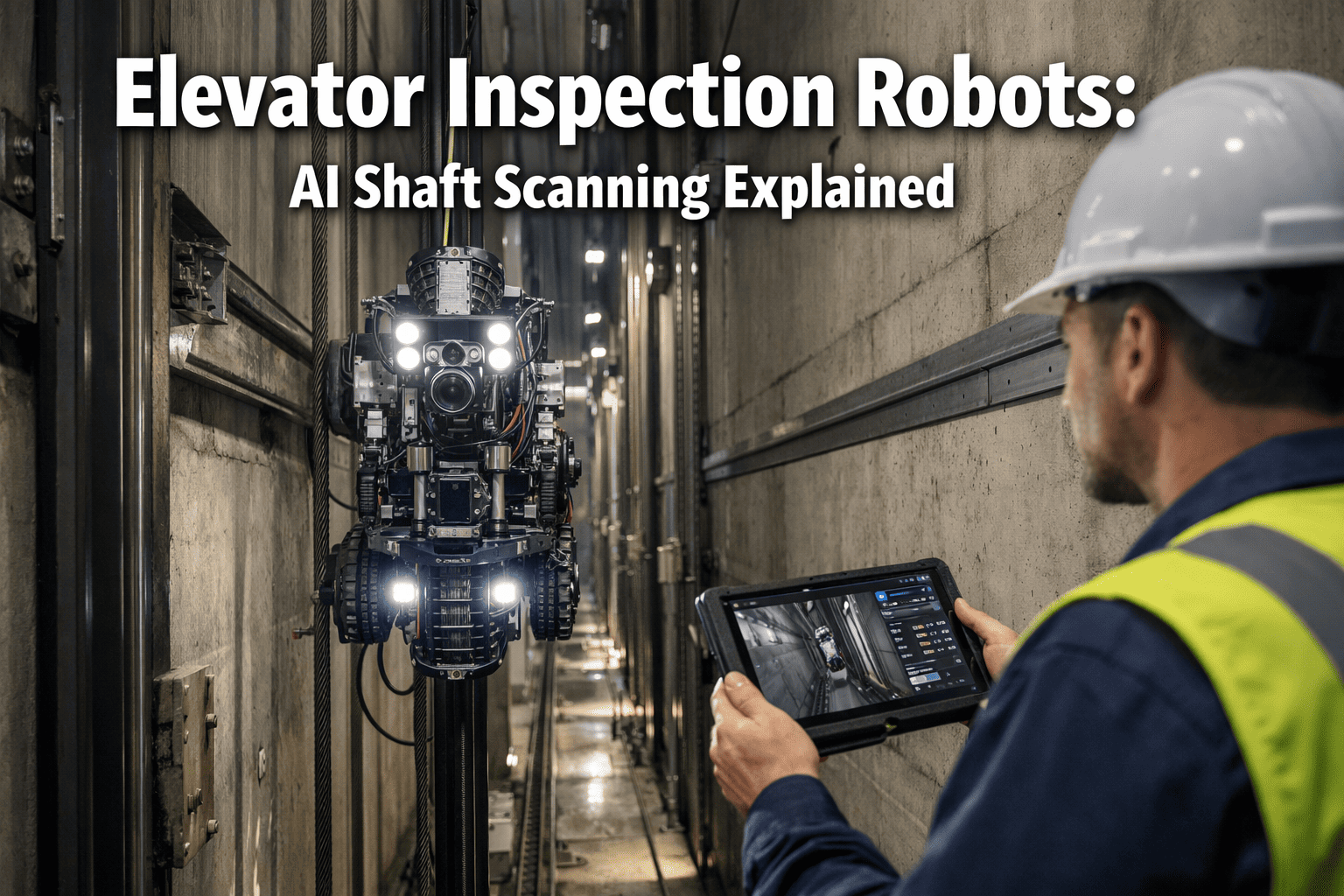
Manual elevator shaft inspections require technicians to ride on top of the car, work in confined spaces, and visually assess components that are difficult to see and impossible to measure precisely with the naked eye. AI-powered inspection robots change this equation entirely — deploying LiDAR scanners, high-resolution cameras, and environmental sensors into the shaft to produce millimeter-accurate 3D maps of every guide rail, bracket, door header, and structural element. The result is not just a faster inspection — it is a quantified condition baseline that makes every future inspection a comparison, not a guess. A CMMS like OxMaint integrates robotic inspection data directly into asset records, condition scores, and PM schedules — turning scan results into maintenance actions automatically.
What Inspection Robots Detect: Sensor Technologies
Modern elevator inspection robots combine multiple sensor modalities to detect conditions that manual inspection cannot reliably identify — sub-millimeter misalignments, thermal anomalies, and structural degradation patterns invisible to the human eye.
3D LiDAR Scanning
Creates millimeter-accurate 3D point cloud maps of the entire shaft — measuring guide rail alignment, bracket spacing, and structural deformation that drift over years.
HD Visual Inspection
High-resolution cameras with LED illumination capture detailed imagery of every door header, interlock, bracket, and guide rail surface — creating a photographic record for comparison over time.
Thermal Imaging
Infrared cameras detect thermal anomalies in electrical connections, motor mounts, and door operator components — identifying overheating before it causes failure.
Vibration and Acoustic
Accelerometers and acoustic sensors mounted on the robot detect guide rail surface irregularities, loose brackets, and bearing wear through vibration signature analysis.
How AI Processes Inspection Data
Raw sensor data from a single shaft scan can exceed 50GB. AI algorithms process this data into actionable maintenance intelligence — detecting defects, classifying severity, and comparing against the baseline scan to identify progressive degradation.
What Robots Inspect vs. Manual Methods
| Inspection Area | Manual Method | Robotic + AI Method | Improvement |
|---|---|---|---|
| Guide rail alignment | Plumb line, visual estimate | LiDAR 3D measurement, 0.5mm accuracy | 10x more precise |
| Bracket condition | Visual check from car top | HD photography + point cloud analysis | 100% coverage vs sampled |
| Door header wear | Manual measurement per floor | Automated scan all floors in one pass | 85% time reduction |
| Electrical connections | Visual + spot thermal check | Full thermal sweep every connection | 3x more faults detected |
| Shaft wall condition | Flashlight visual from car top | HD camera with uniform LED lighting | Complete photo record |
| Trend detection | Technician memory between visits | AI comparison against baseline scan | Quantified degradation rates |
Global Compliance: Robotic Inspection Acceptance
OxMaint vs. Competitors: Robotic Inspection Integration
| Capability | OxMaint | MaintainX | UpKeep | Fiix | Limble | IBM Maximo | Hippo (Eptura) |
|---|---|---|---|---|---|---|---|
| Robotic scan data import | Yes | No | No | No | No | Custom | No |
| AI defect-to-work-order conversion | Yes | No | No | No | No | Custom | No |
| Baseline comparison trending | Yes | No | No | Limited | No | Yes | No |
| Condition score per asset | Yes | No | Limited | Limited | No | Yes | No |
| Multi-code compliance | Yes | No | No | Limited | No | Yes | No |
| Photo evidence per defect | Yes | Yes | Yes | No | Yes | Yes | Limited |
| Setup | Minutes | Hours | Hours | Days | Hours | Months | Days |
| Pricing | Free tier | Mid-range | Mid-range | Enterprise | Mid-range | Enterprise | Mid-range |
Implementation Roadmap
Results
Data Security
Frequently Asked Questions
What types of defects can elevator inspection robots detect?
Guide rail misalignment and wear, bracket deflection, door header wear, interlock condition, shaft wall damage, corrosion, and thermal anomalies in electrical connections. AI algorithms classify each finding by severity for maintenance prioritization. Book a demo to see defect classification in OxMaint.
Do robotic inspections replace code-required manual inspections?
Not yet in most jurisdictions. Robotic scan data is accepted as supplementary evidence alongside required ASME A17.1, EN 81, and AS 1735 inspections. OxMaint stores both robotic and manual inspection records per unit for complete audit documentation.
How does OxMaint use robotic scan data?
AI-classified defects are automatically converted into prioritized work orders with location, severity, and photographic evidence. Baseline comparisons track progressive degradation over time, enabling condition-based PM scheduling instead of calendar-based intervals.
How accurate is LiDAR shaft scanning?
Modern elevator inspection robots achieve 0.5mm accuracy for guide rail alignment measurement — an order of magnitude more precise than manual plumb line methods. This precision enables detection of progressive drift that manual methods cannot reliably measure. Start free.
What is the ROI of robotic elevator inspection?
85% reduction in inspection time, 3x more defects detected, and elimination of car-top ride hours for routine shaft surveys. The primary ROI is early defect detection preventing costly emergency repairs and unplanned outages.
Continue Reading
Elevator Door Problems: Troubleshooting and Repair
Fix door sensor faults, alignment issues, and safety edge failures with structured CMMS workflows.
Read Article Elevator MaintenanceElevator Controller Faults: Troubleshooting Guide
Diagnose drive errors, relay failures, and encoder faults with systematic CMMS diagnostic workflows.
Read Article ComplianceElevator Code Compliance Requirements Guide
ASME A17.1, EN 81, ADA — compliance scheduling and audit-ready documentation with CMMS.
Read Article Capital PlanningElevator Modernization Cost Guide and Upgrade Planning
Budget planning, ROI analysis, and phased modernization strategies using CMMS condition data.
Read Article


