
Elevator door malfunctions account for nearly 80% of all elevator service calls — stuck doors, misaligned tracks, failing sensors, and worn operators disrupt building operations and create serious safety hazards. A CMMS like OxMaint turns reactive door repairs into a structured preventive program — tracking door operator health, sensor calibration, alignment inspections, and parts inventory so your vertical transportation system stays safe, compliant, and operational.
Stop Chasing Elevator Door Failures — Prevent Them
OxMaint tracks every door operator, sensor, and safety edge across your elevator fleet — automated PM schedules, real-time fault logging, and compliance-ready inspection records.
Why Elevator Doors Fail: Root Causes and Risk Factors
Misaligned Door Tracks
Building settlement and vibration cause hangers to drift — resulting in binding, scraping, and safety faults.
Door Sensor Faults
IR curtains and photo-eyes accumulate dust and lose calibration — causing continuous reopening or obstruction detection failure.
Operator Motor Wear
Brushes wear, belts stretch, clutches slip over millions of cycles — producing inconsistent speed and excessive closing force.
Safety Edge Degradation
Rubber profiles harden and micro-switches fatigue — creating entrapment risk, the largest source of elevator injury liability.
Interlock Failures
Worn contacts, bent lock rollers, and contaminated switches cause nuisance shutdowns and code violations.
Sill and Threshold Debris
Dust and small objects in door sills prevent closure and damage gibs — the most common and most preventable cause of callbacks.
Elevator Door Troubleshooting Workflow
OxMaint provides digital troubleshooting checklists guiding technicians through systematic fault isolation — reducing mean time to repair and preventing unnecessary parts replacement.
Visual Inspection
Check sill for debris, inspect panels for damage, verify hanger rollers seated in track, look for loose hardware.
Mechanical Testing
Manually cycle doors for binding, measure closing force (max 30 lbs per ASME A17.1), test safety edge response.
Electrical Diagnostics
Check operator motor current draw, test interlock contacts, verify sensor alignment, review controller fault codes.
Component Isolation and Repair
Isolate the failed component using OxMaint fault code cross-reference, replace or adjust, run 10-cycle verification test, and log results.
Digital Troubleshooting Checklists for Every Door Fault
Step-by-step diagnostic workflows, fault code libraries, and parts cross-references — all inside OxMaint's mobile-first CMMS.
Common Door Problems: Diagnosis and CMMS-Managed Solutions
| Problem | Root Cause | Repair Action | OxMaint PM Prevention |
|---|---|---|---|
| Door won't close | Blocked sensor beam, dirty photo-eye, stuck safety edge | Clean sensor lens, realign beam, replace edge switch | Monthly sensor cleaning, quarterly calibration |
| Door closes too slowly | Worn operator belt, low motor torque, timing drift | Replace belt, adjust motor, recalibrate timer | Cycle-count belt triggers, annual timing audit |
| Excessive closing force | Clutch drift, motor over-torque, broken nudging circuit | Recalibrate clutch, adjust speed, repair nudging | Quarterly force gauge testing with logged results |
| Door won't open | Failed operator, broken coupler, hoistway door binding | Replace motor/coupler, realign hoistway door | Monthly current draw checks, hanger inspections |
| Repeated reopening | Misaligned sensor curtain, intermittent edge, EMI | Realign sensors, replace edge, shield wiring | Sensor alignment on every PM visit |
| Door noise/grinding | Worn rollers, misaligned tracks, loose gibs | Replace rollers, realign tracks, adjust gibs | Semi-annual alignment checks, roller grading |
| Interlock fault | Worn lock roller, contaminated contacts, bent cam | Replace roller, clean contacts, adjust cam | Quarterly resistance testing with alerts |
Global Elevator Door Safety Compliance
Elevator door maintenance is mandated by national safety codes. Non-compliance results in violations, shutdowns, and liability exposure. OxMaint maintains compliance-ready records and automated PM schedules aligned to every jurisdiction.
ASME A17.1 / CSA B44
Max 30 lb closing force, monthly safety edge testing, annual Cat 1 inspections, five-year Cat 5 testing. OxMaint auto-schedules all intervals and logs force-gauge results.
CSA B44 / Provincial TSSA
Provincial regulators enforce B44 with door restrictor and interlock requirements. OxMaint tracks provincial-specific requirements and generates jurisdiction-aligned checklists.
BS EN 81-20/50 / LOLER
Six-monthly LOLER thorough examination, door protection testing per EN 81-20, landing door lock verification. OxMaint schedules LOLER exams and tracks certifications.
EN 81-20/50 / BetrSichV
Biennial inspections by ZUeS-accredited bodies with door force and interlock testing. OxMaint maintains dual-language records and coordinates TUeV/DEKRA scheduling.
AS 1735 / AS/NZS 4431
Annual competent person inspections with door protection and interlock testing. OxMaint generates state-specific PM checklists and WorkSafe audit documentation.
SBC / SASO EN 81
EN 81 standards with SASO certification requirements. Annual inspections mandatory. OxMaint supports Arabic-language documentation and SASO compliance tracking.
OxMaint stores every inspection result and compliance document in a tamper-evident digital audit trail — accessible by building owners, contractors, and inspectors. Sign up free to build your compliance-ready program.
OxMaint vs. Competitors: Elevator Maintenance CMMS
| Capability | OxMaint | MaintainX | UpKeep | Fiix (Rockwell) | Limble | IBM Maximo | Hippo (Eptura) |
|---|---|---|---|---|---|---|---|
| Elevator-specific PM templates | Yes | Limited | Limited | No | No | Custom build | No |
| Door fault code tracking | Yes | No | No | No | No | Custom build | No |
| Closing force log per unit | Yes | No | No | No | No | Custom build | No |
| Multi-code compliance | Yes | No | No | Limited | No | Yes | No |
| Mobile-first field app | Yes | Yes | Yes | Yes | Yes | Limited | Yes |
| Multi-site fleet view | Yes | Limited | Limited | Yes | Limited | Yes | Limited |
| Photo/video evidence | Yes | Yes | Yes | No | Yes | Yes | Limited |
| Parts inventory + reorder | Yes | Limited | Yes | Yes | Limited | Yes | Limited |
| Setup complexity | Minutes | Hours | Hours | Days | Hours | Months | Days |
| Pricing | Free tier + affordable | Mid-range | Mid-range | Enterprise | Mid-range | Enterprise | Mid-range |
See Why Teams Switch to OxMaint from Legacy CMMS
Pre-built elevator templates, zero setup complexity, and a free tier that lets you prove value before committing budget.
Implementation Roadmap
Register every elevator with door type, operator model, sensor config, and install date. Import from spreadsheets or scan QR codes on site.
Configure code-aligned PM schedules for operators, sensors, safety edges, and interlocks. Assign technicians and establish checklist templates.
Map inspection requirements to your jurisdiction, configure compliance dashboards, and establish audit-ready document storage.
Analyze fault trends to identify chronic problem doors, optimize PM frequencies from failure data, and implement parts forecasting.
The OxMaint Advantage: Why Building Operators Choose Us
Tamper-Evident Audit Trail
Every inspection and measurement is time-stamped and immutable — bulletproof compliance documentation for regulators and insurance auditors.
Real-Time Fleet Dashboard
Every elevator across every building on one screen — fault counts, overdue PMs, compliance status, and workload at a glance.
Instant QR Fault Reporting
Occupants scan a QR code to report door problems — work orders created, categorized, and assigned in seconds.
Downtime Cost Tracking
Log elevator downtime per event with repair costs — data to negotiate service contracts and justify capital upgrades.
Multi-Vendor Coordination
Manage in-house techs and third-party contractors on one platform — assign work, track SLAs, verify with photo evidence.
Predictive Parts Forecasting
Fault history analysis predicts when operators, edges, and sensors need replacement — stock parts before failures occur.
Results: What OxMaint Clients Achieve
| Metric | Before OxMaint | After OxMaint | Improvement |
|---|---|---|---|
| Door callbacks/month | 18 – 25 per 100 units | 5 – 7 per 100 units | 72% reduction |
| Elevator uptime | 82% – 88% | 94% – 97% | 10 – 12 point gain |
| Compliance violations/year | 3 – 8 per portfolio | 0 – 1 per portfolio | 85% – 100% reduction |
| Mean time to repair | 4 – 8 hours | 1.5 – 3 hours | 55% – 65% faster |
| Emergency repair spend/year | $45K – $80K per 100 units | $12K – $25K per 100 units | 65% – 70% reduction |
Data Security and Platform Trust
Your Elevator Doors Deserve Better Than Reactive Repairs
Join hundreds of building operators using OxMaint to prevent door failures, maintain compliance, and extend equipment life across their portfolios.
Frequently Asked Questions
What is the most common cause of elevator door problems?
Sill debris and misaligned tracks account for over 60% of door service calls. Both are preventable with structured cleaning schedules and alignment inspections in OxMaint. Book a demo to see how.
How often should elevator door sensors be calibrated?
Quarterly calibration with monthly visual inspections. OxMaint auto-generates sensor PM work orders and tracks pass/fail results per unit for compliance documentation.
What closing force is allowed on elevator doors?
ASME A17.1 limits kinetic energy to 2.5 ft-lbs (approximately 30 lbs closing force). EN 81-20 uses a 150 N static force limit. OxMaint logs force-gauge readings per inspection.
Can OxMaint manage elevators across multiple buildings?
Yes. Multi-site architecture lets property managers manage fleets across unlimited buildings from a single dashboard with building-level permissions and portfolio-wide reporting.
How does OxMaint help with elevator code compliance?
OxMaint maps PM schedules to your jurisdiction's code (ASME, EN 81, AS 1735, CSA B44), generates inspection checklists, and maintains audit-ready records with time-stamped evidence. Start tracking free.
Continue Reading
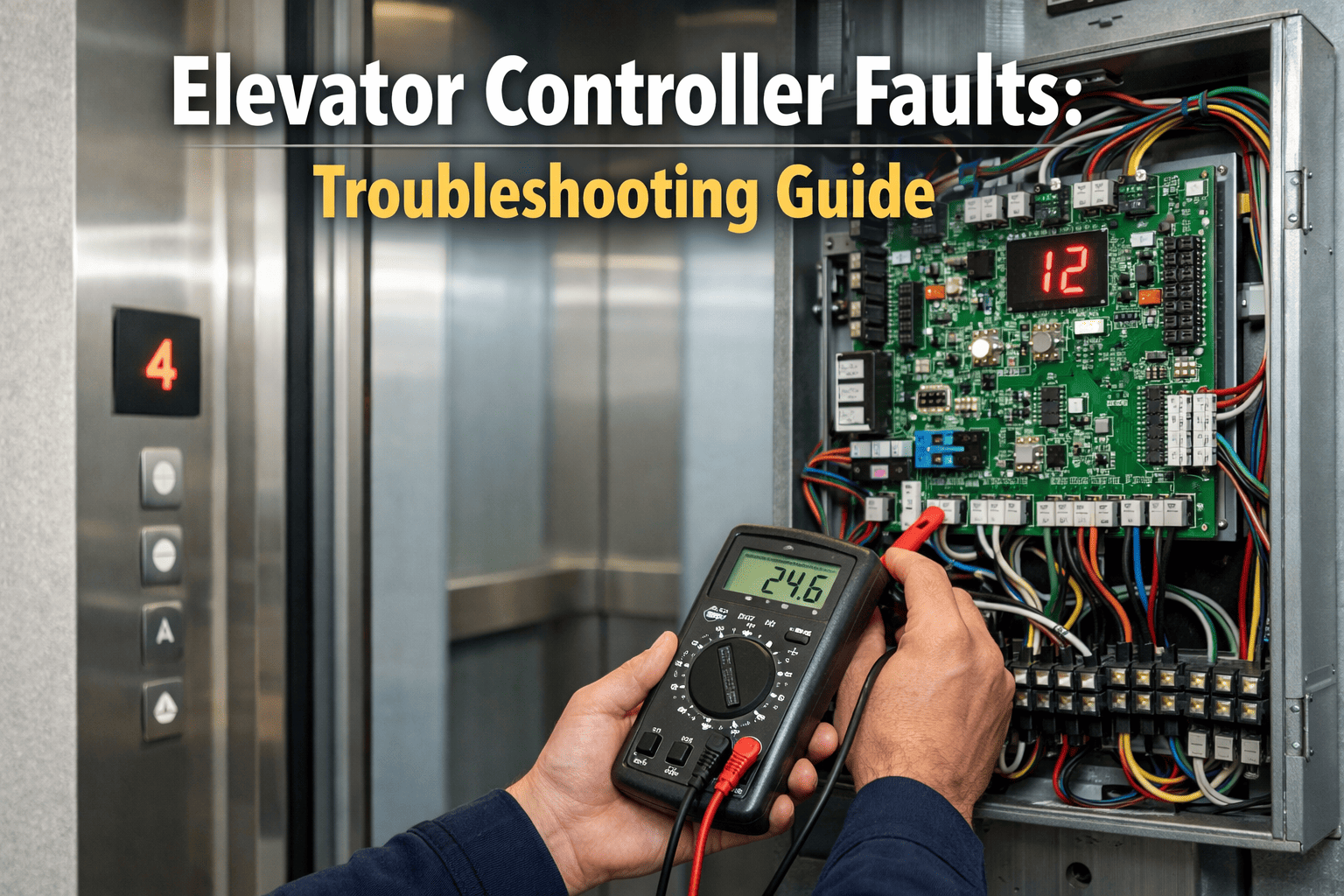
Elevator Controller Faults: Troubleshooting Guide
Diagnose and resolve controller fault codes with structured CMMS workflows and preventive maintenance programs.
Read Article Elevator ComplianceElevator Code Compliance Requirements Guide
ASME A17.1, EN 81, and global elevator safety codes — compliance scheduling and audit-ready documentation.
Read Article Vertical TransportationEscalator Maintenance Checklist and Inspection Guide
Complete escalator PM checklists, step chain inspection protocols, and handrail maintenance programs.
Read Article Capital PlanningElevator Modernization Cost Guide and Upgrade Planning
Budget planning, ROI analysis, and phased modernization strategies for aging elevator systems.
Read Article

-for-elevator-door-fault-failures.png)
.png)


