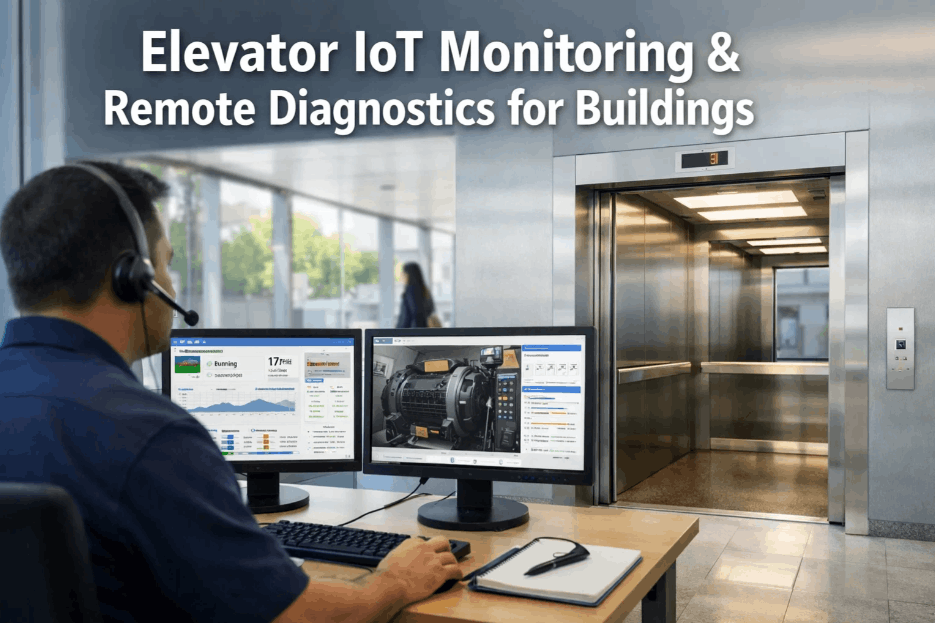
Elevator IoT monitoring is transforming how building owners, facility managers, and property engineers manage vertical transportation assets. Traditional reactive maintenance models — waiting for a fault code or a stuck car before dispatching a technician — are being replaced by connected elevator monitoring systems that stream real-time diagnostics, automate fault alerts, and trigger predictive maintenance work orders before a single passenger is inconvenienced. Whether you manage a single mid-rise or a portfolio of high-rise towers, deploying elevator remote monitoring technology delivers measurable reductions in downtime, maintenance costs, and regulatory compliance risk. Sign up for OxMaint to connect your elevator assets to a compliance-ready maintenance platform built for building engineers.
Automate Elevator Maintenance with IoT + CMMS
OxMaint integrates with your elevator monitoring system to automate work orders, track asset health, and maintain compliance documentation — all in one platform built for facility engineers and building operators.
Why Elevator IoT Monitoring Is Now a Building Operations Imperative
Elevators are among the most heavily regulated and operationally critical mechanical systems in any commercial, residential, or mixed-use building. A single cab out of service during peak hours triggers tenant complaints, ADA compliance exposure, and lease-threatening service level agreement breaches. Elevator remote monitoring systems address this operational risk at its root by providing continuous visibility into the health and performance of every connected lift — without requiring a technician on-site or a passenger to report a problem first.
The global elevator IoT monitoring market is accelerating rapidly as building owners recognize that connected elevator diagnostics deliver returns far beyond reactive maintenance savings. Real-time elevator status dashboards surface utilization patterns that inform dispatch algorithm optimization, energy consumption benchmarks that feed ESG reporting, and component wear trajectories that allow maintenance teams to pre-stage parts and schedule interventions during low-traffic windows. The shift from time-based to condition-based elevator maintenance is the single largest lever available to facility managers seeking to reduce vertical transportation operating costs. Sign up free to start monitoring your elevator assets today.
Core Components of an Elevator Remote Monitoring System
A production-grade elevator IoT monitoring deployment consists of four interconnected layers: edge hardware installed in the machine room, a secure communication gateway, a cloud analytics platform, and a CMMS integration layer that converts sensor events into documented maintenance actions. Understanding each layer is essential for building engineers evaluating elevator connected solutions from competing vendors.
Edge Monitoring Hardware
Accelerometers, current transducers, door sensors, and temperature probes installed in the machine room and hoistway capture continuous operational data without interrupting elevator service. Modern edge devices support non-invasive clamp-on installation compatible with any elevator manufacturer's controller.
Secure Communication Gateway
Industrial LTE-M or building Wi-Fi gateways transmit encrypted sensor data to cloud platforms. Cellular-primary with Wi-Fi fallback architectures ensure continuous elevator cloud monitoring even when building network infrastructure experiences outages.
Cloud Analytics Platform
Machine learning models applied to streaming sensor data identify fault signatures, anomalous vibration patterns, and developing component failures before they cause service interruptions. Elevator data analytics dashboards aggregate fleet-wide performance for portfolio managers and individual cab views for on-site engineers.
CMMS Integration Layer
API connections between the elevator monitoring platform and maintenance management systems translate alert events into structured work orders with equipment identification, fault codes, and response procedures. Closed-loop documentation satisfies regulatory inspection requirements and building owner reporting obligations.
Elevator Remote Diagnostics: Key Parameters Monitored
Comprehensive elevator remote diagnostics programs monitor a broad array of mechanical, electrical, and operational parameters simultaneously. The following monitoring capabilities represent the current standard for enterprise-grade elevator smart monitoring deployments across commercial and residential building portfolios.
| Monitored Parameter | Sensor Type | Fault / Failure Mode Detected | Alert Threshold Example |
|---|---|---|---|
| Motor Current Draw | Current Transducer (CT) | Motor overload, phase loss, bearing degradation | >115% FLA sustained >5 seconds |
| Cabin Vibration | MEMS Accelerometer | Guide rail wear, roller wear, imbalance | >25 mg RMS during travel |
| Door Cycle Time | Hall Effect / Encoder | Door operator wear, obstruction, misalignment | >150% of baseline cycle time |
| Machine Room Temperature | RTD / NTC Thermistor | Cooling failure, drive overheating, fire risk | >40°C sustained |
| Rope Tension / Load | Load Cell | Overload, rope stretch, counterweight drift | ±10% deviation from calibrated baseline |
| Travel Speed | Encoder / Tachometer | Governor activation, drive fault, speed deviation | >5% deviation from rated speed |
| Brake Performance | Accelerometer + Encoder | Brake lining wear, solenoid degradation | Deceleration rate outside ±8% of spec |
| Emergency Power Status | Voltage Monitor | UPS failure, battery degradation, transfer failure | Voltage <90% nominal on transfer test |
Real-Time Elevator Status Dashboard: What Building Engineers Need to See
An effective elevator status dashboard is the operational nerve center of a building's vertical transportation management program. The most valuable dashboards for facility engineers and building operations teams balance at-a-glance fleet health visibility with the ability to drill into individual cab diagnostics when an alert demands investigation. Elevator cloud monitoring platforms that deliver both portfolio-level summaries and granular per-cab diagnostic views enable the tiered response workflows that high-performance maintenance organizations depend on. Book a demo to see OxMaint's real-time dashboard in action.
Fleet Health Overview
Color-coded status indicators for every monitored elevator in the portfolio — green for normal operation, amber for condition warnings requiring scheduled attention, red for active faults demanding immediate response. Building managers can assess the health of a 50-cab portfolio in under 30 seconds without opening a single work order or calling a technician.
Individual Cab Diagnostic Panel
Drill-down views for each elevator showing real-time parameter trends, historical fault logs, active alert status, and upcoming maintenance schedules. Technicians dispatched to a fault can review the diagnostic timeline before arriving on-site, enabling faster root-cause identification and first-visit resolution rates that reduce callback costs.
Usage Analytics and Traffic Patterns
Trip count, door cycle frequency, peak-hour utilization, and floor-by-floor demand mapping give building managers the elevator data analytics they need to optimize dispatch algorithms, justify additional cab capacity, and correlate usage intensity with component wear rates for more accurate maintenance budget forecasting.
Predictive Maintenance Timeline
ML-generated component life predictions displayed as time-to-action indicators give maintenance planners 30–90 days of advance notice for bearing replacements, brake inspections, and drive service intervals. Pre-staging parts and scheduling downtime windows during low-traffic periods eliminates the emergency premium costs that dominate reactive maintenance budgets.
Connect Your Elevator Monitoring Alerts to Automated Work Orders
OxMaint turns elevator IoT alert events into structured CMMS work orders with assigned technicians, response procedures, and closed-loop compliance documentation — automatically, without manual transcription.
Elevator Predictive Maintenance: From Sensor Data to Actionable Insights
Elevator predictive maintenance programs built on continuous IoT sensor streams deliver fundamentally different outcomes than traditional time-based maintenance schedules. Time-based programs replace components on fixed intervals regardless of actual condition — resulting in premature replacement of healthy parts and, paradoxically, missed failures that develop rapidly between scheduled visits. Condition-based elevator smart monitoring programs replace components when sensor data indicates actual deterioration, extending service life of healthy components while catching developing failures before they cause service interruptions.
The most impactful predictive maintenance applications in elevator remote monitoring focus on the components with the highest failure frequency and downtime consequence: door operators, traction machine bearings, and variable frequency drives. Door-related failures account for over 70% of elevator service calls in commercial buildings — and continuous door cycle monitoring with cycle time trend analysis provides advance warning of door operator wear weeks before a failure strands a passenger between floors. Machine bearing deterioration surfaces in vibration frequency domain analysis as characteristic defect frequencies that trained ML models identify with sufficient lead time for planned replacement during scheduled downtime. Get started free to bring predictive maintenance to your elevator portfolio.
Elevator Alert System Design: Preventing Notification Fatigue
The most common failure mode in first-generation elevator IoT monitoring deployments is not hardware failure or data quality — it is alert fatigue. Poorly configured elevator alert systems that generate excessive nuisance notifications cause maintenance teams to disable or ignore alerts, directly negating the operational value of the monitoring investment. Designing an effective elevator alert system requires a tiered notification architecture that matches alert urgency to response requirement.
Immediate Response Alerts
Passenger entrapment signals, safety circuit faults, emergency brake activations, and machine room temperature exceedances trigger immediate SMS and push notification to on-call technicians and building management with escalation if unacknowledged within 5 minutes.
Scheduled Attention Alerts
Motor current trending upward, door cycle time increasing, vibration levels approaching alarm thresholds — these condition warnings route to CMMS work order queues for next available scheduled maintenance visit, not urgent technician dispatch.
Trend Analysis Notifications
Weekly performance reports, usage analytics summaries, and component life update notifications delivered by email or dashboard digest. No action required — these data points feed the predictive maintenance planning process and maintenance budget forecasting cycle.
Wireless Connectivity Options for Lift Remote Monitoring
Selecting the right communication architecture for a lift remote monitoring deployment requires accounting for building-specific RF challenges — elevator hoistways and machine rooms present shielding conditions that attenuate wireless signals, and deep basement machine rooms in urban high-rises create particularly difficult cellular connectivity environments. Successful deployments match communication protocol to facility characteristics rather than defaulting to a single technology across all building types.
Cellular LTE-M / NB-IoT
The preferred primary communication layer for elevator cloud monitoring. Independent of building network infrastructure, LTE-M supports real-time data transmission with low power consumption. Distributed antenna systems resolve coverage gaps in basement machine rooms.
Building Wi-Fi Integration
Industrial Wi-Fi gateways in machine rooms leverage existing enterprise wireless infrastructure for high-bandwidth data transmission, particularly suitable for vibration waveform uploads that exceed LoRaWAN payload limits. Requires IT network access and VLAN segmentation for security compliance.
Wired Ethernet (BACnet / Modbus)
Direct integration with elevator controller serial interfaces via BACnet or Modbus protocols delivers deterministic, interference-free data from the elevator's own diagnostic registers. Preferred for new installations and modernization projects where wiring infrastructure can be planned in advance.
Hybrid Cellular + Wired
The most resilient architecture for mission-critical buildings — wired controller integration for primary process data with cellular backup communication ensuring monitoring continuity during building network outages. Recommended for hospitals, data centers, and high-occupancy residential towers.
CMMS Integration: Closing the Loop from Elevator Alert to Work Order
Raw elevator diagnostic data displayed on monitoring dashboards without a structured maintenance response workflow creates operational silos that undermine both the ROI of the IoT investment and the compliance documentation requirements of regulatory inspection programs. The full value of an elevator remote monitoring program is realized only when sensor alert events flow automatically into a maintenance management system that assigns technicians, documents corrective actions, and generates the closed-loop inspection records that elevator safety authorities and building owners require. Book a demo to see OxMaint's elevator IoT-to-work-order workflow in action.
Effective elevator CMMS integration uses bidirectional API connections that not only push sensor alerts into work order creation but also pull maintenance completion data back into the monitoring platform — creating an equipment history record that continuously enriches the ML models generating predictive maintenance recommendations. Each completed work order adds failure mode data, parts consumption records, and technician labor time to the asset's digital twin, improving the accuracy of future fault predictions and enabling more precise maintenance budget forecasting for portfolio-level planning cycles.
Elevator IoT Monitoring Deployment Roadmap
A phased deployment approach allows building operators to realize ROI at each stage while building the sensor network and integration infrastructure that supports advanced predictive analytics in later phases. The following roadmap reflects deployment priorities based on downtime risk and compliance obligation.
Safety-Critical Fault Monitoring and Alert System
Deploy edge hardware and cellular gateways on highest-criticality elevators first — high-occupancy residential towers, hospital patient transport cabs, and data center service lifts where downtime has immediate safety or operational consequence. Configure immediate-response alert tiers and establish CMMS integration for automated work order generation. This phase delivers immediate liability risk reduction and compliance documentation value.
Predictive Diagnostics on High-Trip-Count Units
Expand monitoring to all passenger elevators with vibration analysis, door cycle monitoring, and motor current trending. Enable ML-based predictive maintenance recommendations on units accumulating sufficient historical baseline data. Configure condition-warning alert tiers and CMMS work order routing for scheduled maintenance responses. This phase delivers the door fault reduction and bearing replacement optimization that provide measurable maintenance budget savings.
Usage Analytics and Energy Optimization
Activate traffic analysis, dispatch algorithm assessment, and energy consumption benchmarking across the full elevator fleet. Usage data feeds building management system integrations that optimize elevator group controller settings for peak-hour performance and off-hours energy conservation. ESG reporting modules generate sustainability data required for LEED certification maintenance and building energy benchmarking compliance.
Portfolio-Wide Digital Twin and Lifecycle Management
Integrate monitoring data streams with full equipment lifecycle management — capital planning, modernization scheduling, and service contract performance benchmarking. Digital twin models for each elevator cab incorporate sensor history, maintenance records, and component age data to generate accurate remaining useful life estimates that inform multi-year capital expenditure planning. Book a demo with OxMaint to see how Phase 4 data flows into a fully integrated maintenance and asset management platform.
Frequently Asked Questions: Elevator IoT Monitoring
What is elevator IoT monitoring and how does it work?
Elevator IoT monitoring is a system of sensors, communication gateways, and cloud software that continuously tracks the operational health and performance of elevator equipment. Sensors installed in the machine room and hoistway capture parameters including motor current, vibration, door cycle time, temperature, and speed. This data transmits via cellular or Wi-Fi to cloud analytics platforms that detect fault conditions, identify developing failures, and surface performance trends — enabling facility teams to respond to problems proactively rather than reactively.
How does elevator remote diagnostics reduce downtime?
Elevator remote diagnostics reduce downtime through two mechanisms: faster response to active faults and earlier detection of developing failures. When a fault occurs, remote diagnostics provide technicians with a complete picture of the fault event — sensor readings, fault codes, and system state at the time of failure — before they arrive on-site. This pre-visit diagnostic information dramatically increases first-visit resolution rates. For developing failures, continuous sensor monitoring detects deterioration trends weeks or months before catastrophic failure, enabling planned repairs during low-traffic windows.
Can elevator IoT monitoring systems integrate with existing maintenance software?
Yes. Modern elevator IoT platforms provide REST API integrations that connect with CMMS, CAFM, and BMS systems through standard data exchange protocols. Integration enables automatic work order generation from sensor alerts, equipment history consolidation, and compliance documentation automation. Building engineers should verify API availability and CMMS compatibility during vendor evaluation to ensure seamless data flow between monitoring and maintenance management systems.
What communication protocol is best for elevator cloud monitoring?
Protocol selection depends on machine room location, building network infrastructure, and data volume requirements. Cellular LTE-M is the most reliable option for buildings where machine rooms lack stable Wi-Fi coverage or where IT network access is restricted. Building Wi-Fi supports higher-bandwidth applications like vibration waveform uploads. Wired BACnet or Modbus integration is preferred where direct controller interface is possible. Most enterprise deployments use hybrid architectures combining wired primary data collection with cellular backup to ensure continuous monitoring regardless of building network status.
How do you prevent alert fatigue in an elevator monitoring program?
Preventing alert fatigue requires a tiered alarm architecture that matches notification urgency to response requirement. Safety-critical faults demand immediate escalating notifications. Equipment condition warnings should route to CMMS work order queues for scheduled response without generating urgent push alerts. Informational trend data belongs in weekly digest reports, not real-time notifications. Alert thresholds must be validated against historical baseline data for each specific elevator — generic manufacturer defaults generate excessive nuisance alarms that erode team confidence in the monitoring system.
Does elevator IoT monitoring satisfy regulatory inspection requirements?
Elevator IoT monitoring systems generate tamper-resistant, timestamped operational logs that satisfy the documentation requirements of ASME A17.1 inspection regimes and local elevator safety authority audit programs. Automated sensor records eliminate manual log compilation, accelerate inspection readiness, and provide auditors with continuous performance data that demonstrates ongoing maintenance program effectiveness. Consult your local elevator safety authority to confirm specific documentation format requirements applicable to your jurisdiction.


