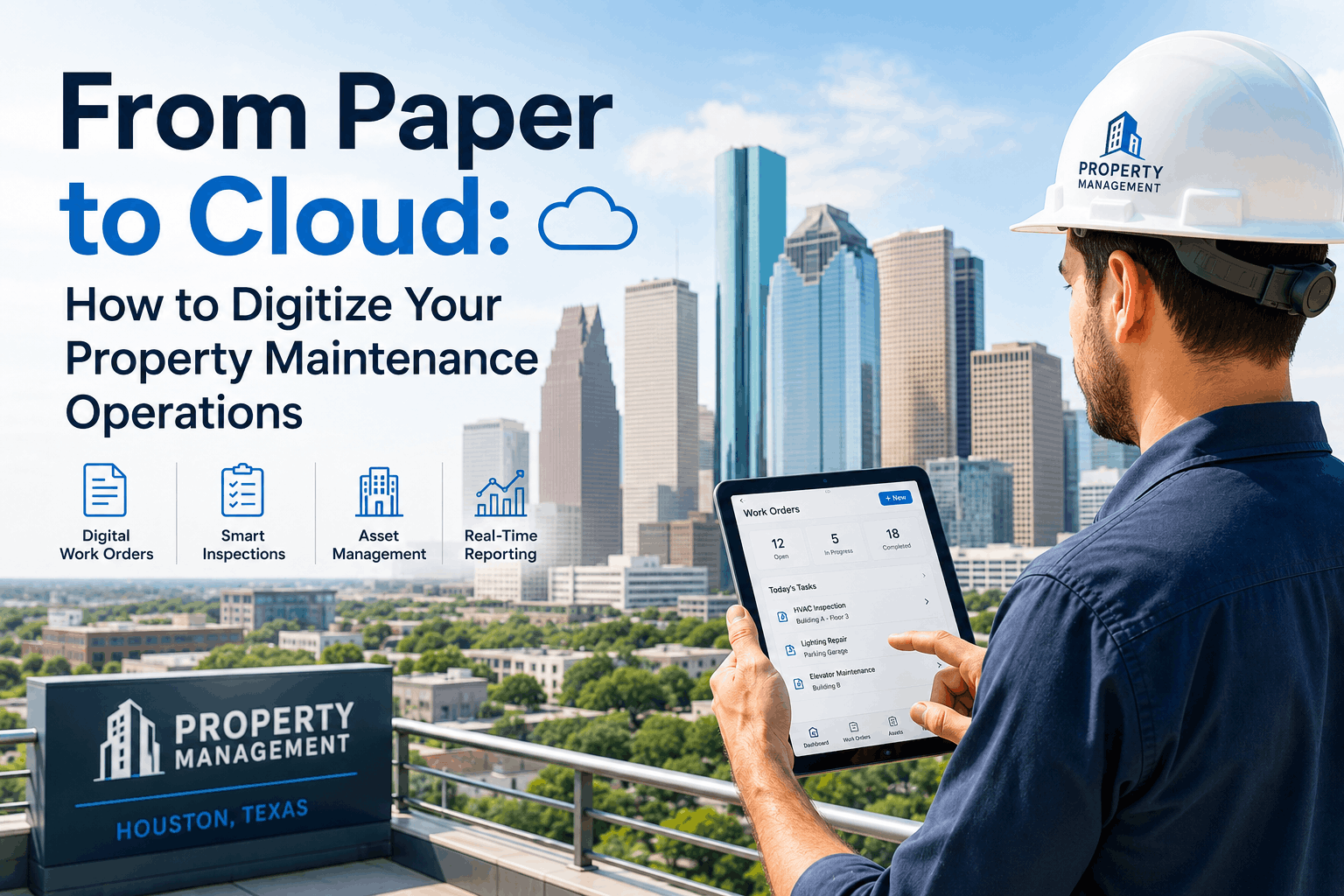
Transitioning from paper logs, spreadsheets, and manual record-keeping to a cloud-based Computerized Maintenance Management System (CMMS) is one of the most transformative decisions a property management organization can make. Yet the path from legacy operations to digital workflows is not straightforward. Property managers juggling multiple portfolios face real obstacles: legacy data scattered across decades of filing cabinets, technicians resistant to new technology, vendor systems that don't talk to each other, and the pervasive fear that moving to the cloud means losing control. OxMaint simplifies this transition with rapid data migration, zero-training overhead, and transparent SLA tracking that holds vendors accountable — turning the paper-to-cloud shift from a 12-month organizational project into a 3-to-5 day operational launch.
Move Your Property Maintenance From Paper to Cloud in Days, Not Months
Eliminate spreadsheets, automate work order routing, track vendor performance, and centralize asset histories — all without implementation consulting fees or data loss risk.
The Hidden Costs of Paper-Based Property Maintenance
Paper-based maintenance tracking is not just outdated — it is economically catastrophic. Organizations managing property portfolios across multiple buildings without a centralized digital system face a compounding cost structure that extends far beyond spreadsheet inefficiency. Every work order exists in isolation: a technician notes a repair on paper, the note goes into a filing cabinet, the property manager never knows if the repair was completed, a tenant calls about the same issue six months later, and emergency repair costs skyrocket. This cycle repeats across dozens of vendors and properties simultaneously. Without a centralized asset register, routine inspections get skipped because nobody remembers when the last one was scheduled. Without automated work order routing, vendors take 36 hours to respond to "urgent" requests because they never saw them. OxMaint's digital work order system timestamps every request, routes it automatically, tracks response times, and escalates breaches — eliminating the data loss and accountability gaps that make paper operations so expensive.
Paper to Cloud Migration: The Five Critical Phases
A successful transition from paper to cloud requires more than just uploading files. It requires deliberate project sequencing, data validation, user adoption support, and continuous governance through the first 90 days post-launch. Organizations that rush this process or treat implementation as an IT checkbox exercise consistently report system abandonment within 6 months and ROI realization delays of 18–24 months. In contrast, property management teams that follow a structured five-phase migration protocol — beginning with executive sponsorship and data audit, progressing through configuration and pilot testing, and concluding with phased rollout and optimization — consistently achieve break-even ROI within 6 months and full platform value within 12 months. Schedule a demo to see how OxMaint's migration playbook handles your specific property portfolio composition and data legacy.
Digital Work Orders: From Paper Notes to Automated Routing
In a paper-based operation, a maintenance request written on a sticky note travels through a chain of people and offices before it reaches the technician who needs it — if it reaches them at all. Digital work orders eliminate every step of that chain. A tenant submits a request via a mobile app or web portal, the system automatically routes it to the assigned vendor based on priority and skill match, the vendor receives a timestamped notification, and the property manager gets real-time visibility of response time and completion status. This single transformation — from paper to digital work order routing — reduces average response times from 11.4 hours (paper-based median) to under 2 hours, increases tenant lease renewal rates by 31%, and reduces emergency repair costs by 45–65% within the first 90 days. OxMaint's mobile-first work order system captures photos, signatures, and completion notes at the point of service — eliminating the post-work paperwork that consumes 35% of technician time in traditional operations.
Technicians complete work orders on-site with photos, time stamps, and digital signatures — eliminating the need to return to an office to close out paperwork. Work order closure triggers automatic invoice generation and PM schedule updates.
Work orders are automatically routed based on priority level (emergency, urgent, routine), vendor availability, location proximity, and skill requirements — eliminating the need for manual dispatch coordination.
Property managers see live work order status — submitted, assigned, in-progress, completed — with response time tracking against SLA targets. Breaches trigger automatic escalations to vendor management.
Every completed work order is linked to the asset it serviced — creating a searchable maintenance history per asset. Query past repairs, view trends, and make data-driven decisions on replacement timing.
We were managing 18 properties with spreadsheets and filing cabinets. Our property manager spent 8 hours per week just tracking down paperwork. We couldn't answer simple questions like "when was the HVAC last serviced?" without calling the technician. After moving to OxMaint, we have complete asset histories, vendors know their response time targets, and we caught a missed roof inspection that would have cost $45,000 in water damage. The system pays for itself every month.
Replace Spreadsheets With a Cloud CMMS in 3–5 Days
OxMaint migrates your asset data, configures your PM schedules, deploys mobile apps, and trains your team — with zero implementation fees and no vendor lock-in. Full data export available anytime.
Common Paper-to-Cloud Transition Challenges
Messy Legacy Asset Data — Missing Dates, Duplicate Records
Paper records contain incomplete information: assets without purchase dates, vendors listed by first name only, PM schedules scattered across different sheets. OxMaint's pre-migration audit identifies data quality issues and provides a structured cleanup protocol that takes 20–40 hours upfront and prevents months of post-launch data entry.
Technician Resistance to Adopting New Workflows
Field technicians accustomed to paper work orders and office-based dispatch resist mobile-first systems. Low adoption rates cause the CMMS to sit idle while staff continue paper workarounds. Change management success requires hands-on training and incentive alignment — not rollout conferences.
Vendor System Integration and SLA Tracking
If vendors operate on their own systems and the CMMS doesn't talk to them, compliance tracking remains manual. True integration requires real-time work order visibility to vendors and automated response time tracking that vendors cannot dispute.
"Big Bang" Launch Attempts Without Pilot Testing
Rolling out a new CMMS to all 50 properties on day one causes immediate system failures, data loss, vendor confusion, and tenant dissatisfaction — then property managers blame the software. Phased pilots with a single property first identify workflow gaps before full rollout.
Frequently Asked Questions
How long does it take to migrate from paper to a cloud CMMS?
OxMaint goes live in 3–5 days from contract signature, including data migration, configuration, and mobile rollout. Most property management firms complete full portfolio adoption within 6–8 weeks through phased property launches.
Will we lose data during migration to a cloud CMMS?
No. OxMaint's migration process includes parallel data validation — your legacy system remains accessible during the entire transition. We retain a complete historical record and provide full data export at any time.
What kind of training do technicians need for a cloud CMMS?
OxMaint's mobile interface requires minimal training — most technicians are productive within 2–4 hours of hands-on walkthrough. We provide role-based training videos, live support during the first 30 days, and a dedicated success manager.
What happens if our CMMS vendor goes out of business or we need to switch?
OxMaint guarantees data portability and provides 90 days of export assistance at no additional cost. Your asset data, work order history, and PM schedules export in standard formats compatible with any CMMS platform.
Can we keep using spreadsheets for some properties and the CMMS for others?
Hybrid approaches create data inconsistency and defeat the purpose of centralization. Phased rollout — one property at a time on the new system — gives teams time to adjust without maintaining parallel spreadsheets.
How do we measure ROI after migrating to a CMMS?
Track emergency repair costs before and after (expect 45–65% reduction), technician hours spent on paperwork, vendor response times, and tenant lease renewal rates. OxMaint's analytics dashboard calculates these automatically.
Is a cloud CMMS secure for property data and vendor information?
OxMaint uses military-grade encryption for data in transit and at rest, multi-factor authentication for user access, role-based permissions, and maintains SOC 2 Type II certification. Audit trails log all system activity.
Your Property Portfolio Is Losing Thousands Every Month to Paper Inefficiency. Move to Cloud Today.
OxMaint's rapid 3-to-5 day implementation, zero setup fees, and transparent vendor SLA tracking turn paper-based operations into data-driven maintenance management — with measurable ROI in 90 days.