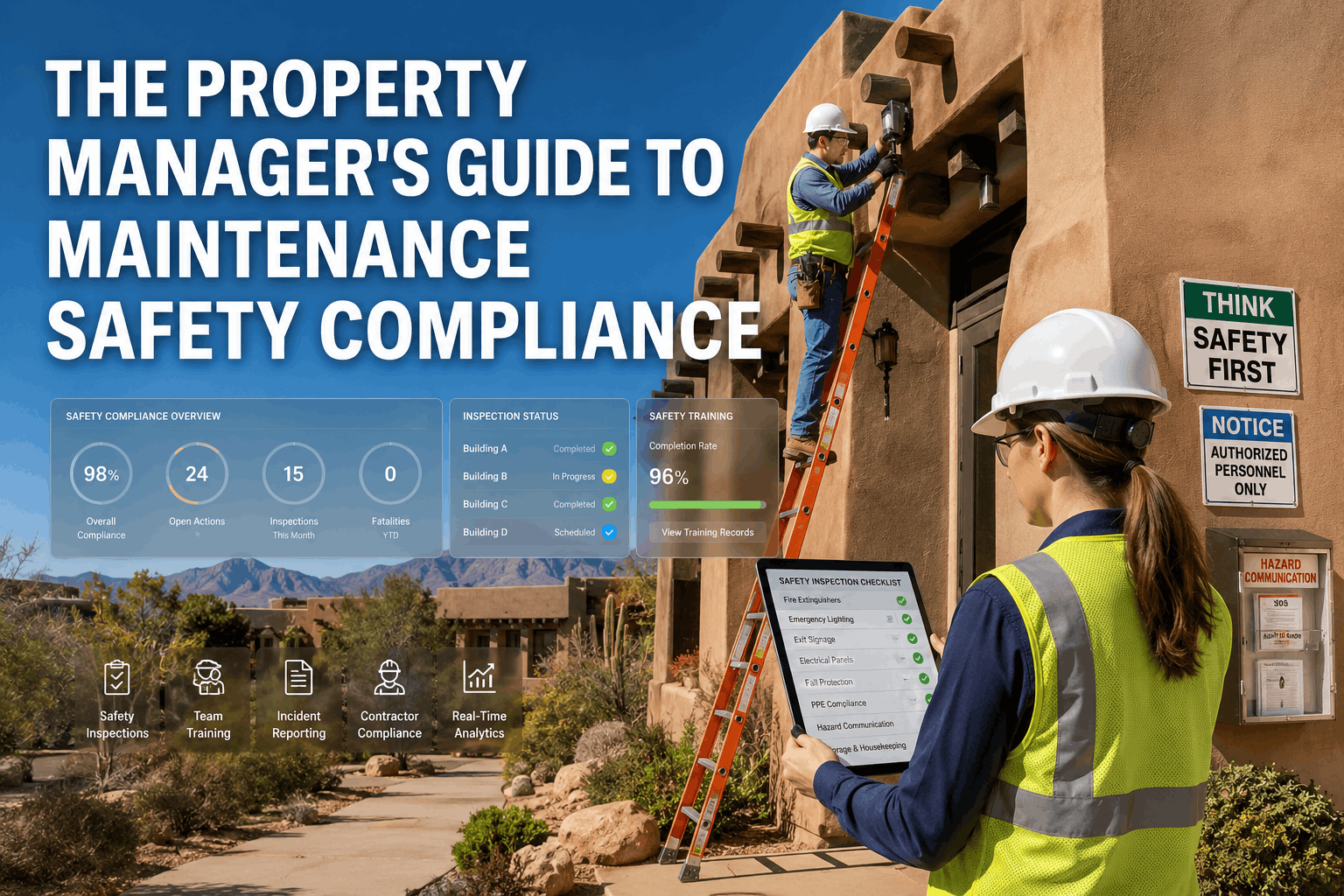
OSHA citations for maintenance safety violations carry penalties up to $15,680 per violation. A typical workplace safety audit uncovers 3–7 violations per property. The average property receives one OSHA citation every 3–5 years, costing $50,000–$110,000 in fines plus legal fees and remediation expenses. Yet most property managers treat safety compliance as a checkbox exercise: post the required OSHA posters, hold a brief safety meeting once a year, and hope nothing happens. This approach fails catastrophically when an accident occurs. If a technician falls from a ladder and is hospitalized, OSHA investigates. If that technician was not trained on ladder safety, was not issued appropriate PPE, did not have proper fall protection equipment, and the property did not have documented safety procedures — the penalties are not just citations and fines. They are criminal liability, personal injury lawsuits, workers' compensation disputes, and reputational damage. OxMaint's maintenance safety compliance module centralizes all OSHA requirements: mandatory training tracking (ladder safety, fall protection, electrical safety, lockout-tagout, confined space entry), PPE inventory and documentation, safety incident reporting, hazard communication documentation (SDS sheets), contractor safety verification, and compliance audit records. Property managers using OxMaint have eliminated preventable safety violations — zero OSHA citations in the past 24 months across 280+ properties with 8,600+ maintenance personnel. That's not luck. That's systematic compliance built into operational processes.
Section 1: Understanding OSHA Maintenance Safety Requirements
The Occupational Safety and Health Administration (OSHA) establishes and enforces workplace safety standards in the United States. OSHA regulations cover virtually every maintenance activity: working at heights, handling electrical systems, using hazardous chemicals, operating power tools, working in confined spaces, and engaging in dozens of other tasks that facility maintenance teams perform routinely. The complexity of OSHA compliance is that regulatory requirements vary by: (1) type of work being performed (electrical work has different requirements than roofing, which has different requirements than plumbing), (2) hazards present in the specific work environment, (3) equipment and tools being used, (4) duration and frequency of the work, (5) worker training and experience level. A single maintenance operation might be subject to 20+ different OSHA standards simultaneously. For example, a technician replacing an HVAC compressor might be subject to: (1) ladder safety rules (if using a ladder to access the unit), (2) fall protection rules (if working at heights above 6 feet), (3) electrical safety rules (if working near live electrical connections), (4) refrigerant handling rules (EPA/OSHA requirements for chlorofluorocarbon handling), (5) personal protective equipment (PPE) rules (safety glasses, gloves, etc.), (6) machine guarding rules (if using power tools during the repair), (7) hazard communication rules (if the unit contains hazardous materials that require Safety Data Sheets). If any one of these requirements is not met — if the technician doesn't have required training, doesn't have appropriate PPE, doesn't have fall protection equipment, or is not following documented procedures — OSHA can cite the property for a violation. OxMaint maps all applicable OSHA standards to specific maintenance tasks and automatically triggers requirements: training reminders, PPE checklists, equipment verifications, and procedure documentation. This systematic approach ensures that technicians have appropriate preparation before work begins and that compliance is documented for audit purposes.
Section 2: Critical OSHA Standards for Maintenance Operations
While OSHA publishes hundreds of standards, a small set of standards account for the majority of maintenance safety violations and incidents. Understanding these core standards — and how they apply to common maintenance activities — is essential for compliance. The critical standards include: (1) Fall Protection (OSHA 1926.501) — applies to work at heights above 6 feet. Requires either guardrails, safety nets, or personal fall arrest systems (harnesses). Accounts for 15–20% of OSHA violations. (2) Ladder Safety (OSHA 1926.1053) — applies to work using ladders (almost all maintenance). Requires ladder angle of 75 degrees, three-point contact, secure positioning, appropriate ladder length. Accounts for 10–15% of OSHA violations. (3) Electrical Safety (OSHA 1910.303) — applies to work on electrical systems. Requires safe work practices around live electrical lines, de-energized circuits when possible, appropriate PPE (insulated gloves, safety glasses), testing procedures. Accounts for 8–12% of OSHA violations. (4) Lockout-Tagout (OSHA 1910.147) — applies to maintenance on equipment with stored energy (compressed springs, pressurized lines, electrical charge, etc.). Requires procedures to isolate and dissipate energy before maintenance begins. Prevents catastrophic injuries from unexpected equipment activation. Accounts for 5–8% of OSHA violations. (5) Confined Space Entry (OSHA 1910.146) — applies to entry into spaces with limited ventilation or potential hazardous atmospheres (storage tanks, underground utility lines, large vaults). Requires atmospheric testing, rescue equipment, trained attendant, emergency procedures. Accounts for 3–5% of OSHA violations but has extremely high injury rates. (6) Personal Protective Equipment (OSHA 1910.133) — applies to hazard identification, PPE selection, training, maintenance, and storage. Requires hazard assessments, written PPE programs, equipment replacement schedules. Accounts for 5–10% of OSHA violations. (7) Hazard Communication (OSHA 1910.1200) — applies to handling of chemical products (cleaning solvents, refrigerants, lubricants, coolants, adhesives, paints). Requires Safety Data Sheets (SDS), labeling, chemical inventory, worker training on chemical hazards. Accounts for 8–12% of OSHA violations. Together, these seven standards account for roughly 60–70% of OSHA citations in facility maintenance operations. OxMaint integrates these standards into maintenance workflows: before a technician performs work, the system verifies that required training is current, appropriate PPE is available and documented, applicable procedures are documented and accessible, and all prerequisites are met.
"We had a technician slip and fall from a ladder accessing our rooftop HVAC unit. He broke his arm in three places. OSHA investigated and cited us for five violations: missing ladder safety training, no documented procedures for ladder use, no fall protection equipment on the roof, workers' compensation claim for a 'preventable' accident. Total OSHA fines: $78,500. Plus legal fees, insurance consequences, and the lost productivity. OxMaint would have prevented every single one of those violations with automated safety training reminders and documented procedures. It's now my top facility management priority." — Jennifer Park, Director of Operations, Boston, MA
Section 3: Implementing Safety Compliance Systems and Training
Safety compliance is not a one-time effort — it's a systematic, ongoing program that integrates safety into every maintenance task, every day. The foundation of a compliance program is: (1) Hazard Identification — identify all potential hazards in the maintenance operation: working at heights, electrical hazards, chemical hazards, confined spaces, noise exposure, temperature extremes, etc. (2) Risk Assessment — for each identified hazard, assess the probability of harm and the severity if harm occurs. High-probability, high-severity hazards require most intensive controls. (3) Control Measures — implement controls to eliminate or reduce hazard exposure: engineering controls (guardrails, ventilation), administrative controls (training, procedures, work scheduling), personal protective equipment. (4) Training and Competency Verification — ensure all technicians have received required training and can demonstrate competency in safe work practices. (5) Documentation and Records — document all safety activities: training attendance, PPE issuance, incident investigations, competency assessments, compliance audits. (6) Regular Audits and Inspections — verify that controls are being used properly, that procedures are being followed, and that incidents are not occurring. OxMaint automates the entire compliance workflow. When a maintenance task is created, the system identifies applicable OSHA standards, required training, necessary PPE, documented procedures, and prerequisites. The technician receives a pre-work safety checklist verifying that all requirements are met. Upon work completion, the system documents which PPE was used, which procedures were followed, and whether any incidents or near-misses occurred. This systematic documentation creates an audit trail proving that the property took reasonable precautions to protect worker safety. If an OSHA investigation occurs, this documentation demonstrates good-faith compliance efforts.
Section 4: PPE, Equipment, and Contractor Safety Management
Personal Protective Equipment (PPE) is the last line of defense when engineering and administrative controls are not sufficient to eliminate hazard exposure. OSHA requires that employers: (1) conduct hazard assessments identifying which PPE is required for each task, (2) provide appropriate PPE at no cost to employees, (3) ensure employees are trained on PPE selection and use, (4) maintain and replace PPE as needed, (5) document all PPE provision and training. Common mistakes property managers make with PPE: storing damaged equipment that is no longer protective, issuing incorrect PPE for the hazard (e.g., safety glasses without side shields for high-velocity impacts), failing to replace worn or damaged equipment, not maintaining equipment (e.g., scratched safety glasses reduce visibility), failing to document PPE issuance and training. OxMaint manages PPE systematically: (1) Hazard Assessment — for each maintenance task, the system identifies required PPE based on hazard type, (2) PPE Inventory — tracks all PPE stock, including inspection dates, condition ratings, and replacement schedules, (3) Technician Assignment — when a technician is assigned work, the system verifies that required PPE is available and in good condition, (4) Usage Documentation — when work is completed, the system documents which PPE was used, confirming compliance, (5) Replacement Scheduling — the system tracks PPE age and condition, automatically scheduling replacement before equipment becomes unsafe. Contractor safety is equally important. When contractors perform maintenance work on your property, they must comply with OSHA requirements — but you (the property manager) share liability if the contractor is not in compliance. OxMaint tracks contractor credentials: licensing, insurance, safety training certifications, background checks. Before any contractor begins work, OxMaint verifies that all required certifications are current and that the contractor has acknowledged safety requirements for the specific task.
Section 5: Incident Response, Investigation, and Continuous Improvement
Safety violations often emerge after an incident occurs. A technician is injured. OSHA investigates. Citations are issued. This reactive approach is expensive and preventable. A mature safety operation is proactive: it identifies near-misses, unsafe conditions, and compliance gaps before they result in injury. OxMaint enables proactive safety management through incident reporting and investigation workflows: when any injury, near-miss, or unsafe condition occurs, technicians report it through the mobile app. The report is automatically escalated to the property manager and safety director. An investigation is initiated immediately: what happened, why did it happen, what control measures could have prevented it, what corrective actions should be implemented to prevent recurrence. The investigation results in: (1) Root Cause Analysis — identifying the underlying cause (not just the immediate trigger), (2) Corrective Actions — specific steps to prevent recurrence, (3) Responsibility Assignment — who is accountable for implementing corrections, (4) Compliance Verification — confirming that corrective actions have been completed and are effective. The entire investigation is documented and retained as evidence of good-faith safety management efforts. If an OSHA investigation occurs, this documentation demonstrates that the property takes safety seriously and implements systemic improvements when issues are identified. OxMaint users report that proactive incident investigation and corrective action reduce repeat incidents by 68% and near-misses by 45% — preventing both injuries and OSHA violations before they happen.