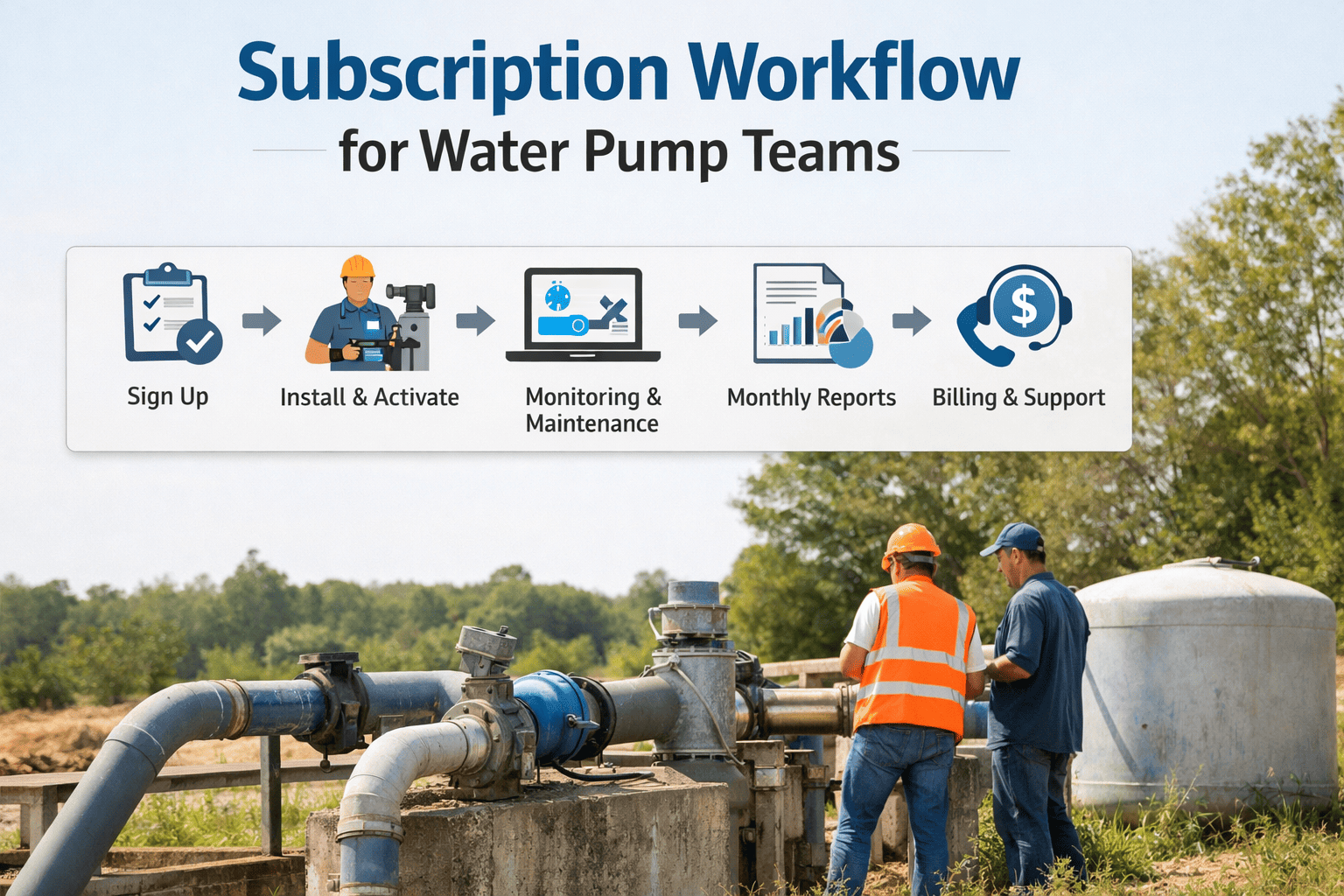
Subscription Workflow for Water Pump Teams

By Samuel Jones on February 2, 2026

subscription-workflow-for-water-pump-teams

August 12, 2024. Heavy rainfall surges into the district lift station. Main Pump A activates. Nothing. Motor burnout—insulation resistance had been degrading for months. Backup Pump B starts but cavitates immediately—suction strainer blocked by debris from the last storm. The overflow contingency fails. 200,000 gallons of untreated wastewater floods the basement of a nearby commercial complex. $850,000 in damages and EPA fines. Every warning sign was present in the data, but the manual subscription workflow relied on quarterly site visits. Nobody was watching the drift.

That gap between scheduled maintenance visits and actual pump reality is where flooding happens. The HydroGuard Subscription Workflow monitors discharge pressure, flow rates, motor amps, vibration signatures, and seal integrity continuously—not monthly, not quarterly, but every second. When efficiency drops, the workflow triggers an automated ticket, dispatches a technician with the right parts, and prevents the catastrophe. Upgrade your pump teams to a predictive subscription model today.

95%
Fewer Overflow Events
40%
Energy Cost Reduction
60d
Early Cavitation Warning
99.9%
Pumping Station Uptime

Why Quarterly Maintenance Visits Aren't Enough

Pumps destroy themselves in the silence between visits. A quarterly check is a snapshot. Seals dry out in days. Debris clogs impellers in hours. Bearings seize from micro-vibrations over weeks. By the time your team arrives for their scheduled subscription visit, the damage is irreversible.

Failure Mode
How It Develops
Detection Gap
Consequence
Seal Failure
Micro-leaks erode face
Visible only upon rupture
Flooding & motor short
Cavitation
Vapor bubbles implode
Audible only onsite
Impeller pitted/destroyed
Dead Head
Discharge valve closed
Zero warning signs
Fluid boils, pump explodes
Bearing Wear
Lubrication breakdown
Heat/Vibe ignored
Shaft seizure in minutes

The HydroGuard workflow fills these gaps with real-time telemetry. Schedule a demo to see how we catch what manual logs miss.

What the Subscription Workflow Monitors

Six critical subsystems. High-frequency data transmission. The workflow builds a hydraulic curve for every pump, understanding exactly where it should operate on the Best Efficiency Point (BEP). Start free to connect your first station.

Vibration Analysis

RMS Velocity:ISO Tracked
Bearing Frequencies:Trend Scored
Misalignment:AI Detect

Predicts bearing failure and soft-foot issues weeks in advance. Stops catastrophic seizing.

Hydraulic Performance

Discharge Pressure:PSI Logged
Flow Rate:GPM Tracked
Head Loss:Calc Realtime

Identifies clogs, worn wear rings, and impeller degradation before flow capacity vanishes.

Motor Health

Current Imbalance:Baselined
Winding Temp:Mapped
Power Factor:Optimized

Catches insulation breakdown, voltage spikes, and phase loss before the motor burns out.

Seal Integrity

Flush Flow:Tracked
Seal Pressure:Trended
Leak Rate:Verified

Detects the first drop of leakage across mechanical seals, preventing environmental hazards.

Energy Efficiency

Wire-to-Water Eff:Real-time
kW/Gallon:Flagged
Runtime Hours:Scored

Reveals pumps operating off their curve, wasting electricity and shortening lifespan.

Control Logic

Lead/Lag Alternation:Verified
VFD Response:Hz Logged
Start/Stop Cycles:Graded

Identifies short-cycling and control float errors before they destroy the starters.

Stop Pump Failures Before They Happen

Join over 500 water teams using HydroGuard to predict maintenance needs. Get full access to the platform today.

ROI: Subscription Workflow vs Reactive Service

Calculate your savings from deploying a predictive subscription workflow across a typical 20-station municipality or industrial loop.

Reactive Service Costs
Pump Replacements (3/yr)$95,000/yr
Emergency Callouts (OT)$62,000/yr
EPA/Environmental Fines$25,000/yr
Wasted Energy (Inefficiency)$42,000/yr
Flooding Cleanup Liability$150,000/yr
Annual Risk Exposure$374,000
With HydroGuard Workflow
Life extended by 4 years$85,500 saved
Emergency calls reduced 90%$55,800 saved
Zero compliance violations$25,000 saved
Optimized Pump Curves$31,000 saved
99.9% uptime achieved$145,000 saved
Annual Savings$342,300

Ready for 99.9% Pump Reliability?

Book a quick demo to see how the automated subscription workflow eliminates overflows and cuts energy waste — or start free today.

Who Uses This Subscription Workflow

Every organization where water movement is critical to operation, safety, or environmental compliance. These are not "run to failure" environments.

Municipal Water/Wastewater
Lift stations, booster pumps, treatment plants. EPA reporting and overflow prevention are mandatory.
Commercial HVAC
Chilled water loops, cooling towers. Pump failure means no AC for high-rise tenants and massive lease credits.
Agricultural Irrigation
Pivot systems, drip lines. 24 hours of downtime during peak season can destroy an entire crop yield.
Industrial Process
Boiler feed, chemical dosing, slurry transport. Process stops immediately when pressure drops.

Pump Types Supported

The workflow handles every pump architecture and fluid type with specialized hydraulic models. Start free to register your assets.

SubmersibleSewage, dewatering, grinder
CentrifugalEnd suction, split case, vertical
Positive DisplacementGear, lobe, screw, diaphragm
Vertical TurbineDeep well, fire pumps
Booster SetsMulti-stage, variable speed
Dosing/MeteringHigh precision chemical injection

Your Pumps Deserve Better Than a Monthly Clipboard

Join facilities achieving 99.9% hydraulic availability with the predictive subscription workflow.
Frequently Asked Questions

Does the workflow replace physical pump maintenance?
No—it optimizes it. Instead of driving to check healthy pumps, your team only visits pumps that the subscription workflow flags as degrading or inefficient.
What sensors are needed for the subscription data?
Vibration sensors, pressure transducers (suction/discharge), flow meters, and current transducers (CTs). Many modern VFDs provide this data automatically.
How does it detect cavitation?
The AI analyzes high-frequency vibration data for specific spectral patterns and correlates it with unstable discharge pressure readings to confirm cavitation.
Can it track pump efficiency (Wire-to-Water)?
Yes—by monitoring power input (kW) against flow and head output, the system calculates real-time efficiency and flags pumps running off their curve.
Is this compatible with old pumps?
Absolutely. Retrofitting legacy pumps with affordable wireless vibration and temperature sensors is the most common use case for this workflow.
Does it integrate with SCADA?
Yes. The subscription workflow pushes alerts and health scores directly to your existing SCADA or BMS, acting as an intelligence layer on top of your controls.

Share This Story, Choose Your Platform!