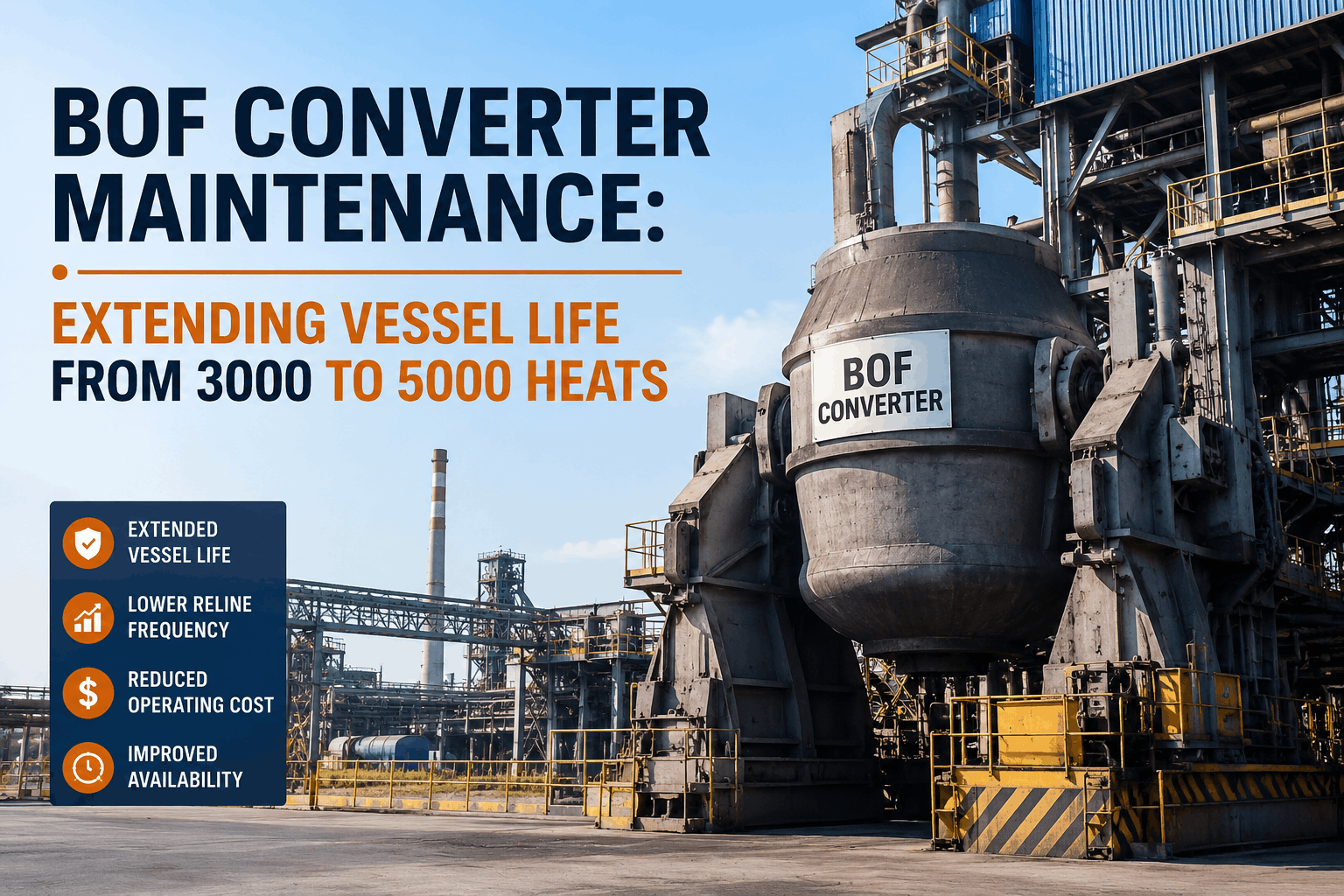
A BOF vessel at a 3-million-tonne steelworks in Germany reached 3,847 heats before an unplanned lining failure forced an emergency reline. Post-incident analysis found that the shell scanning system had logged thermal anomalies in the charge pad zone for eleven heats before the breach — but those readings sat in a standalone measurement console with no connection to the maintenance work order system. Nobody acted because nobody saw a task. The lining data existed. The maintenance trigger did not. Oxmaint connects your BOF vessel monitoring data to integrated work orders — so every thermal anomaly, every lance wear threshold, every hood condition flag becomes a tracked, owned, and escalated maintenance action. Book a demo to see vessel campaign tracking configured for your converter fleet.
Three Maintenance Failures That Shorten BOF Campaign Life and Increase Reline Cost
BOF converter maintenance involves three simultaneous degradation mechanisms — vessel lining wear, oxygen lance consumption, and gas recovery hood condition — each tracked on different systems by different teams with no integration between them. The consequence is that the total picture of converter health is never visible to anyone at the point where intervention decisions are made.
Shell scanning, thermocouple readings, gunning records, and heat logs are tracked in separate systems — offline spreadsheets, paper records, and standalone measurement consoles. No integrated view means no early warning. Maintenance engineers base reline decisions on experience and a rough heat count rather than actual lining condition data correlated to wear rate per zone. Sign up for Oxmaint to consolidate all vessel condition data into a single campaign record.
Oxygen lance consumption is recorded when tips are changed, but rarely analysed systematically. Variations in heat intensity, oxygen flow rates, and blowing patterns that drive accelerated tip wear go untracked until consumption rates spike. When a tip fails mid-heat, the resulting skull buildup, vessel skull accumulation, or off-spec heat can cost more than an entire month of lance procurement budget. Book a demo to see lance wear tracking and consumption analytics in Oxmaint.
The primary and secondary gas recovery hood system — water-cooled panels, skirt seals, off-gas ducting, and the suppression system — degrades continuously under extreme thermal cycling. Hood condition is typically assessed during planned shutdown windows, but between shutdowns there is no systematic tracking of panel leak rates, skirt seal condition, or dust collection efficiency that would flag accelerating degradation before it forces an unplanned stop. Sign up for Oxmaint to configure hood condition work orders with trend tracking.
01BOF Vessel Lining Campaign Management
Vessel lining campaign management is the highest-value maintenance discipline in BOF steelmaking. The difference between a 3,200-heat campaign and a 4,800-heat campaign on the same converter is not primarily refractory grade — it is the quality and consistency of gunning, patching, and bottom maintenance interventions executed throughout the campaign based on actual measured condition rather than scheduled dates.
Campaign optimisation requires that every gunning event, patching intervention, measurement result, and heat log entry feeds a single vessel record that makes the wear trajectory visible across the full campaign. Sign up for Oxmaint to configure vessel campaign records for your BOF fleet with integrated lining wear trending and automatic PM trigger generation.
02Oxygen Lance Wear Monitoring and Consumption Tracking
Oxygen lance life in a BOF converter is determined by the combination of oxygen flow rate, blowing pattern, skull management practices, and the quality of the splash protection. In plants without structured wear tracking, lance tip changes happen on a rough heat-count schedule that treats all heats as equivalent — the result is both premature changes that waste serviceable tips and delayed changes that allow degraded tips to affect blowing performance and heat quality.
Oxmaint tracks tip changes against actual heat intensity data — oxygen volume per heat, blowing duration, metal temperature at turndown — rather than treating every heat equally. When a campaign of higher-intensity heats is detected, the system recalculates the consumption rate projection and advances the tip change work order accordingly. Conversely, lighter heat campaigns allow interval extension backed by data rather than guesswork. Sign up for Oxmaint to activate heat-weighted lance consumption tracking for your BOF lance fleet.
Lance body skull accumulation between the tip and the upper lance assembly is the primary mechanism of lance failure in the mid-body rather than at the tip. Skull measurement at each lift, combined with the record of skull-clearing interventions, builds a predictive model of body condition alongside the tip wear record. Work orders for skull clearing are generated automatically when accumulation rates indicate risk. Book a demo to see skull tracking integrated with lance wear records in Oxmaint.
Lance cooling water flow rate and inlet/outlet temperature differential are the most reliable indicators of cooling circuit integrity. A developing leak in the lance body — before it becomes a catastrophic failure — manifests as a flow anomaly that is detectable weeks ahead of the failure event. Oxmaint integrates cooling water sensor data into the lance asset record, triggering inspection work orders when flow or temperature thresholds are exceeded during blowing. Sign up for Oxmaint to connect lance cooling sensor data to automated work orders.
03Gas Recovery Hood Condition Management
The primary off-gas hood system in a BOF shop — suppression-type or recovery-type — is subject to the most severe thermal cycling of any fixed structure in the plant. Water-cooled panels experience temperature differentials exceeding 400°C between the hot face and cooling water inlet on each blowing cycle. The hood skirt seal, dust collection baffles, and off-gas duct lining degrade continuously across these cycles, with degradation accelerating at higher heat intensities and shorter tap-to-tap times.
Panel leak detection through outlet water temperature monitoring and flow balance measurement. Each panel circuit tracked independently — a single circuit deviation triggers an inspection work order before the leak becomes a production-stopping event. Panel condition photographed at each shutdown and stored against the panel asset record for campaign lifecycle tracking. Sign up for Oxmaint to configure panel circuit monitoring and inspection records.
The primary hood skirt seal between the vessel mouth and the hood body is a critical component for emissions compliance and gas recovery efficiency. Seal wear rate depends on vessel tilt angle consistency, mechanical contact frequency, and thermal expansion patterns. Seal inspection work orders scheduled on heat-count intervals with draught measurement logged to confirm sealing performance before and after each intervention. Book a demo to see skirt seal tracking in Oxmaint.
The off-gas duct lining between the hood and the gas recovery or suppression system carries dust-laden gas at temperatures above 1,200°C during blowing. Lining condition in the first three to five metres downstream of the hood is the highest-wear zone. Inspection and relining work orders scheduled to coincide with planned vessel campaigns to minimise total shutdown time. All relining scope, materials consumed, and condition before/after logged to the duct asset record. Sign up for Oxmaint to align duct relining with vessel campaign scheduling.
Wet scrubber or bag filter performance determines both emissions compliance and the quality of recovered dust for process recycling. Differential pressure trend across the system is the primary indicator of collection efficiency degradation. Oxmaint tracks DP readings against production heat rate, generates cleaning work orders when DP trend indicates filter loading, and stores emissions monitoring data alongside the maintenance record for regulatory reporting. Book a demo to see dust collection maintenance tracking.
04Spreadsheet Tracking vs Oxmaint CMMS for BOF Maintenance
The operational difference between managing BOF maintenance on spreadsheets and managing it through an integrated CMMS is not a matter of data entry convenience. It is a difference in what interventions are executed, when they happen, and whether the collective maintenance history of the vessel is available to inform the next decision.
05Oxmaint Capabilities for BOF Converter Maintenance
Oxmaint's CMMS platform provides four connected capabilities that together give BOF maintenance teams the integrated visibility to optimise campaign length, reduce lance consumption, and manage hood condition — all from a single platform accessible on mobile in the plant environment.
Before Oxmaint, our gunning schedule was driven entirely by heat count. We were relining at 3,400 heats because that is what we had always done. After 18 months of condition-based tracking through the CMMS, we pushed the last two campaigns to 4,650 and 4,720 heats by adjusting gunning volume to actual per-zone wear rates. The refractory cost saving on those two campaigns alone was greater than our CMMS spend for three years.
06Frequently Asked Questions
Vessel Lining, Lance Wear, and Hood Condition — Tracked Together, Not Apart.
Campaign heat tracking. Condition-based gunning triggers. Lance consumption analytics. Hood panel circuit monitoring. Reline planning documentation. Integrated from day one.