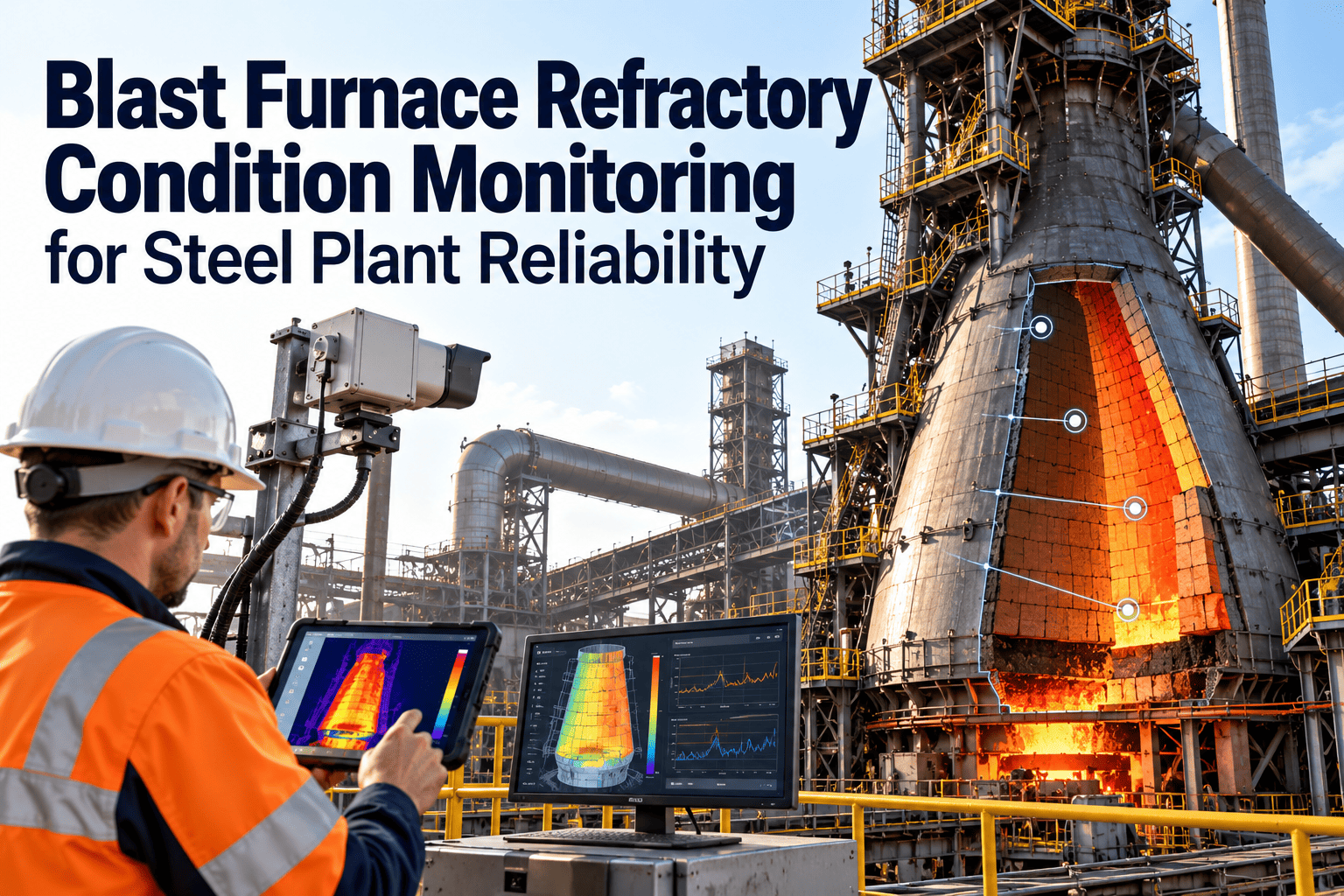
A blast furnace hearth breach is not a maintenance event — it is a catastrophic safety incident followed by a $50–150 million emergency reline, six to twelve months of lost production, and a forensic investigation asking why the thermocouple data that predicted it was never acted on. The data exists in every instrumented blast furnace. The gap is a platform that converts raw thermocouple readings, cooling water heat flux, and carbon block temperature gradients into a living erosion model that tells operators — with months of advance notice — when and where the hearth lining is approaching its operational limit. Oxmaint's AI anomaly detection and asset health platform is that system.
Blast Furnace Refractory Monitoring: AI-Powered Erosion Detection & Campaign Life Extension
How continuous thermocouple array analysis, cooling water heat flux trending, and AI anomaly detection extend blast furnace campaign life beyond 20 years — and prevent the unplanned hearth breach that ends campaigns early at catastrophic cost.
The Gap Between Raw Thermocouple Data and Actionable Erosion Intelligence
Every modern blast furnace is instrumented. Hearth thermocouples are embedded in the carbon block lining at multiple depths and elevations. Cooling stave temperatures are monitored continuously. Cooling water inlet/outlet differentials are logged by the process control system. The raw data exists — terabytes of it, accumulating every shift. The problem is that none of this data is integrated into a model that shows the maintenance and operations team what it actually means: where the erosion front currently sits, how fast it is moving, and how much residual lining thickness remains at each critical zone.
The result is that blast furnace campaigns end in one of two ways. Either operators reline conservatively — taking the furnace off-line with significant life remaining, leaving millions in unproduced iron on the table — or they push the campaign until thermocouple readings force a crisis decision, with the line between controlled reline and emergency breach growing thinner by the day. Both outcomes are failures of information management, not of the refractory itself. Sign up for Oxmaint to begin converting your existing thermocouple data into an active erosion model.
Thermocouple Array Analysis and Carbon Block Erosion Modelling
The blast furnace hearth is the highest-risk zone in the refractory system. Carbon block temperature readings at successive depths — typically 300 mm, 600 mm, 900 mm, and 1200 mm from the hot face — define the temperature gradient through the lining. The position of the 1150°C isotherm within this gradient is the primary indicator of remaining lining thickness: as the carbon block erodes, the isotherm migrates outward, and each thermocouple at a given depth crosses above 1150°C as the erosion front reaches it.
AI Isotherm Tracking, Erosion Rate Calculation, and Freeze-Lining Health
Oxmaint's AI anomaly detection ingests the full thermocouple array — bottom, sidewall, and taphole zones — and fits a continuous erosion model that tracks the 1150°C isotherm position in three dimensions, updated at each data acquisition cycle. The erosion rate at each circumferential zone is calculated from the isotherm migration velocity, flagging zones where local erosion is accelerating beyond the fleet average — the signature of channelling or salamander movement that precedes localised breakthrough.
Freeze lining integrity — the solidified iron skull protecting the carbon block in well-cooled zones — is assessed from the relationship between cooling stave heat flux and the inner thermocouple temperatures. When heat flux increases while inner temperatures fall, the freeze lining is thickening — a controlled response. When both increase simultaneously, the freeze lining is thinning — an alert condition requiring cooling circuit inspection and burden distribution review. Book a demo to see hearth erosion modelling configured for your furnace instrumentation.
Cooling System Heat Flux Trending and Stave Condition Assessment
The cooling system is the refractory's life-support mechanism. Cooling staves in the lower stack and bosh zones must maintain sufficient heat extraction to stabilise the accretion layer that protects the carbon lining from direct contact with the process. When a cooling stave fails — through water circuit blockage, stave cracking, or scale deposition reducing heat transfer — the accretion in that zone destabilises and the erosion rate at the underlying refractory accelerates. Stave failures are predictable through heat flux trending weeks before they produce visible refractory deterioration.
Heat Flux Per Stave, Water Circuit Integrity, and Accretion Layer Stability
Oxmaint calculates heat flux per cooling stave from the inlet/outlet temperature differential and measured flow rate. Individual stave heat flux is trended against the stave's historical baseline and against adjacent staves in the same panel — the statistical comparison that identifies a single failing stave in a panel where all others are performing normally. A stave with heat flux declining to less than 60% of its panel average while adjacent staves maintain normal output is a blocked water circuit requiring immediate investigation before the corresponding refractory zone loses its thermal protection.
Stave temperature monitoring — where stave body thermocouples are installed — provides a second confirmation signal. A stave body temperature rising above the normal operating range while water flow is confirmed indicates internal cracking or hot metal penetration of the stave body. At this point the stave has lost its heat extraction function and the refractory behind it is operating without cooling protection. Sign up for Oxmaint to begin stave-level heat flux monitoring for your blast furnace cooling circuits.
Lost Per Hour During Blast Furnace Unplanned Downtime
A modern 3,000 m³ blast furnace producing 8,000 tonnes of iron per day generates over $1 million in revenue every hour of operation. An unplanned hearth breach requiring emergency reline stops that revenue for 6–12 months, destroys the campaign investment, and triggers capital procurement for a reline that could have been planned and budgeted with 12–18 months of advance notice.
The plants achieving 20+ year campaign lives are not running better refractory — they are running better data. AI-driven erosion monitoring gives the operations team the 12–18 month decision window needed to plan burden adjustments that extend life, schedule the reline during a planned low-demand period, and procure materials at contracted rather than emergency rates. Start your free Oxmaint account to build an active hearth condition model from your existing instrumentation.
Lower Stack Refractory Condition and Belly/Bosh Zone Erosion Tracking
The bosh and lower stack are the highest-wear zones in the blast furnace refractory above the hearth. The extreme thermal cycling from charging, the mechanical abrasion from descending burden, and the chemical attack from alkalis and zinc that condense and penetrate the lining at these temperatures produce erosion rates that vary dramatically between furnace campaigns and between individual operators. A CMMS that maintains a complete operational record — blast parameters, burden distribution, alkali input rates, and slag chemistry — alongside the refractory condition data creates the correlation capability needed to identify which operational decisions are accelerating lining wear.
Accretion Stability Monitoring and Alkali/Zinc Penetration Tracking
In the bosh and lower stack, the refractory itself is often largely consumed after the first years of campaign — the primary protection is the accretion layer formed from solidified slag and ore constituents adhering to the lining. The accretion is dynamic: it builds during high-productivity periods and dissolves during operational disturbances, thermal cycling, and alkali-rich burden. Cooling stave heat flux in the bosh zone is the primary proxy for accretion thickness — decreasing heat flux indicates a thicker accretion building, increasing heat flux indicates thinning.
Alkali and zinc load tracking — calculated from charged burden analysis data integrated with Oxmaint from the raw materials system — correlates directly with refractory attack rates in the lower stack. Periods of elevated alkali input that are not offset by increased slag basicity appear in the operational record as correlates to accelerated bosh erosion in the 4–8 weeks that follow. Oxmaint flags these operational events and links them to the subsequent thermocouple responses, building the operational intelligence that enables burden management decisions to protect campaign life. Book a demo to see operational parameter tracking linked to refractory condition data in Oxmaint.
Convert Your Thermocouple Data Into a Living Erosion Model
AI isotherm tracking, cooling stave heat flux analysis, operational parameter correlation, and campaign life prediction — all in Oxmaint, connected to your existing furnace instrumentation.
Blast Furnace Refractory Monitoring: Key Parameters and Alert Thresholds
Use this reference when configuring Oxmaint monitoring parameters and anomaly detection thresholds for your blast furnace instrumentation.
| Zone / Component | Primary Parameter | Alert Condition | AI Detection Method | Risk Level |
|---|---|---|---|---|
| Hearth Carbon Block | 1150°C isotherm depth at each circumferential zone | Isotherm reaching 80% of designed campaign limit OR erosion rate >2× fleet average | Continuous isotherm model updated per scan cycle | Critical |
| Hearth Taphole Zone | Taphole thermocouple gradient and drilling length trend | Thermocouple at 600mm depth exceeds 800°C or drilling depth declining trend | Statistical trend analysis + drilling record integration | Critical |
| Cooling Staves | Individual stave heat flux (kW/m²) | Stave heat flux <60% of panel mean or declining >30% from stave baseline | Panel statistical comparison + historical baseline deviation | Critical |
| Freeze Lining | Inner wall thermocouple + cooling water delta-T | Both inner TC and delta-T rising simultaneously (thinning signature) | Correlated multi-parameter anomaly detection | High |
| Bosh Refractory | Bosh cooling stave heat flux + accretion proxy | Heat flux increasing >25% above campaign average for 48+ hours | Campaign-normalised trending with alkali load correlation | High |
| Lower Stack Lining | Stack thermocouple gradient and cooling water temperature | Thermocouple gradient flattening indicating lining thinning in zone | Gradient profile analysis across multiple elevations | High |
| Cooling Water System | Total heat load, flow rate per circuit, water chemistry | Total heat load increasing without production increase; circuit flow below design | Production-normalised heat load trending + circuit flow monitoring | High |
| Campaign Life Forecast | Remaining lining thickness at worst-case zone | Projected campaign end date within 18 months at current erosion rate | AI erosion rate extrapolation with confidence interval | Planning |
| Alert thresholds are starting points for configuration. Oxmaint's anomaly detection baselines are calibrated to each furnace's historical operating envelope during commissioning, then updated continuously as the campaign progresses. Thresholds should be validated against your furnace OEM specifications and your metallurgical engineering team's campaign management criteria. | ||||
How Oxmaint's AI Anomaly Detection and Asset Health Platform Serves Blast Furnace Teams
Continuous Thermocouple Array Analysis
Oxmaint ingests thermocouple array data from hearth, bosh, and stack zones via OPC-UA, Modbus, or direct historian connection. The AI anomaly detection engine runs continuous isotherm calculations across the full array, identifying statistically anomalous temperature gradients — a single thermocouple reading that deviates from the spatial pattern expected at its location given the readings of its neighbours — before it is visible as a simple threshold alarm. Sign up free to configure your thermocouple integration.
Asset Health Score and Campaign Life Forecast
Oxmaint's asset health module maintains a composite health score per furnace zone — hearth north/south/east/west quadrants, taphole zones, cooling stave panels — updated at each data acquisition cycle. The campaign life forecast projects the date at which the worst-case zone reaches its minimum safe lining thickness at the current erosion rate, with a confidence interval that narrows as the campaign progresses and the erosion model accumulates more data. The forecast drives the reline planning decision with quantified remaining time rather than engineering judgement. Book a demo to see campaign life forecasting configured.
Operational Parameter Correlation
Oxmaint integrates blast parameters, burden composition, slag chemistry, and alkali/zinc load data from the L2 process control system alongside the refractory monitoring data. The correlation engine identifies which operational events — blast temperature spikes, burden distribution changes, high-alkali burden periods, slag chemistry excursions — are statistically associated with accelerated refractory wear in the subsequent weeks. This closes the feedback loop between operations and refractory management that conventional systems leave open.
Cooling Circuit Monitoring and Stave Failure Early Warning
Individual cooling circuit heat flux is calculated and trended per stave with automatic comparison against the stave's own baseline and against the panel mean. Circuit flow monitoring detects blockage development before heat flux loss reaches the refractory impact threshold. Stave body temperature monitoring (where instrumented) provides an independent confirmation of stave physical integrity. Work orders for cooling circuit inspection are generated automatically when heat flux anomalies are detected, with the relevant trend data attached for the maintenance team's diagnosis.
"Blast furnaces running 24/7 with a single unexpected failure trigger catastrophic losses. Yet most plants still operate on reactive maintenance strategies developed decades ago. The difference between struggling plants and profitable ones is not luck — it is real-time AI monitoring that predicts failures weeks before they occur."
Frequently Asked Questions
Stop Managing Blast Furnace Campaigns on Threshold Alarms
AI isotherm tracking, cooling stave heat flux analysis, campaign life forecasting, and operational parameter correlation — all in Oxmaint, connected to your existing blast furnace instrumentation to give your metallurgical and maintenance teams the 12–18 month decision window that emergency relines cost you.