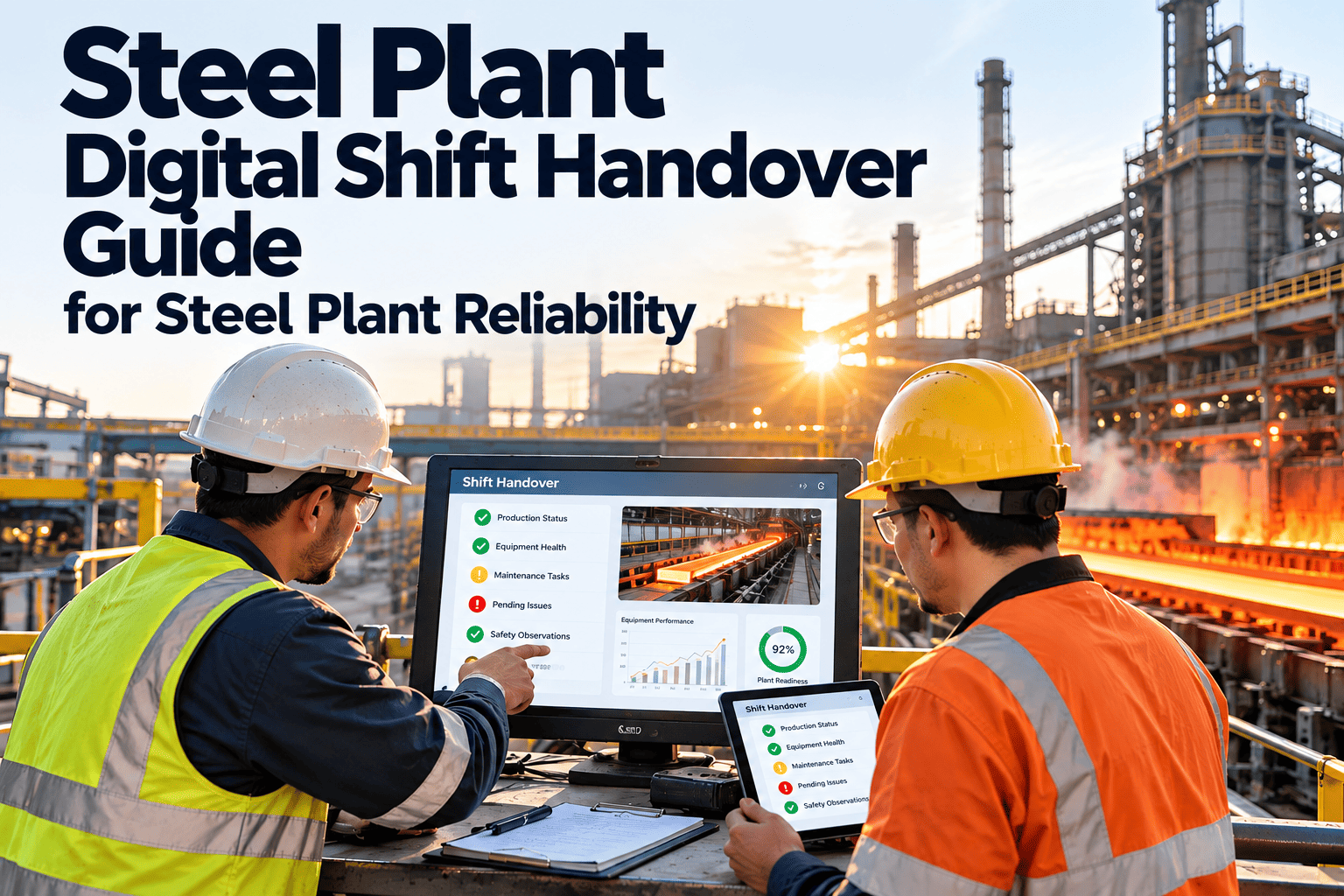
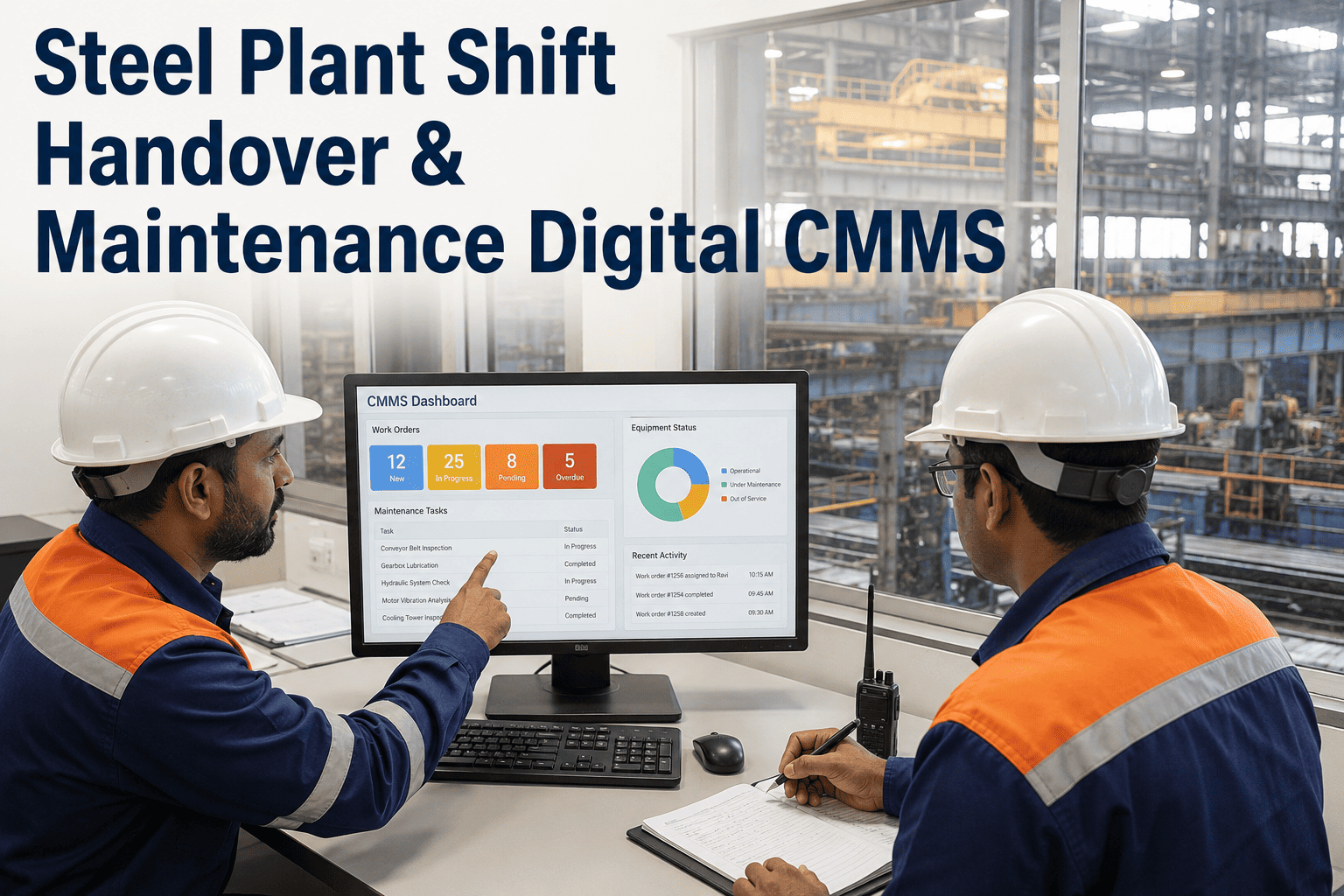
Every shift change in a steel plant is a knowledge transfer event — and most plants are failing it. Critical alarms, pending work orders, production deviations, near-miss safety events, and asset risk conditions are passed from outgoing to incoming crews through a combination of verbal briefings, paper logbooks, and informal WhatsApp messages. When that transfer breaks down — when the incoming supervisor doesn't know that Rolling Mill Stand 4 has been running hot for three hours, or that the BOF converter hydraulic system was flagged but not actioned — the next failure is already in motion. OxMaint's Workforce Management module replaces paper shift logs with a structured digital handover system — capturing every critical event, pending task, and risk condition in a searchable, accountable record that travels with every shift change across your entire plant.
Steel Plant Digital Shift Handover Intelligence
How a 1.8 MTPA integrated steel plant eliminated critical information loss at shift handover — reducing post-handover incidents by 71% and cutting unplanned downtime by 38% within 6 months of deploying OxMaint's digital shift log.
The Problem: What Gets Lost at Shift Change
In the plant this case study covers — a 1.8 MTPA integrated facility with blast furnace, BOF steelmaking, continuous caster, and hot rolling operations — three shifts ran 24/7. The shift handover process relied on a combination of a physical logbook, a whiteboard in the control room, and supervisor-to-supervisor phone calls. A 2023 internal audit of 90 shift handovers identified the following information loss patterns.
In 43% of audited handovers, at least one active or recently silenced alarm on a critical asset — rolling mill bearing temperature, blast furnace cooling water pressure, BOF tilt drive — was not mentioned in the handover and was discovered by the incoming crew only when the condition worsened.
In 61% of handovers, work orders that were "in progress" at shift end had no status update in the CMMS. Incoming technicians had no information about what had been done, what parts had been sourced, or what the next action was — triggering duplicate diagnostic effort and delayed completion.
Near-miss events and unsafe condition observations reported verbally during handover were not systematically captured. 7 of the 90 audited handovers had verbal near-miss references with no corresponding written record — creating both a safety culture and a regulatory compliance gap.
Grade changes, heat sequence modifications, caster speed adjustments, and rolling schedule deviations made during a shift were captured in the MES but not in the maintenance handover. Maintenance crews had no visibility into why an asset had been run outside normal parameters — reducing the quality of any PM or corrective action performed.
Before vs After: The Handover Transformation
How OxMaint Digital Shift Handover Works
OxMaint structures the handover process around five mandatory information categories — each auto-populated from live CMMS data where available, and requiring technician input only for context that cannot be pulled automatically. The outgoing supervisor cannot complete the handover sign-off until all required fields are confirmed.
At shift end, OxMaint automatically compiles all open P1 and P2 work orders, active alarms, and overdue PMs for assets in the outgoing crew's responsibility zone. This list is pre-populated into the handover form — eliminating the most common cause of information loss: forgetting to mention something because the logbook is manual.
The safety section is mandatory — the handover form cannot be submitted with this field blank. Supervisors log any near-miss, unsafe condition, temporary repair, or equipment operating outside normal limits. Each entry auto-generates a linked safety observation record for the plant safety team.
Grade changes, speed adjustments, bypass conditions, and any production deviation that could affect maintenance interpretation are entered by the outgoing supervisor. This context is attached to the relevant assets in OxMaint — so the next work order on a caster roll that was pushed beyond normal speed has that context visible to the technician.
The incoming shift supervisor reviews the handover package on their mobile device and signs off digitally — confirming receipt of all open items. This creates a bilateral accountability record: the outgoing crew has documented what they passed, and the incoming crew has acknowledged receipt. No more "I wasn't told."
Every completed handover is stored in OxMaint's searchable archive — indexed by date, asset, event type, and supervisor. When an investigation needs to reconstruct what was known about a rolling mill bearing condition three weeks before it failed, the answer is available in seconds — not buried in a physical logbook on a shelf.
Every Shift Change Is a Risk Transfer Event — Make It Accountable
OxMaint's digital shift handover connects open alarms, pending work orders, safety notes, and production context into a single sign-off record — so your incoming crew knows exactly what they are walking into. See it live in 30 minutes.
12-Month Results: Measured Impact Across Key Operations Metrics
Results measured across all three operating shifts in the blast furnace, steelmaking, casting, and rolling departments — comparing the 6 months before and 6 months after OxMaint digital shift handover deployment.
| Metric | Before (Paper Log) | After (OxMaint) | Improvement |
|---|---|---|---|
| Post-handover safety incidents / month | 14 avg | 4 avg | −71% |
| Unplanned downtime (hrs/month) | 68 hrs | 42 hrs | −38% |
| Critical alarm transfer rate | 57% | 100% | +43 pts |
| Near-miss documentation rate | 22% | 96% | +74 pts |
| Work order status defined at handover | 39% | 100% | +61 pts |
| Avg handover completion time | 28 min | 5 min | −82% |
| Repeat failures linked to handover gaps | 9 / month | 2 / month | −78% |
Impact Visualised: Before vs After Key Metrics
Expert Review
The shift handover is the single highest-risk moment in a continuous steel plant operation — and it is the one that receives the least structured attention. In two decades of integrated steel operations, I have seen more unplanned outages that trace back to a handover gap than to any single equipment failure mode. The incoming supervisor who doesn't know about the bearing that's been trending hot for six hours, the work order that was "almost done" but left open, or the caster nozzle that was flagged but not replaced — that supervisor is set up to fail before their shift begins. OxMaint's digital handover system solves this with a structure that makes information transfer mandatory and accountable — not dependent on whether two supervisors had a good five-minute conversation in a noisy control room at 6 AM.
Frequently Asked Questions
Stop Losing Critical Information at Every Shift Change
OxMaint gives your steel plant a structured, accountable, and searchable digital shift handover — so every incoming crew knows exactly what they are inheriting, and every risk condition is documented before it becomes an incident. Start with a free trial or see a live plant walkthrough in 30 minutes.