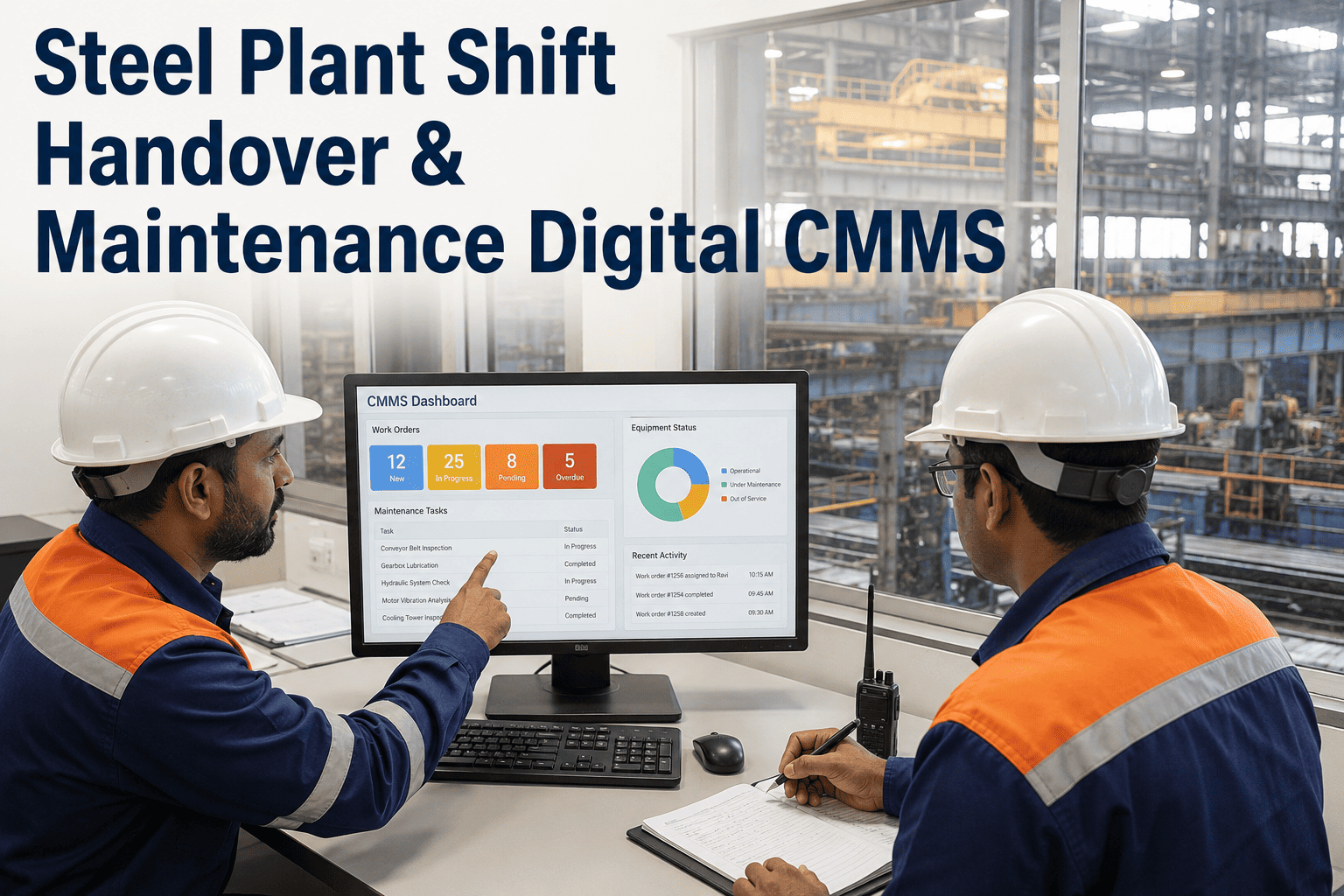
Shift handover at a steel plant is not a paperwork ritual — it is the single most dangerous 20 minutes of the operating day. When a blast furnace crew hands control to the next shift without capturing equipment status, active alarms, deferred work orders and consumable levels, the next team inherits a machine they do not fully understand. Industry studies estimate that 15% of all steel-industry incidents occur during the first hour of a new shift, and the U.S. Chemical Safety Board has repeatedly traced process upsets back to incomplete or verbal-only handovers. A digital CMMS-based shift log removes the ambiguity: every alarm, work order, isolation point and reading is time-stamped, role-stamped and visible before the incoming crew clocks in. Start Free Trial and turn handover from a liability into a controlled, auditable process.
DIGITAL SHIFT HANDOVER FOR STEEL
15% of steel incidents happen in the first hour of a shift.
Poor shift handovers in steel plants cost operators up to 12 minutes of lost runtime per transition — roughly 9 hours of production every week, per line. A CMMS-based digital handover captures equipment status, alarms, work orders and critical readings before the incoming crew steps on the floor.
THE COST OF INCOMPLETE HANDOVERS
What a bad handover actually costs a steel plant
On a 2-million-tonne-per-year hot strip mill, every minute of unplanned downtime is worth roughly $4,200 in lost contribution margin. A 12-minute handover gap compounds to over $2.1 million per year — before counting scrap, energy waste and safety exposure.
A 12-minute gap × 42 handovers/week = 8.4 hours of dark time the maintenance scheduler never sees and the production report never flags.
At $4,200/minute of lost contribution on a 2 Mt/y HSM, the annualized cost of handover ambiguity alone exceeds the price of a full CMMS rollout.
Internal audits across integrated mills find over a third of paper or verbal handovers omit at least one active alarm, isolation or open work order.
Mean-time-to-repair doubles when the incoming crew must rediscover fault context that the outgoing crew already held but never logged.
WORKED EXAMPLE
A 180-asset integrated mill: before vs after digital handover
Consider a mid-sized integrated plant running two blast furnaces, a BOF shop and a three-stand rolling mill — roughly 180 critical tagged assets across three 8-hour shifts. Here is the before/after over a 90-day window.
| Shift handover metric | Paper / verbal handover | CMMS digital handover | Improvement |
|---|---|---|---|
| Average handover duration | 18 min | 6 min | -67% |
| Handovers with complete data | 62% | 99% | +37 pts |
| Mean time to repair (MTTR) | 4.2 hrs | 1.9 hrs | -55% |
| Repeat failures within 24 hrs | 14 events / qtr | 3 events / qtr | -79% |
| Audit trail completeness | Partial | Full, time-stamped | ISO 55000-ready |
| Annualized downtime recovered | — | 412 hrs | ~$1.73M |
5-STAGE DIGITAL HANDOVER
From clock-out to clock-in: a 5-stage CMMS handover
A controlled handover is not a single form — it is a sequence. Each stage has an owner, a digital record and a measurable exit criterion inside the CMMS.
The CMMS automatically compiles blast furnace equipment status, rolling mill active alarms, outstanding work orders and consumable levels 30 minutes before shift end. No manual data entry, no clipboards.
The outgoing shift lead reviews the auto-generated log, adds free-text context on anomalies, and digitally signs. The system blocks sign-off if any active alarm or open isolation is unacknowledged.
The area superintendent reviews flagged items, assigns priority to outstanding work orders, and confirms LOTO status. High-risk items are pushed to the incoming crew's mobile dashboard before they step on the floor.
The incoming shift lead opens the handover on tablet or kiosk, walks each flagged asset, and acknowledges each item. Acknowledgement is time-stamped and tied to the user's role-based access.
Every action — sign-off, review, acknowledgement, work-order creation — is stored in an immutable log. The record supports ISO 55000 asset-management audits, CSB investigations and internal KPI reviews.
WHAT EVERY HANDOVER MUST CAPTURE
The steel-plant shift log checklist
A compliant digital shift log for a steel plant must contain, at minimum, the following eight data domains. Each is a field in the CMMS template — not a free-text box.
- Hot blast temperature & pressure
- Cast house status & tapping schedule
- Stockline level & charging system
- Refractory wear monitoring alerts
- Cooling water flow & delta-T
- Gas cleaning plant alarms
- Stand-by-stand roll force & torque
- Active alarms on drives & hydraulics
- Coiler temperature & tension
- Cobble events & scrap tally
- Lubrication system status
- Roll change / schedule status
- Outstanding work orders by priority
- Active LOTO / isolation permits
- Spare parts consumed & on-hand
- Deferred maintenance backlog
- Contractor activity on-site
- PM compliance rate this shift
VOICES FROM THE FLOOR
What shift leads say after going digital
Operators who have moved from paper logs to a CMMS-based handover report faster startups, fewer repeat failures and a calmer first hour on shift.
"Before the CMMS, our night-to-day handover was a 20-minute conversation and a clipboard. Now the incoming crew sees every active alarm on the rolling mill before they walk in. Our first-hour cobble rate dropped by half in six weeks."
"The blast furnace crew used to spend the last 30 minutes of every shift writing notes. The auto-pull cut that to under 5 minutes and gave us a real audit trail for the first time. ISO 55000 reviewers were impressed."
READY TO DIGITIZE?
Stop losing the first hour of every shift.
Deploy a CMMS-based shift handover in under 14 days. Capture every alarm, work order and isolation — automatically, every shift, on every asset.
FREQUENTLY ASKED
Steel plant shift handover: 5 questions answered
How long does it take to roll out a digital shift handover in a steel plant?
A typical integrated mill with 150–200 tagged assets goes live in 10–14 days. The CMMS imports your asset register, alarm tags and work-order templates in the first 48 hours; the remaining time is spent configuring handover templates per area (blast furnace, BOF, rolling mill) and training shift leads. You can Start Free Trial and configure the first area the same day.
Does the system work for continuous 24/7 operations with rotating shift patterns?
Yes. The CMMS supports 8-hour and 12-hour shift patterns, DuPont and 2-2-3 rotations, and cross-coverage when a shift lead is absent. Handover records are tied to shift ID and timestamp, so the audit trail remains continuous even when the crew pattern changes.
Can it pull live alarm data from our existing DCS and SCADA?
Yes. The platform integrates with major steel-industry control systems via OPC-UA, Modbus and REST connectors. Active alarms and equipment status are pulled automatically into the handover template 30 minutes before shift end — no manual transcription, no clipboard.
What happens if a shift lead forgets to sign off?
The system escalates automatically. If a handover is not signed off within 15 minutes of shift end, it alerts the area superintendent and flags the handover as incomplete. The incoming crew cannot acknowledge an unsigned handover, which prevents a silent gap in the audit trail.
Is the digital handover record accepted by ISO 55000 and CSB auditors?
Yes. Every action — sign-off, review, acknowledgement, work-order creation — is stored in an immutable, time-stamped, role-stamped log. This satisfies the asset-management documentation requirements of ISO 55000 and provides the traceability expected during CSB or internal incident investigations. To see the audit export format, Book a Demo.
YOUR NEXT SHIFT CAN BE DIFFERENT
Give every incoming crew the full picture before they clock in.
Join the steel plants that have cut handover time by 67% and recovered over 400 hours of runtime per year — with a CMMS built for continuous operations.
Free 14-day trial · No credit card