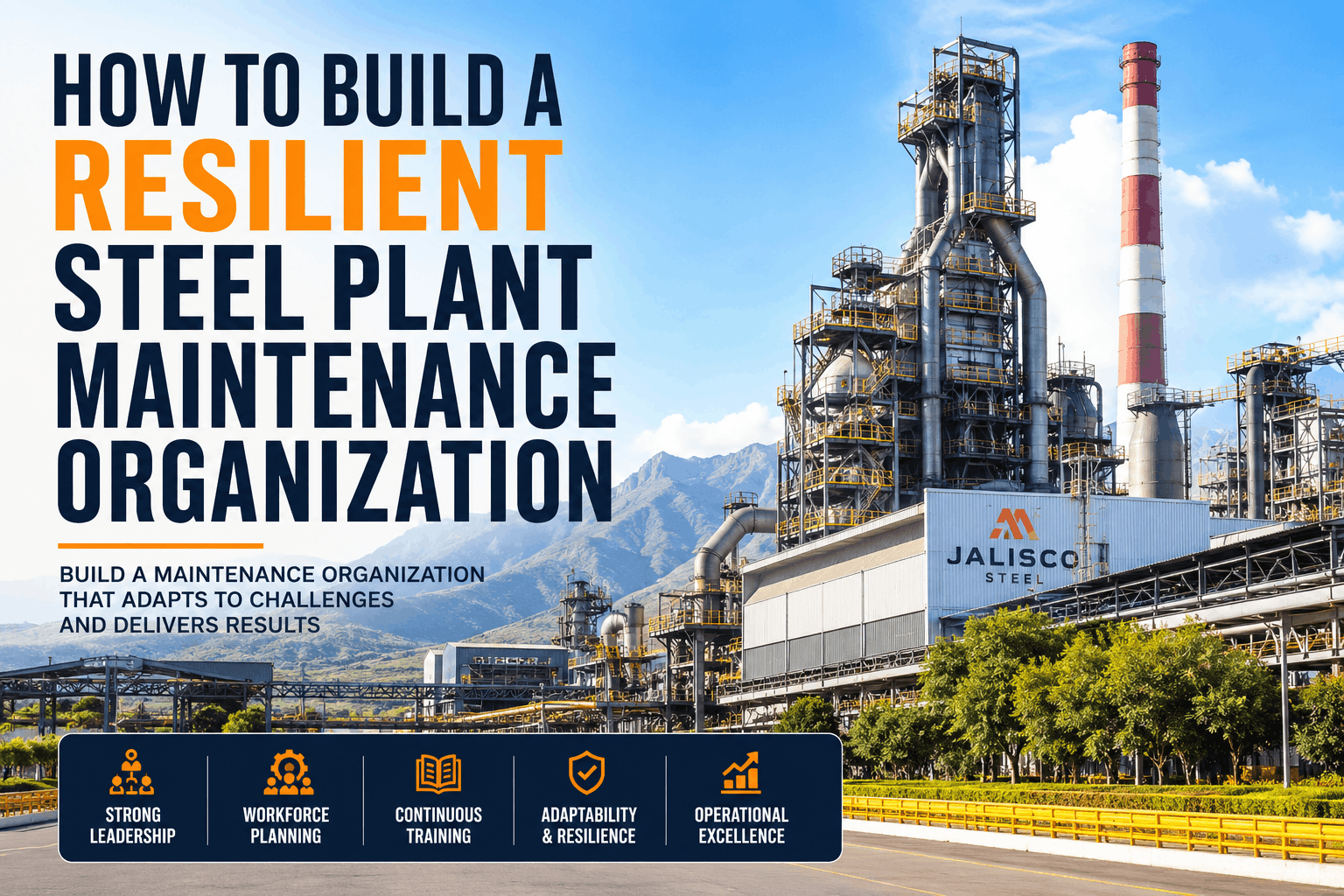
How to Build a Resilient Steel Plant Maintenance Organization
By Alex Jordan on June 29, 2026
Building a resilient steel plant maintenance organization is arguably the most important strategic initiative a plant manager can undertake. Technical systems and equipment are essential, but they are not the differentiator. The true competitive advantage lies in an organization's ability to adapt, learn, and sustain high performance through leadership changes, market pressures, and operational challenges. A resilient organization doesn't just weather storms; it builds the capacity to prevent them. It shifts the team's focus from fighting fires to preventing them, creating a culture where reliability is a shared responsibility, not just a department's goal. This is the foundation for long-term operational excellence in the demanding environment of steel production [citation:1]. Sign in to OxMaint to build the data-driven culture that underpins organizational resilience, or book a demo to see how we help steel plants build resilient maintenance organizations.
Build a Maintenance Organization That Thrives Through Change and Delivers Consistent Results.
OxMaint provides the data, structure, and framework to build a resilient maintenance organization — shifting from reactive firefighting to proactive reliability, and embedding excellence as a cultural norm, not a goal.
reduction in conveyor failures achievable with a hybrid strategy combining traditional maintenance and advanced analytics [citation:3]
7%
OEE improvement seen in a hot strip mill by implementing reliability best practices and shifting culture [citation:7]
90%+
PM compliance rate sustained in world-class facilities where culture is self-sustaining [citation:2]
20%
potential reduction in maintenance costs by adopting better maintenance practices [citation:8]
15-20%
Of a steel plant's total operating costs are tied to maintenance [citation:8]. A resilient, data-driven organization can reduce these costs by 20%, directly improving plant profitability. This goes beyond saving money; it's about creating a system that prevents the costly disruptions that eat into margins and damage customer confidence.
The Foundation of a Resilient Organization — The Four Pillars of Reliability
The Building Blocks · Road to Reliability Framework [citation:8]
Resilient Maintenance Organization
Planning & Scheduling
Optimize workforce utilization [citation:7]
Increase wrench time [citation:2]
Joint Ops & Maint planning [citation:7]
Schedule compliance tracking
Preventive Maintenance
Data-driven PM optimization [citation:1]
FMEA to target tasks [citation:1]
Eliminate duplicate tasks [citation:1]
Connect task to failure mode [citation:2]
Defect Elimination
Root cause analysis [citation:2]
Identify "bad actors" [citation:7]
Systematic improvement [citation:3]
Recurring failure reduction
Leadership & Culture
Executive sponsorship [citation:7]
Recognize prevention [citation:2]
Data used for improvement [citation:2]
Peer accountability [citation:2]
The Four Stages of Cultural Transformation — From Reactive to Resilient
Stage 1 — Reactive
Equipment failures define the schedule. The organization celebrates firefighters. PMs are often deferred. Planned ratio is 30-50% [citation:2]. The culture is dominated by emergency response, and leaders measure speed of recovery rather than preventing failure.
Stage 2 — Aware
Leadership has acknowledged the problem and begun measuring it. A CMMS is deployed, and the data is uncomfortable. Planned ratio improves to 50-65% but is inconsistent across shifts [citation:2]. The team is aware of the problems but struggles to act on data consistently [citation:1].
Stage 3 — Disciplined
Processes are followed. PM compliance holds above 85% across all shifts. Planned ratio reaches 70-85%. Technicians understand that their documentation drives improvement [citation:2]. The team is experiencing the connection between their preventive work and reliable equipment.
Stage 4 — Excellence
The maintenance culture is self-sustaining and resilient. New technicians are socialized into high performance by the team itself. Planned ratio is 88-95% and PM compliance stays above 90% without active management intervention [citation:2]. This is the ultimate goal for a resilient organization.
Building a Resilient Culture — Five Observable Markers of a World-Class Maintenance Team
The Behavioral Signatures of a Resilient Maintenance Culture [citation:2]
Marker 1
Abnormalities Are Reported, Not Hidden
In a reactive culture, reporting a problem creates extra work. In a resilient culture, it's recognized as the most important thing a technician can do. Work order volume becomes a positive signal of vigilance, not a blame trail.
→
Marker 2
PM Compliance Is a Point of Personal Pride
Compliance is maintained through peer accountability and personal standards, not just management oversight. When dashboards are visible to the whole team, this shift is reinforced. Compliance stays high through shift changes.
→
Marker 3
Data Is Used to Improve, Not Assign Blame
When data is used for discipline, technicians stop documenting accurately. In resilient cultures, data is used in post-incident reviews to find systemic improvements. Root cause classifications shift from "operator error" to process causes.
→
Marker 4
Maintenance Teams Know Why, Not Just What
A technician who understands why a task matters performs it with fundamentally better quality. Resilient cultures invest in technical education that connects the task to the consequence, not just the procedure to the asset.
→
Marker 5
Continuous Improvement Is a Weekly Habit
World-class departments don't run improvement projects—they run continuous improvement as normal operations. Work order history is reviewed for recurring failures. PM tasks are candidates for efficiency improvement every week.
OxMaint · Strategy · Organizational Resilience
Build a Culture That Sustains Excellence Through Leadership Changes and Market Pressures.
OxMaint provides the real-time dashboards, shared compliance views, and team-level performance metrics that create the transparency required for a resilient, self-sustaining maintenance culture.
OxMaint for Building Organizational Resilience — Full Feature Capability
Diagnose Your Cultural Stage
OxMaint analyzes your CMMS data to determine your organization's current cultural stage — Reactive, Aware, Disciplined, or Excellent. Know where you stand and what is required to move to the next stage [citation:2].
KPI Dashboard in Every Meeting
World-class leaders review the same three numbers in every planning meeting: planned maintenance ratio, PM compliance rate, and open deferral count. OxMaint makes this possible for every leader, from plant manager to shift supervisor [citation:2].
Standardized Asset Hierarchy
A lack of standardization is a core complication that prevents organizations from generating useful KPIs. OxMaint helps you build a logical, standardized asset hierarchy to improve traceability, reports, and decision-ready information [citation:1].
Optimized Maintenance Plans
Link FMEA directly to equipment to review and optimize maintenance plans. Eliminate duplicate tasks, add missing critical tasks, and ensure PMs are focused on high-impact areas [citation:1].
Recurring Failure Reporting
In a resilient culture, continuous improvement is a weekly habit. OxMaint automatically generates monthly recurring failure reports that drive team improvement conversations, not management investigations [citation:2].
Deferral Risk Scoring & Escalation
Prevent discipline collapse under production pressure with OxMaint's automated deferral escalation and risk scoring. Every deferral must be documented with a named approver, rationale, and rescheduled date [citation:2].
Steel Plant Organization — The Roadmap to a Resilient Structure
Step 1 · Diagnose
Assess Your Current State
A formal Reliability Excellence Assessment is the critical first step. This identifies where your organization stands in areas like Reliability Leadership, Culture Change, Work Management, and Reliability Engineering [citation:7].
Baseline
Know where you are
Gap
Identify what's missing
Step 2 · Educate
Build Capability from the Top Down
Start with the executive team. They must understand that reliability gives them a competitive advantage. Then, provide managers and supervisors with training and one-on-one coaching on reliability leadership, work management, and change management [citation:7].
Leadership
Active sponsorship
Coaching
Reinforce behaviors
Step 3 · Execute
Implement & Reinforce
Standardize processes, redesign your asset hierarchy, and optimize maintenance plans. Create partnership agreements between Operations and Maintenance. Track progress with performance measures and reinforce proactive behaviors with coaching [citation:7].
KPIs
Track performance
Sustain
Ensure lasting results
Organizational Resilience — The Performance Comparison
Fragile Organization
PM Compliance40-60% — inconsistent, often deferred [citation:2]
Planned Ratio30-50% — reactive and unpredictable [citation:2]
Maintenance CostHigh — premium for emergency repairs
Focus on critical equipment "bad actors" [citation:7]
Optimizes PM program
Reduction in maintenance delays
Leadership & Culture
Coach and reinforce proactive behaviors [citation:7]
Creates a self-sustaining culture
Long-term organizational resilience
85%
PM compliance achieved in a hot strip mill that transitioned from reactive to disciplined through a structured program of education, process change, and leadership coaching [citation:7]
7%
OEE improvement from 74% to 81% documented through reliability best practices and culture change in a flagship hot strip mill [citation:7]
3-4 mos
downtime prevented by a single proactive repair identified through real-time monitoring of a transformer at Tata Steel [citation:5]
"The technical side of the solution is the easy part compared to the tenacity it requires to change the culture. The latter can be a multi-year effort with tremendous dividends, as illustrated in this case study."
— Life Cycle Engineering, on the journey from reactive to a resilient maintenance organization [citation:7]
Resilience is not a program—it's a culture that must be built and sustained.
OxMaint provides the data transparency and structure to assess your cultural stage, drive consistent discipline, and build an organization that sustains excellence through change.
What is the first step in building a resilient maintenance organization?
The first step is to assess your current state. This involves diagnosing your organization's maturity in areas like reliability leadership, culture, and work management [citation:7]. OxMaint can help analyze your CMMS data to determine your cultural stage: Reactive, Aware, Disciplined, or Excellent [citation:2].
How does leadership behavior impact resilience?
Culture is set by what leaders do, not what they say. Resilient leaders review the KPI dashboard in every meeting, recognize prevention, make deferral decisions visible, and involve technicians in improvement decisions [citation:2]. Executive education and one-on-one coaching on reliability leadership are foundational to creating lasting change [citation:7].
What are the key performance indicators for a resilient maintenance organization?
The most critical leading indicators are: Planned maintenance ratio (target: 88-95%), PM compliance rate (target: 90-96%), and open deferral count [citation:2]. Additional metrics include OEE, MTBF, and maintenance cost per tonne. A standardized asset hierarchy and data quality are essential for generating these KPIs [citation:1].
How can a steel plant sustain a resilient culture through leadership changes?
A culture built on systems and team norms is more durable than one built on a leader's personality. Resilience is sustained by embedding proactive behaviors in processes, maintaining data transparency, and socializing new hires into high-performance standards set by the team itself [citation:2].
What is the role of a CMMS in building organizational resilience?
A robust CMMS is the foundation for data-driven decision-making. It provides the visibility into performance metrics that drives accountability and enables the transition from reactive to proactive maintenance. OxMaint's real-time dashboards, compliance views, and team-level performance metrics create the transparency required for a resilient culture [citation:1][citation:2].
Build a Maintenance Organization That Thrives Through Change.
Deploy OxMaint to build a resilient maintenance culture that sustains excellence, adapts to challenges, and delivers consistent operational results. Start free today.