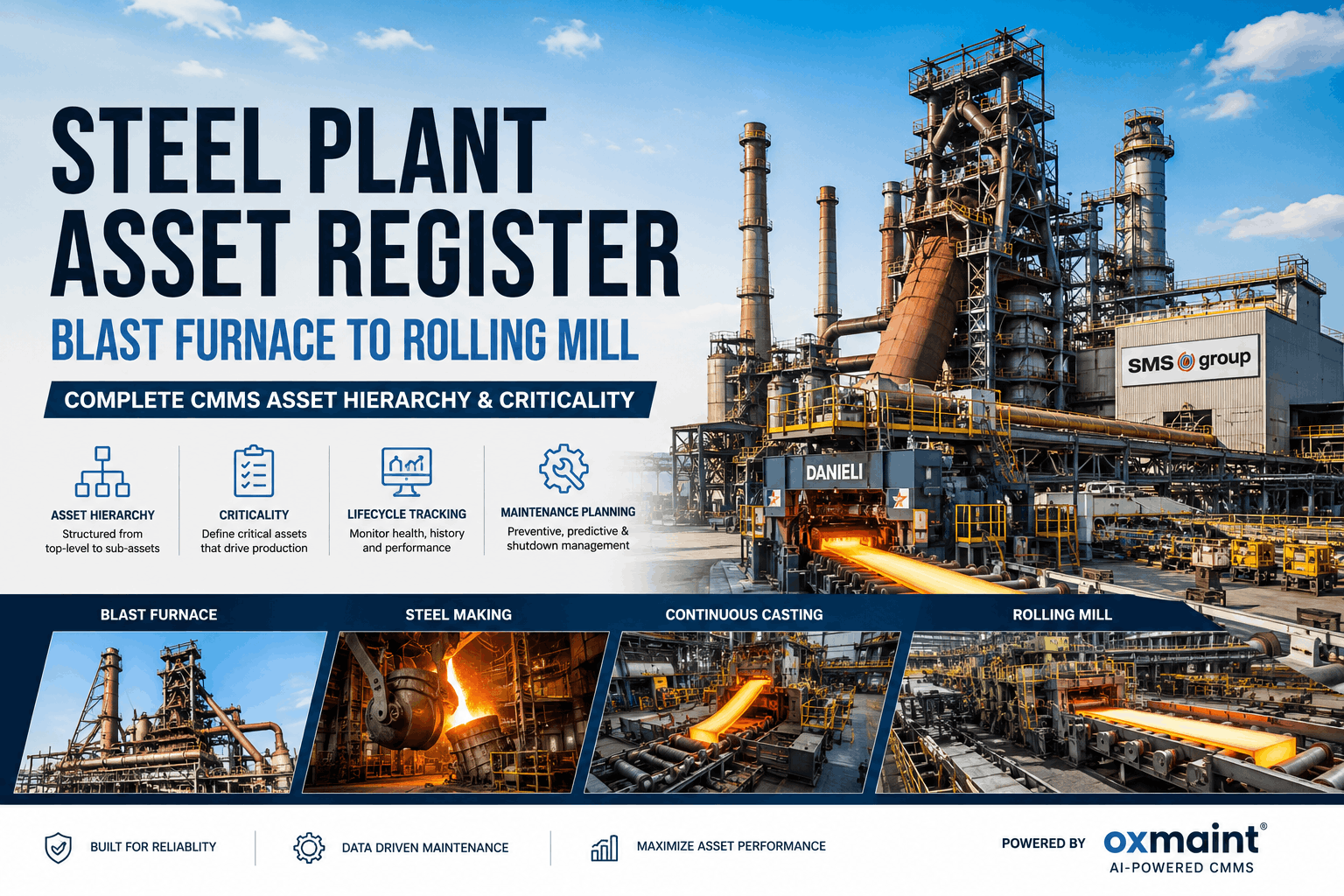
A major steel plant shutdown compresses twelve months of high-risk maintenance into a window that often lasts fewer than thirty days — and a single misstep in scope definition, sequencing, or contractor coordination can add millions in lost tonnage. Blast furnace reline campaigns alone routinely span 45 to 75 days and consume 8 to 12 percent of a plant's annual maintenance budget, while BOF vessel relining, caster overhauls, and rolling mill rebuilds each carry their own critical-path constraints. Success demands eighteen to twenty-four months of planning, integrated with your CMMS, permitting, and procurement workflows — not a checklist assembled the quarter before execution. This guide walks through the scope, sequencing, and controls that separate a clean turnaround from a costly overrun, and you can Start Free Trial to pilot the planning workflow on your next campaign.
Can you compress a year of high-risk steel plant work into a 30-day window without losing a million dollars a day?
A major steel plant turnaround concentrates every deferred repair, statutory inspection, and capital project into a single critical path. When the blast furnace blows out, the clock starts — and every hour of unplanned overrun translates to roughly 1,500 to 2,200 tonnes of lost hot metal production. The plants that finish on schedule are not the ones with the biggest crews; they are the ones whose scope, sequence, and resource curves were locked eighteen months ahead.
Eighteen months to T-minus: the steel plant shutdown timeline
Industry benchmark data from over 120 integrated mill turnarounds shows that campaigns planned on an 18-to-24-month horizon finish within 4 percent of budget, while those planned in under 12 months overrun by an average of 19 percent. Below is the phase-gated timeline that high-performing plants follow.
Identify every work order across blast furnace, BOF, caster, and rolling mill. Lock down refractory quantities, copper stave replacements, and BOF trunnion ring inspections. Long-lead items — specialty refractories, tuyere stocks, mold tubes — typically carry 10-to-14-month procurement cycles.
Finalize contractor packages and issue tenders. Refractory installation specialists, scaffolding vendors, and NDT crews must be booked against overlapping demand from competing mills. Statutory permits for confined space, hot work, and crane lifts are filed with state safety regulators.
Run Monte Carlo simulations on the integrated schedule. Identify float, converge parallel work streams, and set contractual milestones for the top fifteen contractors. Pre-position 85 percent of materials in laydown yards to eliminate day-of delays.
Validate crew ratios against each work package — refractory masons, rigging teams, welders. Conduct tabletop exercises for emergency evacuation, rescue from confined spaces inside the BF throat, and crane failure scenarios. CMMS data must be fully loaded and reconciled.
Freeze the scope baseline. Any new work order above $25K requires turnaround manager and plant manager joint sign-off. Mobilize contractor trailers, tooling, and safety equipment. Daily progress reporting cadence moves from weekly to twice-daily.
Cooling, isolation, and lockout-tagout proceed in strict sequence. Two daily control meetings — 6:00 AM and 6:00 PM — review critical path variance, safety incidents, and next-24-hour resource needs. Earned-value reporting tracks schedule performance index against the baseline.
Where the money goes: four high-value work streams
A typical integrated steel plant shutdown routes 70 to 80 percent of its total cost across four asset groups. Each carries distinct scope, contractor profiles, and risk exposure — and each demands its own micro-critical-path within the master schedule.
Full hearth reline including carbon block installation, ceramic cup, and tuyere replacement. Typical campaign duration: 45 to 75 days. Crew peaks at 600 to 900 workers on the furnace deck. Risk drivers: hearth excavation in confined space, refractory curing curves, and hot-face temperature management during blow-in.
Replacement of the working lining and permanent lining, trunnion ring inspection, and lance tip overhaul. Campaign window compresses to 10 to 14 days per vessel. Risk drivers: refractory brick fit-up tolerances, tipping gear NDT, and slag-line wear assessment.
Mold tube replacement, oscillation mechanism rebuild, segment roller reconditioning, and hydraulic system flush. Shutdown window: 14 to 21 days. Risk drivers: segment alignment to within 0.1 mm tolerance, secondary cooling spray nozzle cleaning, and caster break-out prevention during restart.
Stand refurbishment, roll chock relining, gear housing inspection, and water descaling system overhaul. Shutdown window: 10 to 18 days per stand. Risk drivers: bearing fit tolerances, roll gap calibration, and drive train alignment to AGMA Class 11 standards.
Contingency math: how much reserve is enough?
Industry consensus from turnaround benchmarking forums recommends a contingency reserve calculated against the integrated risk profile — not a flat percentage. The formula below is the working model used by planners at tier-one integrated mills, calibrated against historical actual-to-plan variance.
A plant with a $28M base scope, $1.9M/day production value, and a $4.2M/day contractor exposure uses Pr = 0.18, Pc = 0.11. The formula yields a recommended contingency of approximately $2.6M — roughly 9.3 percent of base scope. Plants that under-reserve at 5 percent typically absorb $1.8M to $3.4M in unbudgeted overrun costs when refractory wear patterns deviate from the pre-shutdown sonar survey.
What separates a clean turnaround from a costly one
The difference between a shutdown that finishes 2 percent under budget and one that overruns by 15 percent is rarely a single decision. It is the cumulative effect of control practices applied — or skipped — across the planning and execution phases.
| Control Practice | On-Time Plants | Overrun Plants |
|---|---|---|
| Scope freeze timing | T-90 days, hard freeze with CCB sign-off | T-30 days, scope still drifting at T-14 |
| Pre-shutdown inspections | Furnace sonar + thermography at T-120 | Visual inspection only, week before blow-out |
| CMMS work order completeness | 98% loaded with materials, labor, permits | 70% loaded, 30% added during execution |
| Contractor milestone contracts | 15+ milestone-gated contracts with penalties | Time-and-materials with daily rate cards |
| Daily control meeting cadence | Twice daily, 30 minutes, critical-path focused | Once daily, 90 minutes, status-reporting only |
| Laydown yard readiness | 85%+ materials pre-positioned at T-30 | 50% positioned, JIT deliveries during shutdown |
| Earned value reporting | SPI and CPI tracked daily against baseline | Percent-complete estimates, no variance analysis |
| Post-shutdown debrief | Formal lessons-learned within 14 days | Informal notes, lost within 60 days |
A 2.8 Mtpa plant cut 6 days off a blast furnace reline
When a Great Lakes-region integrated mill applied disciplined scope freeze, CMMS-driven work order completeness, and milestone-gated contractor contracts to their 2023 BF reline campaign, the results were measurable within the first week of execution.
The shift from time-and-materials contractor contracts to milestone-gated packages, combined with a hard scope freeze at T-90, gave us a schedule we could actually control. We finished the reline six days early and recovered over eleven million dollars in production value.
— Turnaround Manager, Great Lakes Integrated Steel Mill
Ready to bring your next shutdown in on time and under budget?
Pilot the OxMaint shutdown planning workflow on your next campaign — scope freeze tracking, milestone-gated contractor management, and daily earned-value reporting in one platform.
Steel plant shutdown planning: the questions planners ask most
How early should we start planning a blast furnace reline?
For a full hearth reline, start scope definition at T-18 to T-24 months. Specialty refractories like carbon blocks and ceramic cups carry 10-to-14-month procurement lead times, and tier-one refractory installation contractors book 12 to 16 months ahead. Plants that begin at T-12 typically pay 15 to 25 percent premiums on expedited materials and accept second-tier contractor crews.
What contingency percentage should we hold for a major steel plant turnaround?
Industry benchmarks recommend 8 to 12 percent of base scope for integrated mill turnarounds with mature CMMS data, and 12 to 18 percent for plants with limited historical actual-to-plan data. The reserve should be calculated against the probability-weighted impact of refractory scope growth and contractor resource conflicts, not applied as a flat percentage. You can model this inside the OxMaint platform — Start Free Trial to test the reserve calculator on your campaign data.
How do we prevent scope creep during the execution window?
Implement a hard scope freeze at T-90 days with a formal change control board (CCB) that requires joint sign-off from the turnaround manager and plant manager for any work order above a defined threshold — typically $25,000. New work identified during execution goes into a post-shutdown backlog unless it is safety-critical or directly blocks the critical path restart.
What is the single biggest cost driver in a steel plant shutdown?
Lost production, not labor or materials. A mid-sized integrated mill forfeits $1.5M to $2.2M per day of delayed restart in hot metal and crude steel tonnage. This is why milestone-gated contractor contracts with penalty clauses for critical-path delays consistently outperform time-and-materials arrangements — they transfer schedule risk to the party best positioned to manage it.
How do we sequence BOF, caster, and rolling mill work around the blast furnace reline?
The blast furnace defines the master critical path. BOF vessel relining and caster overhauls are typically scheduled in parallel during the BF cool-down and reline window, since hot metal is unavailable anyway. Rolling mill rebuilds can be staggered either before BF blow-out or during the reline window, depending on downstream inventory positions and customer order commitments. A 30-minute walkthrough with our team can help you map the optimal sequence — Book a Demo to schedule it.
Your next major shutdown starts with a better plan
Join the steel plants using OxMaint to freeze scope, gate contractor milestones, and track earned value daily — all in one platform built for heavy industrial turnarounds.
Free 14-day trial · No credit card