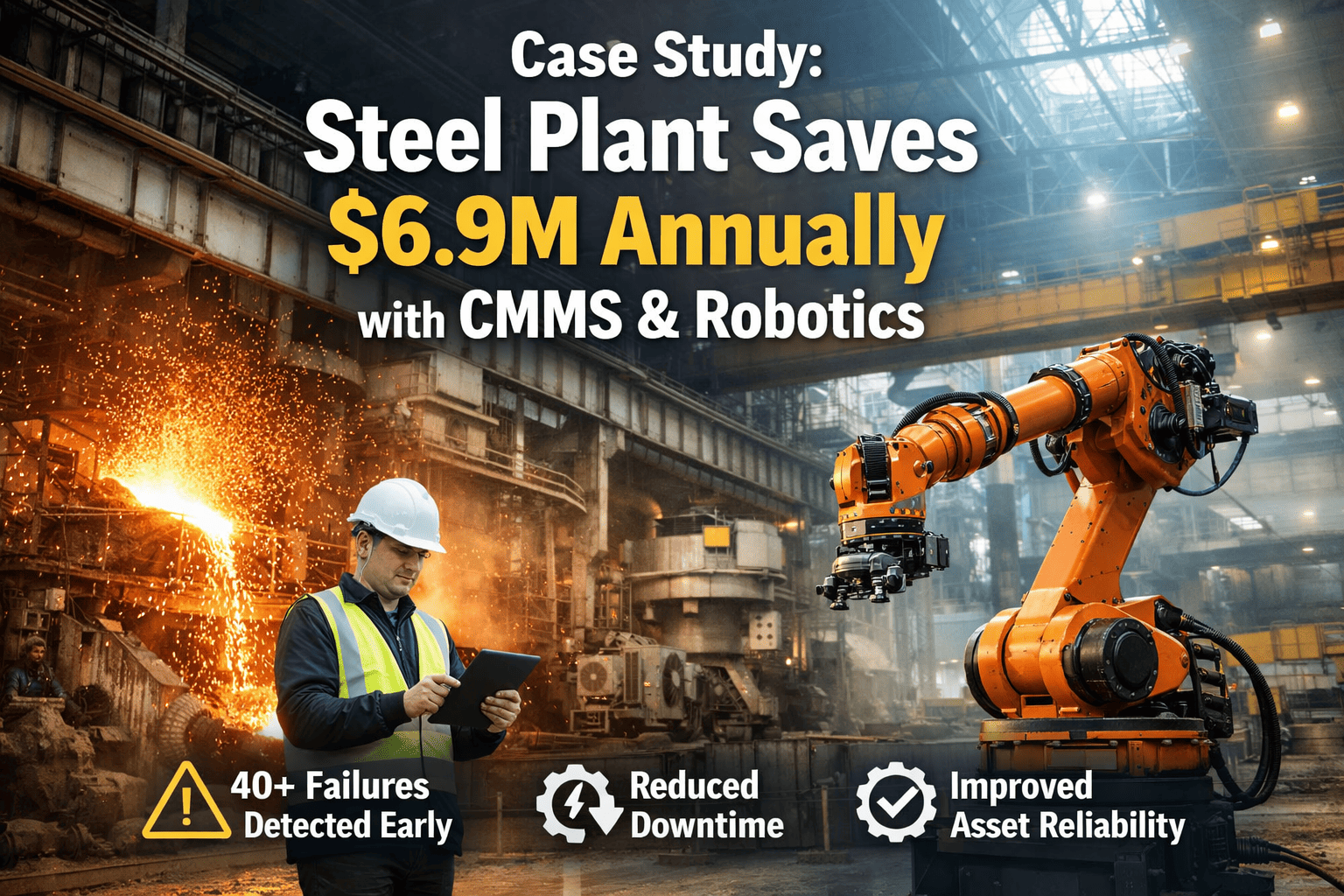
The structural steel shop at Mercer Fabrication in Houston ran six robotic welding cells and two CNC plasma cutting tables across two shifts. In March 2025, Cell 4 — a six-axis MIG welding robot handling heavy plate girder assemblies — began producing inconsistent bead profiles on fillet welds. The operator noticed slight undercut on one side but attributed it to fit-up variation. No work order was created. Over the next 18 days, the wire feed motor's drive gear wore past tolerance, the contact tip eroded to 1.8mm beyond spec, and the TCP (Tool Center Point) drifted 2.4mm from calibration. On day 19, the cell produced 14 consecutive reject welds on a bridge girder assembly for a state DOT project. By the time QC caught it, the shop had consumed $8,200 in weld wire and shielding gas on scrap, spent 26 labor hours on rework grinding and re-welding, missed the fabrication deadline by 3 days triggering a $45,000 liquidated damages clause, and lost the next $380,000 project bid because the GC questioned their delivery reliability. Total cost: $8,200 in consumables, $26,000 in rework labor, $45,000 in contract penalties, $380,000 in lost future revenue, and $12,000 in emergency parts and recalibration. Total: $471,200. All from a wire feed motor that needed a $340 gear replacement and a 45-minute TCP recalibration. In May, Mercer connected all eight robotic systems to a CMMS with sensor-driven maintenance triggers. The wire feed motor issue would now generate a work order at the first sign of current draw deviation — 15 days before it ever affected weld quality. Book a demo to see how predictive maintenance keeps robotic welding and cutting cells producing at peak quality.
Robotic welding and cutting systems are the production backbone of modern steel fabrication. A single six-axis welding robot produces the equivalent output of 3-5 manual welders at higher consistency and lower defect rates. A CNC plasma or laser cutting table processes plate steel at speeds and tolerances that manual cutting cannot approach. But these systems are not maintenance-free. They are high-precision electromechanical systems operating in the harshest environment in fabrication: heat, spatter, fume, vibration, and continuous duty cycles that push consumables, motion components, and electrical systems to their limits. When maintenance is reactive — when you wait for weld quality to degrade or a cutting head to crash — the cost is not a repair bill. It is scrap, rework, missed deliveries, contract penalties, and lost customers. This guide covers the maintenance best practices that keep robotic welding and cutting systems in steel fabrication running at peak performance, the failure modes that take them down, and how a CMMS turns scattered PM checklists into a predictive maintenance program that catches failures weeks before they reach the weld.
$471K
Total cost from a single robotic welding cell failure cascade in a steel fab shop
85%
Of robotic weld defects trace back to maintenance-preventable consumable or calibration issues
3-5x
Output multiplier of a single welding robot vs. manual welders at equivalent quality
92%+
Uptime achievable with CMMS-driven predictive maintenance on robotic welding cells
Critical Maintenance Zones in Robotic Welding Systems
A robotic welding cell is not one machine — it is a system of interdependent subsystems where degradation in any single component cascades into weld quality defects, unplanned downtime, or both. Effective maintenance requires treating each zone with dedicated schedules, sensor monitoring, and failure-specific protocols.
Wire Feed System
Drive rolls, feed motors, liner conduits, and wire straighteners. Wire feed inconsistency is the #1 root cause of robotic MIG weld defects. Drive roll pressure drift of 5% causes erratic arc starts. Liner contamination increases friction, creating burn-back and bird-nesting. Motor current draw trending is the earliest indicator of developing feed problems.
Torch & Consumables
Contact tips, gas nozzles, diffusers, and torch neck assemblies. Contact tip bore wear of 0.2mm changes arc characteristics enough to produce reject welds on structural code work. Gas nozzle spatter buildup restricts shielding gas flow, causing porosity. Torch neck alignment directly affects TCP accuracy — a 1mm deviation compounds across every joint in the program.
Robot Arm & Motion
Servo motors, reducers, encoders, cables, and bearings across 6 axes. Reducer backlash in axis J2 or J3 creates positioning errors that worsen under heavy plate welding loads. Cable harness fatigue from repetitive motion causes intermittent signal faults. Bearing wear in the wrist axes (J4-J6) shows as vibration before it shows as positional error.
Positioners & Fixtures
Headstock/tailstock positioners, turntables, and welding fixtures. Positioner gear backlash causes workpiece positioning errors that the robot's seam tracking may not fully compensate. Fixture wear — clamp degradation, locating pin mushrooming, datum surface erosion — allows part-to-part variation that drives weld defects.
Power Source & Controls
Welding power supply, pendant, cables, and controller electronics. Contactor wear causes arc instability. Power cable resistance increases with connection degradation, reducing delivered amperage at the arc. Controller cooling fan failure leads to thermal shutdown during high-duty-cycle structural welding runs.
Failure Modes That Shut Down Production
Every unplanned stop in a robotic welding or cutting cell has a direct cost in lost production, a quality cost in scrap and rework, and a downstream cost in missed deliveries. These are the failure modes that CMMS-driven maintenance programs are designed to prevent.
| Failure Mode | System Affected | Warning Indicators | Cost if Undetected |
| TCP Drift |
Robot Arm / Torch |
Seam tracking corrections increasing; arc start misses; bead profile asymmetry |
$15,000-$200,000 in scrap, rework, and delivery penalties |
| Wire Feed Degradation |
Wire Feed System |
Motor current draw increase; burn-back frequency; arc start inconsistency |
$5,000-$50,000 in consumable waste and reject welds |
| Reducer Backlash |
Robot Arm Axes |
Vibration amplitude increase at axis; positioning repeatability drift; servo error logs |
$40,000-$150,000 in reducer replacement + production loss |
| Cutting Head Crash |
CNC Plasma/Laser Table |
Height sensor response delay; torch-to-work distance variation; Z-axis positioning errors |
$20,000-$80,000 in head replacement + table downtime |
| Gas Flow Restriction |
Shielding Gas System |
Flow rate variance from setpoint; nozzle back-pressure increase; porosity in test welds |
$10,000-$100,000 in code-reject welds on structural projects |
| Cable Harness Fatigue |
Robot Dress Pack |
Intermittent signal faults; encoder errors during specific motion sequences; insulation cracking |
$8,000-$60,000 in unplanned stop + cable replacement + recalibration |
Mercer Fabrication's $471,200 loss started with a wire feed motor drawing 8% more current than baseline — a deviation their CMMS now flags automatically on the first occurrence. Sign up free to connect robotic welding cell data to automated maintenance workflows.
Every Reject Weld Started as a Maintenance Issue Nobody Caught
Your robotic welding cells are telling you when wire feed, torch consumables, and motion systems are degrading. The question is whether anyone is listening. A CMMS connected to cell performance data catches the deviation at 2% — not at 100% when reject welds start stacking up on the QC table. Stop finding maintenance problems in your weld quality reports.
Maintenance Best Practices by System
Robotic welding and cutting maintenance is not a single checklist. Each subsystem has its own wear patterns, inspection intervals, and replacement triggers. The best-performing steel fabrication shops treat these as distinct maintenance programs unified through a single CMMS platform.
01
Daily: Consumable Inspection & Replacement
Contact tips inspected every shift; replaced at 0.2mm bore wear or every 8 hours of arc-on time, whichever comes first. Gas nozzles cleaned of spatter buildup. Wire liner checked for contamination. Drive roll condition and pressure verified. Anti-spatter compound applied to nozzle. These 15-minute daily checks prevent 60% of weld quality defects.
02
Weekly: TCP Verification & Calibration Check
TCP verified against calibration fixture — any deviation beyond 0.5mm triggers recalibration. Wire feed motor current draw compared to baseline. Seam tracking sensor lens cleaned and verified. Positioner backlash checked with dial indicator. All readings logged in CMMS for trend analysis. A 30-minute weekly check that catches drift before it reaches the weld.
03
Monthly: Motion System & Electrical
Robot arm: check each axis for vibration, backlash, and cable harness condition. Power source: inspect contactors, measure cable resistance, clean cooling systems, verify output calibration. Cutting tables: inspect rail alignment, gantry bearing condition, height sensor calibration, and consumable stack-up. Controller: review error logs, clear accumulated faults, verify backup integrity.
04
Quarterly: Deep Mechanical Inspection
Reducer oil analysis on all axes. Bearing vibration signature analysis with spectrum comparison to baseline. Full dress pack inspection — every cable, hose, and conduit checked for wear, cracking, and routing interference. Positioner gear inspection and lubrication. Fixture audit — every clamp, locating pin, and datum surface measured against drawing tolerances. This is where you find the failures that are 8-12 weeks away.
05
Annual: Full System Overhaul & Recertification
Complete axis calibration with laser tracker verification. Reducer replacement on high-cycle axes per OEM schedule. Power source load bank test and full calibration. Cutting table rail resurfacing if wear exceeds tolerance. Welding procedure requalification test plates to verify system output still meets AWS D1.1 or D1.5 code requirements. Full CMMS asset history review to identify chronic issues and adjust PM intervals.
CNC Cutting Systems: Maintenance That Keeps Plates Moving
Plasma, oxy-fuel, and laser cutting tables are the first operation in steel fabrication — every plate, every beam cope, every gusset starts at the cutting table. When the table goes down, the entire shop starves for parts within hours.
| Cutting System Component | Maintenance Action | Frequency | Consequence of Neglect |
| Plasma Consumables |
Electrode, nozzle, shield, swirl ring inspection and replacement |
Every 2-4 hours of arc-on time |
Cut quality degradation, dross buildup, bevel angle drift on code work |
| Height Control Sensor |
Calibration verification, response time test, tip inspection |
Weekly |
Torch crash into plate ($20K-$80K), inconsistent cut quality from distance variation |
| Gantry Rail System |
Rail cleaning, lubrication, alignment check, drive gear inspection |
Monthly |
Positioning accuracy loss, rack wear acceleration, gantry skew causing dimensional errors |
| Water Table |
Water level management, slat replacement, sludge removal, pH monitoring |
Weekly (level), Monthly (cleaning) |
Plate warping from uneven support, fume extraction failure, fire risk from low water |
| Fume Extraction |
Filter inspection, ductwork cleaning, airflow verification, spark arrestor check |
Weekly |
OSHA citations ($15K+), fire risk, operator health exposure, production shutdown orders |
| Drive Motors & Encoders |
Current draw trending, encoder feedback verification, coupling inspection |
Monthly |
Positional drift causing out-of-tolerance parts, scrap, and downstream fit-up issues |
Manual PM Tracking vs. CMMS-Driven Maintenance
Manual / Spreadsheet PMCMMS-Driven Maintenance
Consumable Tracking
Operator judgment; tips replaced when welds visibly degrade; no usage data
Arc-on time triggers automatic replacement alerts; usage history per tip lot tracked
Calibration Schedule
Calendar-based; often deferred during production crunch; no drift trending
Condition-based triggers from seam tracking data; TCP drift trended and alarmed at threshold
Failure History
Scattered across shift logs, emails, and memory; no root cause linking
Complete asset failure history; repeat failures flagged; root cause analysis automated
Parts Inventory
Emergency orders when parts run out; 24-48 hour lead time stops production
Min/max levels tied to consumption rates; auto-reorder before stockout; vendor lead times tracked
Compliance & Code
WPS and PQR records in binders; calibration certs filed manually; audit-scramble mode
All certifications linked to assets; expiration alerts automated; audit-ready documentation always current
Annual Cost (6-cell shop)
$285,000 (unplanned downtime + scrap + rework + penalties + emergency parts)
$118,000 (CMMS platform + planned maintenance + optimized consumable usage)
Every reject weld has a maintenance root cause. Every cutting table crash has a maintenance root cause. The difference between shops that find these causes proactively and shops that find them in QC rejection reports is a CMMS that connects cell performance data to maintenance action. Book a demo to see how your welding cells' own data drives the maintenance program.
ROI: 6-Cell Robotic Welding & 2-Table Cutting Shop
Eliminated unplanned cell downtime (avg. 340 hrs/yr recovered)$204,000
Reduced weld reject rate from 4.2% to 0.8% (scrap + rework savings)$87,000
Optimized consumable replacement (tips, nozzles, liners, plasma stacks)$34,000
Avoided contract penalties from on-time delivery improvement$95,000
Extended reducer and servo motor life through condition monitoring$52,000
Reduced emergency parts premium purchasing$28,000
Total Annual Savings$500,000
Program Cost (CMMS platform + sensors + planned maintenance)$118,000
Net Annual Benefit$382,000
$382,000 in Net Annual Savings. One Platform. Every Cell and Table Connected.
The math is simple: a $340 wire feed gear replacement costs $471,200 when you find it from reject welds. It costs $340 when your CMMS catches the motor current deviation on day one. Oxmaint connects every robotic welding cell and cutting table to automated work orders, consumable tracking, calibration scheduling, and compliance documentation across your entire shop.
Frequently Asked Questions
What sensors do we need to add to our existing robotic welding cells?
Most modern robotic welding cells already generate the data needed for predictive maintenance — servo motor current draw, arc voltage and amperage logs, wire feed speed data, and error code histories are available from the robot controller and power source. Additional sensors that deliver the highest ROI include vibration sensors on axes J2-J3 reducers, current transducers on wire feed motors, and flow sensors on shielding gas lines. Total sensor investment per cell typically runs $2,000-$5,000. The CMMS connects to existing controller data through OPC-UA, Ethernet/IP, or API integrations — no rewiring required.
Book a demo to assess your current data availability.
How does the CMMS know when a contact tip needs replacement?
The system tracks arc-on time per contact tip and correlates it with arc voltage stability data. As a contact tip bore wears, arc voltage variance increases — the CMMS detects this trend and triggers a replacement work order before the wear reaches the threshold that produces reject welds. For shops running known wire types on consistent joint configurations, the system learns optimal replacement intervals specific to your operation, eliminating both premature replacement waste and quality-affecting over-use.
Sign up free to see consumable lifecycle tracking in action.
Can this work with older robotic welding systems?
Yes. Even robotic cells from the early 2000s generate basic operational data through their controllers. For older systems without native network connectivity, retrofit data collection modules (typically $3,000-$8,000 per cell) capture arc parameters, cycle counts, and error events. External sensors for vibration, temperature, and current monitoring work on any generation of equipment. The CMMS platform is controller-agnostic — it integrates with Fanuc, ABB, KUKA, Yaskawa, Panasonic, Lincoln, Miller, ESAB, and Hypertherm systems across any mix of generations.
How does this help with AWS code compliance documentation?
The CMMS automatically maintains calibration records for every welding power source and robot, links WPS and PQR documents to specific assets and jobs, tracks welder and welding operator qualification expiration dates, and generates audit-ready reports showing maintenance history, calibration verification, and consumable traceability. When an AWS CWI or third-party inspector requests documentation, it is a single report pull instead of a binder search. Shops report reducing audit preparation time from days to minutes.
What about plasma and laser cutting table maintenance?
Cutting tables are fully supported with the same predictive framework. The CMMS tracks consumable stack life (electrode, nozzle, shield, swirl ring) by arc-on time, monitors height control sensor performance, trends gantry positioning accuracy through cut quality metrics, and schedules rail maintenance based on accumulated travel distance. For laser systems, it additionally tracks beam quality metrics, assist gas consumption, lens condition, and chiller performance. Every cutting system in your shop feeds into the same maintenance platform as your welding cells.
Your Welding Cells Are Producing Data Right Now. Turn It Into a Maintenance Program That Prevents the Next $471,000 Failure.
Mercer's Cell 4 told them the wire feed motor was failing for 18 days before it started producing reject welds. Nobody was listening. Your robotic welding cells and cutting tables are generating the same signals — servo currents, arc parameters, cycle data, error logs — every shift. A CMMS turns those signals into work orders that arrive weeks before failures reach the weld or the cut. The demo takes 30 minutes. The first prevented reject run usually pays for the entire year.