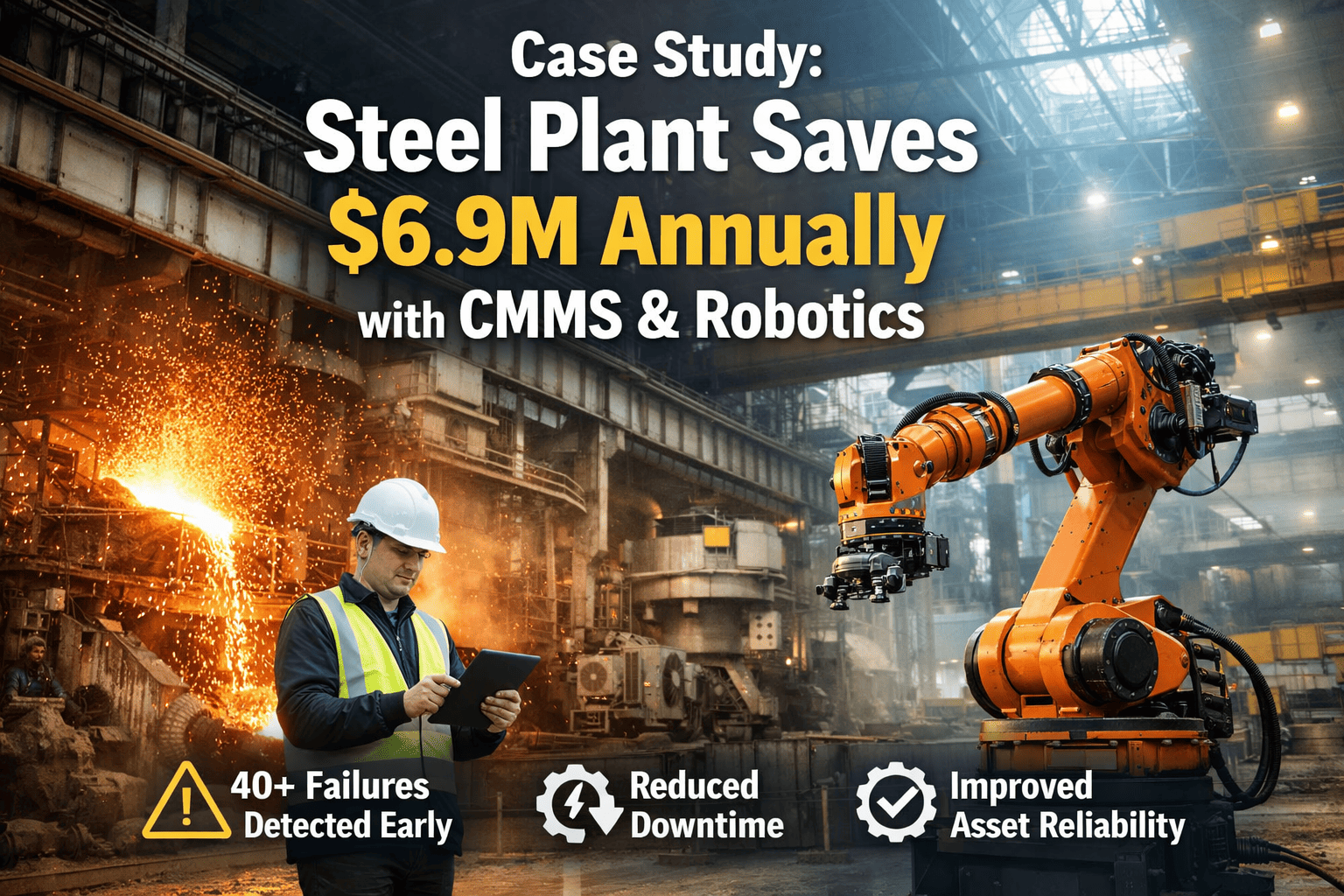
Steel mills that have deployed robotics for maintenance are reporting results that would have seemed impossible five years ago: 25-45% reduction in unplanned downtime, 30-50% lower refractory material consumption, 15-30% decrease in total maintenance spend, and near-elimination of heat-exposure injuries. But these results don't come from simply buying robots. They come from a systematic approach that integrates robotic inspection, automated repair, predictive analytics, and CMMS-driven workflows into a unified strategy where every robotic finding triggers a tracked, prioritised, completed maintenance action.
This case study compiles best practices from 12 steel plants across integrated and EAF-based operations that deployed robotic maintenance between 2023 and 2026. The data represents real results from plants producing 1-8 million tonnes per year. Every plant uses Oxmaint's steel plant CMMS as the central platform connecting robotic data to maintenance execution — because technology only delivers ROI when findings become completed work orders, and completed work orders generate data that improves future predictions.
Aggregate Results Across 12 Plants
Headline results averaged across all 12 plants after 12-24 months of robotic maintenance deployment:
Best Practice 1: Start With Refractory — Highest ROI
Every plant reported the same finding: refractory scanning and robotic gunning delivered the fastest payback, typically 2-6 months:
Deploy laser scanning on ladles first, then expand to converters and EAF
Best Practice 2: Connect Every Robot to the CMMS
Plants with highest ROI were those where every robotic finding auto-generated a tracked maintenance work order:
Integrate robotic data into Oxmaint via API for automatic work order generation
Best Practice 3: Use Quality Data as Maintenance Trigger
Six plants connected AI defect detection to Oxmaint's maintenance module, transforming roll shop management:
Connect AI surface inspection to roll shop and caster maintenance scheduling
12 Plants. 3 Years. One Conclusion: Robots + CMMS = Transformation.
Oxmaint connects robotic inspection data to maintenance execution — turning findings into tracked, completed, verified repairs across every vessel and line.
Best Practice 4: Phase Deployment by ROI
Refractory Scanning + CMMS
Robotic Gunning + Hot Zone
AI Quality + Predictive
Best Practice 5: Measure Everything
Top performers tracked these KPIs for robotic maintenance effectiveness:
% of scheduled windows where robot operational. Below 90% = robot maintenance issues.
Robotic anomaly to dispatched work order. Best plants: <2 min via automated API.
Material reaching target zone. Manual baseline: 50-65%. Robotic target: >85%.
Repeatability between consecutive scans. Indicates calibration health.
% of known defects correctly identified. Validated by human audit.
Additional heats per campaign vs pre-robotics. Most direct refractory ROI measure.
Total Programme Economics: 3-Year View
Complete financial picture for a typical 3-5Mt integrated steel plant:
$15-50M in 3-Year Net Value. The Playbook Is Clear.
Oxmaint connects robotic inspection, refractory management, quality data, and predictive analytics into a single maintenance execution system.
Frequently Asked Questions
What was the biggest implementation challenge?
The #1 challenge was organisational change management, not technology. Maintenance teams needed convincing robotic data was reliable. Most successful plants ran robots in parallel for 2-3 months. When robots consistently found issues manual inspection missed, scepticism converted to advocacy. Second challenge was data integration — connecting multi-vendor robotic systems into one CMMS. Plants using Oxmaint's open API resolved this faster than closed platforms.
How many robot operators does a plant need?
The 12 plants averaged 2-4 dedicated robotic technicians regardless of size. They manage deployment, daily maintenance (track cleaning, sensor calibration, coolant), troubleshooting, and supervise autonomous operations. Refractory scanning runs largely unattended. Hot zone robots need a control room operator. Most plants cross-trained existing maintenance electricians rather than hiring new headcount.
What's the robot maintenance burden?
Robot maintenance costs averaged 8-12% of purchase price per year. Key consumables: tracks (replaced every 200-500 hrs), thermal shielding (quarterly), sensor calibration (weekly), coolant (weekly checks, quarterly flush). Oxmaint manages robot maintenance alongside plant maintenance — each robot has its own asset record, PM schedule, and spare parts in the same CMMS receiving its inspection findings.
Can smaller EAF-only plants justify this?
Yes. Three study plants were EAF mini-mills at 0.8-1.5Mt/year. Scaled programme: laser scanning 6-10 ladles + 1-2 EAFs, one shared gunning robot, AI detection on one rolling line. Investment: $1.5-4M. Savings: $2-8M/year. Refractory costs/tonne are actually higher for EAF (aggressive slag, shorter campaigns), so savings percentages translate to strong absolute dollars. Any plant >500Kt/year can justify at least Phase 1.
Technology evolution over next 3-5 years?
Four key trends: Full autonomy by 2028-2029 as AI navigation matures. Multi-robot fleets coordinating via ROS 2 on shared spatial maps. Digital twin integration with real-time 3D models from continuous robotic scans. Edge AI for sub-second on-robot processing without cloud dependency. Plants investing now will adopt these as incremental upgrades rather than ground-up deployments.
Robots + Data + CMMS = Steel Maintenance Transformation.
Join the plants that proved the model. Oxmaint connects every robot, finding, and repair into one platform delivering measurable results.


.png)