Your CMMS already contains the data that proves your environmental management system is working — the problem is that 73% of steel plant managers never analyze it for ISO 14001 compliance and performance improvement. Every maintenance record, every emissions monitoring report, every waste disposal log your team has recorded over the past 24 months contains environmental performance data that repeats with statistical regularity across production units, emission sources, and waste streams. A 2024 ISO survey found that more than 670,000 organizations worldwide are ISO 14001 certified, with steel plants representing a significant share of certified heavy industry operations. ISO 14001:2026 is the latest edition of the world's most widely used environmental management standard, trusted by organizations to manage environmental responsibilities, improve performance and ensure long-term resilience [citation:2]. The emissions data that shows a 5% increase in NOx from your reheating furnace is not a random variation — it is a pattern sitting in your CMMS right now, invisible because nobody has built the environmental performance analysis that surfaces it. Oxmaint's environmental management module turns your operational data into an EMS compliance engine — automatically tracking environmental aspects, monitoring performance indicators, and generating audit-ready reports for ISO 14001 certification. The data is already yours, and the analysis that demonstrates environmental performance takes minutes to configure, not months. If your steel plant is still managing environmental compliance through spreadsheets instead of integrated EMS data, start a free trial or book a demo to see how Oxmaint surfaces environmental performance insights from your existing data.
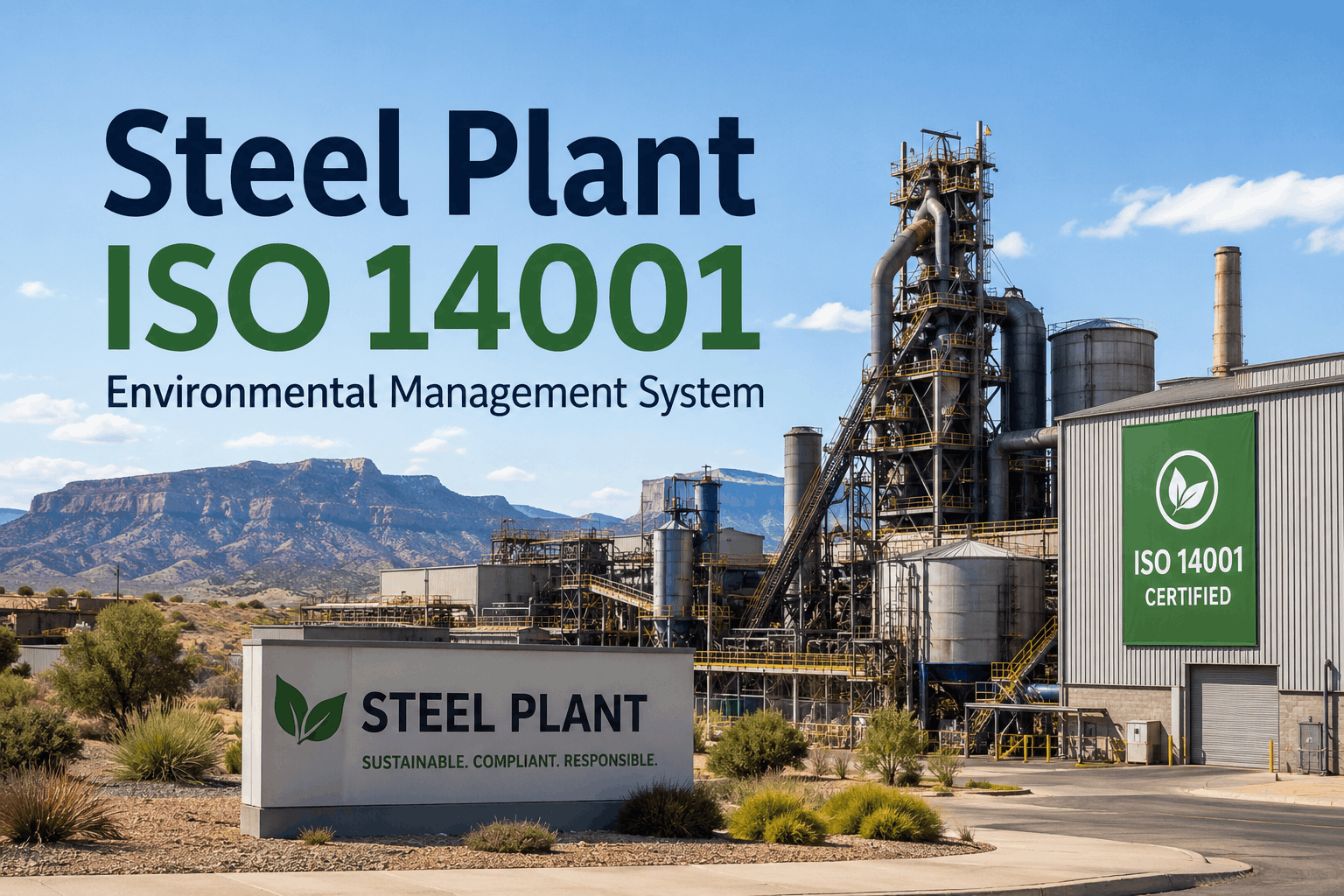
Steel Plant ISO 14001 Environmental Management System
Achieve ISO 14001 certification for steel plant environmental management — environmental aspects, compliance obligations, operational controls, and performance monitoring for sustainable steel production.
You Already Have the EMS Data — You Just Need the System
Every emissions reading, waste disposal record, and energy consumption log in your operations contains environmental performance data. Oxmaint does not require new sensors or environmental consultants — it structures the data you already collect against ISO 14001 requirements and surfaces the performance insights that demonstrate compliance. Steel plant leaders ready to achieve ISO 14001 certification can start a free trial or book a demo to see how EMS data analysis works on your plant's actual data.
What is ISO 14001 and Why Does It Matter for Steel Plants?
ISO 14001:2026 is the International Standard for environmental management systems (EMS). It helps organizations manage their environmental impacts, comply with applicable legal requirements, prevent pollution and improve environmental performance over time [citation:1]. ISO 14001 provides a structured framework that works for organizations of all sizes in both the public and private sectors [citation:1].
For steel plants, ISO 14001 is critical because the industry faces unique environmental challenges — high energy consumption, significant emissions, water usage, waste generation, and biodiversity impacts. Organizations adopt ISO 14001 to reduce their environmental footprint, improve resource efficiency, demonstrate responsible environmental practices, strengthen compliance with environmental obligations, and respond to customer, investor or regulatory expectations [citation:1]. The standard's impact is increasingly measurable; research led by the Standards Council of Canada found that a 1% increase in ISO 14001 certifications is associated with a 0.14% decrease in GHG emissions per unit of GDP [citation:2].
Core Elements of ISO 14001 for Steel Plant Environmental Management
Key elements of ISO 14001 include understanding environmental aspects and impacts, setting environmental objectives and performance indicators, ensuring compliance with environmental laws and regulations, managing risks and opportunities, training and awareness, and monitoring, measurement and continuous improvement [citation:1]. For steel plants, these elements translate into specific environmental management priorities.
ISO 14001:2026 — Key Changes for Steel Plants
The 2026 edition builds on the proven framework while refining it to meet today's expectations with greater clarity, usability and impact [citation:2]. The new edition introduces clearer guidance, more intuitive navigation and stronger alignment with key environmental priorities such as climate change, biodiversity and resource efficiency [citation:2]. For steel plants, these changes represent significant opportunities to strengthen environmental management.
The 2026 edition identifies a broader set of environmental conditions — such as pollution, resource availability, climate change, biodiversity and ecosystem health — that organizations are expected to consider when assessing their context, risks and opportunities [citation:4]. Steel plants must now address a wider range of environmental impacts beyond local pollution to include climate, biodiversity, resource use and ecosystem conditions [citation:3].
The role and accountability of top management are further clarified in the new edition. Requirements related to evaluation of the EMS are strengthened, and it is explicitly stated that top management is accountable for the effectiveness of the EMS and the environmental performance achieved [citation:3]. Environmental performance is positioned as a leadership responsibility [citation:4].
The life cycle perspective is now more clearly articulated and more comprehensive. Organizations are required to consider environmental impacts throughout the value chain — from design and development to procurement, use and end-of-life treatment of products [citation:3]. The requirement that previously applied to outsourced processes has been extended to cover all externally provided processes, products and services [citation:3].
The connection between environmental aspects, compliance obligations and actions is reinforced, placing greater emphasis on measurable performance. The focus shifts from maintaining processes to delivering results that can be tracked, demonstrated and improved over time [citation:4]. The importance of continual improvement is reinforced — organizations are expected to proactively identify opportunities for improvement and implement corrective actions commensurate with their environmental impacts [citation:3].
Environmental Performance Benchmarks for Steel Plants
Leading steel plants track and report environmental performance against specific targets. These benchmarks provide context for ISO 14001 implementation and demonstrate the environmental improvements achievable through systematic EMS.
| Environmental Indicator | Target/Current Performance | Data Source |
|---|---|---|
| Specific Freshwater Consumption | 2.35 m³/tcs (current); 2.21 m³/tcs by 2030 | JSW Steel [citation:10] |
| CO₂ Emission Intensity | 2.29 tCO₂/tcs (current); 1.95 tCO₂/tcs by 2030 | JSW Steel [citation:10] |
| Specific Energy Consumption | 5.41 Gcal/tcs (current); 5.65 Gcal/tcs by 2030 | JSW Steel [citation:10] |
| Zero Liquid Discharge (ZLD) | All JSW units maintain ZLD status | JSW Steel [citation:5] |
| PM Emission Intensity | 0.36 kg/tcs (current); 0.26 kg/tcs by 2030 | JSW Steel [citation:10] |
| NOx Emission Intensity | 1.14 kg/tcs (current); 0.91 kg/tcs by 2030 | JSW Steel [citation:10] |
Implementing ISO 14001 in Your Steel Plant — A Structured Framework
Implementing ISO 14001 requires a structured approach that builds on existing environmental management practices. The framework below provides a step-by-step process for achieving certification.
Assess the organization and its context — identify external and internal issues that affect environmental management. Identify interested parties and their expectations. Define the scope of the EMS. Document key environmental conditions — pollution, resource availability, climate change, biodiversity and ecosystem health [citation:4].
Identify environmental aspects of activities, products and services that can interact with the environment. Determine environmental impacts. Identify applicable legal and other compliance obligations. Use a structured approach to assess the significance of each environmental aspect — considering emissions, water, waste, energy and biodiversity [citation:1].
Establish environmental objectives and targets that align with environmental policy. Define key performance indicators for tracking progress — emissions intensity, water consumption, energy efficiency, waste generation. Set time-bound targets for improvement. JSW Steel's targets for 2030 include CO₂ emission intensity of 1.95 tCO₂/tcs and specific freshwater consumption of 2.21 m³/tcs [citation:10].
Document the operational controls to manage significant environmental aspects. Include procedures for emissions monitoring, wastewater treatment, waste management, and energy management. Establish emergency preparedness and response procedures. Ensure all personnel are aware of their environmental responsibilities [citation:1].
Implement monitoring, measurement, analysis and evaluation of environmental performance. Track progress against objectives and performance indicators. Conduct internal audits at planned intervals. Evaluate compliance with legal obligations. Document results and identify opportunities for improvement. Use data to demonstrate performance to stakeholders [citation:4].
Integrating ISO 14001 with Other Management Systems
Many steel plants implement ISO 14001 alongside other management system standards. The 2026 edition strengthens alignment with the harmonized structure used across all ISO management system standards, ensuring consistency in terminology, structure and core requirements [citation:4].
ISO 9001 focuses on quality, while ISO 14001 focuses on environmental performance. Both follow the High Level Structure, which makes them easy to integrate [citation:1]. Organizations can coordinate processes such as risk management, internal audits, leadership reviews and continual improvement across both systems, reducing duplication and improving overall efficiency [citation:4].
Some organizations combine ISO 14001 with ISO 45001 for occupational health and safety [citation:1]. Integrated systems align environmental and safety objectives, streamline documentation, and demonstrate comprehensive management commitment to sustainability and workforce protection.
ISO 50001 focuses on energy performance and efficiency. Integrated with ISO 14001, it enables steel plants to address energy-related environmental impacts systematically. JSW Steel maintains ISO 50001 certification across all locations, demonstrating integrated environmental and energy management [citation:10].
ROI of ISO 14001 Certification
A 1% increase in ISO 14001 certifications is associated with a 0.14% decrease in GHG emissions per unit of GDP [citation:2]
Leading steel plants target 100% waste recycling by 2030, reducing disposal costs and environmental liability [citation:10]
JSW Steel maintains Zero Liquid Discharge (ZLD) status across all units, eliminating water pollution risk [citation:5]
India has reduced emission intensity by 24% between 2005 and 2016 through standards-based approaches [citation:7]
Frequently Asked Questions
What is ISO 14001 and why is it important for steel plants?+
What are the key changes in ISO 14001:2026 for steel plants?+
How do I start implementing ISO 14001 in a steel plant?+
What environmental performance targets should steel plants track under ISO 14001?+
Your Environmental Performance Data Is Already in Your Systems — Use It to Achieve ISO 14001
Every emissions reading, water consumption log, and waste disposal record your steel plant has ever recorded contains the data needed to build an ISO 14001-compliant environmental management system. Oxmaint's EMS module structures your operational data against ISO 14001 requirements, automates environmental performance tracking, and generates audit-ready reports that demonstrate compliance. No environmental consultants. No manual spreadsheets. Import your data, build your EMS, and achieve ISO 14001 certification in your first 90 days.