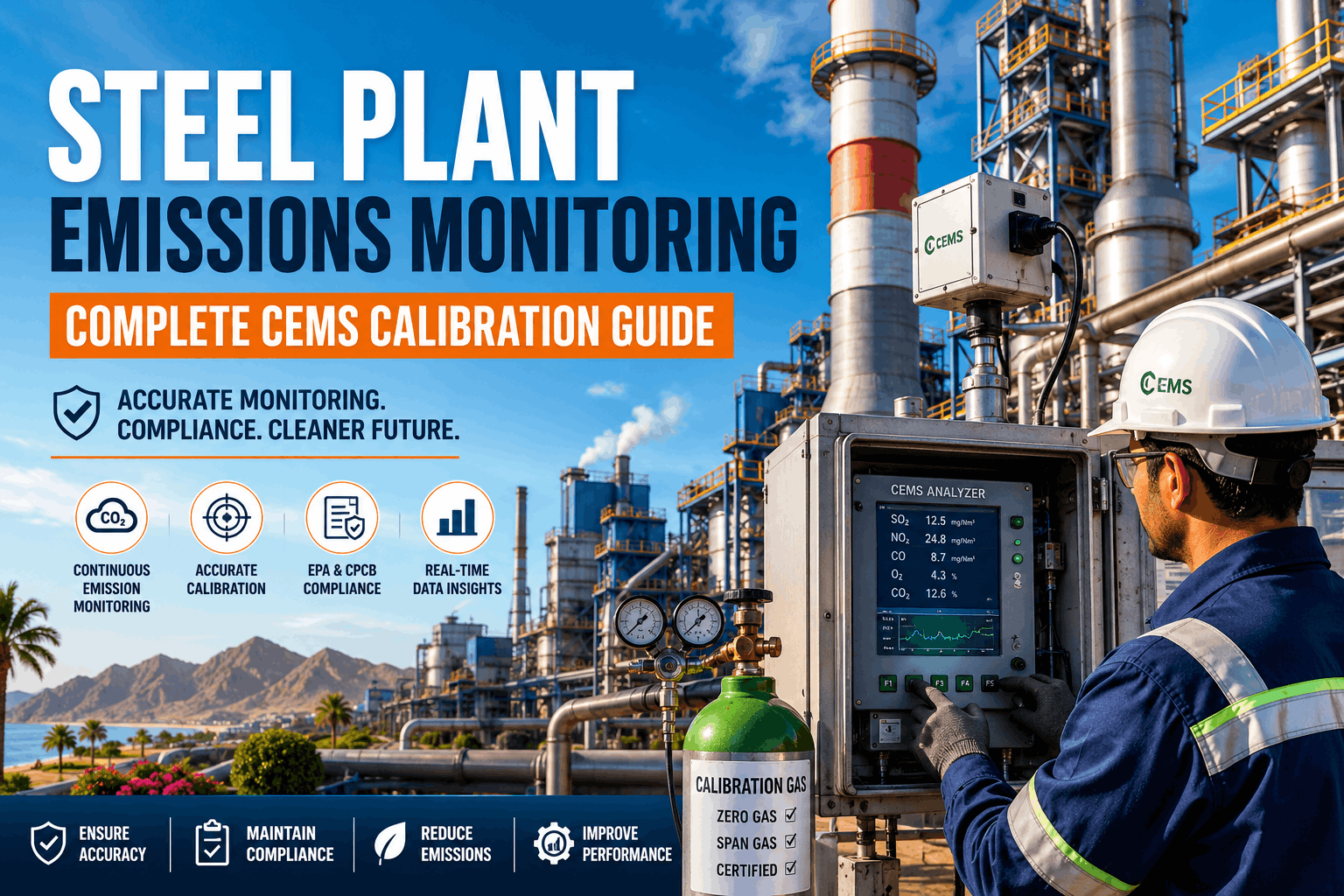
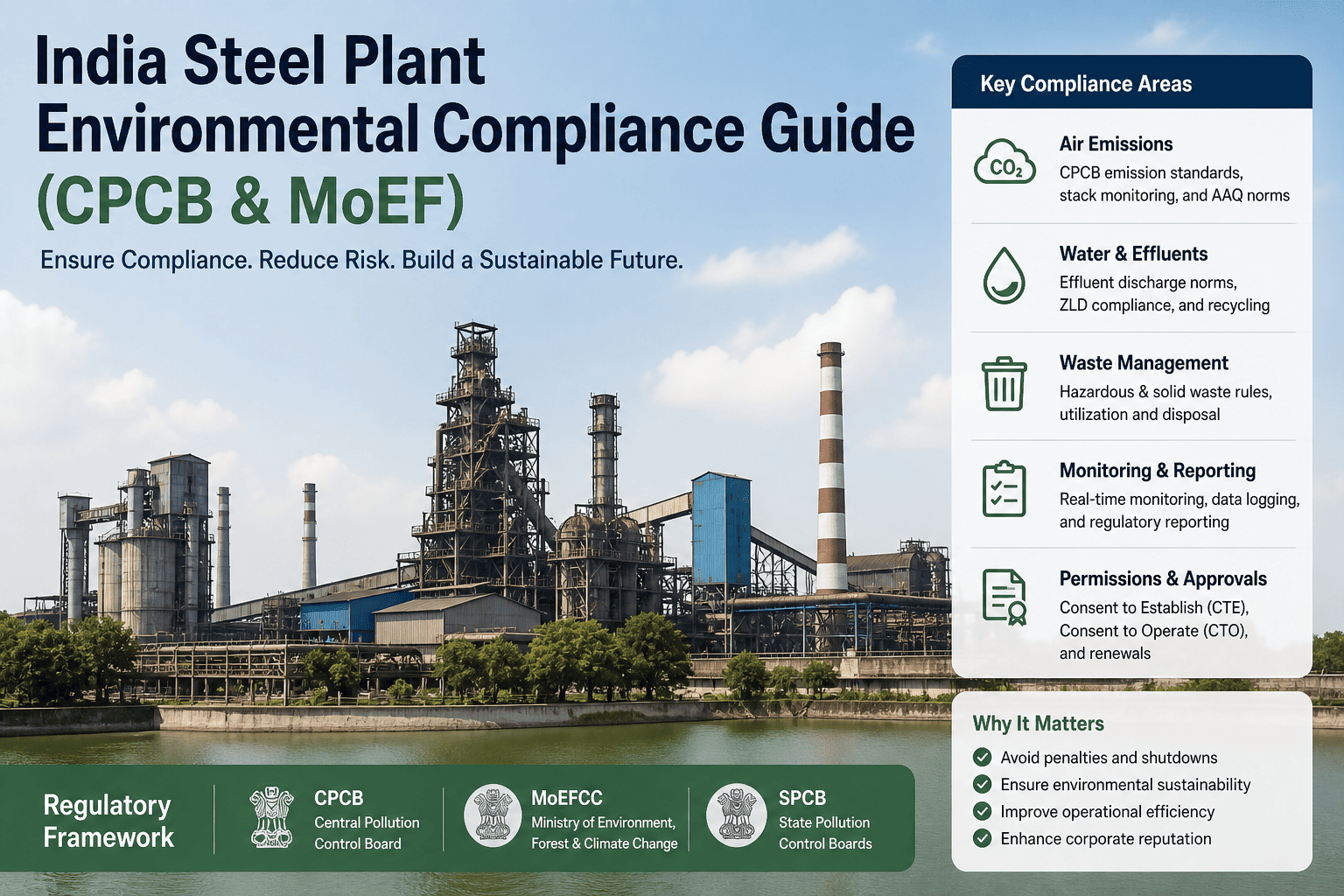
Steel plants in India face the most consequential emissions compliance period in the industry's history. MoEFCC has mandated real-time CEMS data transmission to CPCB servers for all major stack sources — and SPCB consent conditions are tightening simultaneously. Plants still generating compliance reports from manual stack monitoring data collected monthly are not just operationally exposed; they are one regulatory inspection away from a consent-to-operate challenge that can halt production. Start managing CEMS compliance, pollution control equipment maintenance, and GHG reporting with Oxmaint — free trial, no credit card required.
Steel Plant Emissions Monitoring: CEMS, CPCB Compliance & GHG Reporting
Real-time stack emissions monitoring. CPCB server data transmission. SO₂, NOₓ, PM, HF, and CO compliance tracking. Fugitive emissions control. GHG Scope 1 reporting. Pollution control equipment PM scheduling. Oxmaint connects every emissions data stream — from CEMS analyser to compliance certificate — into one auditable platform your environmental team and your regulators can rely on.
Every Pollutant Your Steel Plant Must Monitor — Stack, Fugitive, and GHG
Steel plant emissions compliance covers three distinct categories — stack emissions from combustion and process sources, fugitive emissions from material handling and open areas, and greenhouse gas emissions for ESG and carbon market reporting. Each category has its own measurement method, regulatory standard, and reporting format.
Major stack sources — sinter plant stacks, blast furnace cast house vents, BOF/EAF primary dedusting, coke oven combustion stacks, and reheating furnace exhausts — are subject to CPCB/SPCB concentration limits and require continuous emissions monitoring systems with real-time data transmission. Oxmaint integrates with CEMS DAS outputs, stores 15-minute averaged data, flags exceedances, and generates the automated compliance reports CPCB server upload and SPCB submissions require. Sign in to connect your CEMS data to the Oxmaint compliance dashboard.
Fugitive emissions — diffuse dust from raw material stockyards, coke oven battery door leakage, transfer point spillage, wind erosion from open storage, and unpaved haul roads — are subject to monitoring and control obligations under CPCB fugitive emissions norms. Control measures require scheduled maintenance to remain effective. Oxmaint tracks maintenance compliance for every fugitive control measure and links inspection results to the compliance record. Book a demo to see fugitive emissions control tracking.
Steel plants are among the highest Scope 1 GHG emitters in manufacturing. Primary CO₂ from blast furnace ironmaking, process CO₂ from BOF steelmaking, and fugitive CH₄ from coke oven gas systems all require quantification for CDP disclosure, GRI sustainability reporting, BEE PAT scheme compliance, and investor ESG reporting. Oxmaint aggregates fuel consumption data, CEMS CO₂ measurements, and emission factor calculations into the Scope 1 inventory automatically. Sign in to activate GHG inventory tracking for your plant.
Six Emissions Compliance Failures That Expose Steel Plants to Regulatory Action
Most steel plant environmental teams know what the regulations require. The compliance gap is not a knowledge problem — it is a data integrity problem, a documentation problem, and a maintenance problem. These are the six patterns that generate CPCB notices, SPCB show-cause orders, and consent-to-operate conditions.
From CEMS Analyser to CPCB-Ready Compliance Record — Four Steps
Indian Steel Plant Emissions Standards — CPCB / MoEFCC Reference Table
| Source / Process | Parameter | CPCB / MoEFCC Limit | Monitoring Method | Reporting Frequency | Oxmaint Tracking |
|---|---|---|---|---|---|
| Sinter Plant Stack | PM, SO₂, NOₓ | PM: 50 mg/Nm³ · SO₂: 600 mg/Nm³ · NOₓ: 500 mg/Nm³ | CEMS — continuous | 15-min avg · Monthly report · CPCB real-time | Real-time limit alert + monthly auto-report |
| Blast Furnace Cast House / GCP | PM | 50 mg/Nm³ (after GCP) | CEMS / periodic stack test | Continuous CEMS + 6-monthly stack test | CEMS integration + stack test record |
| BOF / EAF Primary Dedusting | PM, CO | PM: 50 mg/Nm³ · CO: site-specific | CEMS — continuous | 15-min avg · Monthly CPCB upload | Real-time exceedance detection |
| Coke Oven Combustion Stack | PM, SO₂, NOₓ, HF | PM: 50 mg/Nm³ · SO₂: 800 mg/Nm³ · NOₓ: 500 mg/Nm³ | CEMS — continuous | Continuous + monthly compliance report | Multi-parameter compliance dashboard |
| Reheating Furnace | PM, SO₂, NOₓ, CO | PM: 150 mg/Nm³ (coal) · SO₂: 1700 mg/Nm³ | CEMS or periodic | CEMS: continuous · Periodic: 6-monthly | CEMS or test record linkage |
| Raw Material Stockyards (Fugitive) | PM₁₀, PM₂.₅ | Control measures mandated — ambient monitoring | Ambient dust monitoring + control inspection | Quarterly ambient monitoring + control audit | Control maintenance PM + inspection records |
| All Major Sources (GHG) | CO₂, CH₄, N₂O | BEE PAT target — plant-specific SEC reduction | Emission factor × activity data | Annual PAT / CDP / GRI submission | Scope 1 inventory auto-compiled |
Reference: MoEFCC Environment (Protection) Rules, CPCB General Standards for Discharge of Environmental Pollutants, and applicable SPCB consent conditions. Limits vary based on plant capacity, location, and date of establishment. Book a demo to configure Oxmaint with your plant's specific consent conditions and CPCB limit schedule.
What Oxmaint Delivers for Steel Plant Environmental Compliance Teams
Manual Compliance Tracking vs Oxmaint — The Environmental Team's Operational Gap
| Compliance Activity | Without Structured Platform | With Oxmaint |
|---|---|---|
| Stack emissions monitoring | CEMS data stored in DAS only — no integrated compliance tracking | Real-time limit comparison and exceedance alerts per stack |
| CPCB server data transmission | DAS-to-CPCB connection only — gaps unmonitored until inspection | Transmission continuity monitored — gaps flagged and documented immediately |
| Exceedance event documentation | Manual email to SPCB — no structured root cause or corrective action record | Structured workflow — cause, action, and compliance restored timestamp on record |
| Pollution control equipment maintenance | Reactive — repaired when emission increase or breakdown occurs | Scheduled PM linked to stack compliance — maintenance risk visible before emission impact |
| Monthly compliance report preparation | 3–5 days manual data compilation from DAS exports and paper logs | Auto-generated in under 30 minutes from stored CEMS data |
| GHG / Scope 1 inventory | Compiled annually from manual fuel logs — limited auditability | Continuously maintained from CEMS and process data — audit-ready at any time |
| Regulatory inspection readiness | 2–3 days document preparation for each CPCB/SPCB inspection | Audit trail generated instantly — no staff preparation required |