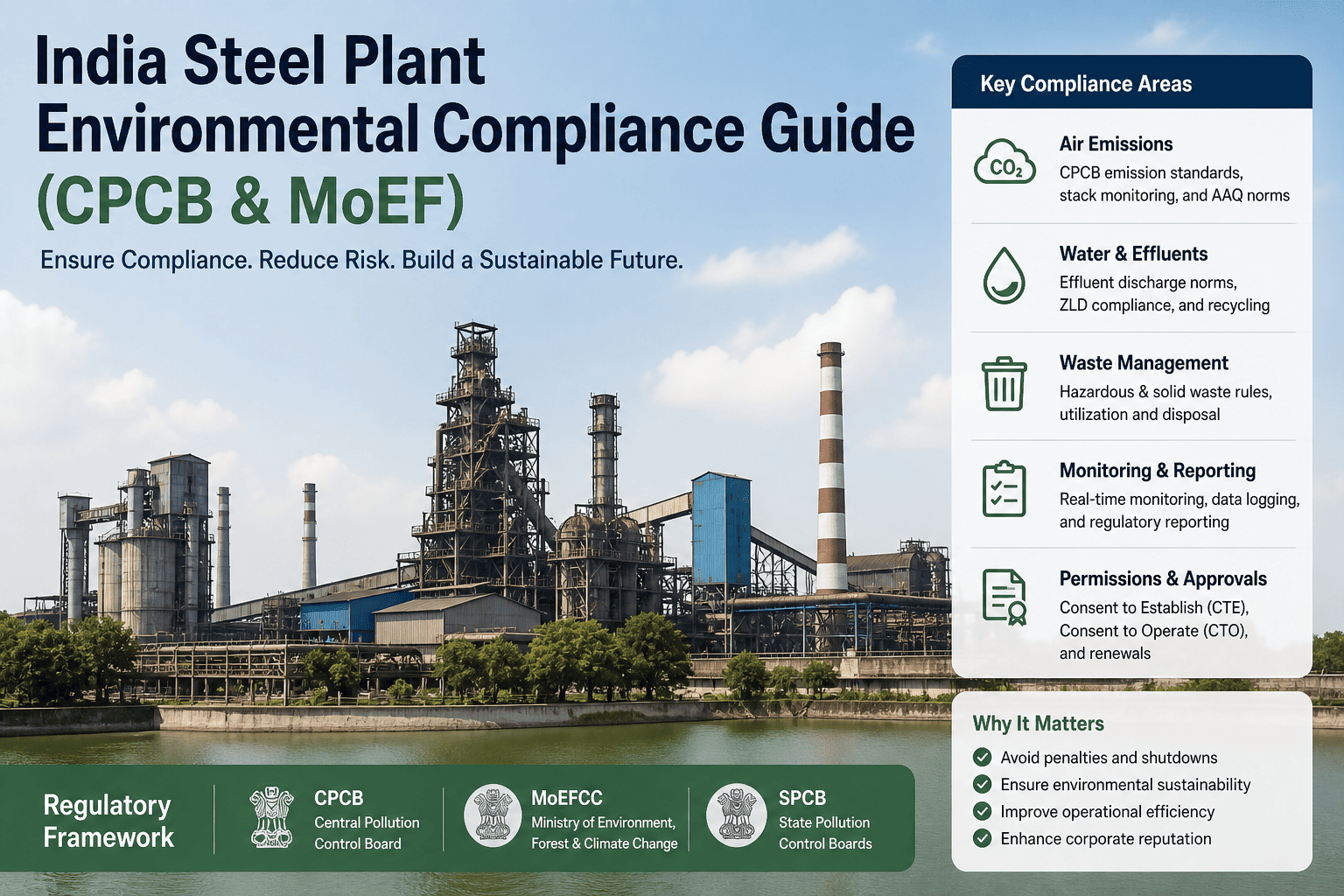
India's steel sector contributes over 9% of national industrial air pollution load — making it one of the most scrutinised industries under CPCB and MoEF regulatory frameworks. Environmental compliance for steel plants in India now spans stack emission limits, ambient air quality monitoring, consent-to-operate conditions, and mandatory OCEMS installation — with non-compliance penalties including production stoppage orders. OxMaint's compliance tracking system helps Indian steel plants maintain continuous documentation of inspection records, stack monitoring data, and regulatory submissions — replacing scattered registers and Excel logs with a single auditable digital trail.
Regional Steel Industry · Compliance Tracking
India Steel Plant Environmental Compliance Guide
CPCB Norms · MoEF Regulations · Stack Monitoring · Consent to Operate · Digital Compliance Tracking
CPCB Emission Standards for Indian Steel Plants — Key Parameters
| Source / Process | Pollutant | CPCB Limit (mg/Nm³) | Monitoring Frequency | Instrument Required |
|---|---|---|---|---|
| Blast Furnace (Cast House) | Particulate Matter (PM) | 50 mg/Nm³ | Continuous (OCEMS) | Online stack analyser |
| Electric Arc Furnace | PM + SO₂ + NOₓ | 50 / 200 / 300 | Continuous (OCEMS) | Multi-parameter CEMS |
| Sinter Plant | PM + SO₂ | 50 / 200 | Continuous (OCEMS) | Online CEMS mandatory |
| Coke Oven Battery | PM + VOC + H₂S | 50 / site-specific | Manual quarterly + OCEMS | OCEMS + isokinetic sampling |
| Lime / Dolomite Kilns | Particulate Matter | 100 mg/Nm³ | Quarterly manual | Isokinetic stack sampler |
| Rolling Mill Furnaces | PM + NOₓ + SO₂ | 50 / 300 / 200 | Half-yearly manual | Certified stack monitoring team |
| Fugitive Dust (Plant-Wide) | PM₁₀ Ambient | 100 µg/m³ (NAAQS) | Continuous AAQMS | Automatic Ambient Air Quality Monitoring Stn. |
The Consent to Operate (CTO) Compliance Cycle — What Steel Plants Must Track
01
Consent to Establish (CTE)
Before construction / capacity expansion
Applied to SPCB before project construction begins
Environmental Impact Assessment (EIA) submission required for plants above threshold capacity
Public hearing documentation for Category A projects
Conditions specify pollution control equipment specifications
02
Consent to Operate (CTO)
Annual or 5-year renewal — site-specific
Renewed annually or per SPCB schedule — lapse triggers production stoppage risk
Stack monitoring reports submitted as renewal supporting documents
OCEMS data availability and calibration certificates required
Water cess payment clearance mandatory before renewal
03
EC Compliance Reports
6-monthly submission to MoEF / SEAC
Half-yearly reports on all EC conditions: emission, effluent, solid waste, greenbelt
Production volumes and capacity utilisation data required
Tree plantation and greenbelt maintenance records submitted
Deviation from EC conditions must be reported with corrective action timelines
04
OCEMS Data Submission
Continuous — real-time server transmission
CPCB and SPCB servers receive real-time OCEMS data via mandatory data logger connectivity
Data availability targets: minimum 95% uptime required to avoid notice
Calibration records and QA/QC logs maintained for audit
Exceedance events must be reported within 24 hours with root cause
Replace Compliance Registers and Excel Logs with a Single Digital Audit Trail in OxMaint
Stack monitoring records, OCEMS calibration logs, inspection certificates, and CTO renewal documents — all stored, tracked, and flagged before expiry in OxMaint's compliance tracking module.
OCEMS Maintenance Compliance — Most Common Violation Sources
38%
OCEMS Data Gaps
Instrument downtime, communication failure, or data logger malfunction causing availability below 95%. OxMaint PM schedules OCEMS calibration and preventive maintenance tasks before gaps accumulate into regulatory notices.
27%
Expired Calibration Certificates
CEMS analyser calibration certificates expire and are not renewed before audit. OxMaint tracks certificate expiry dates per instrument and triggers work orders 30 days before expiry — before the violation exists, not after it is discovered.
21%
Missed Stack Monitoring Schedules
Manual stack monitoring for sources not covered by OCEMS is missed or delayed beyond the quarterly / half-yearly deadline. OxMaint schedules manual stack monitoring as recurring PM tasks per source, with escalation if not completed on time.
14%
CTO / EC Report Submission Delays
Six-monthly EC reports and CTO renewal packages missed due to no centralised tracking. OxMaint's compliance calendar tracks every statutory deadline, assigns ownership, and escalates automatically 45 days before submission dates.
Digital Compliance Tracking — OxMaint vs Traditional Register-Based Systems
| Compliance Requirement | Register / Excel Method | OxMaint Digital Tracking |
|---|---|---|
| OCEMS calibration records | Physical log book — misplaced during audit | Digital record with certificate scan — retrievable in under 30 seconds |
| Stack monitoring schedule tracking | Excel calendar — not linked to work order execution | Auto-scheduled PM task per source — escalation if overdue |
| CTO renewal deadline | Reminder in personal calendar — single point of failure | Compliance calendar with 45-day and 15-day escalation alerts to team |
| EC 6-monthly report data | Assembled manually from 4–6 departments over 2–3 weeks | OxMaint exports production, maintenance, and inspection data in report-ready format |
| Exceedance event documentation | Informal email chain — no structured root cause record | Incident work order with root cause, corrective action, and closure timestamp |
| Pollution control equipment PM | Checked during SPCB inspection — not tracked proactively | Scheduled PM per equipment — ESP, bag filter, scrubber — with compliance status visible |
"
The pattern I see across Indian steel plants — integrated and sponge iron both — is the same: the environment team is competent, the OCEMS is installed, the stack monitoring is being done. The compliance failure happens in the documentation layer. SPCB notices are issued not because the stack exceeded limits, but because the calibration certificate for the CEMS analyser lapsed three weeks ago and nobody tracked it. Or the half-yearly EC report was submitted 12 days late because the production data had to be collected manually from a separate system. Digital compliance tracking with OxMaint solves the documentation gap without adding headcount — the system tracks the deadline, assigns the task, and escalates if it is not done. The environment team can then focus on actual environmental management rather than chasing paperwork before every inspection.
Arun Krishnamurthy, B.E. (Environmental Engineering), MBA, Certified Environmental Auditor (QCI)
Head of Environment, Health & Safety — Tata Steel (Kalinganagar) · 17 Years Industrial Environmental Compliance · Specialist in CPCB/MoEF regulatory management, OCEMS implementation, and digital compliance systems for integrated steel plants and DRI operations across India
Frequently Asked Questions
What are the CPCB penalties for steel plants that miss OCEMS data availability targets?
CPCB and the relevant SPCB can issue show-cause notices if OCEMS data availability falls below 95% in a calendar month, with subsequent penalties under the Environment Protection Act 1986 including closure directions for persistent non-compliance. Beyond regulatory penalties, exceedance events that occur during OCEMS downtime cannot be explained or defended — the absence of data is treated as an admission of non-compliance during audit. OxMaint schedules preventive maintenance for OCEMS instruments including sensor cleaning, calibration checks, and data logger verification to keep availability above the 95% threshold. Start your free trial to see how OxMaint tracks OCEMS instrument maintenance compliance.
Which pollution control equipment requires scheduled maintenance under CPCB conditions?
Key pollution control assets requiring documented PM under CPCB and CTO conditions include Electrostatic Precipitators (ESP), bag house filters, wet scrubbers, de-dusting systems, and gas cleaning plants (GCP) on blast furnaces. SPCB inspectors specifically check PM records for these assets — a poorly maintained ESP with no PM history is a significant audit risk even if current emission readings are within limits, because it demonstrates no system of care for the pollution control infrastructure. OxMaint maintains a full PM schedule per pollution control asset with inspection records, filter replacement logs, and efficiency measurement history. Book a demo to see OxMaint's pollution control equipment compliance module.
How does OxMaint help prepare the 6-monthly EC compliance report for MoEF submission?
OxMaint's compliance reporting module generates structured exports of all maintenance activities, inspection records, equipment performance data, and statutory task completion status within any date range — the data that environmental teams spend 2–3 weeks manually collecting for EC reports. Production volume data from work order records, pollution control equipment PM compliance percentages, and OCEMS calibration records are all exportable in formats aligned with EC report templates. Environmental managers can assemble the 6-monthly report in a fraction of the previous time, with audit-ready documentation for every figure. Explore OxMaint's compliance reporting exports in your free trial.
Does OxMaint support multi-plant compliance tracking for steel groups with plants in multiple states?
Yes. OxMaint's multi-site architecture allows a steel group's environment and compliance team to monitor CTO renewal dates, OCEMS uptime, stack monitoring schedules, and EC report deadlines across all plants from a single dashboard — with each plant's SPCB-specific requirements configured separately, since conditions vary by state. Group environment managers see a portfolio-level compliance status at any time — which plants have upcoming renewal deadlines, which have overdue calibration tasks, and which have open exceedance work orders not yet closed with documented root cause. Book a demo to see OxMaint's multi-site compliance dashboard for steel groups.
OxMaint · Compliance Tracking
CPCB Notices Are Preventable. OxMaint Tracks Every Deadline, Certificate, and Inspection — Before the Violation Exists.
Stack monitoring schedules, OCEMS calibration records, CTO renewal dates, and EC report deadlines — all tracked, all assigned, all escalated automatically so your environment team is always audit-ready.