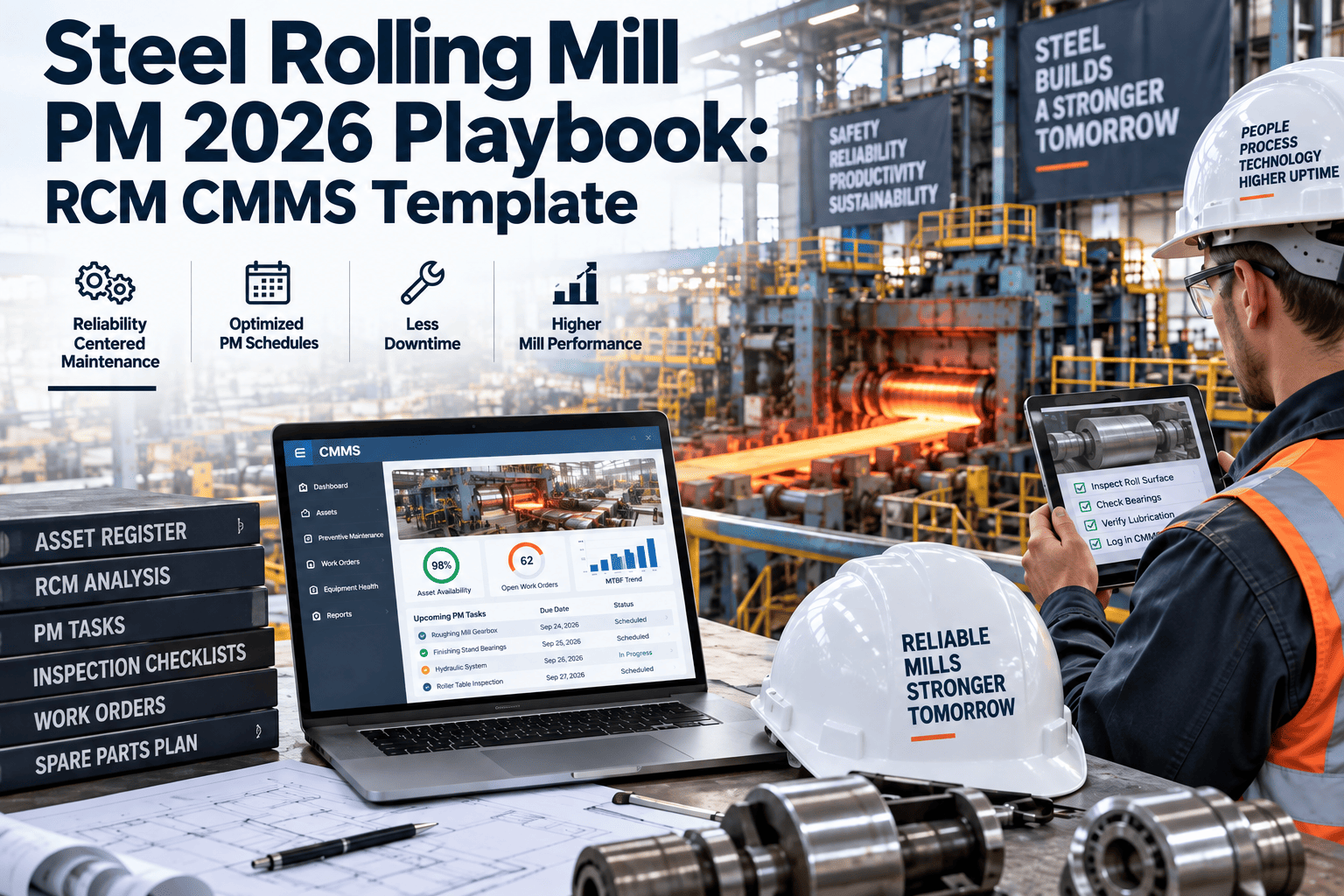
A steel plant running $1.2 million per day in unplanned downtime is not running a maintenance program — it is running a reactive breakdown response operation with a maintenance budget attached to it. The difference between a U.S. integrated steel plant at 88% planned maintenance ratio and one at 52% planned ratio is not staffing levels, technology investment, or capital budget. It is the presence or absence of a steel plant master PM schedule template that defines what gets inspected, what gets serviced, and what gets replaced — at what frequency, by which trade, using which procedure — across every process area from the blast furnace to the finishing lines. Without a master PM schedule that covers the full frequency matrix from daily operator checks through annual overhaul tasks, the maintenance planning function defaults to whichever work orders are loudest at shift start. Tuyere cooling flow checks get skipped because the casthouse crane needs grease. Mold oscillation amplitude verification gets forgotten because a segment drive alarm needs diagnosing. Reheat furnace walking beam lubrication gets deferred until the campaign ends. Each deferred PM is a statistical step toward an unplanned failure in a steel plant where the cascade consequence of any critical asset failure can exceed $500,000 in the first four hours. This free steel plant PM schedule Excel template and Oxmaint-compatible import format covers all six major steel plant process areas — Blast Furnace, BOF/EAF Steelmaking, Continuous Caster, Hot Strip Mill, Cold Mill, and Utilities — across five PM frequency tiers: Daily, Weekly, Monthly, Quarterly, and Annual. Sign Up Free to import this master PM schedule directly into Oxmaint, where every task becomes a tracked work order on a technician's mobile device — completed, documented, and compliance-ready without a single paper checklist.
This steel plant PM matrix template covers 200+ PM tasks across BF, EAF, BOF, caster, rolling mill, and utilities — five frequency tiers, all importable into Oxmaint as scheduled digital work orders tracked per technician, per shift, per asset.
Why Steel Plant PM Programs Collapse Without a Master Schedule
A steel plant PM program that exists as shift supervisor memory, scattered Excel tabs, and paper binders in six different offices is not a PM program — it is the illusion of one. These are the six structural reasons why the absence of a steel plant PM schedule template costs U.S. steel producers between $4–$18 million annually in preventable equipment failures and reactive maintenance premium labor costs.
Problem #1
No Frequency Standard — Tasks Drift
Without a master PM matrix that assigns each task an explicit frequency (daily, weekly, monthly, quarterly, annual), shift supervisors make informal judgments about when equipment was "last inspected." A tuyere cooling check that should happen every shift gets done twice a week when the plant is busy. A rolling mill bearing lubrication that should happen weekly gets done monthly when the lubricator is on another job. These informal deferrals accumulate and compound until an asset fails at a cost that dwarfs every skipped PM combined.
Problem #2
No Trade Assignment — Nobody Owns the Task
A PM task without a specified trade assignment (mechanical technician, electrician, refractory specialist, operator, instrumentation) is a task that belongs to everyone and therefore to no one. In a steel plant where four different trades work on the same EAF vessel — mechanical for electrode arms, electrical for transformer connections, refractory for gunning maintenance, and instrumentation for process sensors — an unassigned PM becomes a shift handover argument instead of a completed inspection record.
Problem #3
No OSHA/MSHA Compliance Evidence
OSHA 29 CFR 1910.217, OSHA PSM (Process Safety Management) for highly hazardous chemicals at steel plants, and MSHA regulations for certain raw materials handling operations require documented evidence of inspection and maintenance activities. A paper PM schedule with incomplete records, unsigned inspection sheets, and undated task completions does not satisfy OSHA's PSM documentation requirements. A digital PM schedule tracked through Oxmaint produces timestamped, signed completion records that satisfy OSHA, MSHA, and ISO 45001 audit requirements automatically.
Problem #4
Heat-Count PMs Not Tracked
Blast furnace refractory components (tuyeres, cooling staves, bustle pipe), BOF/EAF vessel linings, continuous caster mold and segment systems, and ladle refractory all require PM intervals based on heat count or campaign tonnage — not calendar dates. A master PM schedule that only tracks calendar intervals misses the entire heat-count PM tier, which in a U.S. EAF mini-mill producing 250 heats per week means critical refractory inspection triggers are missed entirely during high-production campaign periods when calendar dates suggest "not due yet."
Problem #5
No PM-to-Outage Window Alignment
A steel plant PM schedule that generates work orders without referencing the planned maintenance windows (turns, blown-down periods, roll change slots) forces maintenance planners to choose between running the PM during production (creating safety and quality risks) or deferring it (creating compliance and reliability risks). The master PM schedule template must tag each task with its required access condition — "production access only," "blown-down required," "shutdown window required" — so Oxmaint can schedule PMs against available outage windows rather than generating irreconcilable conflicts.
Problem #6
No Completion Accountability by Technician
A PM schedule on paper or shared Excel has no mechanism to record which specific technician completed each task, when exactly it was completed, what condition was found, and what action was taken. Without this data per technician, the maintenance manager cannot measure PM execution quality, identify underperforming team members, justify training investment, or demonstrate OSHA regulatory compliance with a named responsible person attached to each safety-critical inspection record.
PM Frequency Coverage — Steel Plant Master Schedule Requirements
A complete steel plant PM matrix template must cover five frequency tiers across all process areas. The following checklist shows what each tier must deliver and which Oxmaint features automate the tracking, scheduling, and compliance documentation for each tier. Schedule a PM configuration session to see your specific plant's PM matrix built live in Oxmaint.
Daily & Per-Shift PMs
Operator safety checks: cooling flow, pressure, temperature readings at shift start
Calendar AND heat-count PM triggers — both managed in same platform
Auto-schedule PMs against available maintenance windows and planned outages
Timestamped completion by named technician — OSHA/ISO 45001 ready
Overdue PM escalation: supervisor alert at 24 hrs, manager alert at 48 hrs
85%
Planned vs reactive work order ratio at world-class U.S. steel plants — only achievable with a structured master PM schedule and CMMS enforcement
200+
Pre-built PM tasks in Oxmaint's steel plant library — covering BF, EAF, BOF, caster, rolling mill, and utilities — ready to assign on day one
$4.2B
Spent by the U.S. and global steel industry on unplanned downtime in 2024 — the majority preventable with structured PM programs per World Steel data
30–50%
Reduction in MTTR at steel plants running CMMS-managed PM schedules vs reactive operations — Oxmaint deployment data, 2025–2026
Steel Plant PM Frequency Coverage Heatmap — Master Schedule Overview
The heatmap below shows the relative PM task density by process area and frequency tier. Darker cells indicate higher PM task counts — areas of highest maintenance intensity. The Caster and Utilities areas carry the highest daily PM burden because both operate continuously with zero tolerance for inspection gaps.
Steel Plant Master PM Schedule — Task Count by Process Area & Frequency (Heatmap)
Steel Plant Master PM Schedule — Template Content by Process Area
The following template tables contain the master PM tasks for each major steel plant process area, organized by frequency tier. Copy, adapt to your equipment IDs, and import directly into Oxmaint via CSV upload. All tasks include the required access condition (production access or outage required) to allow Oxmaint's scheduling engine to align PMs with available maintenance windows automatically.
Blast Furnace Complex — Master PM Schedule
Frequency
PM Task
Trade
Access
Est. Duration
Daily (per shift)
Tuyere cooling water flow rate check — all active tuyeres. Record flow vs baseline. Flag any tuyere with >10% flow reduction.
Operator / Mechanical
Production
30 min
Daily (per shift)
Hot blast valve position indicator check — confirm all 4 valves responsive to control room signal. Log any position discrepancy.
Instrumentation
Production
20 min
Daily (per shift)
Casthouse runner depth and refractory condition inspection — visual and measurement at each tap. Flag any runner below 150mm depth.
Refractory Tech
Production
25 min
Daily (per shift)
Top gas temperature profile check — confirm top gas temperature distribution within normal range. Asymmetric distribution indicates burden distribution problem.
Process Engineer
Production
15 min
Weekly
Bustle pipe thermal imaging scan — full circumference using hand-held thermal camera. Flag any hotspot above ambient +80°C threshold.
Mechanical / IR Tech
Blown-down required
2 hrs
Weekly
Skip car mechanical inspection — rope wear measurement, sheave condition, brake effectiveness test, and wheel flange wear gauge.
Mechanical
Skip system down
3 hrs
Monthly
Tuyere cooler flow balance test — measure individual tuyere flow rates under standard blast conditions. Update flow map. Flag units >15% below design flow for replacement scheduling.
Mechanical
Production
4 hrs
Monthly
Stove dome temperature uniformity check — measure across 8 points. Log readings vs previous month trend. Rising asymmetry indicates checker brick deterioration.
Instrumentation
Stove on blast cycle
2 hrs
Quarterly
Hot blast valve overhaul assessment — inspect disc, seat, and actuator for wear. Torque test actuator. Schedule full overhaul if seat leakage exceeds 2% of blast volume.
Mechanical
Full shutdown
8 hrs each
Annual
Full BF profile survey — laser or mechanical profile measurement from top to hearth. Compare to design dimensions. Calculate accretion build-up and campaign wear rate.
Inspection Specialist
Full campaign shutdown
24–48 hrs
EAF / BOF Steelmaking — Master PM Schedule
Frequency
PM Task
Trade
Access
Est. Duration
Daily / Per Heat
EAF electrode length measurement — measure remaining electrode length after each heat. Record electrode consumption rate. Trigger slipping when length falls below 800mm minimum operating length.
Operator
Between heats
10 min
Daily (per shift)
EAF transformer oil temperature and pressure check — log at start of each shift. Oil temperature above 75°C triggers immediate maintenance call.
Electrical
Production
15 min
Daily (per shift)
Fume system differential pressure check — across baghouse. Log dP. Rising dP indicates bag blinding. Trigger cleaning cycle or bag replacement planning when dP exceeds 8 in.w.c.
Mechanical
Production
10 min
Weekly
EAF electrode arm inspection — visual check of arm water cooling connections, clamp mechanism, and position sensor calibration. Log any cooling flow reduction or position deviation >5mm.
Mechanical / Electrical
Tap-to-tap window
90 min
Monthly
BOF/EAF vessel shell inspection — ultrasonic thickness measurement at defined grid points. Compare to baseline. Any shell section reading below minimum thickness triggers emergency repair scheduling.
Inspection Specialist
Full vessel shutdown
8 hrs
Heat-Count (every 1,500 heats EAF / 250 BOF)
Refractory thickness survey — gunning compound consumption log, remaining lining thickness at key positions. Determine remaining campaign life and schedule reline campaign preparation.
Refractory Tech
Between campaigns
4 hrs
Annual
BOF trunnion bearing overhaul — vibration analysis trend review, clearance measurement, lubrication system flush and recharge. Replace if bearing play exceeds OEM tolerance.
Mechanical / OEM Tech
Full vessel down
24–36 hrs
Continuous Caster — Master PM Schedule
Frequency
PM Task
Trade
Access
Est. Duration
Daily (per sequence)
Mold level sensor calibration check — verify sensor output matches physical level measurement. Any drift >±5mm triggers recalibration before next sequence start.
Instrumentation
Between sequences
20 min
Daily (per shift)
Secondary cooling spray nozzle check — visual inspection of Zones 1–3. Any blocked nozzle in primary cooling zone requires immediate replacement before next sequence. Log any clogged nozzles with position ID.
Mechanical
Between sequences
45 min
Daily (per shift)
Mold oscillation amplitude and frequency check — measure vs setpoint. Deviation >±5% requires hydraulic system inspection before next heat.
Mechanical / Hydraulics
Between sequences
30 min
Weekly / Per Sequence Change
Mold copper taper measurement — narrow face taper measurement at top, middle, bottom. Record against wear limit. Mold with taper deviation >0.3mm must be replaced before next sequence.
Caster Mechanic
Mold change window
2 hrs
Monthly / Every 150 Sequences
Segment roll diameter and bearing inspection — measure segment roll diameter against minimum serviceable limit. Inspect roll journal bearing play. Replace rolls approaching minimum per OEM specification.
Caster Mechanic
Segment change window
4 hrs per segment
Quarterly / Per Scheduled Turn
Strand guide alignment survey — full strand guide alignment measurement across all segments. Misalignment >0.5mm between adjacent segments causes internal strand cracking and must be corrected before next campaign.
Caster Specialist
Full caster shutdown
16 hrs
Turn This PM Schedule Template Into Running Digital PMs in Oxmaint Today
Every PM task in this template becomes a scheduled, assigned, tracked digital work order in Oxmaint — with per-technician completion records, OSHA-compliant audit trails, and overdue escalation to supervisors automatically. Book a PM configuration session to see your specific plant's schedule built and imported live.
What a Steel Plant Maintenance Manager Says About Digital PM Scheduling
"
We had a paper PM schedule at our Ohio EAF melt shop that was 80 pages and hadn't been updated since 2019. Nobody could find the right version and the shift supervisors were honestly just doing PMs from memory. When we imported the master PM matrix into Oxmaint, we discovered 47 tasks that should have been happening monthly that hadn't been completed in over a year — including two tuyere-equivalent checks on our ladle furnace. We found a cracking issue on a ladle shell within the first month of running digital PMs that would have caused a steel breakout. That single catch justified the platform cost for the next five years.
What should a steel plant master PM schedule template include for compliance?
A steel plant master PM schedule must define: task description, frequency (calendar or heat-count), responsible trade, required access condition (production or outage), estimated duration, inspection parameters and accept/reject criteria, and regulatory reference where applicable (OSHA PSM, ISO 45001). Every completed PM must capture technician name, completion timestamp, condition found, and any action taken — all of which Oxmaint records automatically as timestamped digital work orders.
How does Oxmaint handle heat-count PM triggers for refractory and caster components?
Oxmaint connects to SCADA or MES heat count data feeds and triggers PM work orders automatically when a defined heat-count or tonnage threshold is reached for any asset — so a BOF refractory thickness survey at every 250 heats or a caster segment roll inspection at every 150 sequences generates automatically without a maintenance planner manually tracking production counters. Heat-count PMs can also be managed manually through Oxmaint's production counter update feature when direct SCADA integration is not yet in place.
How do I import an existing PM schedule into Oxmaint from Excel or Word?
Oxmaint's PM import template accepts CSV files with columns for: asset ID (mapped to your 5-tier hierarchy), PM task description, frequency type (daily/weekly/monthly/quarterly/annual/heat-count), assigned trade, access requirement, estimated duration, and applicable procedure document reference. Most U.S. steel plant PM schedules can be exported from Excel or Word into the Oxmaint CSV format in 2–4 hours using the mapping guide provided in the onboarding package, with all PMs active and generating work orders within the same day of import.
What PM compliance rate should a U.S. steel plant target?
World-class U.S. steel plants maintain 85%+ planned-to-reactive work order ratios, with PM completion rates above 92% measured against all scheduled PMs. Plants below 65% planned ratio are in a reactive cycle where emergency repair labor costs (at 1.5–3x regular rates) progressively consume maintenance budget that should be funding planned activities — Oxmaint's PM compliance tracking exposes this trend in real time at the process area, supervisor, and individual technician level.
How should PM tasks be aligned with steel plant maintenance windows and outage schedules?
Each PM task in the master schedule must be tagged with its access requirement: production access (can be done during a running campaign), blown-down or tap-to-tap window required (short outage during normal operations), or full campaign shutdown required (major outage only). Oxmaint's scheduling engine reads these tags and automatically schedules PMs against available windows in the plant's outage calendar — preventing the generation of work orders for shutdown-required tasks during live production when no access is possible.
Can this PM schedule template be used for both integrated steel plants and EAF mini-mills?
Yes. This template provides separate PM task sections for Blast Furnace (integrated only), BOF Shop (integrated), EAF Shop (mini-mill or integrated), Continuous Caster (both), Rolling Mills (both), and Utilities (both) — so integrated steel plants use all six sections while EAF mini-mills use the EAF, Caster, Rolling Mill, and Utilities sections. Oxmaint allows each section to be imported and activated independently, so a mini-mill implementation does not need to configure unused BF or BOF content to proceed.
How does Oxmaint enforce PM completion accountability by shift and technician?
Every PM work order in Oxmaint is assigned to a specific technician by name before the shift starts. Completion requires the assigned technician to log in to the Oxmaint mobile app, complete each required checklist field (including condition readings and action taken), and submit — generating a timestamped, name-attributed completion record. Overdue PMs automatically escalate to the shift supervisor after a configurable grace period, and to the maintenance manager 24 hours after the escalation — creating a documented accountability chain that satisfies OSHA PSM documentation requirements.
How many PM tasks should a U.S. integrated steel plant have in its master schedule?
A well-structured master PM schedule for a U.S. integrated steel plant covering BF, BOF, caster, hot strip mill, cold mill, and utilities typically contains 180–350 distinct PM tasks across all frequency tiers. EAF mini-mills with one melt shop, caster, and rolling line typically run 120–200 tasks. Oxmaint's pre-built steel plant PM library provides 200+ standard tasks that cover approximately 70–80% of requirements for most U.S. steel plants — the remaining plant-specific tasks are added during the implementation configuration session, typically in 2–4 hours.
Your PM Schedule Is Either Enforced by a System or Forgotten by a Shift.
Oxmaint turns your master PM schedule into digital work orders assigned to named technicians, tracked to completion, escalated when overdue, and documented for OSHA/ISO compliance — automatically, across every shift and every process area. Sign Up Free to import your PM schedule today. Or book a PM configuration session to build and activate your full master schedule with an Oxmaint steel plant specialist.
.png)