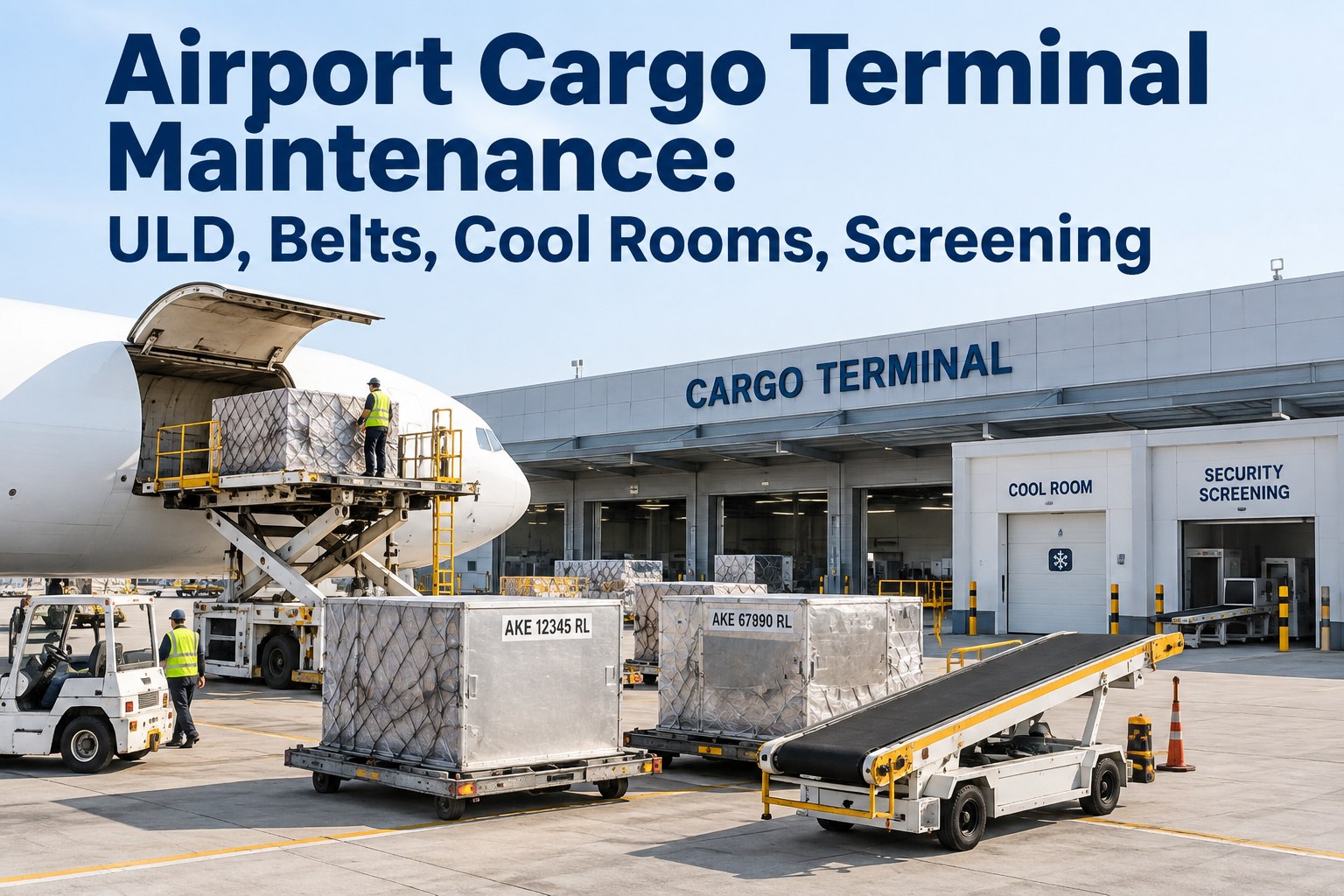
An air cargo terminal isn't one building — it's four facilities stacked into one footprint. A warehouse full of ULD handling gear, a belt and roller network moving freight to and from the apron, cold rooms holding pharma and perishables inside a 2°C window, and a screening hall where every X-ray and ETD unit is a regulatory chokepoint. Each runs on different assets, different failure modes, and different compliance clocks — CEIV Pharma for the cool rooms, the TSA-approved screening list for the security lane. Managing all four in spreadsheets and disconnected tools is how a jammed EDS belt, an unlogged reefer excursion, and a missed SLA all happen in the same shift. OxMaint is the maintenance management software that puts every zone under one asset register — this guide walks through all four and shows exactly where OxMaint keeps the terminal running. Book a walkthrough of your terminal's asset register and we'll flag the gaps live.
One Terminal, Four Maintenance Worlds
ULD handling, belt systems, cool rooms, and screening — each with its own assets, cadence, and compliance clock.
ULD & Handling
Lifts, dollies, transfer decks
Belt Systems
Conveyors, rollers, drives
Cool Rooms
Reefers, chillers, monitoring
Screening
X-ray, EDS, ETD units
Why a Cargo Terminal Breaks Differently
Most maintenance tools treat a facility as one asset class. A cargo terminal defeats that assumption because its four zones fail on completely different terms. A belt jam is a throughput problem measured in minutes; a reefer excursion is a compliance problem measured in a rejected pharma batch; a screening unit fault is a regulatory problem that can halt every departing shipment. OxMaint is built to run all three risk types from one system — below is how the stakes differ, zone by zone, and why a single maintenance platform beats four disconnected calendars.
Throughput risk
A conveyor drive or ULD lift down at peak means freight backs up onto the apron and truck docks — every minute is missed build-up time against a flight cutoff.
Compliance risk
A cool-room excursion breaks the CEIV Pharma cold chain. The product is quarantined, the claim disputed, and the certification audit trail is now under question.
Security risk
A screening unit out of calibration or offline can't clear cargo for a passenger aircraft — a TSA-regulated stoppage, not just a maintenance ticket.
Zone 1 · ULD & Handling Equipment
Unit Load Device handling is the muscle of the terminal — the lifts, transfer decks, dollies, and slave pallets that move containers between truck, warehouse, and aircraft. These assets take constant mechanical load and hydraulic stress, and a failure here strands freight mid-build. OxMaint puts each lift and transfer vehicle on its own PM schedule — hydraulics, drive systems, and structural wear — so wear gets caught on a work order instead of on the apron.
Core assets
ULD transfer lifts
Elevating transfer vehicles
Castor / ball deck panels
Dollies & slave pallets
Weigh scales
What the PM plan watches
DailyHydraulic leak check, deck panel free-roll, safety interlock test
WeeklyDrive chain tension, lift cylinder seals, locking-pin wear
QuarterlyHydraulic fluid analysis, structural weld inspection, scale calibration
Zone 2 · Belt & Conveyor Systems
The belt network is the terminal's circulatory system, and it's where unplanned downtime bites hardest — a single seized roller or misaligned belt can idle an entire sortation line. OxMaint connects IoT vibration sensors on critical conveyor drives and applies AI pattern recognition to catch anomaly trends before they become failures — shifting the belt zone from reactive firefighting to planned intervention. Book a demo to see the sensor-trend dashboard on your own conveyor line.
Belt tracking & tension
Misalignment shreds belt edges and spikes drive load. Weekly tracking checks and tension logging stop the slow damage that ends in a mid-shift tear.
Drive motors & gearboxes
Vibration and temperature sensors on drives feed pattern recognition — bearing wear and gearbox faults surface as trends, not as a dead line at peak.
Rollers & bearings
A single frozen roller drags the belt and burns the motor. Scheduled roller spin checks and greasing keep resistance and heat off the drive train.
E-stops & guarding
Safety interlocks and pull-cords are a daily inspection item — a failed E-stop is both an injury risk and an audit finding waiting to happen.
See Your Terminal's Four Zones on One Dashboard
Working session with our aviation team — bring your asset list. We'll map ULD gear, belts, cool rooms, and screening into a single PM calendar and show how OxMaint tracks compliance across all four in one view.
Zone 3 · Cool Rooms & the Cold Chain
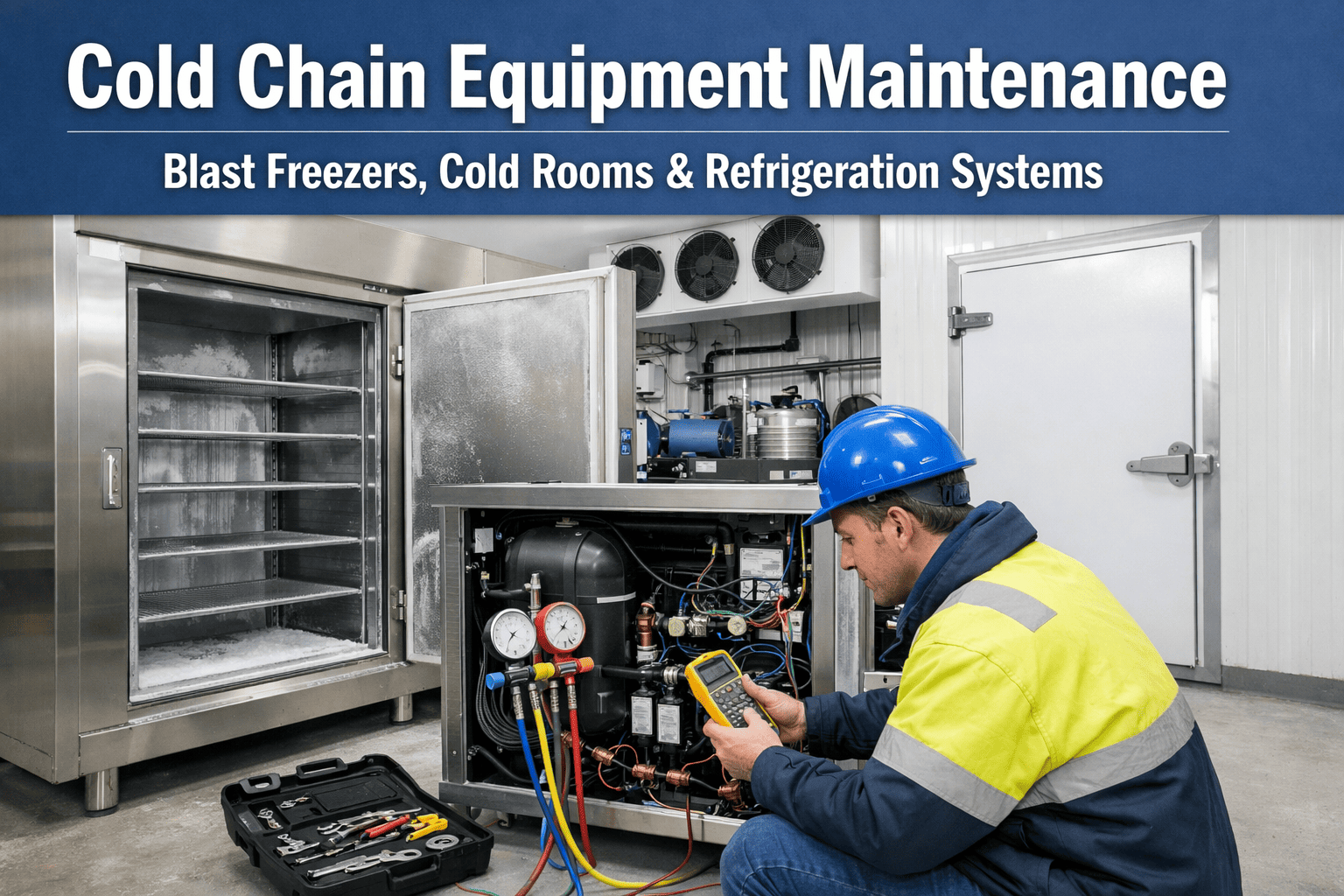
This is the zone where maintenance and compliance become the same job. CEIV Pharma and GDP standards require an unbroken, documented temperature record from acceptance to aircraft load — and CEIV-certified facilities run measurably fewer excursions because the discipline is built into process, not equipment. A reefer that drifts out of range doesn't just need a repair; it triggers a quarantine, an investigation, and a threat to the certification itself. OxMaint runs the PM plan that defends all three temperature bands at once — and logs every check into the audit trail CEIV requires. Start a free trial and build your cold-chain PM schedule in minutes.
−20 °C
Frozen
Deep-freeze pharma and biologics — compressor redundancy and door-seal integrity are the failure points that matter most.
2–8 °C
Refrigerated
The core pharma band. Tightest tolerance, most excursion-prone — continuous monitoring plus calibrated sensors are non-negotiable.
15–25 °C
Controlled ambient
Room-temperature pharma and sensitive perishables — HVAC stability and airflow balance are the maintenance drivers.
The cold-chain PM stack
01Refrigeration plant. Compressor cycling, refrigerant charge, condenser cleaning, and redundant-unit failover tests on a fixed cadence.
02Sensor calibration. Temperature probes and data loggers verified against a traceable reference — an uncalibrated sensor is a failed audit, not a working control.
03Door seals & air curtains. The most common excursion cause — infiltration through worn seals — caught on an inspection schedule, not after a breach.
04Alarm & excursion response. Alarm thresholds tested, and every excursion logged with a corrective work order that becomes part of the CEIV audit trail.
Zone 4 · Cargo Screening Infrastructure
Screening is the zone with the least tolerance for downtime and the strictest sourcing rules. Regulated parties must screen 100% of cargo bound for passenger aircraft using equipment drawn from the TSA-approved Air Cargo Screening Technology List — X-ray, EDS, ETD, and metal detection units. A screening asset that's offline, out of calibration, or running unapproved software can't legally clear cargo, so maintenance here is as much about documentation as it is about mechanics — and OxMaint keeps the calibration logs, downtime history, and software-version records the way a TSA review expects to see them.
Screening asset
Maintenance focus
Compliance hook
X-ray / CT units
Belt drive, image-quality test, radiation-shield integrity
Daily image-quality verification logged
EDS units
Calibration, detection-standard checks, cooling/airflow
Approved software version on record
ETD equipment
Consumable stock, swab supply, verification runs
Daily performance-check records
Metal detectors
Sensitivity calibration, throughput-lane alignment
Documented calibration cycle
The thread through every row is the same: the maintenance record is the compliance evidence. A screening unit's calibration log, downtime history, and software version are exactly what a TSA review asks for — which is why keeping that history in a spreadsheet is a liability the moment an inspector arrives, and why teams move that record into OxMaint where it's timestamped, searchable, and always current. Sign up free to keep your screening records audit-ready.
One CMMS Across All Four Zones
The reason a cargo terminal needs a single system isn't tidiness — it's that the four zones share technicians, spare parts, and a compliance calendar, and managing them in four disconnected tools guarantees something falls through. OxMaint puts every conveyor segment, ULD lift, reefer unit, and screening asset under one QR-tagged register with a full maintenance history behind each scan. Book a demo to see all four zones on one dashboard.
Register
Every Asset, QR-Tagged
Scan any conveyor, lift, reefer, or screening unit to pull its history, open work orders, and spare-parts status on the spot.
Predict
IoT Sensor Trends
Vibration and temperature sensors on drives and reefers feed AI pattern recognition — anomalies surface as trends, before failure.
Schedule
Zone-Specific PM Calendars
Each zone's cadence — daily belt checks, quarterly hydraulic analysis, sensor calibration — runs on its own schedule, one dashboard.
Comply
CEIV & TSA Audit Trail
Every PM, calibration, and excursion logged with who, what, and when — the maintenance history a CEIV Pharma or TSA audit asks for.
Mobile
Execution on the Floor
Technicians close work orders, capture photos, and e-sign from the terminal floor — no paper round-trip, no lost record.
Report
MTBF, MTTR & PM Compliance
Reliability dashboards turn weekly meetings from firefighting reviews into data-driven planning across the whole terminal.
Run the Whole Terminal from One System
Stop juggling four maintenance worlds in four tools. See how OxMaint unifies ULD handling, belts, cool rooms, and screening — with the CEIV and TSA audit trail built in. Free forever plan available.
Frequently Asked Questions
What makes air cargo terminal maintenance different from a normal warehouse?
A cargo terminal combines four distinct facilities — ULD handling equipment, belt and conveyor systems, temperature-controlled cool rooms, and regulated screening infrastructure — each with its own assets, PM cadence, and compliance obligation. A warehouse plan manages throughput; a cargo terminal plan also has to defend a CEIV Pharma cold chain and a TSA screening mandate at the same time.
How does maintenance connect to CEIV Pharma compliance?
CEIV Pharma and GDP require a documented, unbroken temperature record and proof of a maintained, calibrated cold chain. Every reefer PM, sensor calibration, and logged excursion becomes part of the audit trail — so the maintenance system is effectively the compliance system for the cool-room zone.
Start free to build your CEIV audit trail.
Why does screening equipment need such tight maintenance records?
Cargo bound for passenger aircraft must be screened with equipment from the TSA-approved Air Cargo Screening Technology List. A unit that's offline, out of calibration, or running an unapproved software version can't legally clear cargo — so calibration logs, downtime history, and version records are exactly what a TSA review inspects.
Can one CMMS really handle all four zones?
Yes — and that's the point. The zones share technicians, spare parts, and a compliance calendar, so a single register with zone-specific PM schedules prevents the gaps that four disconnected tools create. OxMaint tags every asset, runs each zone's cadence, and keeps the CEIV and TSA audit trail in one place.
Book a demo to map your terminal.
Does OxMaint support IoT-based predictive maintenance for cargo assets?
Yes. OxMaint connects vibration and temperature sensors on critical conveyor drives, ULD lift hydraulics, and reefer units, then applies AI pattern recognition to flag anomaly trends before they become failures — with MTBF, MTTR, and PM-compliance dashboards to steer weekly reliability planning. A free forever plan is available to trial the full workflow.