best-cmms-pharma-maintenance-compliance-2026

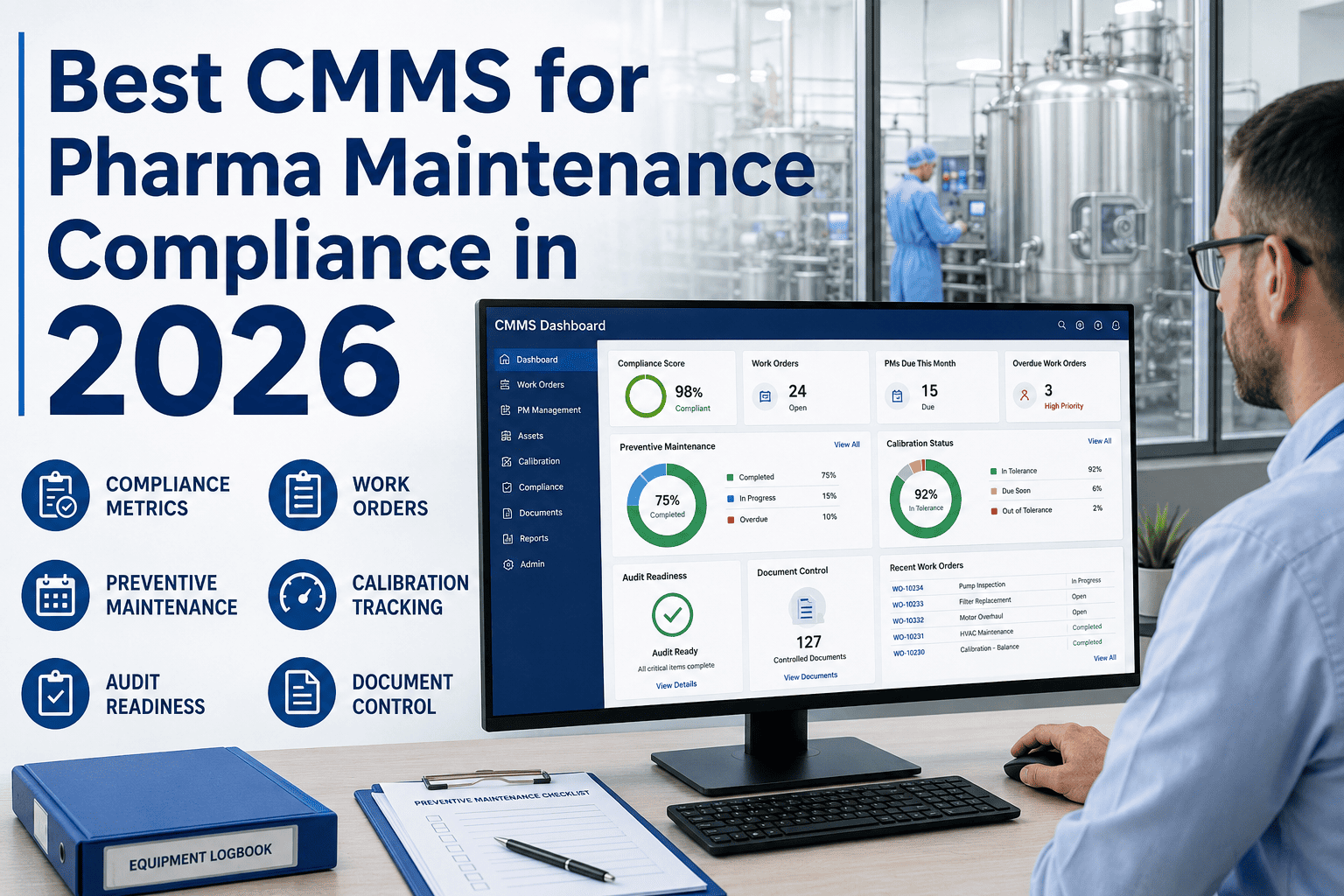
Best CMMS for Pharma Maintenance Compliance in 2026


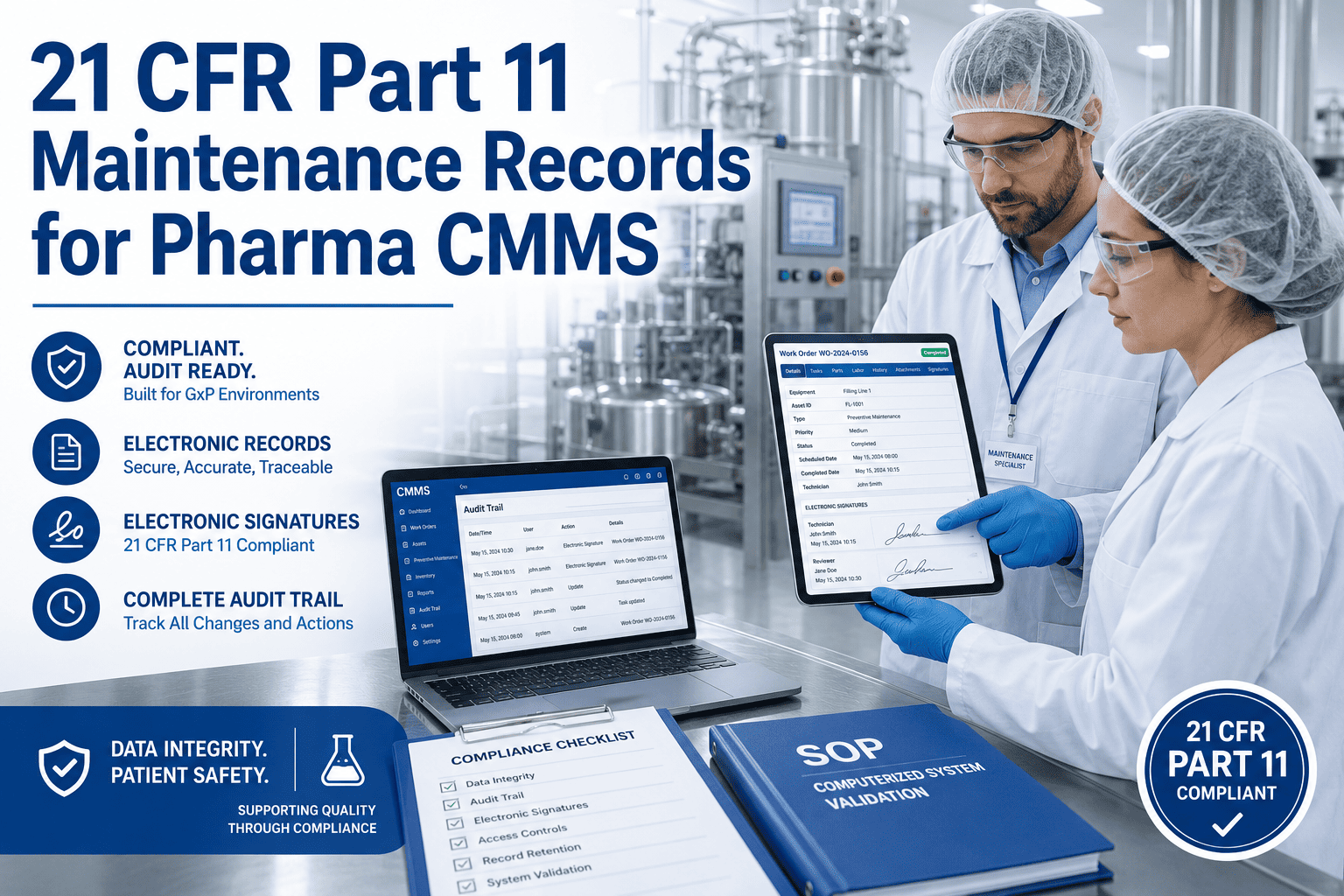
Pharmaceutical manufacturers face a uniquely unforgiving maintenance environment — where a missed calibration record, an undocumented corrective action, or a gap in equipment qualification history can trigger an FDA Form 483 observation, a warning letter, or a consent decree. A CMMS built for pharma maintenance compliance isn't just about scheduling PMs; it's about creating tamper-evident audit trails, enforcing 21 CFR Part 11 electronic records, managing calibration lifecycles, and keeping every piece of critical manufacturing equipment in a validated, inspection-ready state. Start your free Oxmaint trial and see how leading pharma teams manage GMP compliance digitally.

PHARMA MAINTENANCE · GMP COMPLIANCE 2026

Your CMMS Is Your First Line of Defense in an FDA Audit

Oxmaint gives pharma maintenance teams digital calibration logs, electronic signatures, equipment qualification records, and real-time compliance dashboards — built for 21 CFR Part 11 and GMP inspections.

21 CFR Part 11 Ready
FDA Audit Trail
GMP-Aligned Workflows
Electronic Signatures
Calibration Management

Critical GMP Maintenance Capabilities — What to Look For

01
21 CFR Part 11 Audit Trail
Every work order, inspection, calibration record, and PM completion must be timestamped, user-attributed, and tamper-evident. Any post-entry modification must log who changed what and when — this is non-negotiable for FDA.
02
Calibration Management
Track calibration due dates, as-found and as-left values, calibration intervals, and out-of-tolerance events with automatic escalation. Link calibration records to the equipment qualification history file.
03
Equipment Qualification Records
Maintain IQ, OQ, and PQ documentation linked to asset records. Track requalification triggers — including after major repairs, modifications, or calibration failures — so validation status is always current.
04
Cleanroom Maintenance Protocols
Enforce cleanroom-specific procedures: gowning requirements, HEPA filter schedules, differential pressure monitoring, and environmental monitoring linkage — with electronic verification at each step.
05
Change Control Integration
Link maintenance work orders to the change control system when equipment modifications could affect product quality. Ensure affected validation documents are flagged for review before equipment returns to service.
06
Deviation & CAPA Tracking
When maintenance failures, missed PMs, or calibration exceedances create quality deviations, the CMMS must link directly to the CAPA system — with evidence attachments, timelines, and closure verification.

CMMS Compliance Requirements for Pharma — Platform Comparison

Compliance Capability OxMaint Generic CMMS A Generic CMMS B
21 CFR Part 11 Audit Trail Built-in, Tamper-Evident Limited Log No
Electronic Signatures (ERES) Full 21 CFR Part 11 Basic Login No
Calibration Due Date Tracking Automated Alerts Manual Limited
Equipment Qualification History IQ/OQ/PQ Linked No No
Out-of-Tolerance Escalation Automatic + CAPA Link Manual No
GMP Inspection-Ready Reports One-Click Export Custom BI Required Manual Export
Cleanroom Protocol Templates Pre-Built Library No No

EXPERT REVIEW
Dr. Meera Krishnaswamy
GMP Compliance Director · Former FDA CDER Investigator · 18 Years Pharma Quality Assurance

During FDA inspections, the maintenance CMMS records are reviewed with the same rigor as batch records. Investigators specifically look for gaps in calibration history, undocumented corrective actions, and evidence that equipment returned to service after repair without proper verification. I have seen Warning Letters issued primarily because the CMMS could not produce a complete, unedited maintenance history for critical manufacturing equipment. The difference between a pharmaceutical CMMS and a generic maintenance tool is 21 CFR Part 11 compliance, calibration-to-qualification linkage, and the ability to demonstrate that every maintenance decision was authorized, documented, and verified. Oxmaint's architecture was built with these requirements as design constraints, not afterthoughts.

GMP COMPLIANCE · CMMS

Make Your Next FDA Inspection a Non-Event

Oxmaint gives pharma maintenance teams the audit-ready documentation, calibration tracking, and GMP workflow enforcement that turns inspection preparation from a 6-week scramble into a one-click report.


Frequently Asked Questions

What does 21 CFR Part 11 compliance mean for a pharma CMMS?
21 CFR Part 11 governs electronic records and electronic signatures used in FDA-regulated industries. For a CMMS, this means every maintenance record must be tamper-evident with a complete audit trail of all entries and modifications — including who made the change, when, and the original value. Electronic signatures must use secure credentials tied to a specific individual and cannot be shared or reused. A CMMS that is not 21 CFR Part 11 compliant creates data integrity risk that FDA investigators treat as a critical GMP failure. See how Oxmaint handles Part 11 compliance in a free trial.
How should pharma maintenance teams manage calibration records in a CMMS?
Calibration records in a pharma CMMS should capture as-found values before adjustment, as-left values after adjustment, the calibration standard used (with traceability to NIST), the technician and reviewer identity, and the pass/fail determination against instrument specifications. Out-of-tolerance findings must trigger an impact assessment to evaluate whether any product manufactured since the last passing calibration may have been affected. The CMMS should automatically generate calibration work orders based on the defined calibration interval and provide automated alerts 30 days before due dates to prevent overdue calibrations.
When does a maintenance repair require requalification of pharmaceutical equipment?
Equipment requalification is typically required after repairs or modifications that could affect product contact surfaces, critical process parameters, cleaning validation boundaries, or measurement accuracy for controlled parameters. Most pharma quality systems require a risk assessment after any significant repair — evaluated by quality, maintenance, and validation teams — to determine whether IQ, OQ, or PQ activities need to be repeated before the equipment returns to production service. The CMMS should flag repair work orders for quality review when they meet pre-defined requalification criteria and prevent equipment status from being returned to qualified without documented authorization.
Can Oxmaint integrate with existing pharma quality management systems?
Yes — Oxmaint integrates with leading pharmaceutical QMS platforms via API, enabling bidirectional data flow between maintenance records and CAPA, deviation, and change control modules. When a maintenance event creates a quality deviation, the CMMS work order can automatically initiate a CAPA record in the QMS with all relevant maintenance documentation attached. Similarly, QMS change control approvals can trigger maintenance work orders in Oxmaint when equipment modifications are approved. Book a demo to review integration options for your specific QMS platform.


Share This Story, Choose Your Platform!