
Government buildings and public facilities carry a maintenance obligation that private facilities do not: accountability to taxpayers, elected officials, and regulatory bodies who expect documented evidence that public assets are being preserved, that compliance standards are being met, and that maintenance spending is producing measurable outcomes. A courthouse that has deferred HVAC maintenance for three years cannot simply tell the county council that the systems are "generally okay" — it must produce work order histories, asset condition assessments, and energy consumption trends that justify the capital request for replacement. A municipal water treatment plant cannot tell the EPA that its instrumentation calibration is current without dated records from a tracked work order system. The gap between what government facilities are required to demonstrate and what paper-based or spreadsheet maintenance systems can actually produce is exactly where compliance failures, audit findings, and deferred maintenance backlogs accumulate. Sign up for Oxmaint to build your government facility's CMMS-based asset management program today.
What Government Facility CMMS Covers — Six Critical Operational Areas
Government facilities span every building type — courthouses, public safety facilities, water and wastewater plants, parks infrastructure, transit maintenance facilities, and administrative offices. Oxmaint provides a single CMMS platform across all of them, with each use case delivering distinct compliance and operational benefits.
One CMMS for all government building types — from courthouses and civic centres to water treatment plants and transit depots. All six use cases managed in a single asset register with shared compliance reporting.
Public-facing buildings require the highest standard of documented maintenance compliance — HVAC inspections, elevator certifications, fire safety records, and ADA accessibility maintenance must all be traceable for public records requests and elected official accountability. Oxmaint work orders create timestamped maintenance records for every service event in every building, searchable by council members and auditors without staff involvement. Sign up to register your civic building assets.
Emergency services facilities require 24/7 operational readiness — apparatus bay equipment, backup generators, breathing air systems, and emergency communication infrastructure cannot fail when a call comes in. Oxmaint's predictive PM scheduling ensures critical systems are serviced before failure, with overdue maintenance alerts that escalate to the facility director when mission-critical equipment approaches service thresholds. Book a demo to see public safety PM configuration.
Water treatment facility maintenance is directly regulated — EPA requires documented calibration schedules for analytical instruments, pump station PMs are reviewed during NPDES permit inspections, and equipment failure records are required for discharge monitoring reports. Oxmaint stores calibration records per instrument, pump maintenance histories per station, and generates the documented evidence that regulatory inspectors review. Sign up to configure EPA-aligned PM schedules.
Municipal transit agencies and public works vehicle fleets require DOT-compliant preventive maintenance schedules, documented pre-trip inspections, and vehicle condition records for federal transit funding compliance (FTA Circular 5010). Oxmaint manages fleet PMs by mileage and calendar interval, tracks operator inspection records, and generates the FTA-required maintenance records documentation that transit agencies must produce for triennial reviews.
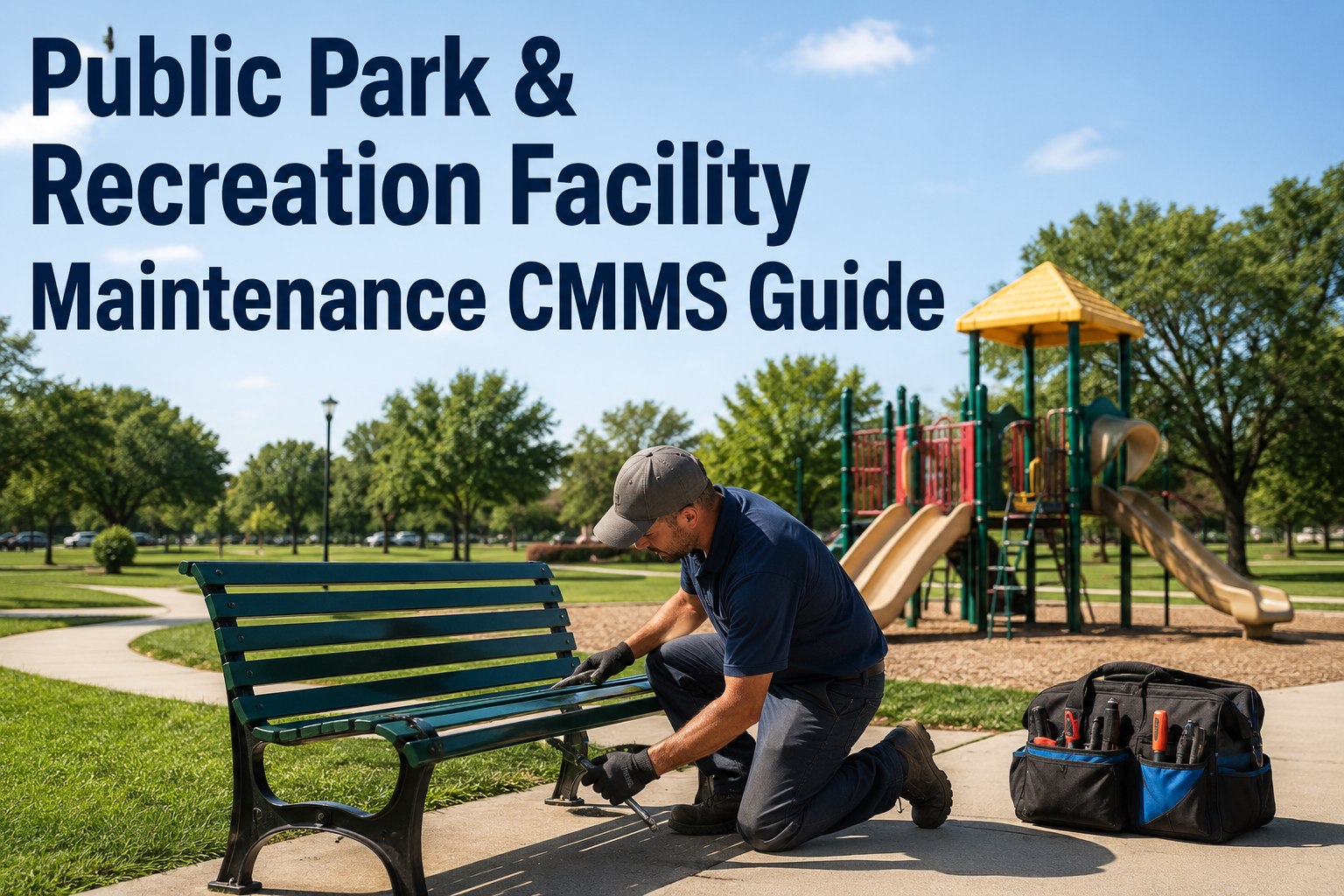
Parks departments manage some of the most geographically dispersed maintenance programs in any government portfolio — playground safety inspections, sports field irrigation systems, lighting and electrical infrastructure, restroom facility maintenance, and park structures all require scheduled maintenance with documented inspection records. ASTM F1292 playground safety standards require documented annual and post-incident inspections — Oxmaint generates these work orders automatically by equipment location and type.
Federal agencies must comply with the Energy Independence and Security Act (EISA) requirements for facility energy intensity reduction. State and local governments face similar mandates and sustainability commitments that require documented energy performance data. Oxmaint tracks energy consumption per building against baseline, links maintenance work orders to energy performance changes, and generates the audit trail required for ENERGY STAR certification and federal sustainability reporting. Book a demo to configure energy management.
Government Facility Maintenance Calendar — What CMMS Must Schedule at Each Frequency
Year-round maintenance readiness for a government facility portfolio requires work orders at every frequency from daily to annual. This calendar shows what Oxmaint must be configured to schedule across your facility types. Sign up for Oxmaint to activate auto-scheduling across your entire facility portfolio.
Government Facility Management Maturity Spectrum — Where Does Your Agency Stand?
Most government agencies operate somewhere between reactive maintenance and strategic asset management. Where your agency sits on this spectrum determines your federal grant win rate, your deferred maintenance trajectory, and your ability to demonstrate accountability to elected officials and taxpayers.
How Oxmaint Builds Your Federal Grant Application Evidence Base
Federal infrastructure grant applications score 35–40% of their points on "demonstrated need" and "project justification" — categories that require quantified asset data, not narrative descriptions. Oxmaint generates that data automatically from your maintenance operations. Sign up for Oxmaint to start building your grant evidence base today.
Every asset in your Oxmaint registry carries a current condition score based on inspection data, failure history, and maintenance frequency. When federal grant applications ask you to "quantify infrastructure need," your CMMS generates the answer: condition ratings, photos, trend data, and remaining useful life projections for every building system, pump station, fleet vehicle, and public space. The difference between "our water system is aging" and "our water main on 5th Street has experienced 14 breaks in 36 months costing $287,000 and is rated condition score 2 of 5" is the difference between rejection and award.
Federal scoring committees reward applications that show actual maintenance expenditure trends — not estimates. Oxmaint tracks every work order cost by asset: labour hours, parts, contractor fees, and emergency response expenses. When a pump station has accumulated $180,000 in repairs over five years, that CMMS data makes the $2.1M replacement project self-evidently justified in a way that a statement of intent never can. Every work order closed in Oxmaint is a data point that builds the evidence base for your next competitive grant application. Book a demo to see grant evidence reporting.
BCA calculations for federal grant applications require hard data on current costs, failure probabilities, and projected savings. Oxmaint provides the actual numbers: repair frequency per asset, downtime costs, emergency response expenditures, and component lifecycle data. Applications built on CMMS-generated BCA inputs produce evidence-based analyses that scoring committees can verify against your operational records — rather than assumption-based projections that reviewers discount.
Active federal grants require quarterly or annual performance reporting with documented milestone completion, expenditure tracking, and outcome metrics. Oxmaint automates compliance reporting by tracking work completed against grant milestones — eliminating the manual report compilation that consumes 40–60 hours per grant per reporting cycle. The agency that can generate a quarterly grant performance report in 30 minutes instead of 40 hours has a structural advantage in managing multiple simultaneous grant awards. Sign up to configure grant milestone tracking.
Align your 5-year Capital Improvement Plan directly to anticipated federal grant cycles by ranking projects using Oxmaint data: condition score, failure risk, maintenance cost trend, safety criticality, and equity metrics. The CIP projects that score highest on CMMS-derived metrics are the ones most likely to win competitive federal awards — because the same data that informs your prioritisation informs the application's demonstrated need score. Grant-ready agencies maintain shovel-ready projects for their top-5 priority assets at all times, with Oxmaint condition and cost data ready to attach.
Paper-Based Government Facility Management vs. Oxmaint CMMS — What Changes
Most government agencies operate with a mixture of spreadsheets, paper work orders, and filing cabinets. This comparison shows exactly what becomes possible when that infrastructure is replaced with Oxmaint.
| Capability | Paper / Spreadsheet | Oxmaint CMMS |
|---|---|---|
| Asset condition documentation for grant applications | Narrative estimates — no quantified evidence | Condition scores with trend data, photos, cost history per asset |
| Compliance inspection records (fire, elevator, EPA) | Physical files — retrievable in days, not seconds | Digital records searchable and printable in under 60 seconds |
| Energy cost tracking per building | Portfolio-level utility bills only — no per-building baseline | Sub-metered energy per building vs. baseline — ENERGY STAR ready |
| Deferred maintenance visibility | Discovered when asset fails or inspector finds it | Real-time dashboard of all overdue PMs across all facilities |
| Grant milestone reporting | 40–60 hrs manual compilation per grant per cycle | Automated report generation — 30 minutes per grant cycle |
| Maintenance cost per asset for BCA | Estimated from invoices — no per-asset breakdown | Exact lifetime cost per asset from work order actuals |
| CIP project justification data | Staff recollection and anecdotal failure history | CMMS-generated: repair frequency, cost trend, condition score |
| Contractor compliance records | Physical contractor files — may be incomplete or missing | Digital contractor work orders with certification verification |
Swipe to see full comparison
Every Work Order You Close in Oxmaint Is a Data Point in Your Next Grant Application
Government facilities that run Oxmaint don't just maintain their buildings better — they build the evidence base that wins competitive federal awards, passes regulatory inspections, and demonstrates fiscal accountability to the communities they serve.
What Government Facility Teams Are Saying
Our county manages 34 public buildings across three departments. Before Oxmaint, when the state auditor asked us for the maintenance history on our courthouse HVAC system, it took three days to find the paper records — and two years were completely missing. The auditor's report cited "insufficient documented maintenance" as a deficiency. After implementing Oxmaint across all 34 buildings, our next audit took 20 minutes. The auditor was able to pull every work order, every inspection, and every contractor invoice for the last 24 months directly from the system. We also submitted our first competitive BIL grant application using Oxmaint asset condition data and won a $4.2 million award for our water system rehabilitation — the application committee specifically cited the quality of our asset documentation.
Government Facility CMMS — Common Questions
The Energy Independence and Security Act (EISA) and federal sustainability executive orders require federal agencies to reduce energy intensity, benchmark energy performance, and report progress annually. Oxmaint tracks energy consumption per building from utility meter data, links maintenance work orders to energy performance changes (combustion tuning, insulation repairs, HVAC optimisation), and generates the energy performance trend reports required for ENERGY STAR Portfolio Manager submissions and federal sustainability reporting. For state and local governments with comparable sustainability mandates, the same energy tracking infrastructure applies. Sign up for Oxmaint to configure energy performance tracking per building.
Yes — this is one of the highest-value capabilities for government facility teams. Oxmaint stores asset condition scores, inspection records, failure histories, and maintenance cost data per asset. For a competitive BIL grant application, you can export a per-asset data package showing current condition score, condition trend over the last 36 months, cumulative maintenance cost, failure frequency, and remaining useful life estimate — exactly the "demonstrated need" evidence that federal scoring committees reward most heavily. Municipalities using CMMS-backed applications have won competitive awards at 3–5x the rate of agencies submitting narrative-only applications. Book a demo to see grant evidence package generation.
Oxmaint supports multi-department and multi-location structures within a single platform. Each department — Public Works, Parks and Recreation, Water Utilities, Facilities Management — operates with its own asset register, work order queue, and reporting dashboard, while central administration has a portfolio-level view across all departments. Department-level access controls ensure that Parks staff see only their assets and work orders, while the city administrator or public works director can view the full portfolio. This structure matches the typical government organisational hierarchy without requiring separate software instances per department.
Government maintenance spending is subject to procurement rules — competitive bidding thresholds, approved vendor lists, purchase order requirements, and public records retention obligations. Oxmaint's work order system links to parts and contractor purchasing with cost tracking per work order — providing the audit trail that public procurement officers need to demonstrate compliance with competitive bidding thresholds and approved vendor requirements. Emergency repairs that must proceed without competitive bid are documented with the reason for exception in the work order record — maintaining transparency for future audit review. Sign up to configure procurement tracking in Oxmaint.
Government facilities receive maintenance requests from citizens — park equipment problems, building accessibility complaints, public restroom issues, and pothole or sidewalk damage reports. Oxmaint accepts service requests via a public-facing intake form that generates a work order in the maintenance queue, assigns it to the responsible crew, and sends an automated acknowledgement to the requestor. When the work order is completed, the citizen receives a closure notification. This closed-loop citizen service record provides elected officials with documented response performance data and eliminates the "citizen complaint with no follow-up" findings that frequently appear in government accountability reviews.
Government Facilities Serve the Public. Your Maintenance Records Should Prove It.
Every work order you close is accountability data. Every inspection you document is audit protection. Every asset condition score you track is competitive advantage in federal grant applications. Oxmaint gives government facility teams the CMMS infrastructure to operate, comply, and demonstrate value to the communities they serve — at a cost that public budgets can justify.


.png)


