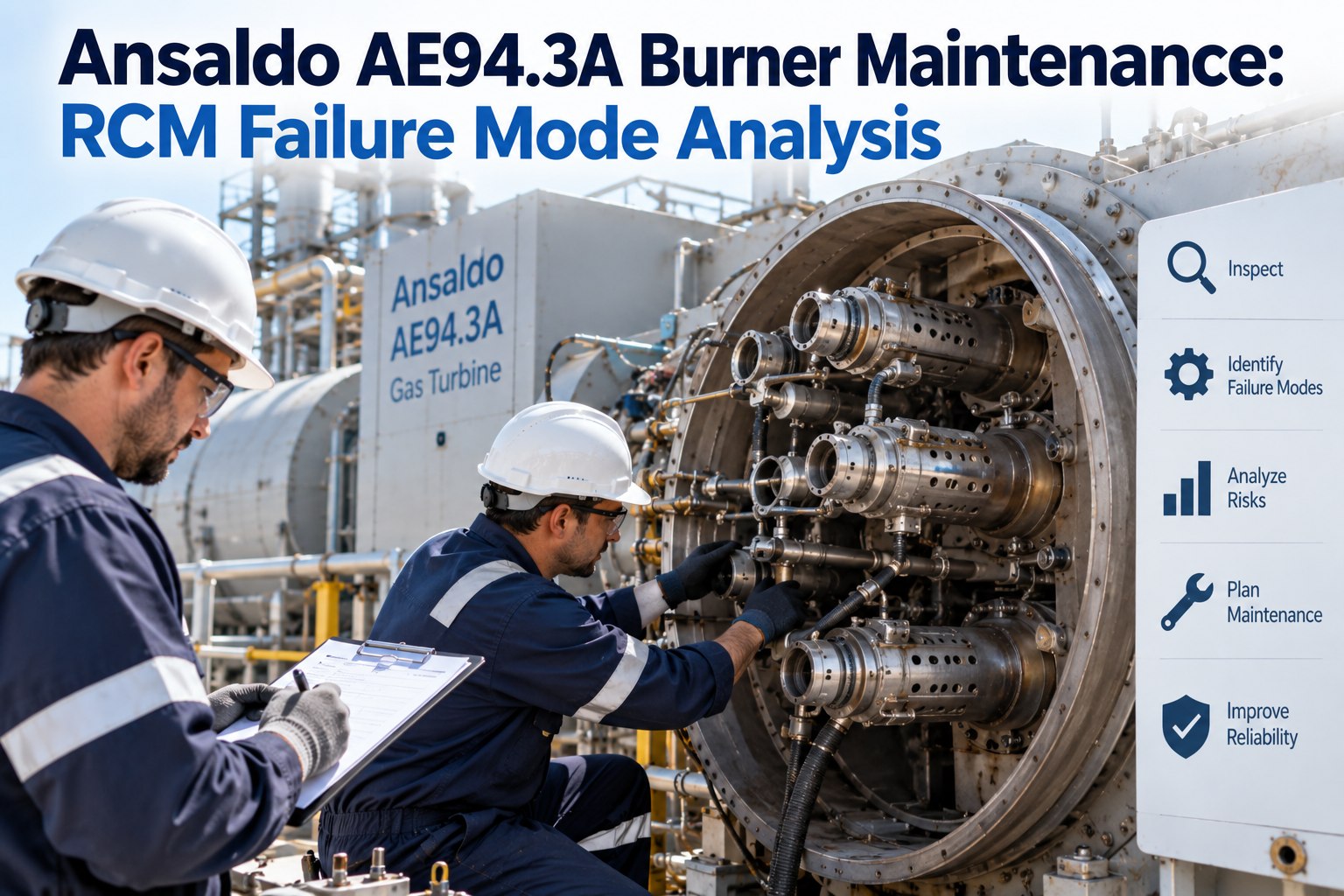
How do you separate routine combustion drift from early-stage, failure-prone hybrid burner lance degradation in an AE94.3A unit — before a costly shutdown or emissions exceedance occurs? In a mid-summer base-load run, creeping CO and NOx, narrowing NOx margin and subtle exhaust spread shifts can look like normal variation but often signal cumulative lance tip wear, fouling or internal cracking. AE94.3A burner problems involving hybrid burner lances are typically slow, cumulative, and hard to spot with static alarms — left unchecked they erode emissions margins and increase hot-spot risk. This walkthrough shows how Oxmaint Augment overlays 5–15 years of historian + CMMS to catch the drift, and how a 30-minute demo shows your AE94.3A data with RCM logic and suggested WOs.
Ansaldo AE94.3A · Burner & Hybrid Lance · RCM Overlay · 2026
Ansaldo AE94.3A Burner and Hybrid Burner Lance Degradation: RCM Failure Mode Analysis for Combustion Tuning Drift
Long-window detection, correlated inspection evidence, and condition-based RCM decisions. Augment overlays existing historian, SCADA, DCS and CMMS data — no control-system replacement — and turns long-term signal correlations into prioritized, CMMS-friendly actions.
5–15 yrs
historian + CMMS window overlaid
12–24 mo
drift invisible on short windows
3-Pane
Timeline · Signal → Confidence · Suggested WO
Overlay
no replacement of controls or SCADA
At a Glance (Illustrative)
Common symptom set, monitoring signals, initial task and integration model — the shape of the AE94.3A burner problem in one panel. Sign up to try Augment on your unit.
01
Primary keyword: ae94.3a burner problems — common symptom set: slow CO/NOx creep, rising exhaust temperature spread, rising combustion dynamics amplitude
02
Typical signals to monitor: CO/NOx trend, exhaust temp spread, combustion oscillation indices, fuel valve compensation, hybrid lance DP (if instrumented)
03
Recommended initial task: borescope + deposit sampling + targeted NDT if borescope shows tip deformation
04
Integration: overlay 5–15 years of historian + CMMS records in Augment to detect long, low-slope trends
05
Illustrative costs (labelled): borescope inspection $1,200–$3,000 (illustrative) — validate locally
06
Illustrative costs (labelled): targeted lance replacement parts $5,000–$25,000 (illustrative) — validate locally
Failure Physics Summary (No OEM Proprietary Data)
AE94.3A burners use standard and hybrid lances to control local stoichiometry and staging for low-NOx operation. Thermal cycling, high-temperature oxidation, particle erosion and deposit sintering gradually alter tip geometry and internal passages. Book a demo to walk the physics on your unit's trend history.
Degradation Mechanisms
What Alters Lance Geometry
! Thermal cycling
! High-temperature oxidation
! Particle erosion
! Deposit sintering
! All gradually alter tip geometry and internal passages
Observed Effects
Slow Monotonic Drift
• Reduced atomization
• Local fuel-rich zones
• Degraded flame stability
• Higher CO and NOx, increased combustion dynamics
• Signals show as slow monotonic drift, not abrupt steps
Look-Alike Failure Modes (Quick Triage)
Not every emissions drift is lance degradation. Four look-alikes and the key differentiator that separates them. Sign up to run the differential on your historian.
Premix Swirler Erosion
Similar emissions drift but typically less spread in exhaust temperature and smaller pressure-oscillation signatures.
Fuel Nozzle Blockage
Often shows upstream pressure transients and abrupt DP shifts rather than slow drift.
Combustor Liner Cracking / Tile Loss
Spatial hotspots on IR scans and discrete changes post-inspection.
Secondary Air Leaks
Sudden O2 step changes on probes rather than gradual migration.
Key Differentiator for Lance Degradation
Protracted, multi-signal trend correlated with inspection notes showing tip rounding or deposits.
Why It's Hard
Degradation is incremental — a 12–24 month drift that matters is often invisible on short windows, which is why the 5–15 year historian view is critical.
5–15 Year Historian + CMMS in Augment
Augment's overlay approach ingests and aligns long-window historian trends (5–15 years where available) with CMMS/EAM work order history and inspection photos. That historical span is critical for ae94.3a burner problems because degradation velocity is slow. This combined view turns anecdotal operator recollection into data-driven decision triggers. Book a demo to see your own long-window trends surfaced.
Long-Window View · AE94.3A · CO/NOx · Exhaust Spread · Dynamics
Baselines
Long-term emission baselines · and their seasonal shifts
Intervals
Shrinking intervals between combustion tuning work orders · CMMS overlay
Photos
Visual evidence from past borescope photos · tied to specific timestamps and WOs
SIGNAL Persistent upward slope in CO/NOx over weeks to months, unlinked to fuel quality or load cycles
SIGNAL Increasing exhaust temperature spread across partitions
SIGNAL Rising combustion dynamics amplitude or shift in dominant frequencies
SIGNAL Fuel valve position gradually compensating more for same load setpoints · borescope tip rounding, deposits, discoloration
Augment RCM Panes — How the Product Surfaces the Problem
Three panes take the drift from a stream of signals to an exportable, evidence-backed work order. Book a demo to walk the three panes with your data.
Pane 1
Failure Mode Timeline
Visualize months-to-years of CO/NOx, exhaust temp spread, combustion-dynamics index and fuel valve compensation. Overlay inspection events, borescope photos and minor WOs to show correlation between signs and physical findings.
Pane 2
Signal → Confidence
Lists contributing signals (CO slope, temp spread slope, oscillation amplitude) and computes an explainable confidence score linking the signature to "burner/hybrid lance degradation" vs look-alikes. Highlights the minimal set of signals that most increase confidence — enabling targeted inspection choices.
Pane 3
Suggested WO → Maximo/SAP
Auto-generates a suggested WO — "Hybrid burner lance visual inspection + borescope + deposit sampling + conditional NDT" — with a checklist and estimated labor/skill needs. Exports to CMMS/EAM with mapped fields: priority, required trades, parts list, photos and links to historical evidence.
Overlay
Not Rip-and-Replace
Ingests existing historian, SCADA, DCS and CMMS data without requiring replacement of your control systems. You keep existing combustion controls and SCADA while adding an interpretive, RCM-backed layer.
RCM: Why Condition-Based, Not Calendar-Only.
Functional failure: loss of tuned combustion envelope / emissions exceedance. Failure mode: lance tip erosion, internal passage fouling or incipient cracking. Effects: emission drift, flame instability, liner hot spots, potential downstream hardware stress. Trigger inspection when multi-signal confidence crosses a predefined risk threshold — not on arbitrary hours.
RCM Decision Logic
Three rules govern when the overlay recommends a task — derived from baseline variability, not arbitrary hours. Sign up to configure the logic for your AE94.3A.
Condition-Based Trigger
Condition-based inspections triggered when multi-signal confidence crosses a predefined risk threshold — derived from baseline variability, not arbitrary hours.
Adaptive Interval
Periodic inspections remain relevant, but interval should be adaptive — shorten as trend velocity increases.
Reactive Replacement
Reactive replacement only when condition signals or inspection confirm advanced degradation.
What Augment Does — and Doesn't
Reduces false positives by weighting multiple independent signals and historical inspection records. Does not, and cannot, guarantee elimination of failures — it increases early detection and guides better-prioritized decisions.
Detect → Diagnose → Prioritize → Dispatch (Operational Workflow)
The four-step loop that runs continuously on ingested CO/NOx, exhaust spread, combustion dynamics and fuel control compensations. Book a demo to see the loop on your combustion signals.
Step 1
Detect
Continuous ingestion of CO/NOx, exhaust spread, combustion dynamics and fuel control compensations. Long-window trends are compared against historical baselines.
Step 2
Diagnose
Augment correlates trends with CMMS entries and past photos to surface probable failure modes. The Signal → Confidence pane identifies lance degradation likelihood vs alternatives.
Step 3
Prioritize
Risk-scored WOs are generated: safety/emissions-first, then operations-impact, then cost. Prioritization uses trend velocity, emissions margin left and outage schedules.
Step 4
Dispatch
Suggested WO is pushed to Maximo/SAP with borescope/NDT instructions, parts pick lists and a technician capability match. Photos and evidence are attached to avoid unnecessary full outages.
Inspection & WO Suggestions (Illustrative)
A staged inspection pathway — from immediate borescope to staged replacement — with the suggested WO exported to Maximo/SAP with attached evidence and recommended priority at every stage. Sign up to run the staged path on your data.
Immediate
Targeted borescope inspection of suspect burner/lance rows; photograph and compare to prior images.
If Borescope Shows Deformation / Deposits
Deposit sampling and targeted NDT on suspect lances.
If NDT Confirms Cracking / Severe Erosion
Plan staged replacement during next outage; consider stocking critical spare lance components.
"
Augment reduces false positives by weighting multiple independent signals and historical inspection records. It does not, and cannot, guarantee elimination of failures — rather it increases early detection, reduces unnecessary inspections, and guides better-prioritized maintenance decisions. Addressing ae94.3a burner problems requires long-window detection, correlated inspection evidence, and condition-based RCM decisions.
Augment Reliability Desk
Frequently Asked Questions
What are the most common burner problems in the AE94.3A turbine?
Slow lance tip erosion/fouling, swirler wear, fuel nozzle issues and liner distress are common themes; lance degradation typically shows as gradual emission drift and rising combustion dynamics. Diagnosis requires signal correlation plus visual inspection.
How can slow drift in combustion tuning indicate burner lance degradation?
Slowly increasing CO/NOx and compensatory fuel valve movement, together with growing exhaust temp spread and shifting dynamics, form a multi-signal pattern consistent with reduced atomization or blocked passages in lances.
How do historian data and CMMS records combine to diagnose hybrid burner issues?
Historian trends identify the drift; CMMS/inspection records confirm physical change. Overlaying both lets you see when a minor finding first appeared relative to the trend, enabling earlier, targeted action.
What RCM tasks best mitigate lance failure risk on an AE94.3A?
Condition-based borescope inspections triggered by trend velocity, targeted NDT when borescope shows anomalies, and adaptive inspection frequency based on historical drift rather than fixed calendar hours.
When should an operator escalate from monitoring to active inspection?
Escalate when multi-signal confidence indicates lance degradation risk and emissions margin is narrowing, or when emission excursions occur that cannot be explained by fuel or operational changes.
Protect Emissions Margins. Avoid Unplanned Outages.
Using historian + CMMS overlays preserves existing control investments while giving operations the early-warning capability needed to protect emissions margins and avoid unplanned outages. Book a 30-minute demo to see your AE94.3A data overlaid with RCM logic and suggested WOs, or sign up to try Augment.